Quick Answer
The most natural way to ask 'How old are you?' in Korean is 몇 살이에요? /mjʌt s͈aɾ i.e.jo/, used politely with someone near your age. For older people or formal situations, use 나이가 어떻게 되세요? /na.i.ɡa ʌ.t͈ʌ.ke twe.se.jo/ or the honorific 연세가 어떻게 되세요? /jʌn.se.ɡa ʌ.t͈ʌ.ke twe.se.jo/.
To say “How old are you?” in Korean, use 몇 살이에요? /mjʌt s͈aɾ i.e.jo/ with someone near your age in an ordinary polite conversation. With an older person, a customer, or a formal acquaintance, choose 나이가 어떻게 되세요? /na.i.ɡa ʌ.t͈ʌ.ke twe.se.jo/ instead. Korean age questions are common because age affects the speech level and relationship language people use, but choosing the right version shows social awareness.
Korean is spoken by roughly 80 million people worldwide, according to Ethnologue’s 27th edition. It is the official language of both South Korea and North Korea, and it is also used by substantial diaspora communities across China, the United States, Japan, and Central Asia. That broad community means habits vary, but polite age questions remain a familiar part of first conversations.
If you are still mastering introductions, start with how to say hello in Korean. Then learn the age question below, including when it is appropriate to ask it.
| English | Korean | Pronunciation | Formality |
|---|---|---|---|
| How old are you? | 몇 살이에요? | myut sah-ree-eh-yoh | polite |
| How old are you? | 나이가 어떻게 되세요? | nah-ee-gah uh-tuh-keh dweh-seh-yoh | formal |
| How old are you? (honorific) | 연세가 어떻게 되세요? | yuhn-seh-gah uh-tuh-keh dweh-seh-yoh | formal |
| How old are you? | 몇 살이야? | myut sah-ree-yah | casual |
| I am 25 years old. | 저는 스물다섯 살이에요. | juh-neun seu-mul-dah-sut sah-ree-eh-yoh | polite |
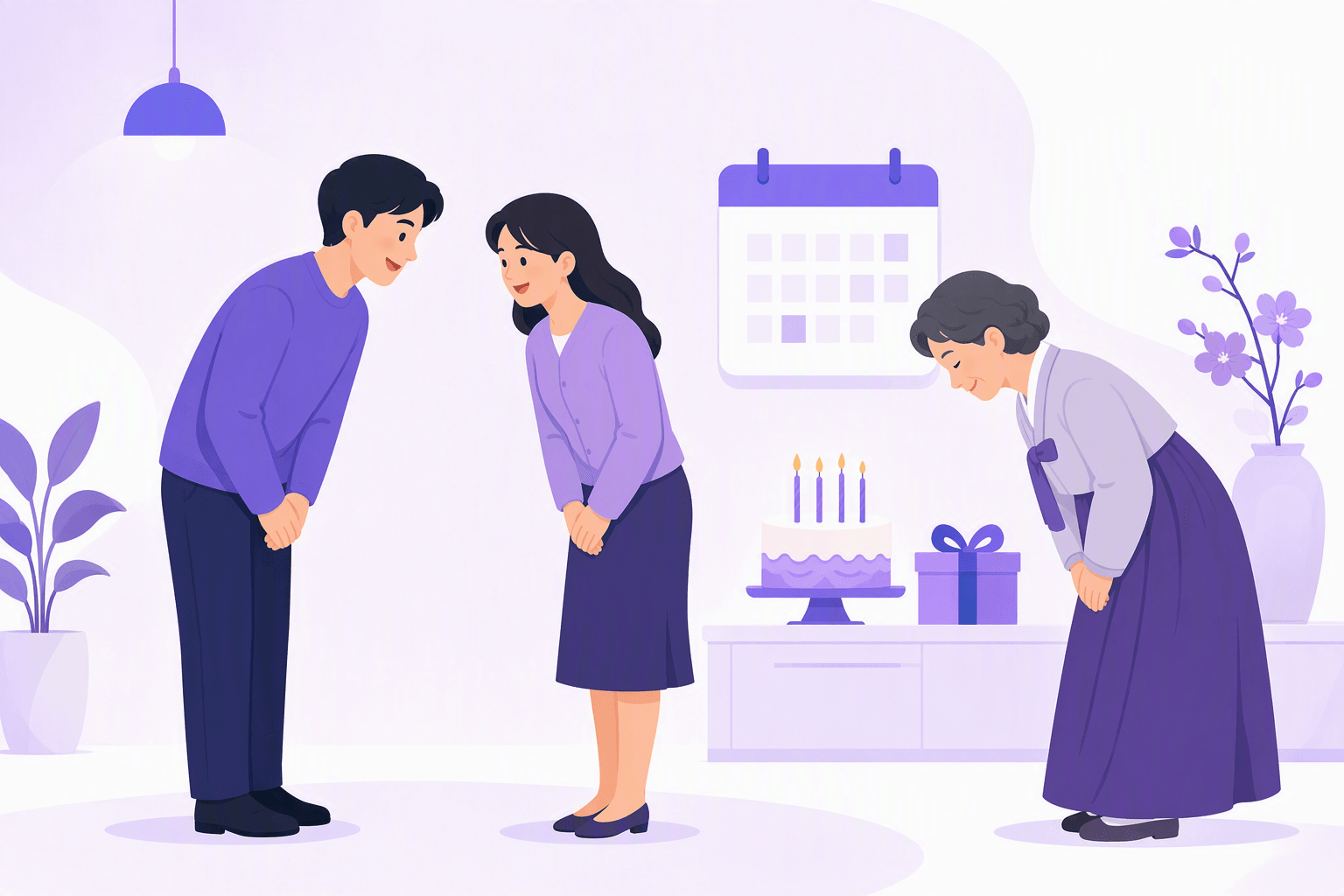
The safest everyday question
For most new acquaintances who seem close to your own age, 몇 살이에요? /mjʌt s͈aɾ i.e.jo/ is natural and friendly.
The phrase has three useful parts: 몇 /mjʌt/ means “how many,” 살 /s͈aɾ/ is the counter used for a person’s age, and 이에요 /i.e.jo/ makes the question polite. Korean sentence subjects are often omitted when context makes them clear.
몇 살이에요?
/myut sah-ree-eh-yoh/
Literal meaning: How many years of age are you?
“실례지만, 몇 살이에요?”
Excuse me, but how old are you?
A warm, ordinary question for a new acquaintance near your age. Add 실례지만 to soften it when you are unsure whether the question is welcome.
The final 요 /jo/ marks a polite conversational style. It is not stiff or distant. You will hear this style between classmates, colleagues, neighbors, friends who are not yet close, and strangers in relaxed settings.
A careful opener can make the question feel less abrupt. 실례지만 /ɕil.ɾje.dʑi.man/ means “excuse me, but,” while 혹시 /hok̚.ɕ͈i/ means “by any chance.” Together, they give the listener room to decline or redirect the conversation.
More respectful ways to ask
Age can be relevant in Korea, but directness changes with the relationship. Asking a person who appears significantly older 몇 살이에요? /mjʌt s͈aɾ i.e.jo/ may sound too familiar. Use a more indirect question instead.
나이가 어떻게 되세요?
나이가 어떻게 되세요? /na.i.ɡa ʌ.t͈ʌ.ke twe.se.jo/ literally asks what someone’s age is. It is more respectful than 몇 살이에요? /mjʌt s͈aɾ i.e.jo/ because it avoids the blunt “how many years” structure.
/nah-ee-gah uh-tuh-keh dweh-seh-yoh/
Literal meaning: What is your age?
“처음 뵙겠습니다. 나이가 어떻게 되세요?”
It is nice to meet you. May I ask how old you are?
A respectful choice for a new adult acquaintance, a professional contact, or someone who seems older. It remains a direct personal question, so use it after some initial conversation.
The verb 되세요 /twe.se.jo/ is a polite honorific form of 되다 /twe.da/, meaning “to become” or “to be” in this context. You do not need to analyze every grammar detail to use the phrase correctly, but recognizing the honorific ending helps you hear its respectful tone.
연세가 어떻게 되세요?
For an elderly person, use 연세가 어떻게 되세요? /jʌn.se.ɡa ʌ.t͈ʌ.ke twe.se.jo/. 연세 /jʌn.se/ is the honorific counterpart of 나이 /na.i/, meaning age.
/yuhn-seh-gah uh-tuh-keh dweh-seh-yoh/
Literal meaning: What is your honored age?
“할머니, 연세가 어떻게 되세요?”
Grandmother, may I ask how old you are?
Use 연세 for an older person you should treat with clear respect. It is appropriate for elders, senior customers, and older relatives, but it would sound overly ceremonious for a friend.
The National Institute of Korean Language identifies 연세 /jʌn.se/ as an honorific lexical choice. This is a useful pattern in Korean: respect is not only added through verb endings. It can also appear through entirely different nouns and verbs.
Casual Korean with friends
Once you are already speaking casually with a close friend, you can ask 몇 살이야? /mjʌt s͈aɾ.i.ja/. The polite ending disappears, leaving a short informal question.
몇 살이야?
/myut sah-ree-yah/
Literal meaning: How many years old are you?
“너 몇 살이야?”
How old are you?
Use this only with a close friend, a younger person, or someone who has clearly invited casual speech. Do not use it with a teacher, manager, customer, or unfamiliar older person.
The pronoun 너 /nʌ/ means “you,” but Korean often omits it. Saying 너 몇 살이야? /nʌ mjʌt s͈aɾ.i.ja/ is natural between friends, yet it can sound confrontational if the relationship is not close.
Do not jump into casual speech just because someone is younger. Korean speakers often wait until both people agree on the speech level. A brief age question can lead to that negotiation, but it does not automatically give you permission to drop politeness.
🌍 Age questions have a practical social purpose
In Korean, age can influence whether people use polite speech, casual speech, kinship-style address terms, or titles. That does not mean every conversation needs an age question. In international, workplace, or privacy-conscious settings, wait for the topic to arise naturally.
How to answer with your age
Korean normally uses native Korean numbers with 살 /s͈aɾ/ for age. For example, “I am 25 years old” is 저는 스물다섯 살이에요 /tɕʌ.nɯn sɯ.muɾ.ta.sʌt s͈aɾ i.e.jo/.
You can omit 저는 /tɕʌ.nɯn/, meaning “as for me,” when the answer is obvious. Simply saying 스물다섯 살이에요 /sɯ.muɾ.ta.sʌt s͈aɾ i.e.jo/ sounds complete and natural.
| English | Korean | Pronunciation | Note |
|---|---|---|---|
| one year old | 한 살 | hahn sahl | Age one, also said as 한 살이에요. |
| twenty years old | 스무 살 | seu-moo sahl | Special shortened form before 살. |
| twenty-one years old | 스물한 살 | seu-mul-hahn sahl | Native Korean number plus 살. |
| twenty-five years old | 스물다섯 살 | seu-mul-dah-sut sahl | A common model answer. |
| thirty years old | 서른 살 | suh-reun sahl | Native Korean age expression. |
| forty years old | 마흔 살 | mah-heun sahl | Native Korean age expression. |
| born in 2000 | 2000년생 | ee-chun-nyeon-saeng | Literally a person born in the year 2000. |
The special forms 스무 /sɯ.mu/ and 스물 /sɯ.muɭ/ matter. Use 스무 살 /sɯ.mu s͈aɭ/ for exactly age 20, but use 스물한 살 /sɯ.muɭ.han s͈aɭ/ for 21, 스물두 살 /sɯ.muɭ.tu s͈aɭ/ for 22, and so on.
For a more formal answer, use 입니다 /im.ni.da/ rather than 이에요 /i.e.jo/. For example, 저는 서른 살입니다 /tɕʌ.nɯn sʌ.ɾɯn s͈aɭ.im.ni.da/ means “I am 30 years old.” This fits an interview, presentation, or formal introduction.
Ask about birth year instead
In modern Korean conversation, asking someone’s birth year can be easier than asking their exact age. Say 몇 년생이에요? /mjʌt njʌn.seŋ.i.e.jo/, meaning “What year were you born?”
This is especially useful when people are comparing school years, deciding whether to use casual speech, or clarifying how they count age. A reply such as 2000년생이에요 /i.tɕʌn.njʌn.seŋ.i.e.jo/ means “I was born in 2000.”
Why birth year can prevent confusion
South Korea revised age-counting rules in 2023, making international age the standard for most legal and administrative purposes. Before that change, Korean age was often calculated by counting a baby as one at birth and adding a year collectively on January 1.
Social habits do not change overnight. People may still mention 한국 나이 /han.ɡuŋ na.i/, Korean age, or ask which system someone means. Birth year often gives both speakers the same factual reference point.
Lee Iksop and S. Robert Ramsey, in The Korean Language, describe how Korean social interaction encodes relative status and interpersonal distance. Age is one element of that system, alongside occupation, family role, and familiarity. It explains why a simple question can carry more social meaning than it might in English.
What not to say
Avoid using 너는 몇 살입니까? /nʌ.nɯn mjʌt s͈aɾ.im.ni.k͈a/ as your default. It is grammatically possible, but combining the blunt pronoun 너 /nʌ/ with a highly formal ending creates an unnatural mismatch in most real conversations.
Also avoid asking immediately after meeting someone in a sensitive setting. Korean speakers may ask age relatively early, but people still value tact. A shared activity, school context, or mutual introduction often makes the question feel more natural.
Do not use 연세 /jʌn.se/ for a friend in their twenties or thirties. Excessive honorific language can sound joking, sarcastic, or strangely distant. Respectful Korean is about matching the relationship, not using the most formal word available.
💡 Use a soft lead-in when unsure
Try 혹시 몇 살이에요? /hok̚.ɕ͈i mjʌt s͈aɾ i.e.jo/, meaning “By any chance, how old are you?” The word 혹시 makes the question less demanding and gives the listener a natural chance to change the subject.
A short natural conversation
Here is a polite first-meeting exchange:
A: 안녕하세요. 저는 민지예요. /an.njʌŋ.ha.se.jo tɕʌ.nɯn min.dʑi.je.jo/
Hello. I am Minji.
B: 안녕하세요. 저는 다니엘이에요. /an.njʌŋ.ha.se.jo tɕʌ.nɯn ta.ni.eɭ.i.e.jo/
Hello. I am Daniel.
A: 혹시 몇 살이에요? /hok̚.ɕ͈i mjʌt s͈aɾ i.e.jo/
By any chance, how old are you?
B: 저는 스물네 살이에요. 민지 씨는요? /tɕʌ.nɯn sɯ.muɭ.ne s͈aɾ i.e.jo min.dʑi ɕ͈i.nɯn.jo/
I am 24. How about you, Minji?
A: 저는 스물세 살이에요. /tɕʌ.nɯn sɯ.muɭ.se s͈aɾ i.e.jo/
I am 23.
The title 씨 /ɕ͈i/ after a given name is a neutral, polite way to address an adult in many everyday settings. It is safer than assuming a family-style term or casual nickname.
Build age questions into real listening
Age questions often appear in Korean dramas, variety shows, university scenes, and workplace introductions. Listen for 몇 살 /mjʌt s͈aɭ/, 나이 /na.i/, 연세 /jʌn.se/, and 년생 /njʌn.seŋ/ rather than trying to memorize one isolated script.
The King Sejong Institute materials emphasize choosing expressions according to context and social relationship, which is exactly the skill this topic requires. Learn the polite phrase first, then notice how native speakers change it based on who they are talking to.
For more core phrases, practice how to say goodbye in Korean and how to say I love you in Korean. For a different side of register and social risk, see our guide to Korean swear words.
The practical default is simple: use 몇 살이에요? /mjʌt s͈aɾ i.e.jo/ with peers, 나이가 어떻게 되세요? /na.i.ɡa ʌ.t͈ʌ.ke twe.se.jo/ when more politeness is needed, and 연세가 어떻게 되세요? /jʌn.se.ɡa ʌ.t͈ʌ.ke twe.se.jo/ for elders. Ask with a friendly tone, accept that someone may prefer not to answer, and let the relationship guide your next sentence.
Frequently Asked Questions
What is the most common way to ask how old someone is in Korean?
Is it rude to ask someone's age in Korean?
How do I say I am 25 years old in Korean?
What is the difference between 나이 and 연세 in Korean?
Does Korea still use Korean age?
Sources & References
- National Institute of Korean Language, Standard Korean Language Dictionary, accessed 2026
- King Sejong Institute Foundation, Sejong Korean language learning materials, accessed 2026
- Ethnologue, Korean, 27th edition, 2024
- Sohn, Ho-min, Korean: A Descriptive Grammar, Routledge
- Lee, Iksop and S. Robert Ramsey, The Korean Language, SUNY Press
Start learning with Wordy
Watch real movie clips and build your vocabulary as you go. Free to download.


