Quick Answer
Japanese manga vocabulary is a mix of everyday Japanese (greetings, school talk, emotions) and manga-specific terms (genres, tropes, honorifics, sound effects). If you learn the high-frequency words that repeat across panels, you can follow basic scenes faster and understand character dynamics, even before you know every kanji.
Japanese manga vocabulary is easiest to learn when you focus on the words that repeat across scenes: relationship markers (like honorifics), emotion reactions, school and family terms, and the genre and trope labels readers use to describe stories. Start with the high-frequency items below, learn their kana and rhythm, and you will understand far more panels than you expect, even before you can read every kanji.
If you are using manga and anime as input, you will also benefit from pairing it with real spoken clips. Wordy’s movie and TV approach is built for that kind of listening-first practice, and it complements reading-heavy input well. For more Japanese basics you can reuse everywhere, start with how to say hello in Japanese and how to say goodbye in Japanese.

Why manga vocabulary feels different from textbook Japanese
Manga mixes normal Japanese with stylized language choices that signal character type, age, region, and power. A tough character might use rough sentence endings, while a polite character sticks to neutral forms. You are not just learning words, you are learning social stance.
Japanese also has a large set of mimetic words (often called onomatopoeia in English, though many are not literal sounds). Kimi Akita’s linguistic research on Japanese mimetics is a strong reminder that these words encode texture and feeling, not only noise, which is why they show up constantly in panels.
For scale, Japanese has about 123 million native speakers, and the language is concentrated mainly in Japan (Ethnologue, accessed 2026). That means manga is not a niche register, it is a mainstream cultural product in a single dominant speech community, with shared conventions that readers recognize immediately.
How to study manga vocabulary without learning the wrong habits
Use three buckets: everyday, relationship, and trope
Everyday words are safe and reusable. Relationship words (honorifics, pronouns, speech endings) are powerful but easy to misuse. Trope labels (like tsundere) are mostly for fandom talk, not daily conversation.
Read for repetition, not for rarity
A rare kanji word that appears once is less valuable than a simple reaction that appears 40 times. NHK’s language and media research regularly highlights how frequency drives comprehension, and manga is a frequency machine when you follow a long series.
Keep a “sounds and feelings” list
Manga SFX can look like noise, but they are vocabulary. Treat them like verbs and adverbs you can recognize at a glance.
⚠️ A quick realism check
Some manga dialogue is 'role language': stylized speech that signals a character archetype rather than how people talk every day. Learn it for comprehension and tone, but copy it into real conversation only after you have heard it used by real people in real settings.
Core manga and fandom terms (what readers actually say)
These are the labels you will see in recommendations, reviews, and discussions. Many are loanwords or abbreviations, so they are easy to spot.
| English | Japanese | Pronunciation | Note |
|---|---|---|---|
| Manga | 漫画(まんが) | MAHN-gah | General term for Japanese comics. |
| Anime | アニメ | AH-nee-meh | Short for アニメーション. |
| Light novel | ライトノベル | RYE-toh NOH-beh-roo | Often shortened to ラノベ. |
| Original work | 原作(げんさく) | gehn-SAH-koo | Source material, often the manga. |
| Adaptation | アニメ化(か) | AH-nee-meh-kah | Turning a work into an anime. |
| Volume | 巻(かん) | kahn | Book volume, as in 第1巻. |
| Chapter | 話(わ) | wah | Often counted as 第1話. |
| Spoiler | ネタバレ | neh-tah-BAH-reh | Literally 'content reveal'. |
| Shipping (pairing) | カップリング | kahp-poo-REEN-goo | Often shortened to カプ. |
| Fan art | ファンアート | fahn AHH-toh | Also 二次創作 for fan works. |
| Fan fiction / fan works | 二次創作(にじそうさく) | nee-jee SOH-sah-koo | Secondary creation, fan-made works. |
| Doujinshi | 同人誌(どうじんし) | doh-JEEN-shee | Self-published works, often sold at events. |
Genres and demographics you will see on covers and shelves
These terms are common in publishing and fandom. They are useful for searching and describing, but you do not need them in daily conversation unless you talk about manga a lot.
| English | Japanese | Pronunciation | Note |
|---|---|---|---|
| Shounen | 少年(しょうねん) | shoh-NEHN | Demographic label, often teen boys. |
| Shoujo | 少女(しょうじょ) | shoh-JOH | Demographic label, often teen girls. |
| Seinen | 青年(せいねん) | SAY-nehn | Demographic label, often adult men. |
| Josei | 女性(じょせい) | joh-SAY | Demographic label, often adult women. |
| Isekai | 異世界(いせかい) | ee-seh-KYE | Another world setting. |
| Romcom | ラブコメ | RAH-boo KOH-meh | Short for ラブコメディ. |
| Slice of life | 日常系(にちじょうけい) | nee-CHEE-joh-kay | Everyday-life stories, often low drama. |
| Sports manga | スポーツ漫画(まんが) | suh-POH-tsu MAHN-gah | A major mainstream category. |
| Horror | ホラー | hoh-RAH | Loanword genre label. |
| Mystery | ミステリー | mees-teh-REE | Loanword genre label. |
🌍 Why these labels matter in Japan
In Japanese publishing, labels like 少年 and 少女 are tied to magazine lines and marketing, not just content. That is why you can find romance in 少年 titles and action in 少女 titles. Treat them as audience signals, not strict genre rules.
Character relationships: honorifics and social distance
Honorifics are small, but they carry a lot of meaning. They show respect, closeness, teasing, hierarchy, and sometimes romance tension.
If you want a broader foundation, pair this section with how to say I love you in Japanese, because romance scenes often combine honorific shifts with confession language.
| English | Japanese | Pronunciation | Note |
|---|---|---|---|
| -san | 〜さん | sahn | Neutral polite default for most adults. |
| -kun | 〜くん | koon | Often for boys, juniors, or subordinates. |
| -chan | 〜ちゃん | chahn | Cute or affectionate, often for kids or close friends. |
| -sama | 〜様(さま) | SAH-mah | Very respectful, customers, formal writing. |
| Senpai | 先輩(せんぱい) | SEHN-pye | Senior in school or workplace. |
| Kouhai | 後輩(こうはい) | KOH-hye | Junior, often used in third person. |
| Teacher / mentor | 先生(せんせい) | SEHN-say | Teachers, doctors, and respected experts. |
| Boss / section chief | 部長(ぶちょう) | boo-CHYOH | Common office title in workplace scenes. |
School-life staples (because manga loves school settings)
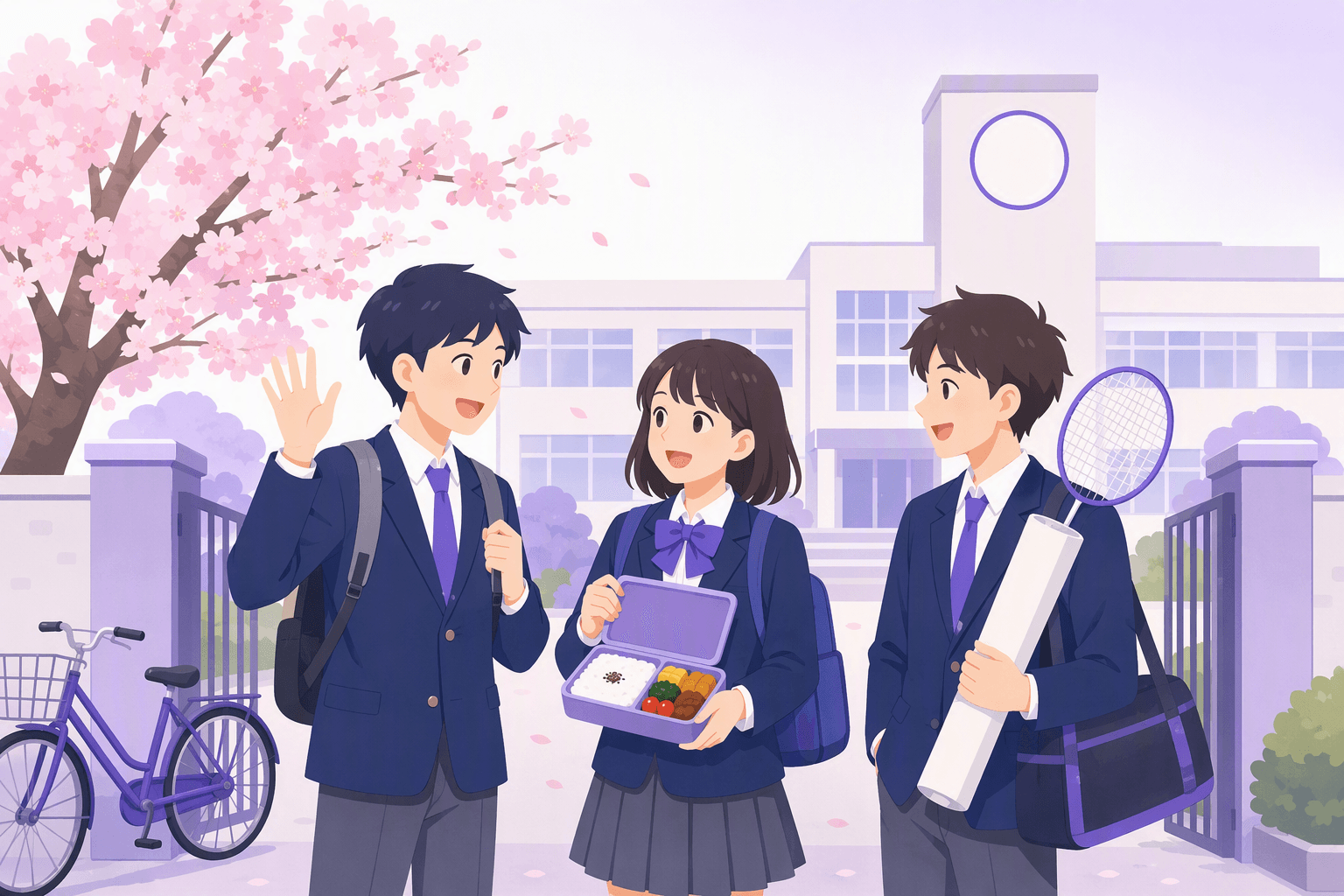
A huge share of popular series use school as the default social world. These words appear constantly, even in fantasy stories that borrow the school structure.
| English | Japanese | Pronunciation | Note |
|---|---|---|---|
| School | 学校(がっこう) | gahk-KOH | Small っ doubles the consonant. |
| Classroom | 教室(きょうしつ) | KYOH-shi-tsu | Two morae in KYO. |
| Class (group) | クラス | koo-RAH-soo | Loanword, very common. |
| Homeroom teacher | 担任(たんにん) | tahn-NEEN | Often heard in school drama. |
| Club (after school) | 部活(ぶかつ) | boo-KAH-tsu | Short for 部活動. |
| Cultural festival | 文化祭(ぶんかさい) | boon-kah-SYE | Classic school-arc event. |
| Sports day | 体育祭(たいいくさい) | tah-ee-koo-SYE | Often a big competition arc. |
| Entrance exam | 受験(じゅけん) | joo-KEHN | Shows up in study and stress scenes. |
| Uniform | 制服(せいふく) | SAY-foo-koo | Common in slice-of-life and romance. |
| Lunch | 昼ご飯(ひるごはん) | hee-roo goh-HAHN | Also お弁当 in school scenes. |
| Bento | お弁当(おべんとう) | oh-behn-TOH | Often a romance signal. |
Emotion and reaction words that repeat in speech bubbles
These are the payoff words. They are short, frequent, and tied to facial expressions, so they stick fast.
| English | Japanese | Pronunciation | Note |
|---|---|---|---|
| Amazing / wow | すごい | suh-GOH-ee | Very common, tone depends on context. |
| No way! | うそ! | oo-SOH | Casual disbelief. |
| Seriously? | マジ? | MAH-jee | Very casual, common among friends. |
| Really (is that so) | そうなんだ | SOH nahn-dah | Neutral casual acknowledgment. |
| I see (polite) | なるほど | NAH-roo-hoh-doh | Often used when understanding clicks. |
| Wait a second | ちょっと待って | CHOHT-toh MAHT-teh | Small っ and doubled consonant. |
| Sorry / excuse me | すみません | soo-mee-mah-SEN | Polite, also used to get attention. |
| Thank you | ありがとう | ah-ree-GAH-toh | Casual, add ございます for polite. |
| What? | え? | eh | Short reaction, often confusion. |
| Huh? | は? | hah | Can sound rude depending on tone. |
💡 A fast reading trick for reactions
When you see え?, うそ!, マジ?, and は?, do not translate word-by-word. Treat them like sound cues that set the emotional temperature of the panel, surprise, disbelief, annoyance, confusion.
Tropes and archetypes (useful for understanding, not always for speaking)
These words are common in summaries and comments. They also help you interpret character behavior.
Here, it helps to think like cultural theorist Tamaki Saitō, who writes about how manga and anime build recognizable character patterns that audiences learn to read quickly. These labels are part of that shared reading skill.
| English | Japanese | Pronunciation | Note |
|---|---|---|---|
| Tsundere | ツンデレ | tsoon-DEH-reh | Cold outside, soft inside trope. |
| Yandere | ヤンデレ | yahn-DEH-reh | Affection turns obsessive or violent. |
| Chuunibyou | 中二病(ちゅうにびょう) | choo-nee-BYOH | Delusional 'middle school' syndrome trope. |
| Overpowered | 俺TUEEE(おれつええ) | oh-reh tsoo-EH | Slangy meme spelling, common online. |
| Reincarnation | 転生(てんせい) | tehn-SAY | Common in isekai plots. |
| Cheat skill | チート能力(のうりょく) | CHEE-toh NOH-ryoh-koo | Unfairly strong ability. |
| Flag (romance/death flag) | フラグ | foo-RAH-goo | Meta term for foreshadowing. |
| Plot twist | どんでん返し(がえし) | dohn-DEHN-gyeh-shee | A reversal, often in mystery. |
Manga sound effects (SFX) you will see everywhere
Manga SFX are often written in katakana, but not always. Many represent feelings, silence, atmosphere, or movement texture.
Akita’s work on mimetics is useful here because it explains why Japanese can pack so much sensory detail into short repeated forms. In manga, that becomes a visual rhythm: the SFX is part of the panel’s timing.
| English | Japanese | Pronunciation | Note |
|---|---|---|---|
| Heartbeat (thump thump) | ドキドキ | doh-kee doh-kee | Excitement, nerves, romance tension. |
| Stare / intense look | ジー | jee | Long stare, often comedic. |
| Silence / awkward pause | シーン | SHEE-n | A dead silent moment. |
| Sparkle / glitter | キラキラ | kee-rah kee-rah | Sparkly mood, admiration. |
| Tremble / shake | ブルブル | boo-roo boo-roo | Shivering from cold or fear. |
| Smile (grin) | ニヤニヤ | nee-yah nee-yah | Smirking, often suspicious. |
| Anger vein pop | ピキ | pee-kee | Comic anger cue. |
| Gulp | ゴクリ | goh-koo-ree | Swallowing nervously. |
| Rush / swoosh | ビュー | byoo | Fast movement or wind. |
| Bang | ドン | dohn | Impact, door slam, dramatic emphasis. |
| Knock | コンコン | kohn kohn | Door knocking. |
| Rain | ザーザー | ZAH-zah | Heavy rain atmosphere. |
Pronouns and “I/you” choices (a common manga trap)
Manga makes pronoun variation visible, and that is useful for comprehension. But copying pronouns blindly is one of the fastest ways to sound off.
私(わたし) and 俺(おれ)
私 (wah-TAH-shee) is broadly safe and common in polite speech. 俺 (oh-REH) is casual and masculine-coded, and it can sound rough depending on the setting.
お前(おまえ) is not “you” in general
お前 (oh-MYE) is common in manga, especially in fights or close male friendships. In real life, it can sound insulting. Learn it as a tone marker.
⚠️ If you only remember one pronoun rule
In Japanese, you can often avoid 'you' entirely. Use the person’s name plus 〜さん, or drop the subject when it is obvious. Manga uses pronouns for style and impact, not because Japanese requires them.
Swearing and insults: recognize them, do not default to them
Manga and anime include insults for comedy and conflict, and learners often latch onto them because they are memorable. Recognize them for comprehension, then keep them in a separate mental drawer.
If you want a careful, severity-ranked explanation, read our Japanese swear words guide. It is designed to help you understand what you are hearing without accidentally copying something that escalates a situation.
A practical 15-minute manga study routine
Step 1: Pick one scene type and mine it
Choose a recurring setting: classroom, convenience store, confession, fight prep. Repetition makes vocabulary stick.
Step 2: Capture 10 items, not 50
Write down 10 words from one chapter, including at least two SFX. Add kana reading and a short note like “nervous romance” or “awkward silence.”
Step 3: Re-read the same chapter
On the second pass, aim to recognize, not translate. This aligns with what many extensive reading researchers emphasize: fluency grows when recognition becomes automatic.
Step 4: Add audio input
If you can, watch the anime episode for the same arc, or use short native clips for similar vocabulary. If you are building listening skill alongside reading, you can also practice with curated clips on learn Japanese.
Common mistakes manga learners make (and how to avoid them)
Treating trope speech as neutral speech
A character ending sentences with emphatic masculine flavor can be fun to read, but it is not always appropriate to imitate. Keep a note: “character voice.”
Ignoring mora timing in pronunciation
Japanese rhythm is mora-timed. If you collapse sounds, your pronunciation becomes harder to parse. Pay attention to long vowels and doubled consonants, like がっこう (gahk-KOH) and ちょっと (CHOHT-toh).
Over-focusing on kanji without learning readings
Manga helps because it often includes furigana. Use it. Furigana is your bridge from recognition to speaking.
Where manga vocabulary overlaps with real-life Japanese the most
Greetings and daily routines
Manga uses real greetings constantly, especially in school and workplace scenes. If you want a clean set of greetings with pronunciation, use how to say hello in Japanese and how to say goodbye in Japanese as your baseline.
Politeness and apologies
すみません (soo-mee-mah-SEN) is one of the most reusable words you will learn from manga, because it works as apology, excuse me, and attention-getter.
Emotion and relationship language
Romance manga is especially good for learning emotional nuance, but you should still separate “confession scene language” from everyday affection. For that, see how to say I love you in Japanese.
A final mindset that makes manga input work
Manga is not a dictionary, it is a pattern trainer. When you read with a small, repeated vocabulary goal, you build fast recognition, and that recognition transfers into listening and speaking.
If you want more ways to turn native media into structured learning, browse the full Wordy blog and mix manga reading with short, replayable clips so the words you see on the page become words you can actually hear and use.
Frequently Asked Questions
Is manga good for learning Japanese vocabulary?
Do manga words work in real-life Japanese conversation?
What are the most common manga honorifics and what do they mean?
Why do manga use so many sound effects (SFX) in kana?
How many Japanese speakers are there, and where is Japanese spoken?
Sources & References
- Ethnologue, Japanese (accessed 2026)
- Japan Foundation, Japanese-Language Education Overseas (accessed 2026)
- NHK Broadcasting Culture Research Institute, Japanese language and media research (accessed 2026)
- Akita, Kimi, work on Japanese mimetics, De Gruyter
- Saitō, Tamaki, work on manga and narrative psychology, University of Minnesota Press
Start learning with Wordy
Watch real movie clips and build your vocabulary as you go. Free to download.


