Quick Answer
To write a Japanese letter naturally, choose the right level of politeness, start with a standard opening (often a seasonal greeting in formal letters), state your purpose clearly, then close with a set phrase and your name. For emails, you usually skip seasonal greetings and use business set phrases like お世話になっております. This guide gives templates for friends, work, and cards with pronunciation and usage notes.
Writing a Japanese letter or email is easiest when you follow the expected structure: a polite opening, a clear purpose, and a conventional closing that matches your relationship, casual for friends, formal for work, and extra-formal for ceremonies.
Japanese is spoken by roughly 123 million people, and most learners meet it first through messages, school emails, and workplace communication, not handwritten letters (Ethnologue, 27th ed., 2024). The good news is that Japanese writing is highly “templated”, once you learn the patterns, you can reuse them safely.
If you are also building everyday speaking basics, pair this with how to say hello in Japanese and how to say goodbye in Japanese. Letter writing uses many of the same greetings, but with different levels of formality.

The 3 formats you will actually use
Japanese “letters” come in three practical formats, and each has different rules.
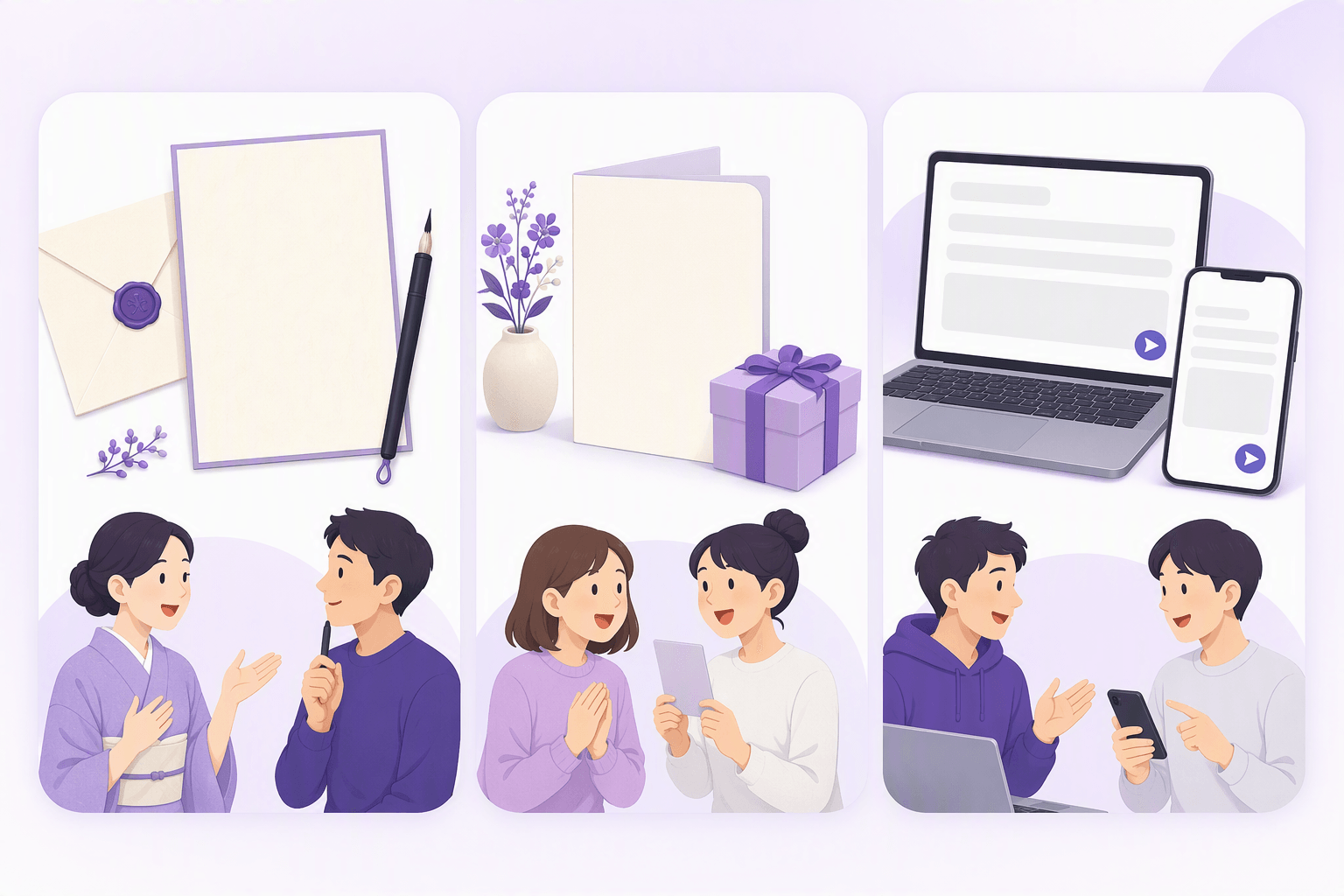
Handwritten formal letter (手紙)
This is for thank-you letters, condolences, congratulations, and traditional business or ceremonial notes. It often includes a seasonal greeting at the start and a set closing at the end.
Casual note or card
This includes birthday cards, small gifts, and short handwritten notes. It is closer to spoken Japanese, and you can keep it simple.
Email (and messaging apps)
Most modern Japanese professional communication happens via email. It uses fixed phrases like お世話になっております and often skips seasonal greetings.
💡 A practical rule
If it is email, prioritize clarity and conventional business phrases. If it is handwritten and formal, add a short seasonal greeting and a more “letter-like” closing.
Politeness levels: decide this before you write
Japanese writing is not just about vocabulary, it is about relationship. The same request can sound normal, cold, or overly intimate depending on form.
Linguist Haruo Shirane’s work on classical and modern Japanese reminds learners that “set expressions” are part of how Japanese encodes social context, especially in writing. In modern usage, the same idea shows up in keigo and email formulas.
Haruko Minegishi Cook’s research on Japanese honorifics and interaction is useful here: politeness is not only “being respectful”, it is managing distance, roles, and expectations in a predictable way. Your goal is not to sound fancy, it is to sound appropriately aligned.
Use this quick decision guide:
- Casual (friends, close classmates): plain form, short greetings, friendly closings.
- Polite (teachers, coworkers you are not close with): です/ます, softening phrases.
- Formal (clients, external partners): business set phrases, humble language, careful closings.
Quick building blocks for Japanese letters and emails
Below is a set of phrases you can mix and match. These are real phrases people actually write, not textbook-only lines.
| English | Japanese | Pronunciation | Formality |
|---|---|---|---|
| Hello (casual letter) | こんにちは | kohn-NEE-chee-wah | polite |
| How are you? (casual) | お元気ですか。 | oh-GEHN-kee dehss kah | polite |
| Thank you (polite) | ありがとうございます。 | ah-ree-GAH-toh goh-zah-ee-MAHSS | polite |
| Excuse me, but... (softener) | すみませんが、 | soo-mee-mah-SEN gah | polite |
| Thank you for your continued support (business) | お世話になっております。 | oh-SEH-wah nee nah-tteh oh-ree-MAHSS | formal |
| I would appreciate your help (standard closing) | よろしくお願いいたします。 | yoh-roh-SHEE-koo oh-neh-GAH-ee-shee-mahss | formal |
| Sincerely (very formal letter closing) | 敬具 | KEH-goo | formal |
| Respectfully (formal opening marker) | 拝啓 | HY-EH-kay | formal |
Notice how some items are “content” (ありがとう) and some are “format markers” (拝啓, 敬具). Those markers are mainly for handwritten formal letters, not everyday email.
The basic structure of a Japanese letter
A safe structure keeps you from sounding abrupt.
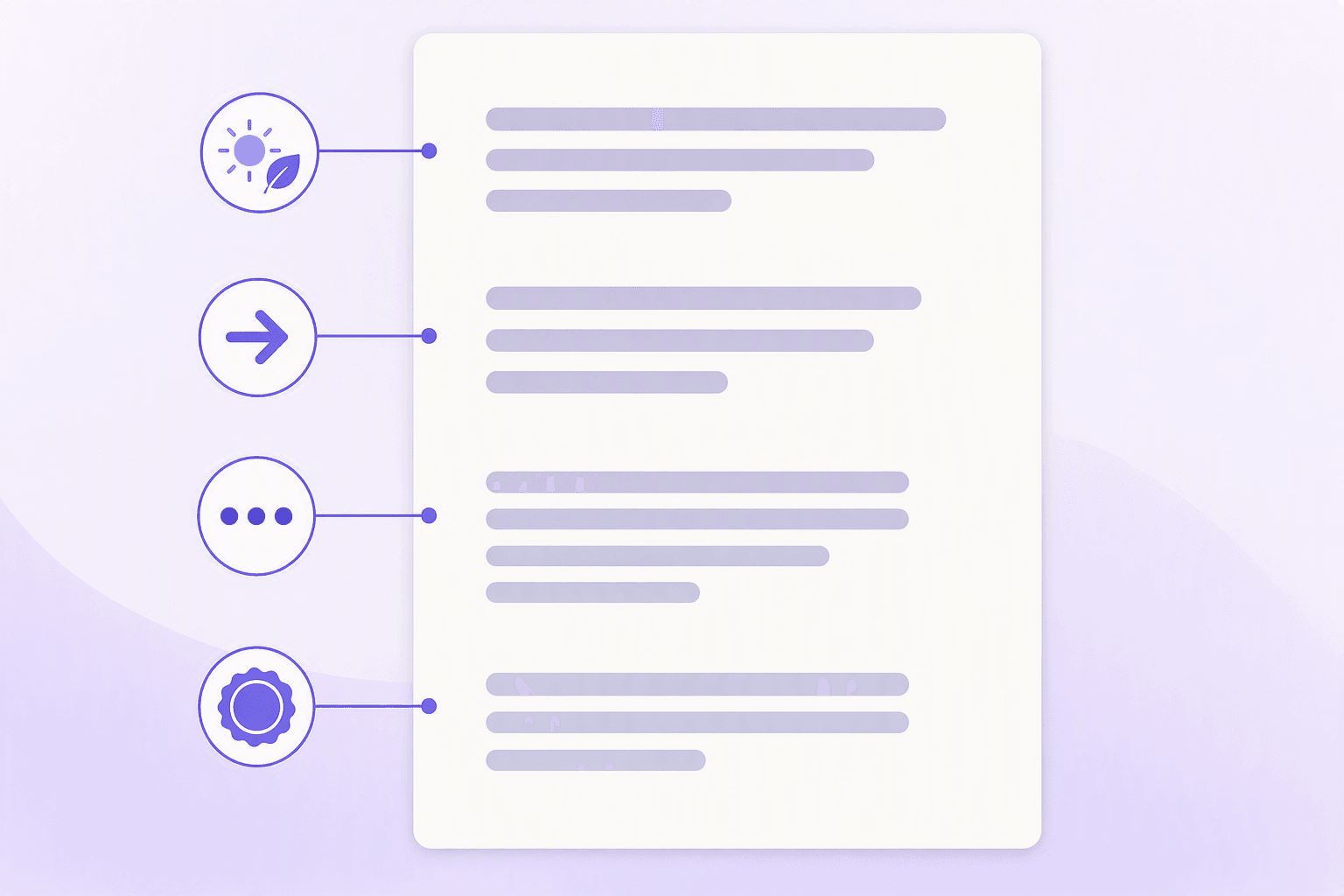
1) Opening
- Formal handwritten: 拝啓 + seasonal greeting + health wish
- Casual: こんにちは + quick check-in
- Business email: お世話になっております + self-introduction line
2) Purpose
State why you are writing in one or two sentences. Japanese letters often include a softener before requests.
3) Details
Add the necessary information, dates, and next steps. Keep paragraphs short.
4) Closing
Use a conventional closing phrase, then your name. In formal letters, you may add date and address formatting.
拝啓
拝啓 (HY-EH-kay) is a formal opening marker used in traditional letters. It signals “this is a proper letter”, not a text message.
In modern life, you mostly see it in ceremonial letters, formal thank-you notes, and some traditional business correspondence. If you use 拝啓, you typically pair it with a matching closing like 敬具.
/HY-EH-kay/
Literal meaning: A set opening used in formal letters.
“拝啓 時下ますますご清栄のこととお慶び申し上げます。”
Dear Sir/Madam, I am pleased to hear that you are enjoying continued prosperity.
Used mainly in handwritten formal letters. Avoid it in normal email unless you are following a very traditional format.
敬具
敬具 (KEH-goo) is a formal closing marker that pairs with 拝啓. Think of it as the “closing bracket” of the formal letter style.
You do not need it for casual letters, and you almost never need it for email. Using it in a casual message can feel performative.
/KEH-goo/
Literal meaning: A set closing used in formal letters.
“今後とも何卒よろしくお願い申し上げます。敬具”
I sincerely appreciate your continued support. Sincerely,
Common in traditional letter writing. If you use it, keep the rest of the letter consistently formal.
お世話になっております
お世話になっております (oh-SEH-wah nee nah-tteh oh-ree-MAHSS) is the single most useful business email opener. It is less about literal meaning and more about relationship maintenance.
It is appropriate for clients, vendors, teachers, and people outside your immediate circle. Inside a team chat, it can be too stiff.
/oh-SEH-wah nee nah-tteh oh-ree-MAHSS/
Literal meaning: A conventional phrase acknowledging ongoing support.
“お世話になっております。ABC株式会社の田中です。”
Thank you for your continued support. This is Tanaka from ABC Co., Ltd.
A default opener in Japanese business email. It reduces friction before you state your request or information.
よろしくお願いいたします
よろしくお願いいたします (yoh-roh-SHEE-koo oh-neh-GAH-ee-shee-mahss) is a workhorse closing. It can mean “please”, “thanks in advance”, or “I look forward to working with you”, depending on context.
In email, it often appears right before your signature. In letters, it can appear before your name and closing marker.
/yoh-roh-SHEE-koo oh-neh-GAH-ee-shee-mahss/
Literal meaning: A conventional request for goodwill and cooperation.
“ご確認のほど、よろしくお願いいたします。”
Thank you in advance for checking.
Extremely common in professional writing. It is polite without being overly emotional.
Templates: copy, then customize
Templates are normal in Japanese. The key is to customize one or two lines so it does not feel like a form letter.
Business email template (request)
Subject lines in Japanese are usually specific and short. Avoid vague subjects like “Hello”.
件名例: 資料送付のお願い / 打ち合わせ日程のご相談
Body:
- お世話になっております。
- [会社/所属]の[名前]です。
- [要件]の件でご連絡いたしました。
- お手数をおかけしますが、[依頼]いただけますでしょうか。
- 何卒よろしくお願いいたします。
Add a signature block with your name, company, phone, and email. Many Japanese companies expect it.
⚠️ Avoid the 'too direct' trap
In English, “Send me the file” can be neutral. In Japanese business writing, a direct imperative can sound harsh. Use softeners like お手数をおかけしますが and いただけますでしょうか.
Email template (apology for delay)
- お世話になっております。
- ご返信が遅くなり、申し訳ありません。
- [回答/状況]は以下の通りです。
- 引き続きよろしくお願いいたします。
If you need a stronger apology, 申し訳ありません is more formal than すみません.
Casual letter to a friend template
- こんにちは。
- 元気?私は元気だよ。
- 最近[近況]で、[相手への質問]はどう?
- また会えるのを楽しみにしてる。
- じゃあね。
- [名前]
If you want more casual, you can start with やあ or ひさしぶり. For relationship phrases, you might also like how to say I love you in Japanese, but be careful, 愛してる is intense and not common in everyday letters.
Thank-you note template (polite)
- このたびは、ありがとうございました。
- [具体的に何がうれしかったか]。
- おかげさまで、[良い結果/気持ち]でした。
- 今後ともよろしくお願いいたします。
- [名前]
In Japanese culture, specificity matters. Naming the gift, the help, or the exact action makes the thanks feel real.
Seasonal greetings: when to use them (and when not to)
Seasonal greetings (時候の挨拶) are a hallmark of formal Japanese letters. They are less common in email, especially fast-moving work threads.
A practical middle ground is to use a light seasonal line only when the situation is formal and the pace is slow, like a thank-you letter after an event.
Examples you might see:
- 春: 春暖の候
- 夏: 盛夏の候
- 秋: 秋冷の候
- 冬: 厳寒の候
You do not need to memorize these to communicate well. If you do use them, keep the rest of the letter formal.
🌍 Why seasons show up in letters
Japan’s letter conventions developed in a culture where written communication often replaced in-person visits, and seasons were a shared, safe topic. Even today, a seasonal line can signal care and social awareness, similar to asking about someone’s wellbeing before getting to business.
Names, honorifics, and addressing people correctly
In Japanese letters and email, addressing is not optional. It sets the relationship.
- Use さん for most people: 田中さん
- Use 様 for customers/clients and formal letters: 田中様
- Use 先生 for teachers, doctors, and some professionals
If you are writing to a company department, you may see:
- [会社名] [部署名] 御中
御中 is used for organizations, not individuals. Do not combine 様 and 御中.
Common mistakes that make your Japanese email feel “off”
Overusing very casual endings
Endings like だよね or じゃん can be fine with close friends, but they can read as immature or overly familiar in semi-formal contexts.
Mixing formal markers with casual body text
If you write 拝啓 and then use emojis and casual slang, it feels inconsistent. Match the level across the whole message.
Using swear words or harsh language
Even mild profanity can be shocking in writing because it is permanent and shareable. If you are curious about what not to use, see our guide to Japanese swear words, but treat it as recognition, not writing material.
Forgetting the “relationship line” in business email
In many workplaces, skipping お世話になっております can feel abrupt, even if your Japanese grammar is correct.
How to practice letter writing with real Japanese (without sounding like a textbook)
Letter writing is a skill, but it is also pattern recognition.
Steal structure, not sentences
Copy the structure from real emails you receive, then swap the content. This avoids unnatural phrasing.
Build a personal phrase bank
Keep 10 openers, 10 request softeners, and 10 closings. Rotate them so you do not repeat the same line every time.
Read your message out loud
If you cannot say it naturally, it is probably too stiff. Spoken rhythm matters even in writing, especially for casual notes.
If you want more listening-first practice, learning from short scenes helps you internalize how Japanese actually signals politeness. Wordy’s movie and TV clips are useful here because you see the same relationship phrases in context, then reuse them in writing.
For more foundational greetings, review how to say hello in Japanese and how to say goodbye in Japanese and notice how the relationship changes the words.
A mini checklist before you hit send
- Did you choose the right level (casual, polite, formal)?
- Did you include an opener that matches the format (email vs letter)?
- Is your purpose stated clearly in the first 2 to 3 lines?
- Did you soften requests (if any)?
- Did you end with a conventional closing and your name?
💡 Fast improvement strategy
Save your best emails as templates. Japanese professionals do this too. The difference between “okay” and “natural” is often just consistent formatting and one or two culturally expected phrases.
If you want to keep building Japanese that works in real life, browse more guides on the Wordy blog and practice with short, repeatable phrases you can actually send.
Frequently Asked Questions
Do Japanese letters still use seasonal greetings?
What is the safest polite opening for a Japanese business email?
How do I end a Japanese letter politely?
Is it rude to be too direct in Japanese email?
How do I write a casual letter to a Japanese friend?
Sources & References
- Ethnologue, Japanese, 27th edition, 2024
- Agency for Cultural Affairs (文化庁), 国語に関する世論調査, accessed 2026
- Japan Foundation (国際交流基金), Japanese-Language Education Overseas, accessed 2026
- Kenkyusha, 新和英大辞典 / 和英大辞典 (dictionary entries), accessed 2026
Start learning with Wordy
Watch real movie clips and build your vocabulary as you go. Free to download.


