Quick Answer
Japanese curse words are less about a long list of taboo words and more about tone, pronouns, and blunt commands. The most common insults you will hear are バカ (bah-kah, 'idiot') and くそ (KOO-soh, 'damn/shit'), but many situations are better handled with safer phrases like ちょっと… (CHOHT-toh, 'uh…') or 失礼だよ (sheh-TSOO-reh dah yoh, 'that's rude').
Japanese curse words are real, but Japanese rudeness is more often built from tone, pronouns, and blunt commands than from a single magic four-letter word. If you learn a few common items like バカ (bah-kah) and くそ (KOO-soh) plus the situations where they are risky, you will understand most “swearing” you hear in anime and TV without accidentally sounding hostile in real life.
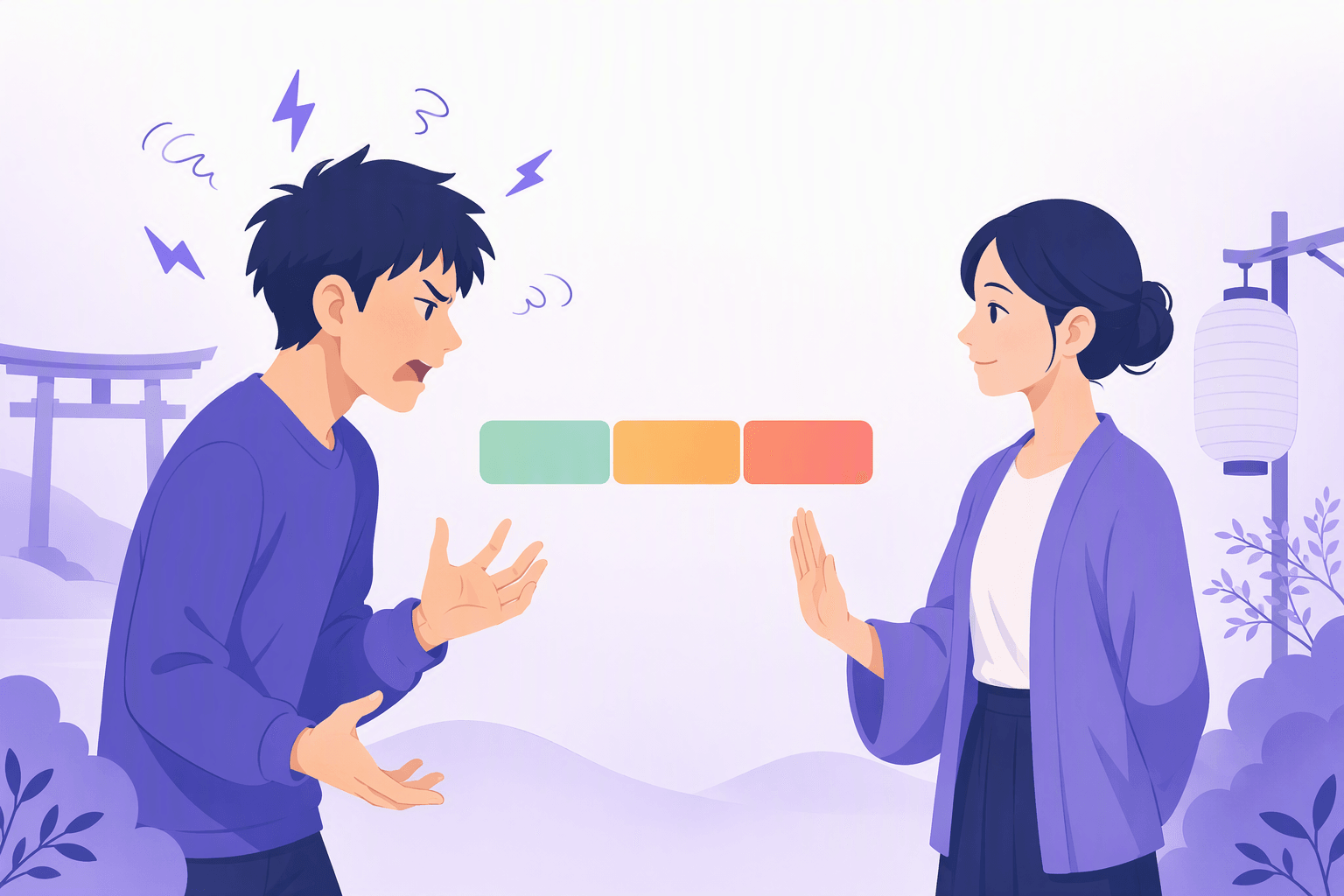
⚠️ A quick safety rule
If you are not sure about the relationship and status difference, do not use insults or rough pronouns. Japanese politeness is highly sensitive to context, and a word that sounds “normal” in fiction can be confrontational in a store, on a train, or at work.
If you want a ranked list with examples, see our dedicated Japanese swear words guide. For everyday polite openers and closers, pair this article with how to say hello in Japanese and how to say goodbye in Japanese.
Why Japanese “curse words” work differently than in English
Japanese has plenty of taboo language, but it also has a powerful politeness system, and that system does a lot of the social work that English often does with swear words. A sentence can be “clean” lexically and still feel cutting if it is too direct, too blunt, or uses the wrong pronoun.
Florian Coulmas, in Sociolinguistics: The Study of Speakers' Choices, frames speech as a set of social choices. Japanese makes those choices very audible: plain vs polite forms, honorifics, and rough masculine styles can change the temperature of a line even when the dictionary meaning stays the same.
A useful statistic for context
Japanese is a major world language with tens of millions of native speakers. Ethnologue lists Japanese among the world’s largest languages by L1 speakers (Ethnologue, 27th ed., 2024). That scale matters because “what sounds rude” is not one rule, it varies by region, age, and subculture, and fiction often selects the most dramatic variants.
The four “channels” of Japanese swearing you will actually hear
Most learners focus on a vocabulary list, but in real Japanese, rudeness usually comes through four channels.
1) Direct insults (simple nouns and adjectives)
Words like バカ (bah-kah) are easy to spot and easy to misuse. They are common in fiction because they are short and punchy.
2) Rough pronouns and address terms
Japanese can sound aggressive just by choosing a harsh “you” or “I.” This is why learners sometimes shock people without intending to: the sentence content is fine, but the pronoun choice is not.
3) Blunt commands and sentence endings
Imperatives and rough endings can turn neutral content into a threat. This is also where subtitles often under-translate the hostility.
4) “Damn it” style exclamations
These are often not aimed at a person. They are still risky in formal settings, but they are less likely to start a fight than a direct insult.
Common Japanese curse words and insults (with real-life notes)
This section focuses on what you are likely to hear in movies, anime, and everyday arguments, plus what each word tends to do socially. Pronunciations are written mora-by-mora so you do not accidentally compress sounds.
バカ
バカ (bah-kah) means “idiot” or “stupid.” It can be playful among close friends, but it is still an insult, and tone decides whether it lands as teasing or contempt.
In some regions and households it is treated as a “hard no,” especially toward family members. In fiction, it is everywhere because it is instantly readable.
/bah-KAH/
Literal meaning: An insult meaning 'idiot' or 'stupid.'
“バカ!何やってんの?”
Idiot! What are you doing?
Common in fiction and among close peers, but risky with strangers, seniors, and in workplaces. Tone can shift it from teasing to hostile fast.
くそ
くそ (KOO-soh) is closer to “damn” or “shit,” and it is often aimed at a situation: you missed the train, you lost a game, your phone died. It can also appear in compounds like くそ野郎, which is more directly insulting.
Because it is an outburst, it is one of the more “understandable” swear words for learners, but it still reads rough in public.
ちくしょう
ちくしょう (chee-KOO-shohh) is a classic frustration cry, often translated as “damn it!” You will hear it in older movies, sports scenes, and dramatic moments.
It is less “dirty” than explicit sexual or bodily terms, but it is still not polite. Think of it as a venting word, not something you say to a person’s face.
この野郎
この野郎 (koh-noh yah-ROH) is like “you bastard” or “you jerk.” It is confrontational and typically male-coded in fiction, especially in fights.
If you say it directly to someone, you are escalating. In real life, most people avoid it unless they are already in a serious argument.
死ね
死ね (sheh-NEH) literally means “die.” It is extremely harsh, and in real-life interaction it can be perceived as threatening, not just rude.
You will hear it in edgy online talk and some fiction, but learners should treat it as “recognize only.” Masayoshi Shibatani’s work on Japanese highlights how form and social meaning interact, and this is a good example: the bare imperative form is part of why it hits so hard.
⚠️ Do not practice this out loud
Words like 死ね are not “spicy vocabulary,” they are socially dangerous. If you want to repeat lines for pronunciation practice, choose frustration words (くそ, ちくしょう) rather than targeted imperatives.
うるさい
うるさい (oo-roo-SAH-ee) means “noisy,” but it is often used like “shut up.” It can be mild in a family context (kids being loud), but it can also be sharp and dismissive.
A safer alternative in public is すみません, ちょっと静かにしてもらえますか (soo-mee-mah-SEN, CHOHT-toh shee-ZOO-kah nee shee-teh moh-rah-eh-MAHSS kah), which is long but socially appropriate.
きもい
きもい (kee-MOH-ee) is slang for “gross” or “creepy,” from 気持ち悪い. It is common among younger speakers and online.
It is also very face-threatening, especially if aimed at someone’s appearance or behavior. If you want to express discomfort without insulting, try ちょっと苦手 (CHOHT-toh noo-GEH-teh, “I’m not good with that”).
ムカつく
ムカつく (moo-KAH-tsoo-koo) means “it pisses me off” or “it annoys me.” It is a strong casual complaint, often about someone’s attitude.
It is safer than calling someone バカ because it can be framed as your feeling, not their identity. Still, it is slang, not workplace language.
The hidden danger zone: pronouns and “you” words
Many learners get in trouble not with a swear word, but with a pronoun that sounds like a challenge. Japanese often drops pronouns, so using one can feel extra pointed.
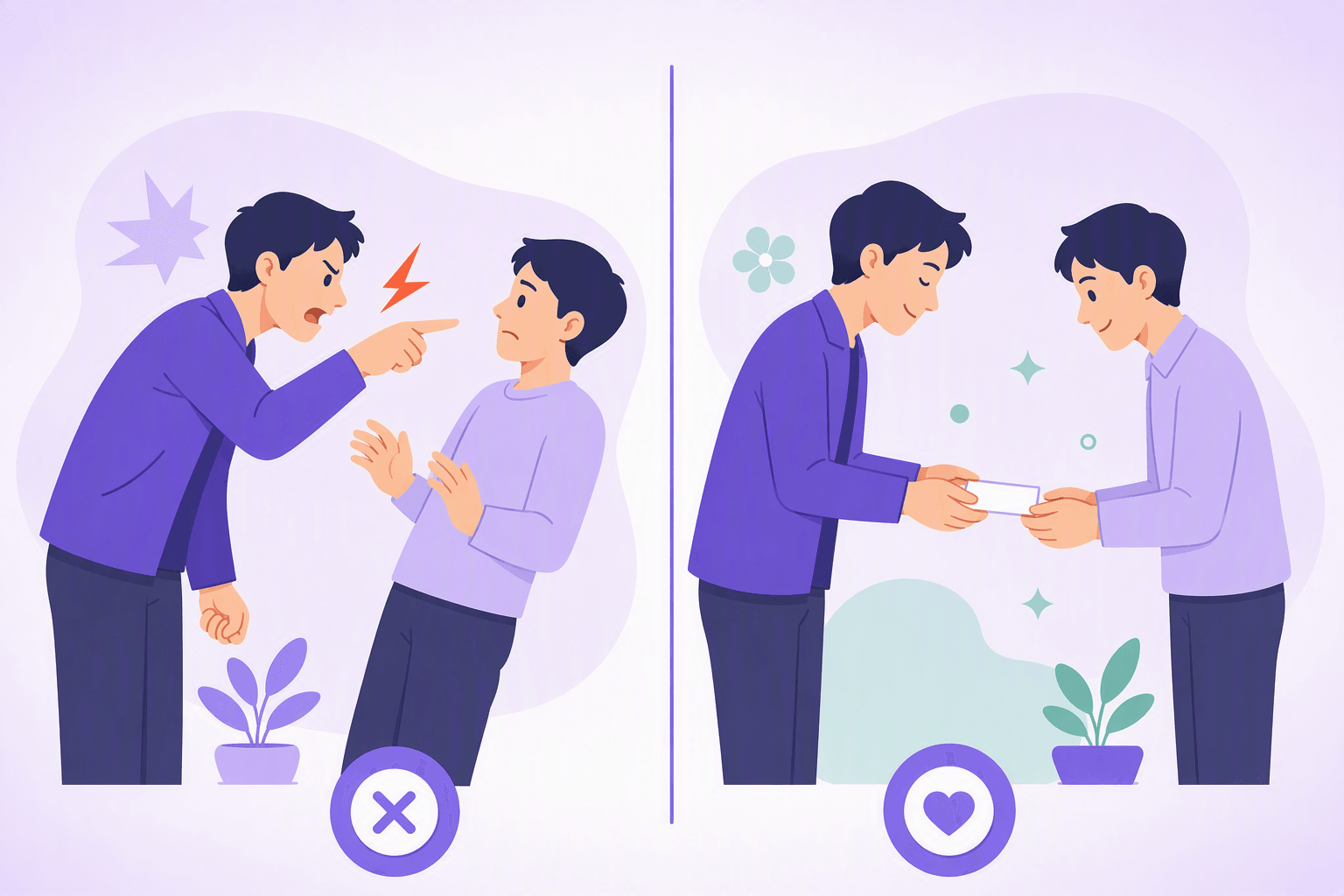
お前
お前 (oh-MAE) is a blunt “you.” In fiction, it is everywhere, especially between male characters, rivals, or close friends.
In real life, it is risky with strangers and in service interactions. If you are speaking politely, you usually do not need “you” at all. Use the person’s name plus さん, or drop the subject.
てめえ
てめえ (teh-MEH-eh) is a very aggressive “you,” associated with fights and threats. Treat it as recognition-only.
貴様
貴様 (kee-SAH-mah) is another very hostile “you,” often used in dramatic or military-flavored fiction. Historically it had different connotations, but in modern usage it is strongly insulting.
How movies and anime exaggerate Japanese swearing
Fiction uses rough language as character design. A polite character signals restraint, a rough character signals toughness, and villains often get harsher pronouns and imperatives.
NINJAL and NHK resources on Japanese language use and communication are useful reminders here: everyday Japanese is shaped by setting, relationship, and role. A character who talks like a delinquent in a classroom scene is not “natural speech,” it is a storytelling shortcut.
If you are learning from media, it helps to balance it with neutral dialogue. Word frequency lists also help you keep perspective, for example our 100 most common Japanese words to anchor what “normal” sounds like.
Safer alternatives that still sound natural (what to say instead)
You do not need to swear to sound fluent. Japanese has many socially acceptable ways to show frustration, disagreement, or “that’s not OK.”
ちょっと…
ちょっと… (CHOHT-toh) is a soft brake. It can mean “uh…” “hold on…” or “that’s a bit…” depending on tone.
It is one of the most Japanese ways to express disapproval without direct confrontation.
/CHOHT-toh/
Literal meaning: Literally 'a little,' used as a soft refusal or disapproval.
“それはちょっと…”
That's kind of... (I'd rather not.)
A common face-saving strategy. It lets you signal 'no' or discomfort without saying it directly, especially with people you do not know well.
失礼だよ
失礼だよ (sheh-TSOO-reh dah yoh) means “that’s rude.” It is direct, but it targets behavior, not the person’s worth.
If you need more distance, use 失礼です (sheh-TSOO-reh dehss).
やめて
やめて (yah-MEH-teh) means “stop it.” It is clear and often safer than escalating into insults.
For a more polite version: やめてください (yah-MEH-teh koo-dah-SAH-ee).
もう!
もう (MOH) is “come on!” or “seriously!” It is a frustration marker that can be playful or annoyed.
It is common in family and couple talk, and it shows up constantly in slice-of-life dialogue.
How to practice without sounding rude by accident
Learning “spicy” lines can be motivating, but you want control: when you hear it, when you can quote it, and when you should never use it.
Step 1: Learn the polite baseline first
If you can greet and exit cleanly, you can avoid many awkward situations. Start with how to say hello in Japanese and how to say goodbye in Japanese, then add rough language as passive comprehension.
Step 2: Train your ear for speech level shifts
A lot of “swearing” is really a shift into blunt plain forms. Listen for short endings, clipped vowels, and imperatives.
If you want a structured way to do this, clip-based study is ideal because you can replay the same line and compare characters. Wordy is built around that loop: short scenes, repeatable audio, and vocabulary tracking, so you can recognize roughness without adopting it as your default voice.
Step 3: Separate “quote it” from “use it”
A useful rule is: if you would not say it to a coworker, do not say it at all. Keep the harshest items as recognition-only, especially targeted imperatives like 死ね.
Regional and social variation (why one rule never fits all)
Japanese varies by region and by in-group norms. Some households treat バカ as normal teasing, others treat it as unacceptable. Some friend groups use お前 casually, others never do.
This is why sociolinguistic framing matters. Coulmas’s speaker-choice perspective helps explain why “the same word” can be read as intimacy in one context and aggression in another: the choice signals relationship stance, not just dictionary meaning.
🌍 A cultural mismatch to watch for
English speakers often treat swearing as a pressure valve, and it can even build camaraderie. In Japanese, rough language can do that inside tight in-groups, but outside them it can signal disrespect or a challenge. When in doubt, choose neutrality and let closeness develop first.
If you want romance language, do not borrow it from insults
A common learner mistake is mixing “intense” language with affection because it sounds dramatic in subtitles. If you are looking for sincere romantic lines, use a dedicated guide like how to say I love you in Japanese rather than copying a tough-guy register.
A quick “do and don’t” list
Do
- Recognize common items (バカ, くそ, ちくしょう) so you understand scenes.
- Use softer frustration markers (もう, ちょっと…) in real life.
- Pay attention to pronouns, often the real source of rudeness.
Don’t
- Use 死ね, てめえ, 貴様 in real interactions.
- Call strangers バカ, even jokingly.
- Assume anime dialogue equals everyday speech.
Want to understand real Japanese arguments without copying them?
If your goal is comprehension, focus on hearing the register shift and mapping it to relationship dynamics. Then keep your own output polite by default, and “borrow” rough speech only when you are quoting a scene with friends who understand you are joking.
For more context and a severity-ranked list, read our Japanese swear words guide. And if you are building everyday fluency, start at the Japanese learning hub and add rough-language comprehension as a later layer.
Frequently Asked Questions
What is the most common Japanese curse word?
Is バカ stronger than くそ?
Do Japanese people swear as much as in English movies?
What should I say instead of swearing in Japanese?
Is お前 always rude in Japanese?
Sources & References
- Ethnologue, Japanese (jpn), 27th edition, 2024
- National Institute for Japanese Language and Linguistics (NINJAL), corpora and research resources, accessed 2026
- NHK Broadcasting Culture Research Institute, language and communication resources, accessed 2026
- Coulmas, Florian, *Sociolinguistics: The Study of Speakers' Choices*, Cambridge University Press
- Shibatani, Masayoshi, *The Languages of Japan*, Cambridge University Press
Start learning with Wordy
Watch real movie clips and build your vocabulary as you go. Free to download.


