Quick Answer
Advanced Japanese colors go far beyond 赤 and 青. Learn traditional 和色 names, useful shades for clothes and design, color grammar, and the cultural meanings that make Japanese color vocabulary so precise.
Japanese has everyday color words such as 赤 /aka/ and 青 /ao/, but advanced Japanese color vocabulary includes precise traditional shades, modern loanwords, and grammar patterns that tell you how a color is being used. Learning terms such as 桜色 /sakuɾa.iɾo/, 紺色 /koɴ.iɾo/, and 生成り /kinaɾi/ helps you understand clothes, anime visuals, packaging, weather reports, and descriptions that basic color lists miss.
Japanese is spoken by roughly 123 million first-language speakers, primarily in Japan, according to Ethnologue's 27th edition. Color vocabulary matters because Japanese design, seasonal culture, textiles, and food presentation often use shade names more specifically than a basic eight-color palette.
For a foundation before these nuanced terms, review Japanese colors and traditional 和色. You can also hear many of the words below in anime vocabulary, especially in scenes about school uniforms, hair, scenery, and fashion.
| English | Japanese | Pronunciation | Note |
|---|---|---|---|
| Navy blue | 紺色 | kohn-ee-roh | A deep blue common in uniforms and formal clothing. |
| Indigo | 藍色 | ah-ee-iroh | Traditional dye color with strong textile associations. |
| Light blue | 水色 | mee-zoo-iroh | Literally 'water color'. |
| Sky blue | 空色 | soh-rah-iroh | Literally 'sky color'. |
| Blue-green | 青緑 | ah-oh-mee-doh-ree | Useful for teal-like shades. |
| Yellow-green | 黄緑 | kee-mee-doh-ree | A bright yellowish green. |
| Vermilion | 朱色 | shoo-iroh | A vivid red-orange seen at shrines. |
| Scarlet | 緋色 | hee-iroh | A strong, bright red with literary and historical tone. |
| Rose pink | 桃色 | moh-moh-iroh | Literally 'peach color'. |
| Purple | 紫 | moo-rah-sah-kee | Historically associated with status and refinement. |
| Gray | 灰色 | hah-ee-iroh | Literally 'ash color'. |
| Brown | 茶色 | chah-iroh | Literally 'tea color'. |
How Japanese color names work
Japanese color terms fall into several useful groups. The first is a small set of core native words, including 赤 /aka/, 青 /ao/, 白 /ɕiɾo/, 黒 /kɯɾo/, 黄色 /ki.iɾo/, 緑 /midori/, and 紫 /mɯɾasa.kʲi/.
The second group is made from a descriptive noun plus 色 /i.ɾo/, meaning color. 水色 /mizu.iɾo/, literally water color, and 空色 /sora.iɾo/, literally sky color, are familiar examples. These compounds are easy to recognize once you know the elements.
The third group includes foreign loanwords written in katakana, such as ピンク /piŋ.kɯ/, オレンジ /o.ɾeɴ.dʑi/, ベージュ /beː.dʑɯ/, and グレー /gɯɾeː/. They appear constantly in fashion, cosmetics, advertising, and interior design.
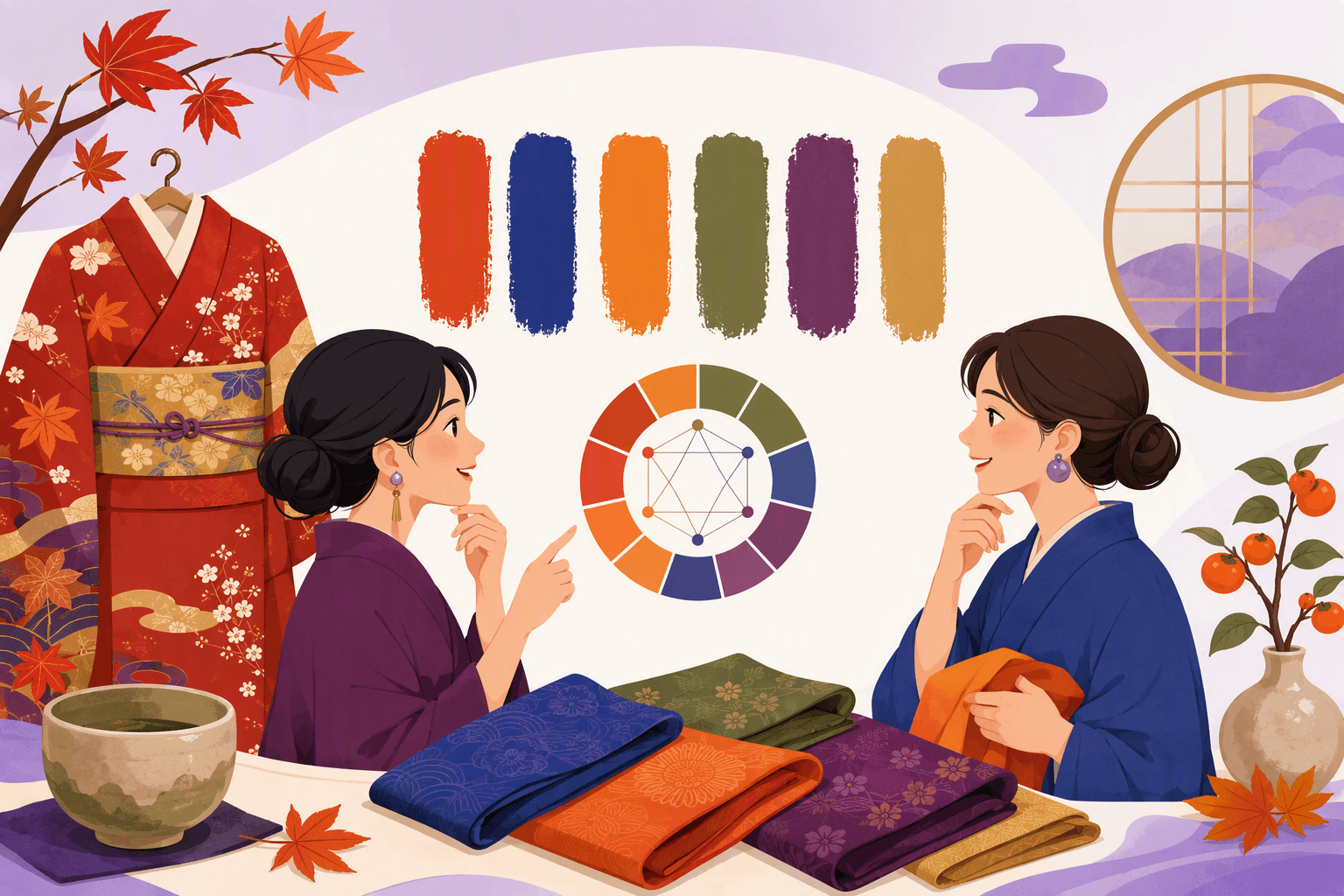
Finally, 和色 /wa.ɕi.ki/, traditional Japanese colors, often use poetic references to flowers, trees, minerals, animals, and dyes. They are not merely old-fashioned museum terms. You will see them in kimono descriptions, cosmetics, stationery, graphic design, seasonal menus, and historical fiction.
Linguists Brent Berlin and Paul Kay, in Basic Color Terms, showed that languages organize basic color categories in patterned ways, even though their boundaries do not line up perfectly. Japanese 青 /ao/ is a well-known reminder that a color category is not always a direct translation of an English label.
Traditional Japanese shades
Traditional color names are especially valuable because they build visual memory. Rather than memorizing a random shade chart, associate each word with a natural object, season, fabric, or setting.
| English | Japanese | Pronunciation | Note |
|---|---|---|---|
| Cherry blossom pink | 桜色 | sah-koo-rah-iroh | A pale pink associated with spring and hanami. |
| Wisteria purple | 藤色 | foo-jee-iroh | A soft purple inspired by wisteria flowers. |
| Golden yellow | 山吹色 | yah-mah-boo-kee-iroh | A rich yellow-orange named after Japanese kerria blossoms. |
| Madder red | 茜色 | ah-kah-neh-iroh | A deep reddish shade associated with sunset and plant dye. |
| Ink black | 墨色 | soo-mee-iroh | A black-gray shade associated with calligraphy ink. |
| Mouse gray | 鼠色 | neh-zoo-mee-iroh | A muted gray, often used for understated colors. |
| Unbleached natural cloth | 生成り | kee-nah-ree | An off-white or natural linen-like shade. |
| Matcha green | 抹茶色 | maht-chah-iroh | A muted green inspired by powdered tea. |
| Gold | 金色 | keen-iroh | Literally 'gold color', used for metallic gold. |
| Silver | 銀色 | geen-iroh | Literally 'silver color', used for metallic silver. |
桜色
桜色 /sakuɾa.iɾo/ is a pale, delicate pink associated with cherry blossoms. It evokes spring, graduation season, new beginnings, and 花見 /hanami/, cherry blossom viewing.
In clothing and beauty advertising, 桜色 /sakuɾa.iɾo/ suggests softness rather than a loud hot pink. A lipstick described as 桜色 /sakuɾa.iɾo/ is likely subtle and light.
藍色
藍色 /a.i.iro/ is indigo, traditionally produced from indigo dye. Japan has a long history of indigo-dyed fabric, particularly through aizome, written 藍染め /a.i.zome/.
The shade can range from vivid blue to a darker, nearly navy tone. In fashion, 藍色 /a.i.iro/ often sounds more traditional and tactile than simply saying 青 /ao/.
山吹色
山吹色 /jamabɯki.iro/ is a rich yellow with orange warmth. The name comes from the yamabuki plant, Japanese kerria, whose blossoms are a striking golden yellow.
This is a high-impact color word. It appears in descriptions of flowers, bright fabric, character costumes, and warm sunlight. It is more specific than 黄色 /kiiro/, yellow.
茜色
茜色 /akane.iro/ describes a deep reddish or red-orange color, often linked to sunset skies. Because 茜 /akane/ also refers to madder, a plant used for red dye, the word connects landscape imagery with traditional craft.
You may encounter 茜色 /akane.iro/ in song lyrics, novels, and poetic descriptions. It gives a scene a warmer, more literary feeling than 赤 /aka/ alone.
墨色
墨色 /sumi.iro/ is ink black, usually a softened black with gray or blue undertones. The reference is 墨 /sumi/, the ink stick used in Japanese calligraphy.
Japanese aesthetics often value subdued tonal variation. 墨色 /sumi.iro/ can suggest quietness, craft, restraint, and an elegant alternative to a flat black.
生成り
生成り /kinari/ is an unbleached off-white, often like natural cotton, linen, or paper. It is common in clothing, home goods, and product descriptions.
Unlike 真っ白 /maɕɕiro/, pure white, 生成り /kinari/ feels warm and organic. If you are shopping online in Japanese, this is a very practical word to know.
The grammar of Japanese colors
Not every Japanese color behaves the same way before a noun. Four core colors commonly have an adjective form ending in い /i/: 赤い /aka.i/, 青い /ao.i/, 白い /ɕiro.i/, and 黒い /kɯɾo.i/.
You can say 赤いドレス /aka.i doɾesɯ/, a red dress, or 青い空 /ao.i sora/, a blue sky. These forms act like standard Japanese adjectives.
Most other colors use の /no/ before the noun. For example, say 紫のバッグ /mɯɾasaki no baggɯ/, a purple bag, or ベージュのコート /beːdʑɯ no koːto/, a beige coat.
| Color type | Natural pattern | Example | Meaning |
|---|---|---|---|
| Core adjective | 赤い + noun | 赤い靴 /aka.i kɯtsɯ/ | red shoes |
| Core adjective | 白い + noun | 白い猫 /ɕiro.i neko/ | white cat |
| Compound color | 水色の + noun | 水色のシャツ /mizu.iro no ɕatsɯ/ | light-blue shirt |
| Traditional shade | 桜色の + noun | 桜色の着物 /sakura.iro no kimono/ | cherry-blossom-pink kimono |
| Katakana color | ベージュの + noun | ベージュの帽子 /beːdʑɯ no boːɕi/ | beige hat |
You will also hear 色 /iro/ used after a color to mean a color tone or color scheme. For example, この色 /kono iro/ means this color, while 色合い /iro.ai/ means color tone, blend, or overall color impression.
💡 Use の with advanced shades
When in doubt, use the color name plus の /no/ before a noun. This works naturally with traditional colors, compound colors, and katakana loanwords. Save 赤い /aka.i/, 青い /ao.i/, 白い /ɕiro.i/, and 黒い /kɯɾo.i/ for the core adjective pattern.
Blue, green, and the meaning of 青
One of the most discussed Japanese color patterns is 青 /ao/. In contemporary Japanese, 緑 /midori/ is the ordinary word for green, but 青 /ao/ remains in expressions where English speakers expect green.
For example, a green traffic light is commonly called 青信号 /ao.ɕiŋgoː/, and an unripe green apple may be called 青りんご /ao.ɾiŋgo/. The phrase 青葉 /ao.ba/, green leaves, also preserves this broader traditional category.
This does not mean modern Japanese speakers cannot distinguish blue from green. They can, and do. It means words retain cultural history even after the everyday color system becomes more precise.
Color theorists often distinguish hue, lightness, and saturation. Albert H. Munsell's A Color Notation helped establish a systematic way of separating these properties. Japanese descriptions make similar distinctions in ordinary language through words such as 薄い /ɯsɯ.i/, light or pale, 濃い /koi/, dark or strong, and くすんだ /kɯsɯnda/, muted.
Modifiers for describing any shade
You do not need to learn every named shade to describe color accurately. Combine a familiar color with a modifier.
- 薄い青 /ɯsɯ.i ao/: pale blue
- 濃い緑 /koi midori/: dark or deep green
- 明るい黄色 /akaɾɯ.i kiiro/: bright yellow
- 暗い紫 /kɯɾai mɯɾasaki/: dark purple
- くすんだピンク /kɯsɯnda piŋkɯ/: muted or dusty pink
- 鮮やかな赤 /aza.jaka na aka/: vivid red
- 柔らかい色 /jawaɾaka.i iro/: soft color
- 落ち着いた色 /otɕitsɯ.ita iro/: subdued, calm color
The adjective 鮮やか /aza.jaka/ is useful for vivid, saturated colors. 落ち着いた /otɕitsɯ.ita/ is common in fashion and interiors for restrained colors that feel calm or mature.
For visual media learners, notice these modifiers in subtitles while watching Japanese shows. A scene about choosing clothes may contrast 派手 /hade/, flashy, with 地味 /dʑimi/, plain or understated. That contrast is central to Japanese fashion descriptions, not just a matter of color vocabulary.
Color in Japanese culture and design
Color names can carry social and historical associations. 紫 /mɯɾasa.kʲi/, purple, was associated with elite rank in earlier periods because purple dyes were difficult to make. Today it can still feel elegant, luxurious, or slightly mature.
Red, especially 朱色 /ɕɯ.iro/, is strongly visible at Shinto shrines through torii gates and vermilion structures. The color is visually striking, but it is also connected with ritual spaces and traditional architecture.
White, 白 /ɕiɾo/, can signal purity and formality, as seen in ceremonial clothing. Black, 黒 /kɯɾo/, can be formal and sophisticated, but it also has mourning associations depending on the occasion.
🌍 Avoid treating color symbolism as a fixed code
Japanese color meanings shift with setting, generation, fashion, religion, and product design. Purple may suggest refinement in a kimono context, while a purple character design may simply look mysterious or stylish. Learn the associations, then use the scene to interpret them.
The Japan Color Research Institute's work on color systems reflects how color is treated as both a perceptual and communicative tool in Japan. In branding and packaging, the exact shade can change whether a product feels seasonal, premium, playful, natural, or formal.
Practical phrases for shopping and conversation
When looking at clothes, home goods, or cosmetics, use these patterns:
- これは何色ですか /kore wa nani.iro desɯ ka/: What color is this?
- もう少し明るい色はありますか /moː sɯkoɕi akaɾɯ.i iro wa aɾimasɯ ka/: Do you have a slightly brighter color?
- 紺色が好きです /koɴ.iɾo ga sɯki desɯ/: I like navy blue.
- この青は少しくすんでいます /kono ao wa sɯkoɕi kɯsɯnde imasɯ/: This blue is slightly muted.
- 桜色のほうが似合うと思います /sakuɾa.iɾo no hoː ga ni.aɯ to omoimasɯ/: I think the cherry-blossom pink suits you better.
The phrase 似合う /ni.aɯ/ means to suit someone, especially in relation to clothes, colors, hairstyles, or accessories. It is a useful word when discussing color choices politely.
If your goal is conversational Japanese rather than memorizing isolated lists, pair color vocabulary with a real context. Watch a wardrobe scene, pause when a speaker names a shade, repeat the line, then make one new sentence with the same pattern. This kind of focused listening is especially effective with Japanese movie and anime learning methods.
Build a color vocabulary that lasts
Start with the colors you will actually see: 黒 /kɯɾo/, 白 /ɕiɾo/, 紺色 /koɴ.iɾo/, ベージュ /beːdʑɯ/, グレー /gɯɾeː/, and 水色 /mizu.iɾo/ are high-value choices for shopping and descriptions.
Then learn seasonal or artistic shades in clusters. Pair 桜色 /sakuɾa.iɾo/ with spring, 茜色 /akane.iro/ with sunsets, 抹茶色 /matɕa.iro/ with tea, and 墨色 /sumi.iro/ with calligraphy. Meaningful associations make the vocabulary easier to retrieve.
Finally, listen for colors in greetings, compliments, and casual conversations. Even a simple exchange after learning how to say hello in Japanese can become richer when you can say that someone’s bag is a beautiful 藍色 /a.i.iro/ or that the evening sky is 茜色 /akane.iro/.
Frequently Asked Questions
What is the Japanese word for color?
Why can 青 mean both blue and green in Japanese?
What are traditional Japanese colors called?
Do Japanese color words change form like adjectives?
Is 肌色 acceptable to say in Japanese?
Sources & References
- Ethnologue, Japanese, 27th edition, 2024
- National Institute for Japanese Language and Linguistics, Japanese Language Research Resources, accessed 2026
- Agency for Cultural Affairs, Japanese Language and Culture Resources, accessed 2026
- Japan Industrial Standards Committee, JIS Z 8102:2019 Colour Terms
- Japan Color Research Institute, PCCS Color System Resources, accessed 2026
Start learning with Wordy
Watch real movie clips and build your vocabulary as you go. Free to download.


