Japanese Colors: 30+ Color Words With Kanji, Grammar Rules, and Traditional 和色
Quick Answer
The essential Japanese colors are 赤 (aka, red), 青 (ao, blue), 白 (shiro, white), 黒 (kuro, black), 緑 (midori, green), and 黄色 (kiiro, yellow). Japanese has a unique grammar distinction: only four original colors (赤い, 青い, 白い, 黒い) conjugate as i-adjectives. All other colors function as nouns or na-adjectives, and many modern colors like ピンク (pinku) and オレンジ (orenji) come from English loanwords written in katakana.
The most important colors in Japanese are 赤 (aka, red), 青 (ao, blue), 白 (shiro, white), 黒 (kuro, black), 緑 (midori, green), and 黄色 (kiiro, yellow). But Japanese color vocabulary goes far deeper than a simple list of translations. It reveals how an entire culture perceives and categorizes the visual world.
Japanese is spoken by approximately 125 million native speakers according to Ethnologue's 2024 data. Its color system is linguistically fascinating: only four colors in the entire language conjugate as true i-adjectives, a grammatical fact that traces directly to Japan's original four-color worldview. Beyond these basics, Japan maintains a system of over 450 traditional color names called 和色 (wairo), drawn from flowers, minerals, seasons, and the natural landscape.
"Languages differ strikingly in the number of basic color terms they employ. Japanese provides a particularly instructive case, having expanded from four basic terms in Old Japanese to the modern system through a combination of native semantic shifts and lexical borrowing."
(David Crystal, The Cambridge Encyclopedia of Language, Cambridge University Press)
This guide covers 30+ essential Japanese color words, the grammar rules that govern them, and the rich cultural symbolism behind Japan's unique relationship with color. For interactive practice with real Japanese content, visit our Japanese learning page.
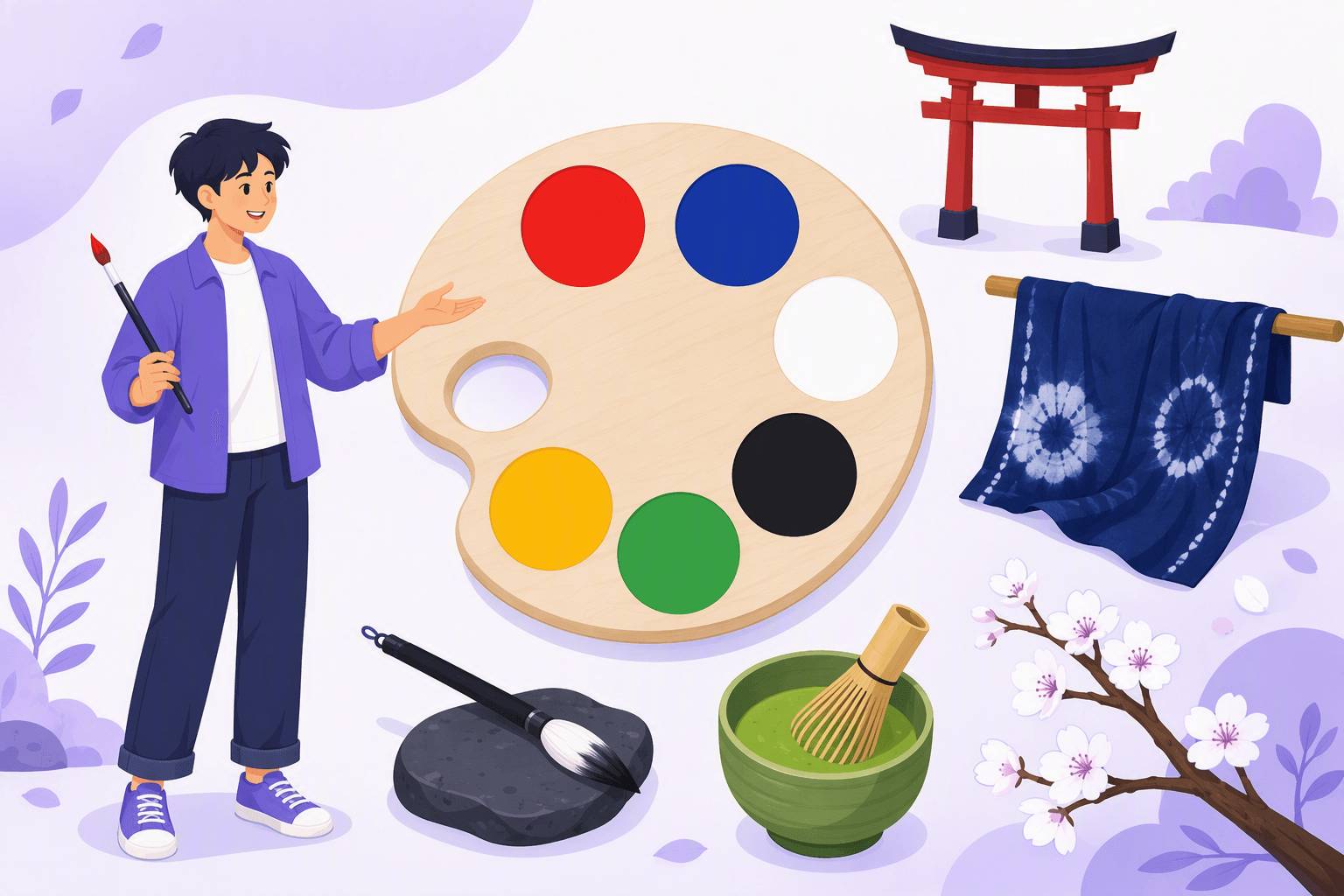
Quick Reference: Essential Japanese Colors
| English | Japanese | Pronunciation | Note |
|---|---|---|---|
| Red | 赤 / あか | ah-kah | i-adj: 赤い (akai) |
| Blue | 青 / あお | ah-oh | i-adj: 青い (aoi). Also covers green |
| White | 白 / しろ | shee-roh | i-adj: 白い (shiroi) |
| Black | 黒 / くろ | koo-roh | i-adj: 黒い (kuroi) |
| Green | 緑 / みどり | mee-doh-ree | Noun, not i-adjective |
| Yellow | 黄色 / きいろ | kee-ee-roh | i-adj: 黄色い (kiiroi) |
| Purple | 紫 / むらさき | moo-rah-sah-kee | Noun. Imperial color |
| Brown | 茶色 / ちゃいろ | chah-ee-roh | Lit. 'tea color' |
| Orange | オレンジ | oh-ren-jee | English loanword (katakana) |
| Pink | ピンク | peen-koo | English loanword (katakana) |
| Gray | 灰色 / はいいろ | hah-ee-ee-roh | Lit. 'ash color'. Also グレー |
| Gold | 金色 / きんいろ | keen-ee-roh | Lit. 'gold color' |
| Silver | 銀色 / ぎんいろ | geen-ee-roh | Lit. 'silver color' |
| Light blue | 水色 / みずいろ | mee-zoo-ee-roh | Lit. 'water color' |
💡 The 色 (Iro) Suffix
Many Japanese colors are compound words ending in 色 (iro, "color"): 茶色 (chairo, tea-color = brown), 灰色 (haiiro, ash-color = gray), 水色 (mizuiro, water-color = light blue). When you encounter 色 attached to a noun, you can often guess the color by knowing what the first kanji means. This pattern makes Japanese color vocabulary highly logical once you learn a few base words.
Japan's Original Four Colors: The I-Adjective Core
Linguists studying Old Japanese have identified that the language originally had only four basic color terms: 赤 (aka), 青 (ao), 白 (shiro), and 黒 (kuro). These four are the only colors that behave as true i-adjectives, a grammatical distinction that has persisted for over a thousand years.
According to research by the National Institute for Japanese Language and Linguistics (NINJAL), these four terms initially described broad perceptual categories rather than specific hues. 赤 covered the warm-bright spectrum, 青 the cool-dark spectrum, 白 meant light or clear, and 黒 meant dark or dim.
赤 (あか)
| English | Japanese | Pronunciation | Note |
|---|---|---|---|
| Red (noun) | 赤 / あか | ah-kah | Noun form |
| Red (adjective) | 赤い / あかい | ah-kah-ee | i-adjective: 赤い車 = red car |
| Crimson | 真っ赤 / まっか | mahk-kah | Intensified: 'bright/deep red' |
赤 (aka) is Japan's color of vitality, celebration, and protection. You see it on torii gates at Shinto shrines, on daruma dolls, and at festivals throughout the country. The phrase 赤ちゃん (akachan, baby) literally means "red one," reflecting the ruddy complexion of newborns. 真っ赤 (makka) is the intensified form meaning "bright red" and also appears in the expression 真っ赤な嘘 (makka na uso, a bold-faced lie, literally "a deep-red lie").
青 (あお)
| English | Japanese | Pronunciation | Note |
|---|---|---|---|
| Blue (noun) | 青 / あお | ah-oh | Noun form |
| Blue (adjective) | 青い / あおい | ah-oh-ee | i-adjective: 青い空 = blue sky |
| Pale / unripe | 青い / あおい | ah-oh-ee | Also means 'inexperienced' |
青 (ao) is the most linguistically fascinating color in Japanese. It historically covered the entire blue-green spectrum, and this legacy persists today. Japanese traffic lights are officially called 青信号 (ao shingou, "blue signal") even though the go light is visibly green. Green apples are 青りんご (ao ringo, "blue apples"). Green leaves are 青葉 (aoba, "blue leaves").
The Agency for Cultural Affairs' language survey confirms that most Japanese speakers still use 青 naturally for things English speakers would call green, particularly in set expressions. The word 青い also carries a metaphorical meaning of "inexperienced" or "immature," similar to English "green" in phrases like "green behind the ears."
白 (しろ)
| English | Japanese | Pronunciation | Note |
|---|---|---|---|
| White (noun) | 白 / しろ | shee-roh | Noun form |
| White (adjective) | 白い / しろい | shee-roh-ee | i-adjective: 白い花 = white flower |
| Pure white | 真っ白 / まっしろ | mahs-shee-roh | Intensified: 'snow white' |
白 (shiro) represents both purity and death in Japanese culture, a duality that surprises many learners. White is the color of wedding kimono (白無垢, shiromuku), but also the traditional color of mourning and funerals. The expression 白紙に戻す (hakushi ni modosu, "to return to white paper") means to start from scratch. 白 also conveys innocence: 潔白 (keppaku) means "innocence" or "being cleared of suspicion."
黒 (くろ)
| English | Japanese | Pronunciation | Note |
|---|---|---|---|
| Black (noun) | 黒 / くろ | koo-roh | Noun form |
| Black (adjective) | 黒い / くろい | koo-roh-ee | i-adjective: 黒い猫 = black cat |
| Pitch black | 真っ黒 / まっくろ | mahk-koo-roh | Intensified: 'jet black' |
黒 (kuro) carries associations of formality, power, and mystery. Black is the standard color for business suits, formal wear, and calligraphy ink. The character 黒 appears in the word 黒字 (kuroji, "in the black," meaning profitable), contrasting with 赤字 (akaji, "in the red," meaning a financial loss). In sumo wrestling, the black side (黒房, kurobusa) represents the winter and north direction, tying back to the ancient color-direction associations in East Asian philosophy.
Modern Colors: Loanwords and Native Terms
As Japan's contact with the West increased from the Meiji era onward, new color terms entered the language. Some are native Japanese compounds using the 色 (iro) suffix, while others are English loanwords written in katakana.
緑 (みどり)
緑 (midori) is the standard modern Japanese word for green. Despite being one of the most common colors today, it was originally a noun meaning "greenery" or "fresh shoots" rather than a color adjective. This is why 緑 does not have an i-adjective form; you cannot say ×緑い (midoroi). Instead, you use 緑の (midori no) before nouns: 緑の葉 (midori no ha, green leaf).
The gradual separation of green from 青 (ao) is still incomplete. NHK Broadcasting research shows that while younger Japanese speakers increasingly distinguish 青 and 緑, traditional expressions like 青信号, 青りんご, and 青葉 remain firmly entrenched. Understanding this overlap is essential for sounding natural in Japanese.
黄色 (きいろ)
黄色 (kiiro) is an interesting case: it is one of the few non-original colors that gained an i-adjective form. 黄色い (kiiroi) works exactly like 赤い or 青い as a modifier: 黄色い花 (kiiroi hana, yellow flower). The word literally means "yellow-color" (黄 + 色), and linguists believe the i-adjective form developed because yellow was perceived early enough to integrate into the core grammar.
カタカナ Colors: English Loanwords
| English | Japanese | Pronunciation | Note |
|---|---|---|---|
| Pink | ピンク | peen-koo | From English 'pink' |
| Orange | オレンジ | oh-ren-jee | From English 'orange' |
| Gray | グレー | goo-reh | From English 'gray' |
| Beige | ベージュ | beh-joo | From French 'beige' |
| Cream | クリーム | koo-ree-moo | From English 'cream' |
| Ivory | アイボリー | ah-ee-boh-ree | From English 'ivory' |
| Khaki | カーキ | kah-kee | From English 'khaki' |
These loanword colors all function as nouns grammatically. To modify a noun, add の (no): ピンクの服 (pinku no fuku, pink clothes), オレンジのジュース (orenji no juusu, orange juice). They never take i-adjective endings.
🌍 Why Japanese Borrowed Color Words
Japan's original color system described broad perceptual categories rather than precise hues. As Western art, fashion, and design entered Japan during the Meiji period (1868-1912), specific color terms like ピンク and オレンジ filled gaps that the existing Japanese vocabulary did not cover with single words. Rather than creating new native terms, Japanese absorbed the English words directly, a pattern visible across many semantic fields in modern Japanese.
Color Grammar: I-Adjectives vs. Nouns
This is the grammatical distinction that trips up most learners. Japanese colors fall into two grammar categories, and using the wrong pattern sounds immediately unnatural.
I-Adjective Colors (directly modify nouns)
Only five colors have i-adjective forms. These are the four original colors plus 黄色い:
| Color | I-Adjective | Example | Meaning |
|---|---|---|---|
| Red | 赤い (akai) | 赤い車 | red car |
| Blue | 青い (aoi) | 青い海 | blue sea |
| White | 白い (shiroi) | 白い雪 | white snow |
| Black | 黒い (kuroi) | 黒い猫 | black cat |
| Yellow | 黄色い (kiiroi) | 黄色い花 | yellow flower |
I-adjective colors conjugate like all Japanese i-adjectives: 赤くない (akakunai, not red), 赤かった (akakatta, was red), 赤くなる (akaku naru, to become red).
Noun Colors (require の or な to modify nouns)
All other colors (including 緑, 紫, 茶色, and all katakana loanwords) are nouns. They need the particle の (no) to modify another noun:
| Color | Pattern | Example | Meaning |
|---|---|---|---|
| Green | 緑の | 緑の木 | green tree |
| Purple | 紫の | 紫の花 | purple flower |
| Brown | 茶色の | 茶色の犬 | brown dog |
| Pink | ピンクの | ピンクの服 | pink clothes |
| Orange | オレンジの | オレンジの傘 | orange umbrella |
⚠️ Common Mistake: ×緑い Does Not Exist
One of the most frequent errors by Japanese learners is adding い to non-i-adjective colors. There is no ×緑い (midoroi), ×紫い (murasakii), or ×ピンクい (pinkui). If the color is not one of the five i-adjective colors listed above, always use the noun + の pattern. Getting this right is a clear signal of grammatical accuracy.
和色 (Wairo): Japan's 450+ Traditional Colors
Japan has one of the world's most elaborate traditional color naming systems. Called 和色 (wairo, "Japanese colors") or 伝統色 (dentou-shoku, "traditional colors"), this system includes over 450 named colors, nearly all derived from natural objects, plants, animals, or seasonal phenomena.
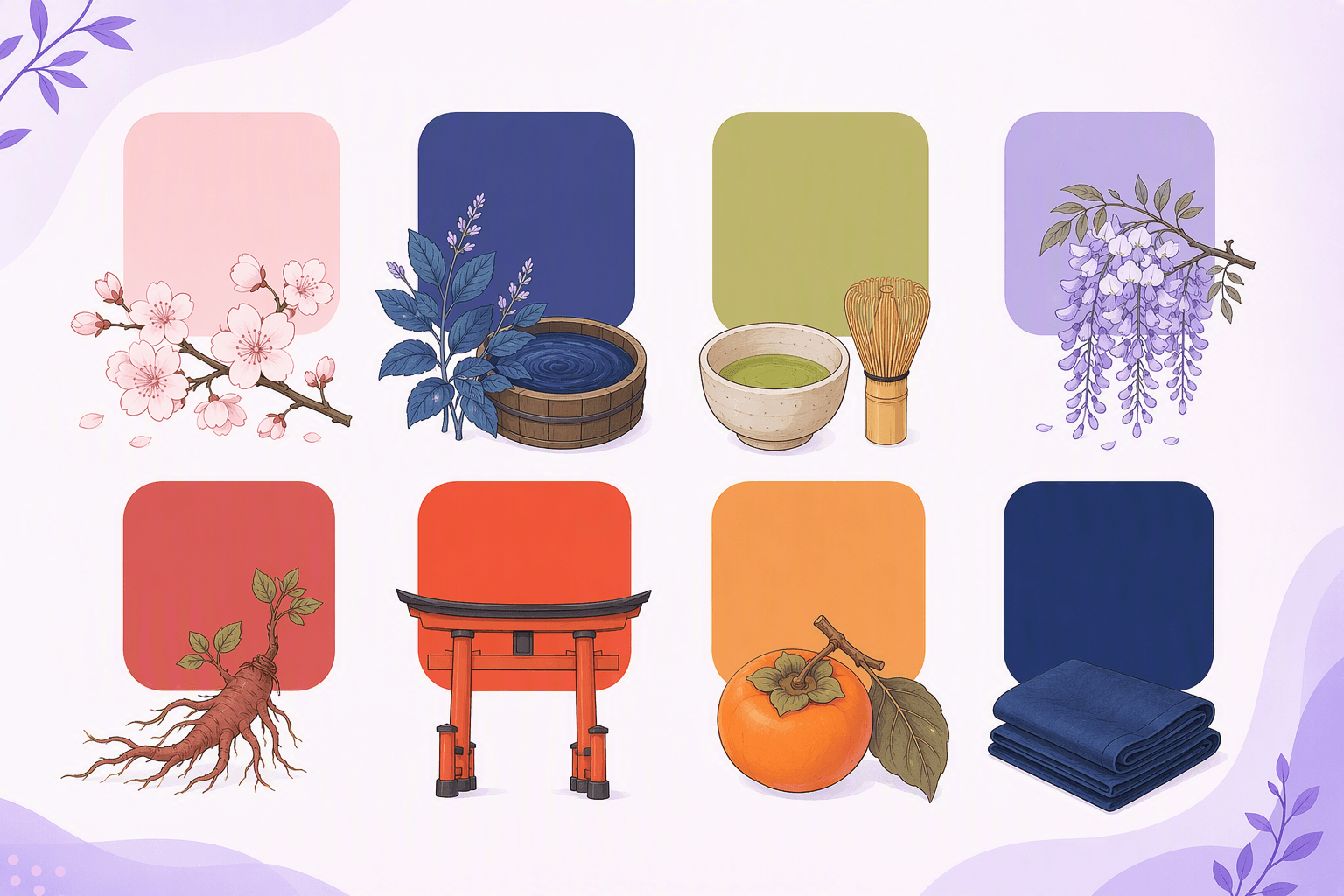
| English | Japanese | Pronunciation | Note |
|---|---|---|---|
| Cherry blossom pink | 桜色 / さくらいろ | sah-koo-rah-ee-roh | Spring. Pale pink |
| Indigo | 藍色 / あいいろ | ah-ee-ee-roh | Japan's iconic dye color |
| Matcha green | 抹茶色 / まっちゃいろ | maht-chah-ee-roh | Muted yellow-green |
| Wisteria purple | 藤色 / ふじいろ | foo-jee-ee-roh | Light purple. Noble families |
| Madder red | 茜色 / あかねいろ | ah-kah-neh-ee-roh | Sunset red. Ancient dye |
| Deep purple | 紫 / むらさき | moo-rah-sah-kee | Imperial color since Nara era |
| Vermillion | 朱色 / しゅいろ | shoo-ee-roh | Torii gate color |
| Navy blue | 紺 / こん | kohn | School uniform color |
| Persimmon | 柿色 / かきいろ | kah-kee-ee-roh | Autumn. Warm orange |
| Plum | 梅色 / うめいろ | oo-meh-ee-roh | Dark pink-red. Winter |
藍 (あい): Japan's Signature Color
Indigo dyeing (藍染め, aizome) holds a special place in Japanese textile history. The deep blue produced from the indigo plant became so associated with Japan that foreigners in the Meiji era called it "Japan Blue." Samurai wore indigo-dyed undergarments because the plant was believed to have antiseptic and healing properties. Today, 藍色 remains one of the most recognized traditional Japanese colors and is experiencing a revival in artisanal fashion and design.
Seasonal Color Associations
Traditional Japanese aesthetics deeply connect colors to seasons. This principle, rooted in the concept of 季節感 (kisetsukan, seasonal awareness), governs everything from kimono selection to wagashi (traditional sweets) to interior design:
| Season | Associated Colors | Examples |
|---|---|---|
| Spring (春) | Pale pink, light green, white | 桜色, 若草色 (wakakusa-iro, young grass) |
| Summer (夏) | Vivid blue, deep green, white | 藍色, 深緑 (fukamidori, deep green) |
| Autumn (秋) | Red, orange, gold, brown | 茜色, 柿色, 紅葉色 (momiji-iro) |
| Winter (冬) | White, gray, dark purple, silver | 銀色, 紺, 梅色 |
"The Japanese traditional color vocabulary is among the most extensive of any language, with over 450 documented named colors. This richness reflects a culture that has historically placed extraordinary value on subtle chromatic distinctions, particularly in the context of seasonal aesthetics and textile arts."
(National Institute for Japanese Language and Linguistics, NINJAL)
Color Symbolism in Japanese Culture
Colors in Japan carry meanings that differ significantly from Western associations. Understanding these can prevent misunderstandings and deepen your appreciation of Japanese art, fashion, and daily life.
赤 (Red): Vitality and Protection. Red torii gates, red daruma dolls, red envelopes at celebrations. Red wards off evil spirits in Shinto belief. Babies' first shrine visit often involves red accessories. However, writing someone's name in red ink is taboo because it is associated with death, as tombstone engravings were historically painted red.
白 (White): Purity, Sacredness, and Death. White is the color of Shinto purity rituals, wedding kimono, and also funeral attire. This dual meaning (celebration and mourning) can confuse learners expecting Western associations. In sumo, the white corner (白房, shirobusa) represents autumn and the west.
黒 (Black): Formality and Sophistication. Black carries none of the negative connotations it sometimes has in English. It represents elegance, authority, and power. Black belt (黒帯, kuroobi) in martial arts, black business suits, and formal black kimono for men all reflect this positive association.
紫 (Purple): Imperial Nobility. Since the Nara period (710-794), purple has been associated with the highest ranks of the imperial court. The Twelve Level Cap and Rank System designated purple for the most senior officials. Even today, 紫 retains an aura of nobility and spiritual refinement.
金 (Gold): Wealth and the Divine. Gold leaf adorns temple pavilions (most famously 金閣寺, Kinkaku-ji), Buddhist statues, and lacquerware. Gold represents both material prosperity and spiritual illumination in Japanese aesthetics.
🌍 Never Write Names in Red Ink
In Japan, writing a living person's name in red ink (赤い字で名前を書く) is a serious cultural taboo. Red ink on names is reserved for the deceased; tombstones and memorial registers use red characters. Handing someone a document with their name written in red can be genuinely upsetting. Always use black or blue ink for names.
Colors in Everyday Japanese Phrases
Color words appear in many common Japanese expressions and compound words. Learning these helps you recognize colors in context beyond simple description:
- 青信号 / あおしんごう (ao shingou): green traffic light (literally "blue signal")
- 赤ちゃん / あかちゃん (akachan): baby (literally "red one")
- 白黒つける / しろくろつける (shirokuro tsukeru): to settle something definitively (literally "to assign black and white")
- 赤字 / あかじ (akaji): financial deficit (literally "red letters")
- 黒字 / くろじ (kuroji): financial surplus (literally "black letters")
- 腹黒い / はらぐろい (haraguroi): scheming, malicious (literally "black-bellied")
- 真っ青になる / まっさおになる (massao ni naru): to turn pale with shock (literally "to become deep blue")
- 灰色 / はいいろ (haiiro): gray area, ambiguous (when used figuratively)
These expressions appear constantly in Japanese movies and anime, making them excellent vocabulary to recognize during immersive viewing.
Practice Japanese Colors With Real Content
Structured vocabulary tables give you the foundation, but encountering colors in authentic Japanese content is what makes them stick. Japanese animation, drama, and film are rich with color vocabulary, from characters describing outfits to nature scenes to cultural discussions.
Wordy lets you watch Japanese content with interactive subtitles. When a color word appears in dialogue, tap it to see the kanji, reading, and meaning in context. Instead of drilling isolated vocabulary, you absorb 赤い, 青い, and 白い naturally as native speakers actually use them.
Browse our blog for more Japanese vocabulary guides, or check out the best movies to learn Japanese for viewing recommendations that bring these color words to life.
Frequently Asked Questions
What are the basic colors in Japanese?
Why does 青 (ao) mean both blue and green in Japanese?
How do you use colors grammatically in Japanese?
What are 和色 (wairo) traditional Japanese colors?
What do colors symbolize in Japanese culture?
Why are many color words in katakana?
Sources & References
- Agency for Cultural Affairs (文化庁), Survey on the Japanese Language, 2024
- National Institute for Japanese Language and Linguistics (NINJAL), Historical Color Term Research
- Ethnologue: Languages of the World, 27th edition (2024), Japanese language entry
- Crystal, D., The Cambridge Encyclopedia of Language, 4th edition (Cambridge University Press)
- NHK Broadcasting Culture Research Institute, Standard Japanese Pronunciation Guide
Start learning with Wordy
Watch real movie clips and build your vocabulary as you go. Free to download.


