Advanced Italian Food Vocabulary: 120+ Real Words for Menus, Markets, and Cooking
Quick Answer
Advanced Italian food vocabulary goes beyond pasta and pizza: you need menu categories (antipasti, primi, secondi), ingredient words (legumi, frattaglie), cooking methods (stufare, rosolare), and market terms (al banco, a peso). This list gives you 120+ high-utility words with pronunciation and notes so you can order confidently, shop at markets, and understand Italian cooking talk.
If you want advanced Italian food vocabulary, focus on the words Italians actually use to read menus, shop at markets, and talk about cooking techniques, not just the names of famous dishes. This guide gives you 120+ high-utility terms with pronunciation and short notes so you can decode real restaurant language and ingredient lists quickly.
Italian is spoken by roughly 67 million people worldwide (Ethnologue, 27th edition, 2024), and food is one of the fastest ways to turn passive vocabulary into confident speaking. When you can say rosolare instead of “cook,” or recognize frattaglie on a menu, you stop guessing and start choosing.
If you are building everyday conversation too, pair this with how to say hello in Italian and how to say goodbye in Italian so you can handle the full interaction, not just the ordering.
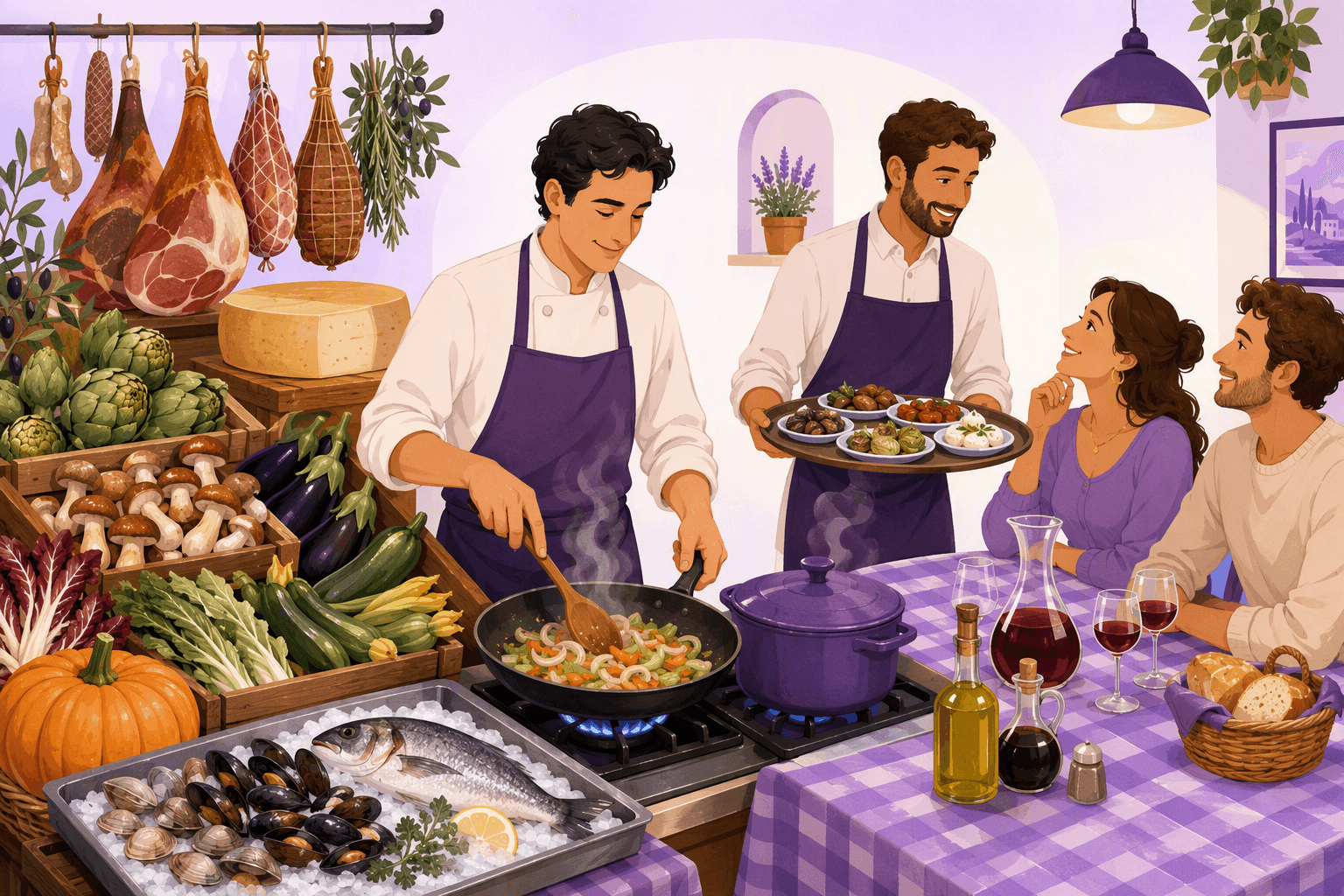
Quick reference: 120+ advanced Italian food words
| English | Italian | Pronunciation | Note |
|---|---|---|---|
| Menu: starters section | antipasti | ahn-tee-PAH-stee | Often small plates, cured meats, vegetables. |
| Menu: first courses | primi | PREE-mee | Pasta, risotto, soup. |
| Menu: main courses | secondi | seh-KOHN-dee | Meat, fish, eggs, cheese. |
| Menu: side dishes | contorni | kohn-TOR-nee | Vegetable sides, potatoes. |
| Menu: desserts | dolci | DOL-chee | Dessert section. |
| Set menu | menù degustazione | meh-NOO deh-goo-stah-TSYOH-neh | Tasting menu. |
| Daily specials | fuori menù | FWOR-ee meh-NOO | Not on the printed menu. |
| House specialty | specialità della casa | speh-chah-lee-TAH DEHL-lah KAH-zah | Often worth asking about. |
| Seasonal | stagionale | stah-joh-NAH-leh | Seasonal ingredients. |
| Local sourcing label | a km zero | ah kee-LOH-meh-troh DZEH-roh | Local supply chain marker. |
| Appetizer (generic) | stuzzichino | stoot-tsee-KEE-noh | Small bite, often with drinks. |
| Cured meats (category) | salumi | sah-LOO-mee | Prosciutto, salame, etc. |
| Cheese board | tagliere di formaggi | tahl-YEH-reh dee for-MAHD-jee | Often mixed regional cheeses. |
| Cured meat board | tagliere di salumi | tahl-YEH-reh dee sah-LOO-mee | Common antipasto. |
| Pickled vegetables | sottaceti | soht-tah-CHEH-tee | Often served with boards. |
| Preserved in oil | sott'olio | soht-TOH-lyoh | Vegetables, tuna, mushrooms. |
| Bruschetta | bruschetta | broo-SKEHT-tah | The 'sch' is a hard K sound. |
| Fried mixed bites | fritto misto | FREE-toh MEE-stoh | Seafood or vegetables. |
| Stuffed | ripieno | ree-PYEH-noh | Also 'ripieni' plural. |
| Battered | in pastella | een pah-STEL-lah | Light batter before frying. |
| Legumes | legumi | leh-GOO-mee | Beans, lentils, chickpeas. |
| Lentils | lenticchie | lehn-TEE-kyeh | Common in winter dishes. |
| Chickpeas | ceci | CHEH-chee | Also used in soups and flour. |
| Beans | fagioli | fah-JOH-lee | Many regional varieties. |
| Spelt | farro | FAHR-roh | Grain used in salads and soups. |
| Barley | orzo | OR-tsoh | Also means 'barley' and appears in soups. |
| Polenta | polenta | poh-LEHN-tah | Cornmeal dish, north especially. |
| Broth | brodo | BROH-doh | Meat, vegetable, fish broths. |
| Stock cube | dado | DAH-doh | Bouillon cube. |
| Soup (thick) | minestra | mee-NEH-strah | Often vegetable-based. |
| Seafood (category) | frutti di mare | FROOT-tee dee MAH-reh | Literally 'fruits of the sea'. |
| Shellfish | crostacei | kroh-stah-CHAY-ee | Shrimp, crab, etc. |
| Mollusks | molluschi | moh-LOO-skee | Clams, mussels, squid. |
| Clams | vongole | VOHN-goh-leh | Often with pasta. |
| Mussels | cozze | KOT-tseh | Common in southern coastal cooking. |
| Squid | calamari | kah-lah-MAH-ree | Fried or stewed. |
| Octopus | polpo | POL-poh | Often grilled or in salad. |
| Anchovies | acciughe | ah-CHOO-gheh | Salted or fresh. |
| Cod (salted) | baccalà | bahk-kah-LAH | Salted cod, many regional recipes. |
| Cod (dried) | stoccafisso | stohk-kah-FEES-soh | Dried cod, distinct from baccalà. |
| Offal (category) | frattaglie | fraht-TAHL-yeh | Organ meats, traditional dishes. |
| Tripe | trippa | TREEP-pah | Classic in central Italy. |
| Sweetbreads | animelle | ah-nee-MEHL-leh | Often in fine dining. |
| Liver | fegato | feh-GAH-toh | Often with onions. |
| Sausage | salsiccia | sahl-SEE-chah | Fresh sausage, many styles. |
| Cured sausage | salame | sah-LAH-meh | Sliced, served as salumi. |
| Cured ham | prosciutto | proh-SHOOT-toh | Crudo vs cotto. |
| Raw-cured ham | prosciutto crudo | proh-SHOOT-toh KROO-doh | Uncooked, cured. |
| Cooked ham | prosciutto cotto | proh-SHOOT-toh KOT-toh | Cooked, milder. |
| Meatballs | polpette | pol-PEHT-teh | Not always served with spaghetti in Italy. |
| Mushrooms | funghi | FOON-ghee | Porcini are especially prized. |
| Porcini mushrooms | porcini | por-CHEE-nee | Often in risotto and sauces. |
| Truffle | tartufo | tahr-TOO-foh | White and black varieties. |
| Artichokes | carciofi | kahr-CHOH-fee | Roman dishes are famous. |
| Zucchini | zucchine | dzoo-KEE-neh | Plural is common for the vegetable. |
| Eggplant | melanzana | meh-lahn-TSAH-nah | Southern staple. |
| Leafy greens (generic) | verdure | vehr-DOO-reh | Vegetables in general, often cooked greens. |
| Chard | bietole | BYEH-toh-leh | Often sautéed. |
| Chicory/greens | cicoria | chee-KOH-ryah | Bitter greens. |
| Pumpkin/squash | zucca | DZOOK-kah | Also used in ravioli fillings. |
| Flour | farina | fah-REE-nah | 00 flour is common for pasta and pizza. |
| Breadcrumbs | pangrattato | pahn-graht-TAH-toh | Used for topping and binding. |
| Yeast | lievito | lyeh-VEE-toh | For bread, pizza, cakes. |
| Baking powder | lievito per dolci | lyeh-VEE-toh pehr DOL-chee | Chemical leavening. |
| Dough | impasto | eem-PAH-stoh | Bread, pizza, pasta dough. |
| Sourdough starter | lievito madre | lyeh-VEE-toh MAH-dreh | Traditional starter culture. |
| Knead | impastare | eem-pah-STAH-reh | To knead, to mix into dough. |
| Roll out (dough) | stendere | STEHN-deh-reh | To roll out, spread. |
| Pastry | pasta frolla | PAH-stah FROL-lah | Shortcrust pastry. |
| Custard | crema pasticcera | KREH-mah pah-stee-CHAY-rah | Classic dessert cream. |
| Extra virgin olive oil | olio extravergine d'oliva | OH-lyoh ehk-strah-VEHR-jee-neh doh-LEE-vah | Often abbreviated as EVO. |
| Vinegar | aceto | ah-CHEH-toh | Balsamic is 'aceto balsamico'. |
| Balsamic vinegar | aceto balsamico | ah-CHEH-toh bahl-SAH-mee-koh | Often from Modena area. |
| Salt | sale | SAH-leh | Also used in 'salare' to salt. |
| Pepper | pepe | PEH-peh | Black pepper is 'pepe nero'. |
| Garlic | aglio | AHL-lyoh | Key base flavor. |
| Onion | cipolla | chee-POL-lah | Often in soffritto. |
| Celery | sedano | seh-DAH-noh | Soffritto trio. |
| Carrot | carota | kah-ROH-tah | Soffritto trio. |
| Soffritto base | soffritto | sof-FREET-toh | Gently cooked aromatics. |
| To brown (lightly) | rosolare | roh-zoh-LAH-reh | Often before simmering. |
| To sauté | saltare | sahl-TAH-reh | Quick toss in pan. |
| To simmer/stew | stufare | stoo-FAH-reh | Low, slow cooking. |
| Stew (noun) | stufato | stoo-FAH-toh | The dish itself. |
| To boil | bollire | bohl-LEE-reh | Pasta, vegetables. |
| To bake/roast | cuocere al forno | KWOH-cheh-reh ahl FOR-noh | Oven cooking. |
| Grilled | alla griglia | AHL-lah GREE-lyah | Grill, often meat or vegetables. |
| Fried | fritto | FREE-toh | Also 'frittura' as a category. |
| Steamed | al vapore | ahl vah-POH-reh | Light cooking method. |
| To season | condire | kohn-DEE-reh | Dress pasta, salads, etc. |
| Rare (meat) | al sangue | ahl SAHN-gweh | Literally 'to the blood'. |
| Medium | a cottura media | ah koh-TTOO-rah MEH-dyah | Useful if asked doneness. |
| Well done | ben cotto | behn KOT-toh | For meat, also baked items. |
| Without | senza | SEHN-tsah | Key for allergies and preferences. |
| Allergy | allergia | ahl-lehr-JEE-ah | Also 'sono allergico/a'. |
| Intolerance | intolleranza | een-tohl-leh-RAHN-tsah | Common on menus. |
| Gluten-free | senza glutine | SEHN-tsah GLOO-tee-neh | Often marked 'SG'. |
| Lactose-free | senza lattosio | SEHN-tsah laht-TOH-zyoh | Useful for dairy intolerance. |
| Vegetarian | vegetariano | veh-jeh-tah-RYAH-noh | Feminine: vegetariana. |
| Vegan | vegano | veh-GAH-noh | Feminine: vegana. |
| Market stall | banco | BAHN-koh | At the counter or stall. |
| By weight | a peso | ah PEH-zoh | Sold by weight. |
| Slice (noun) | fetta | FEHT-tah | A slice of ham, cheese, cake. |
| A little (food amount) | un po' | oon POH | Very common at markets. |
| Fresh | fresco | FREHS-koh | Feminine: fresca. |
| Frozen | surgelato | soor-jeh-LAH-toh | Common in supermarkets. |
| Homemade | fatto in casa | FAHT-toh een KAH-zah | Restaurant signal for house-made. |
| Artisanal | artigianale | ahr-tee-jah-NAH-leh | Often used for gelato, bread. |
| Protected designation (PDO) | DOP | dee-oh-PEE | Denominazione di Origine Protetta. |
| Protected indication (PGI) | IGP | ee-jee-PEE | Indicazione Geografica Protetta. |
| Dessert spoon | cucchiaino | kook-kyah-EE-noh | Also for coffee. |
| Fork | forchetta | for-KEHT-tah | Basic table item. |
| Knife | coltello | kol-TEHL-loh | Basic table item. |
| Glass (drinking) | bicchiere | beek-KYEH-reh | Water, wine. |
| Carafe | caraffa | kah-RAHF-fah | Often for house wine or water. |
| Sparkling water | acqua frizzante | AHK-kwah freet-TSAHN-teh | Still is 'naturale'. |
| Still water | acqua naturale | AHK-kwah nah-too-RAH-leh | Non-sparkling. |
| House wine | vino della casa | VEE-noh DEHL-lah KAH-zah | Often served by the glass or carafe. |
| To toast (verb) | brindare | breen-DAH-reh | To make a toast. |
| Cheers! | cin cin | cheen CHEEN | Common casual toast. |
How Italians organize food talk (so menus stop feeling random)
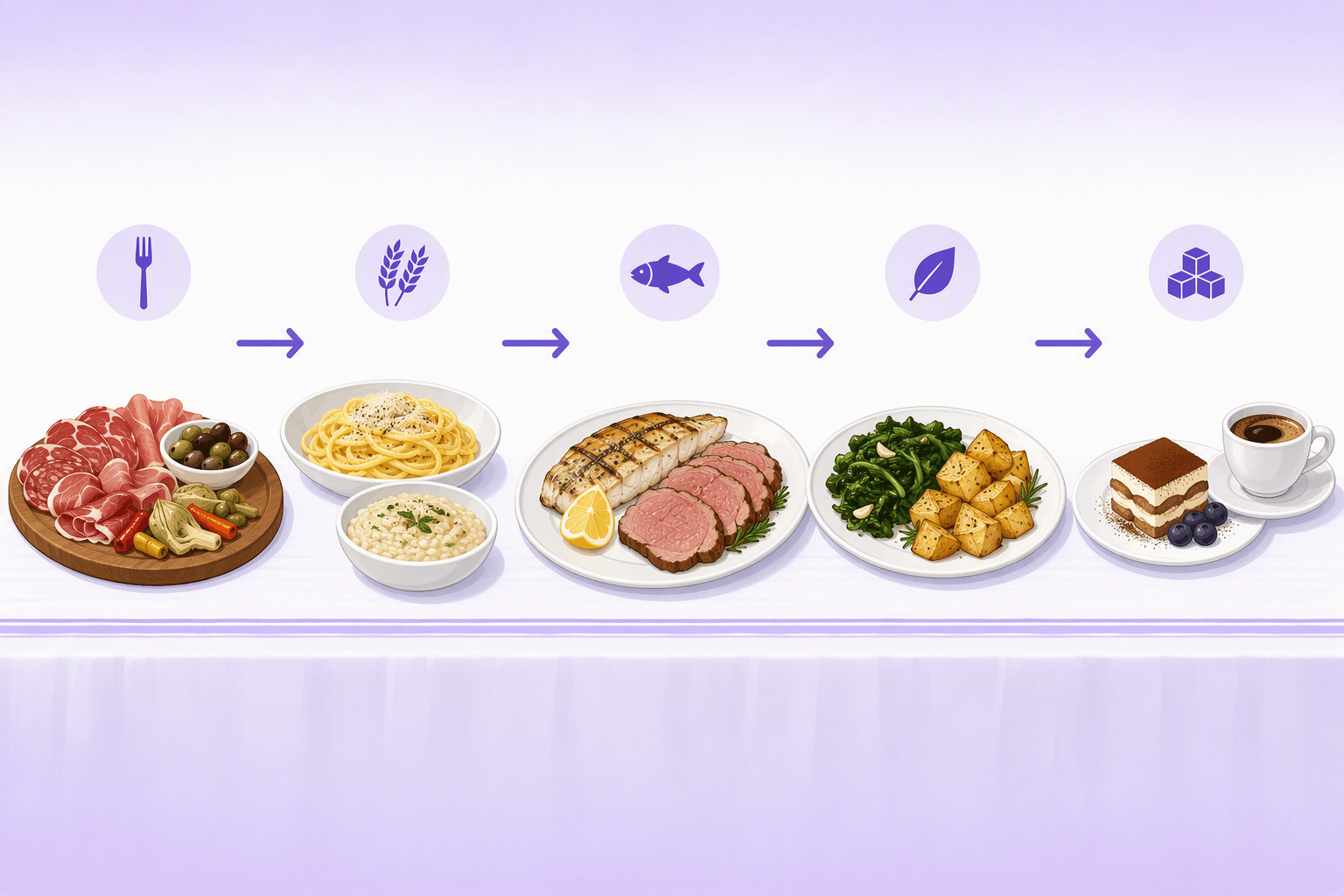
Italian menu vocabulary is structured, and once you learn the structure, you read faster than you translate. The classic sequence is antipasti, primi, secondi, contorni, dolci.
This is not just restaurant tradition, it reflects how Italians often conceptualize a meal as a progression of roles: a starter, a starch-centered course, then a protein-centered course. If you only want one plate, ordering a primo or a secondo is normal.
🌍 Why 'primi' matters more than 'pasta'
In English, learners often search for “Italian pasta words,” but in Italy the category label primi is the real shortcut. Once you recognize it, you can predict what kind of dish you are about to order even if you do not know every ingredient.
Ingredients that show up on real menus (and what they imply)
frattaglie
Frattaglie /fratˈtaʎʎe/ is the umbrella term for offal, and it signals traditional cooking rather than tourist-friendly “safe” choices. If you see trippa /ˈtrip.pa/ or fegato /feˈɡa.to/, expect bold flavors and older regional recipes.
Treccani’s dictionary entries are useful here because they often clarify whether a word is a broad category or a specific cut (Treccani, accessed 2026). That distinction matters when you are ordering.
frutti di mare
Frutti di mare /ˈfrut.ti di ˈma.re/ is a set phrase, and it often includes both shellfish and mollusks. If you are allergic, do not rely on “fish” as a category, ask directly and use senza /ˈsɛn.tsa/ plus the ingredient.
If you want a safer, more specific choice, look for single-ingredient labels like vongole /ˈvɔŋ.ɡo.le/ or calamari /kalaˈma.ri/.
funghi
Funghi /ˈfuŋ.ɡi/ is common, but porcini /porˈtʃi.ni/ and tartufo /tarˈtu.fo/ carry social meaning. They often signal seasonality, higher price, and a region’s identity.
Accademia della Crusca’s language notes are helpful for usage and register, especially when a term is widely used but can be imprecise in casual speech (Accademia della Crusca, accessed 2026).
Cooking methods: the verbs Italians actually say
A lot of learners know dish names but cannot follow a cooking explanation. The verbs in the table are the ones you hear in kitchens, cooking shows, and family talk.
rosolare
Rosolare /rozoˈla.re/ means to brown lightly, usually in oil, to build flavor before a longer cook. If a recipe says rosolare la cipolla, it is telling you to develop sweetness and aroma, not to fry aggressively.
stufare
Stufare /stuˈfa.re/ is low-and-slow simmering or stewing, often with a lid. If you see stufato /stuˈfa.to/ on a menu, expect tender textures and sauce, not a grilled presentation.
condire
Condire /konˈdi.re/ is broader than “season.” It often means to dress or finish, especially pasta and salads, where the sauce or dressing is the key identity of the dish.
💡 A fast menu decoding rule
If you can spot method plus main ingredient, you can guess the dish. Example: al forno (oven) plus verdure (vegetables) usually means roasted vegetables, even if you do not recognize every item listed.
Market and deli vocabulary: ordering like a local
Italian food vocabulary becomes practical when you can use it at a counter. Words like a peso /a ˈpe.zo/ and fetta /ˈfet.ta/ are small, but they unlock real interactions.
A typical request is: Un po' di prosciutto, due fette, per favore. You do not need perfect grammar, but you do need the units and the politeness markers.
If you want to keep your social tone natural, learn a few everyday softeners from how to say hello in Italian. In Italy, the greeting plus the request often matters as much as the request itself.
Labels you will see in Italy: DOP, IGP, and why they matter
You will see DOP and IGP on menus, packaging, and shop signs. They are not just marketing, they are part of how Italians talk about provenance and quality.
Italy has one of the largest sets of protected food products in the EU system, and the acronyms are used in everyday consumer language. The Italian agriculture ministry’s pages explain the framework and terminology (Ministero dell'agricoltura, accessed 2026).
🌍 Food vocabulary is also identity vocabulary
In many Italian regions, naming the product correctly is a form of respect. Using the right term for a cheese, a cured meat, or a protected label signals that you understand the local standard, even if your accent is not perfect.
Pronunciation traps that change meaning
Italian spelling is more consistent than English, but a few food words trip learners up.
bruschetta
Bruschetta /brusˈket.ta/ has a hard K sound because of sch. Saying it with a “sh” sound is a common tourist marker, and Italians will still understand you, but it is easy to fix.
gli
Words like aglio /ˈaʎ.ʎo/ contain the gli sound, which is not the same as English “lee.” You do not need perfection, but aim for a smooth palatal sound rather than a hard L plus Y.
If pronunciation is a main goal, practicing with short clips helps more than isolated word lists. That is also why video-based listening works well for food scenes, you hear the same verbs and ingredients repeated naturally. For more on that method, see how to learn a language with movies.
How to learn this vocabulary fast (without memorizing 120 words blindly)
Pick one context for a week: menus, markets, or cooking videos. Then recycle the same 20 to 30 words until they become automatic.
Paul Nation’s work on vocabulary learning emphasizes that repeated meaningful encounters matter more than one-time exposure. For food vocabulary, “meaningful” is easy to create: order with the word, shop with the word, or hear it in a scene where the item is visible.
⚠️ Do not overgeneralize dish stereotypes
Some “Italian food rules” online are US-Italian habits, not Italy. For example, polpette exist in Italy, but the spaghetti-and-meatballs pairing is not the default. Treat vocabulary as observation-based: learn what you see and hear in Italian contexts.
If you want more everyday Italian beyond food, keep your study balanced with relationship language too, for example how to say I love you in Italian. Food talk is social talk in Italy, and you will use both in the same conversations.
A note on register: when food words sound formal, rustic, or fancy
Some words are neutral (funghi, olio), some sound rustic or traditional (frattaglie, trippa), and some sound upscale (tartufo, animelle). That register shift is part of why this vocabulary is useful: it helps you read the “tone” of a restaurant.
Linguist Tullio De Mauro wrote extensively about Italian usage and the gap between formal and everyday registers. Food is a domain where those registers meet, because menus can be poetic while the waiter speaks casually.
Practice idea with TV and movies (the Wordy way)
Choose one clip where someone orders, cooks, or shops. Write down only the verbs and the ingredient nouns you hear, then rewatch until you can predict them.
If you want a structured way to do that, Wordy is built around short, repeatable scenes, which makes vocabulary like condire and rosolare stick faster than a single long episode. For more tools, browse the blog index and compare approaches like Anki for language learning.
And if your Italian learning includes the full emotional range of real dialogue, be aware that food scenes can include strong language too. Our Italian swear words guide helps you recognize what you hear without copying it blindly.
Frequently Asked Questions
What are the main sections of an Italian menu?
What is the difference between 'primo' and 'secondo' in Italy?
Why do Italian ingredient words vary by region?
How can I understand Italian menus faster without translating every word?
What does 'a km zero' mean on Italian menus?
Sources & References
- Accademia della Crusca, consulenze linguistiche (food and usage notes), accessed 2026
- Treccani, Vocabolario online (definitions and usage), accessed 2026
- Gambero Rosso, Italian food and product guides (menu and ingredient terminology), accessed 2026
- Ethnologue: Languages of the World, Italian language entry (27th edition, 2024)
- Ministero dell'agricoltura, della sovranità alimentare e delle foreste (Italy), PDO/PGI product framework pages, accessed 2026
Start learning with Wordy
Watch real movie clips and build your vocabulary as you go. Free to download.


