Quick Answer
Italian fashion vocabulary includes everyday words such as vestito for dress, scarpe for shoes, and elegante for elegant, plus essential phrases for shopping and describing personal style. Learn these words with pronunciation so you can understand Italian fashion conversations, labels, and store staff.
Italian fashion vocabulary starts with practical words like vestito /veˈstiːto/ for a dress or outfit, scarpe /ˈskarpe/ for shoes, camicia /kaˈmiːtʃa/ for a shirt, and elegante /eleˈɡante/ for elegant. Learn the words below and you will be able to shop in Italian, describe what someone is wearing, and follow fashion dialogue in films set in Milan, Rome, or Florence.
Italian is spoken by roughly 68 million first-language speakers, according to Ethnologue, and is an official language in Italy, San Marino, Switzerland, and Vatican City. That reach matters for fashion learners: the vocabulary changes slightly by region, but the core words below work throughout the Italian-speaking world.
For everyday greetings before entering a boutique, see our guide to saying hello in Italian. A confident buongiorno /bwɔnˈdʒorno/ and a few shopping phrases go a long way.
| English | Italian | Pronunciation | Note |
|---|---|---|---|
| T-shirt | la maglietta | mahl-LYEHT-tah | A casual short-sleeved top. |
| shirt | la camicia | kah-MEE-chah | Usually a button-up shirt. |
| blouse | la camicetta | kah-mee-CHET-tah | A lighter or more feminine shirt. |
| dress | il vestito | veh-STEE-toh | Can also mean an outfit or suit depending on context. |
| skirt | la gonna | GOHN-nah | The doubled n is held slightly longer. |
| trousers | i pantaloni | pahn-tah-LOH-nee | Normally plural in Italian. |
| jeans | i jeans | jeens | Usually pronounced similarly to English. |
| shorts | i pantaloncini | pahn-tah-lohn-CHEE-nee | Literally small trousers. |
| jacket | la giacca | JAHK-kah | The cc is pronounced as a doubled k sound. |
| coat | il cappotto | kah-POT-toh | A warm outer coat. |
| sweater | il maglione | mahl-YOH-neh | A heavier knit sweater. |
| hoodie | la felpa con cappuccio | FEHL-pah kohn kah-POOT-choh | Literally sweatshirt with hood. |
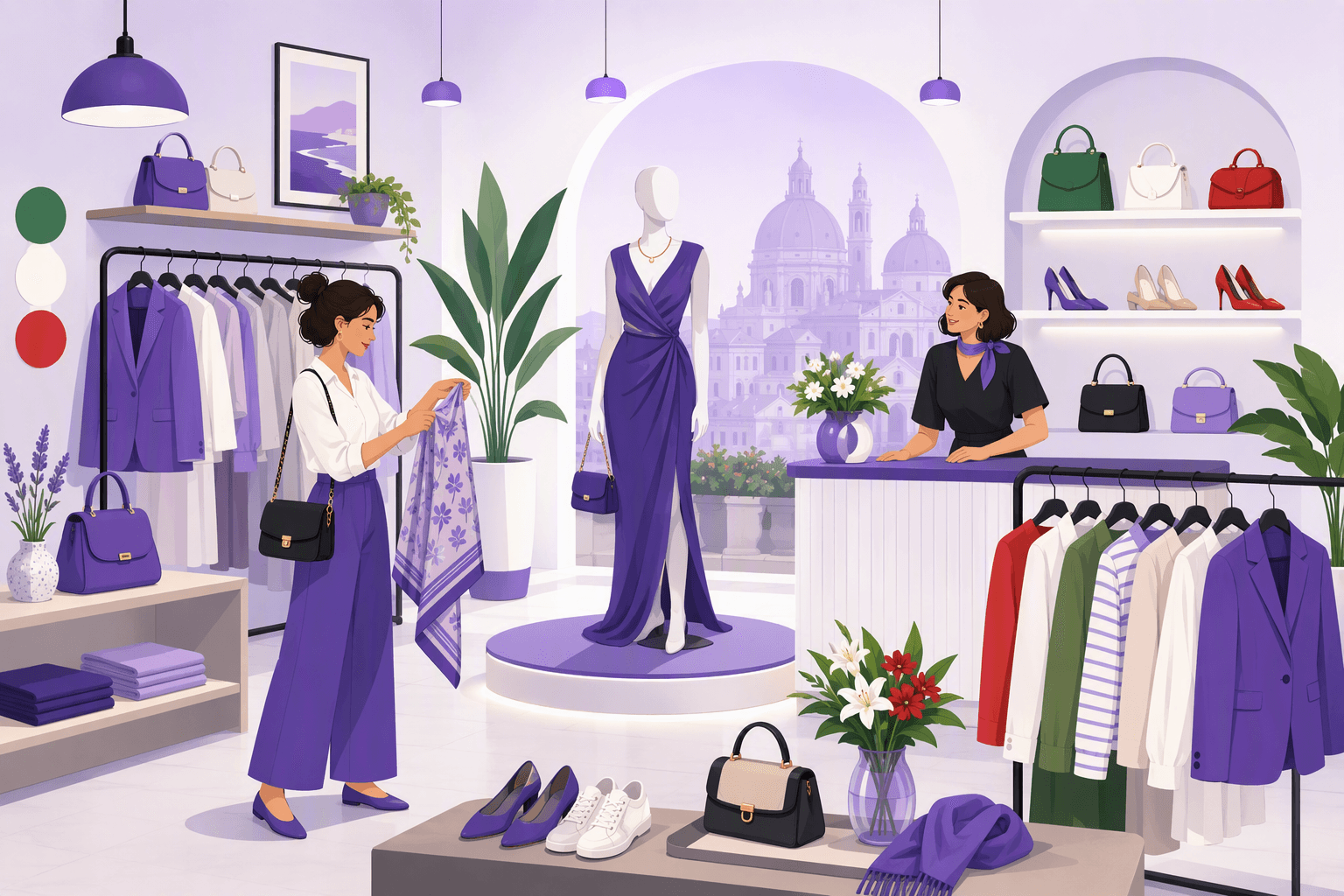
Essential Italian clothing words
Italian distinguishes abito /ˈaːbito/ and vestito /veˈstiːto/ in ways that can confuse learners. Both can mean dress, clothing, or outfit depending on context, but abito often sounds more formal and can refer to a suit, while vestito is a reliable everyday choice for a dress or an item of clothing.
The dictionary published by Treccani records this broad use of abito /ˈaːbito/, from a garment to a formal suit. In a shop, context usually removes ambiguity. If someone points to a rack of women’s dresses and says Che bel vestito! /ke bɛl veˈstiːto/, they mean “What a beautiful dress!”
Gender and agreement in clothing descriptions
Italian adjectives agree with the noun they describe. This is not optional decoration: it is one of the signals that makes a sentence sound complete and natural.
| Noun | Meaning | Correct description |
|---|---|---|
| la camicia /la kaˈmiːtʃa/ | shirt | bianca /ˈbjaŋka/, white |
| la gonna /la ˈɡɔnna/ | skirt | lunga /ˈluŋɡa/, long |
| il cappotto /il kapˈpɔtto/ | coat | nero /ˈneːro/, black |
| il maglione /il maʎˈʎoːne/ | sweater | comodo /ˈkɔmodo/, comfortable |
| i pantaloni /i pantaˈloːni/ | trousers | larghi /ˈlarɡi/, loose |
The ending often changes from -o /o/ to -a /a/ for singular masculine and feminine nouns. In the plural, -o commonly becomes -i /i/, while -a becomes -e /e/.
This pattern helps you understand signs, product descriptions, and dialogue. If a character says una giacca nera /una ˈdʒakka ˈneːra/, every word points to a feminine singular jacket.
Shoes, accessories, and fabrics
| English | Italian | Pronunciation | Note |
|---|---|---|---|
| shoes | le scarpe | SKAHR-peh | Always feminine plural in normal use. |
| boots | gli stivali | lyee stee-VAH-lee | Use gli before the plural noun. |
| heels | i tacchi | TAHK-kee | Often used for high heels. |
| sneakers | le scarpe da ginnastica | SKAHR-peh dah jeen-NAHS-tee-kah | Literally gym shoes. |
| bag | la borsa | BOR-sah | Handbag or bag. |
| belt | la cintura | cheen-TOO-rah | A belt worn at the waist. |
| hat | il cappello | kah-PEHL-loh | The ll is held longer. |
| scarf | la sciarpa | SHAHR-pah | Useful in both fashion and cold-weather contexts. |
| sunglasses | gli occhiali da sole | lyee ohk-KYAH-lee dah SOH-leh | Literally glasses for sun. |
| jewelry | i gioielli | joh-YEHL-lee | Usually plural. |
| leather | la pelle | PEHL-leh | Also means skin. |
| silk | la seta | SEH-tah | A common luxury-material word. |
The word borsa /ˈbɔrsa/ is a good example of context-driven vocabulary. It can be a handbag, a shopping bag, or a larger bag. To specify a handbag, you may hear borsa a mano /ˈbɔrsa a ˈmaːno/, literally “bag in hand.”
For fabrics, cotone /koˈtoːne/ means cotton, lana /ˈlaːna/ means wool, and lino /ˈliːno/ means linen. On a label, pelle vera /ˈpɛlle ˈveːra/ means genuine leather, while pelle sintetica /ˈpɛlle sinˈtɛːtika/ means synthetic leather.
💡 Watch the article before shoe words
Italian uses le scarpe /le ˈskarpe/ for shoes and gli stivali /ʎi stiˈvaːli/ for boots. The different articles are grammatical, not a distinction in formality. Learn each clothing item together with its article.
Style words Italians actually use
Fashion vocabulary is not limited to garments. You also need adjectives that describe fit, formality, color, and overall impression.
| English | Italian | Pronunciation | Note |
|---|---|---|---|
| elegant | elegante | eh-leh-GAHN-teh | Same form for masculine and feminine singular. |
| casual | casual | KAH-zhoo-ahl | A common English borrowing in Italian fashion talk. |
| fashionable | alla moda | AHL-lah MOH-dah | Literally in fashion. |
| stylish | alla moda | AHL-lah MOH-dah | A natural way to say stylish or on-trend. |
| comfortable | comodo | KOH-moh-doh | Changes to comoda for a feminine singular noun. |
| tight | stretto | STREHT-toh | Changes to stretta for a feminine singular noun. |
| loose | largo | LAHR-goh | Can describe a roomy fit. |
| expensive | costoso | koh-STOH-zoh | Changes to costosa for feminine singular. |
| cheap | economico | eh-koh-NOH-mee-koh | Neutral word for affordable, not necessarily low quality. |
| vintage | vintage | VEEN-tahj | An established loanword in Italian. |
| patterned | a fantasia | ah fahn-tah-ZEE-ah | Used for prints and patterns. |
| plain | tinta unita | TEEN-tah oo-NEE-tah | A single solid color. |
Alla moda /alla ˈmɔːda/ is more idiomatic than translating “fashionable” word for word. You can say Questa giacca è alla moda /ˈkwesta ˈdʒakka ɛ alla ˈmɔːda/, meaning “This jacket is fashionable.”
To praise someone’s appearance, Sei elegante /sɛi eleˈɡante/ is direct and appropriate in many settings. For a warmer compliment, Ti sta benissimo /ti sta beˈnissimo/ means “It looks great on you.” The verb structure is useful: the item is the grammatical subject, so it literally means “It suits you very well.”
Shopping phrases for an Italian boutique
In Italy, greetings matter in smaller independent shops. Say buongiorno /bwɔnˈdʒorno/ when entering, then browse. A silent entrance can seem abrupt, even if no one expects a long conversation.
/POHS-soh proh-VAHR-loh/
Literal meaning: Can I try it?
“Posso provarlo? Dove sono i camerini?”
Can I try it on? Where are the fitting rooms?
Use provarla for a feminine item, such as a skirt or blouse. Camerini are fitting rooms.
/ah-VEH-teh KWEH-stah TAH-lyah pyoo GRAHN-deh/
Literal meaning: Do you have this size bigger?
“Avete questa taglia più grande? Questa mi sta stretta.”
Do you have this in a larger size? This one is too tight on me.
The plural avete is the normal polite form when addressing store staff.
/KWAHN-toh KOH-stah/
Literal meaning: How much does it cost?
“Quanto costa questa borsa in pelle?”
How much does this leather bag cost?
This is the most useful price question in any Italian store.
For a feminine item, change the pronoun in Posso provarlo? /ˈpɔsso პროˈvarlo/ to Posso provarla? /ˈpɔsso პროˈvarla/. This small agreement detail is common in natural Italian speech.
If you only want to look, say Sto solo dando un’occhiata /sto ˈsoːlo ˈdando unoˈkkjaːta/, “I’m just having a look.” It is friendly and clear, especially when a salesperson approaches.
Italian fashion culture: more than luxury labels
Italy’s association with fashion is real, but Italian style is not simply about wearing expensive labels. Cities such as Milan, Florence, Rome, Naples, and Bologna have distinct commercial and aesthetic histories. Milan is internationally associated with ready-to-wear and fashion week, while Florence has a major heritage in leatherwork and artisan production.
The Camera Nazionale della Moda Italiana presents fashion as a sector tied to creativity, production, craftsmanship, and sustainability. This wider view helps explain why words such as artigianale /artidʒaˈnaːle/, meaning artisanal, appear frequently in Italian product descriptions.
Fashion scholar Eugenia Paulicelli examines how Italian fashion became connected to national identity, cinema, design, and postwar industry. Valerie Steele’s work on fashion theory also treats clothing as a cultural language, not merely a set of objects to buy. That perspective is especially useful when watching Italian films: a sharply cut completo /komˈplɛːto/, a deliberately casual look /luk/, or a family heirloom accessory can reveal social status and character before anyone explains it.
🌍 Bella figura and clothing
The phrase bella figura /ˈbɛlla fiˈɡuːra/ means making a good impression through appearance, behavior, and social awareness. It does not require designer clothes. Clean, appropriate clothing, attention to context, and polite interaction can all contribute to making a bella figura.
Learn fashion vocabulary from real Italian scenes
Lists build recognition, but screen dialogue teaches timing, gesture, tone, and context. Notice how characters use Che bello! /ke ˈbɛllo/ when admiring something, or Mi piace /mi ˈpjaːtʃe/ when they like an item.
In an Italian film or series, pause when a character gets dressed, enters a shop, comments on an outfit, or prepares for an event. Write down the noun with its article, then the adjective attached to it. This turns one line of dialogue into a reusable grammar pattern.
For more clothing basics, read our Italian food vocabulary guide to build another practical topic set, and use Italian pronunciation guidance to sharpen sounds such as /tʃ/, doubled consonants, and open versus closed vowels. When a shopping trip ends, you can also learn natural ways of saying goodbye in Italian.
The most useful first sentence to remember is Posso provarlo? /ˈpɔsso პროˈvarlo/. Combine it with Che bello! /ke ˈbɛllo/ and Quanto costa? /ˈkwanto ˈkɔsta/, and you can handle a surprising number of real fashion and shopping situations in Italian.
Frequently Asked Questions
What is fashion called in Italian?
What are the most useful Italian clothing words for travelers?
How do I ask for my size in an Italian clothing store?
Does Italian clothing vocabulary have grammatical gender?
What does made in Italy mean in fashion?
Sources & References
- Treccani, Vocabolario online, accessed 2026
- Accademia della Crusca, Consulenza linguistica, accessed 2026
- Camera Nazionale della Moda Italiana, Manifesto della Moda Italiana
- Ethnologue, Italian, 27th edition, 2024
Start learning with Wordy
Watch real movie clips and build your vocabulary as you go. Free to download.


