Quick Answer
To tell time in German, you can use a direct 'digital' style (Es ist 14 Uhr 20) or the everyday spoken style (zwanzig nach zwei, halb drei, Viertel vor drei). The key is that halb drei means 2:30 (half to three), and many regions use Viertel nach/vor while some also say Viertel drei for 2:15. This guide gives the core words, patterns, and real-life phrases with pronunciation.
Telling time in German is mainly about choosing between two formats: the clear 24-hour "digital" style (Es ist vierzehn Uhr zwanzig, 14:20) and the everyday spoken style that uses nach, vor, halb, and sometimes Viertel (zwanzig nach zwei, halb drei). Once you learn that halb drei means 2:30 (half to three), you can understand most real conversations about time.
German has about 90 million native speakers and is used across multiple countries and regions, per Ethnologue (27th edition, 2024). That regional spread matters because time-telling has a few famous variations, especially around Viertel and dreiviertel.
If you are also building your basics, pair this with how to say hello in German and how to say goodbye in German so you can start and end real interactions naturally.
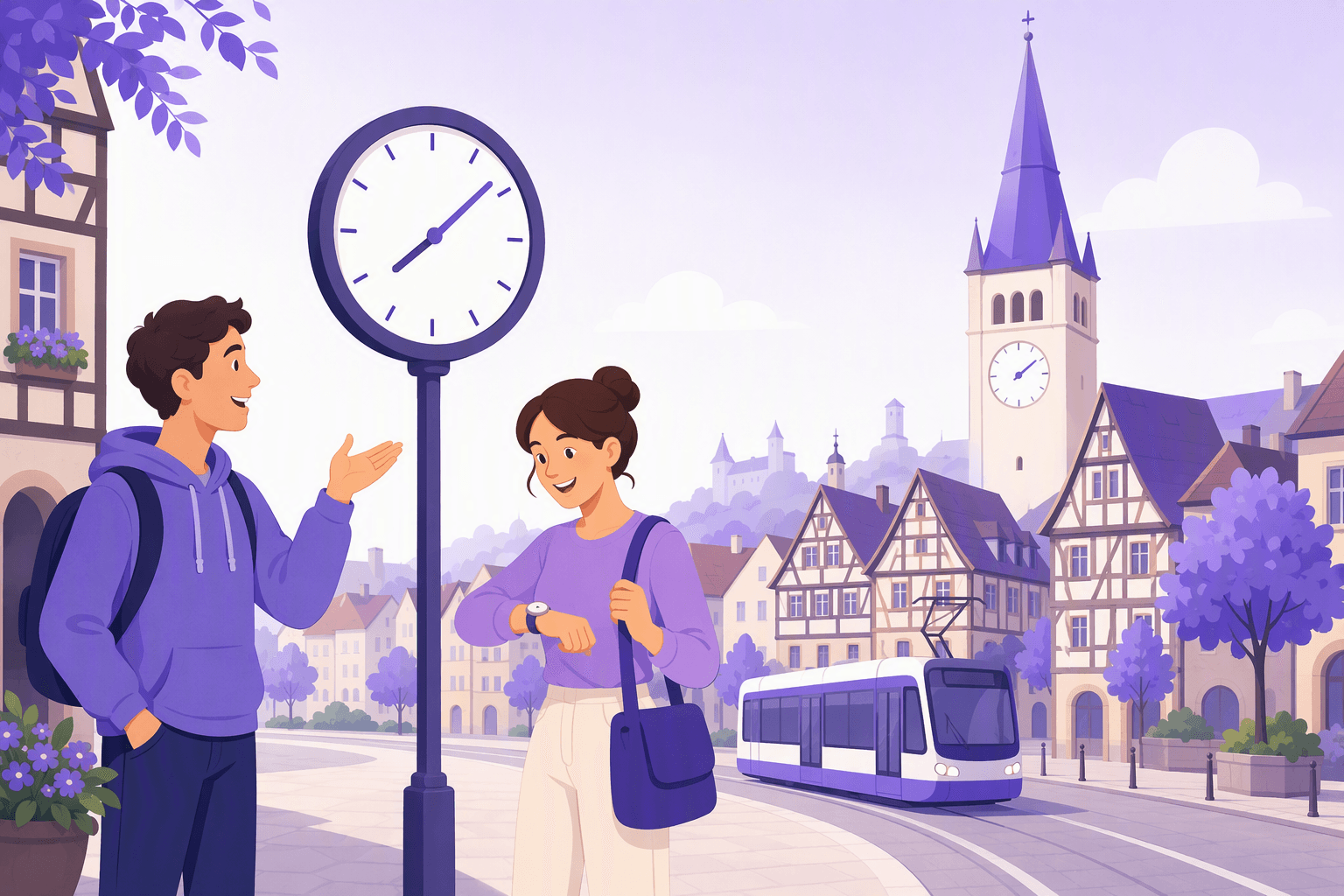
The core idea: German uses both "digital" and "spoken" time
German time has two parallel systems that coexist.
Digital time is what you see on phones, tickets, appointment reminders, and official announcements. Spoken time is what you hear in kitchens, offices, and small talk.
A good rule: if you are reading a schedule, use the digital style. If you are chatting, use the spoken style.
Quick vocabulary you need first
| English | German | Pronunciation | Note |
|---|---|---|---|
| time (clock time) | die Uhrzeit | dee OOR-tsyte | Also used in formal questions: 'Haben Sie die Uhrzeit?' |
| clock/watch | die Uhr | dee OOR | Context decides clock vs watch. |
| hour | die Stunde | dee SHTOON-duh | Plural: Stunden. |
| minute | die Minute | dee mee-NOO-tuh | Plural: Minuten. |
| second | die Sekunde | dee zeh-KOON-duh | Plural: Sekunden. |
| quarter (of an hour) | das Viertel | dahs FEER-tel | Used in time phrases. |
| half (hour) | halb | hahp | Means 'half to' the next hour in spoken time. |
| past (after) | nach | nahkh | Used for minutes past the hour. |
| to (before) | vor | fohr | Used for minutes before the next hour. |
| exactly | genau | geh-NOW | Common with 'Uhr': 'genau um drei Uhr'. |
| around/about | gegen | GAY-gen | Approximate time: 'gegen acht'. |
| at (time) | um | oom | Specific time: 'um 18 Uhr'. |
| from ... to ... | von ... bis ... | fon ... biss ... | Ranges: 'von 9 bis 5'. |
The spellings and standard forms above align well with Duden usage guidance (accessed 2026). For learners, Duden is useful because it treats time expressions as real usage, not just classroom examples.
How to ask for the time (and how to answer)
Wie spät ist es?
Pronunciation: vee SHPAYT ist ess
This is the most universal, polite, and natural way to ask "What time is it?" It works with strangers, coworkers, and service staff.
/ent-SHOOL-dee-goong, vee SHPAYT ist ess/
Literal meaning: Excuse me, how late is it?
“Entschuldigung, wie spät ist es? Ich muss meinen Zug erwischen.”
Excuse me, what time is it? I have to catch my train.
Wie spät ist es? is the safest default in public. Germans often answer with a 24-hour time if the context is travel or appointments.
Wie viel Uhr ist es?
Pronunciation: vee FEEL OOR ist ess
This is also common and not rude, but it can feel slightly more direct. In casual settings it is perfectly normal.
/vee FEEL OOR ist ess/
Literal meaning: How much clock is it?
“Wie viel Uhr ist es? Wir wollten um acht los.”
What time is it? We wanted to leave at eight.
You will hear this a lot among friends and family. In very formal contexts, many speakers prefer Wie spät ist es? or a longer polite question.
Haben Sie die Uhrzeit?
Pronunciation: HAH-ben zee dee OOR-tsyte
This is a very polite option, especially with strangers, older people, or in formal service situations.
Digital time in German (24-hour clock)
Digital time is straightforward: hour + Uhr + minutes.
- 14:20 = vierzehn Uhr zwanzig (feer-TSAYN OOR TSVAHN-tsikh)
- 07:05 = sieben Uhr fünf (ZEE-ben OOR fuenf)
In writing, you often see 14:20 Uhr. In speech, people may drop Uhr if the context is obvious, but keeping it is clear and learner-friendly.
💡 When to default to 24-hour time
Use 24-hour time for travel, appointments, work schedules, and anything where precision matters. If you are meeting someone at a station, saying "um siebzehn Uhr" is clearer than "um fünf" because it avoids AM/PM confusion.
Spoken time: nach, vor, halb, Viertel
Spoken German time is built around reference points, not full minute-by-minute reading.
Instead of "two twenty," you often hear "twenty past two." Instead of "two thirty," you hear "half to three."
This is exactly the kind of phrasing you hear in movie and TV dialogue, especially in scenes about catching trains, being late, or planning dinner. If you like learning through real clips, you can combine this topic with best movies to learn German to hear time phrases in context.
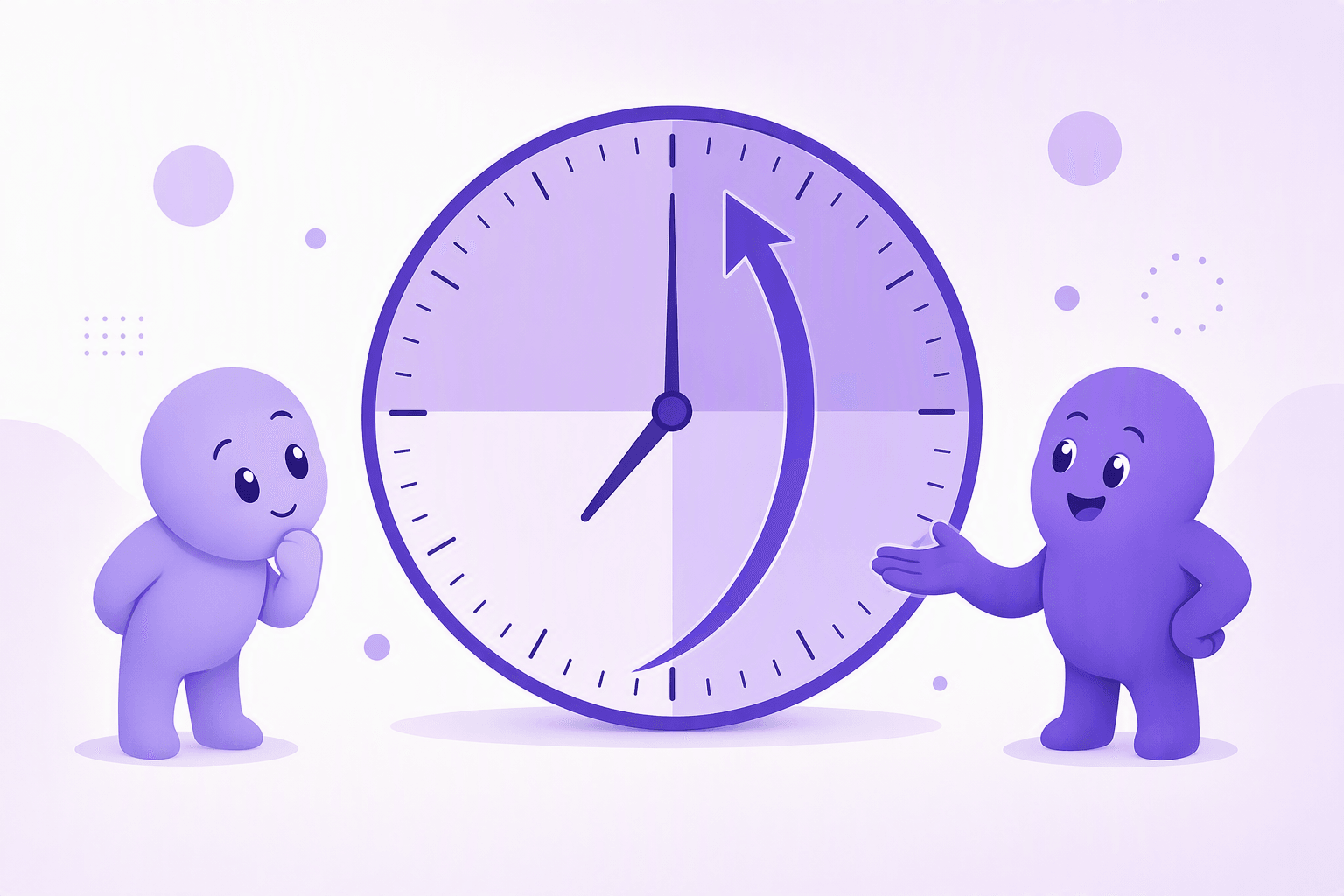
nach
Pronunciation: nahkh
Use nach for minutes after the hour:
- 2:05 = fünf nach zwei (fuenf nahkh TSVY)
- 2:20 = zwanzig nach zwei (TSVAHN-tsikh nahkh TSVY)
vor
Pronunciation: fohr
Use vor for minutes before the next hour:
- 2:55 = fünf vor drei (fuenf fohr DRY)
- 2:40 = zwanzig vor drei (TSVAHN-tsikh fohr DRY)
halb
Pronunciation: hahp
This is the famous one: halb drei is 2:30, not 3:30.
It is "half (an hour) to three." German points toward the next hour.
/ess ist hahp DRY/
Literal meaning: It is half (to) three.
“Es ist halb drei. Wollen wir schon losgehen?”
It's 2:30. Do we want to leave already?
In everyday German, halb + next hour is the default way to say :30. Learners often misinterpret it because English says 'half past' the current hour.
Viertel
Pronunciation: FEER-tel
Many speakers say:
- 2:15 = Viertel nach zwei (FEER-tel nahkh TSVY)
- 2:45 = Viertel vor drei (FEER-tel fohr DRY)
In some regions, you may also hear:
- 2:15 = Viertel drei
- 2:45 = dreiviertel drei
Regional variation is real, and the Institut für Deutsche Sprache (IDS) tracks many such differences across the German-speaking area (accessed 2026). The good news: Viertel nach/vor is widely understood, so it is a safe active choice.
🌍 A practical regional note: 'dreiviertel' time
If you hear dreiviertel drei (DRY-feer-tel DRY), it means 2:45, literally 'three quarters (of the way to) three.' This is common enough that you should recognize it, but you do not need to produce it unless you live in a region where everyone uses it.
A clear map: the most common spoken patterns
Here are the patterns you will hear most often, with pronunciation approximations.
| Clock time | German | Pronunciation | Note |
|---|---|---|---|
| 2:00 | zwei Uhr | TSVY OOR | Also: 'Es ist zwei.' |
| 2:05 | fünf nach zwei | fuenf nahkh TSVY | Spoken style. |
| 2:10 | zehn nach zwei | TSAYN nahkh TSVY | Spoken style. |
| 2:15 | Viertel nach zwei | FEER-tel nahkh TSVY | Regional alternative: 'Viertel drei'. |
| 2:20 | zwanzig nach zwei | TSVAHN-tsikh nahkh TSVY | |
| 2:25 | fünf vor halb drei | fuenf fohr hahp DRY | Common in some regions, but not required. |
| 2:30 | halb drei | hahp DRY | Half to three. |
| 2:35 | fünf nach halb drei | fuenf nahkh hahp DRY | Also heard: 'fünfunddreißig' in digital style. |
| 2:40 | zwanzig vor drei | TSVAHN-tsikh fohr DRY | |
| 2:45 | Viertel vor drei | FEER-tel fohr DRY | Regional alternative: 'dreiviertel drei'. |
| 2:50 | zehn vor drei | TSAYN fohr DRY | |
| 2:55 | fünf vor drei | fuenf fohr DRY |
Time words you will hear around schedules
German is very schedule-aware in public life, especially with transport, appointments, and opening hours. These small words show up constantly.
| English | German | Pronunciation | Note |
|---|---|---|---|
| today | heute | HOY-tuh | |
| tomorrow | morgen | MOR-gen | Also means 'morning' by context. |
| morning | morgens | MOR-gens | Adverb: 'in the mornings'. |
| at noon | mittags | MIT-tags | Adverb. |
| afternoon | nachmittags | NAHKH-mit-tags | Adverb. |
| evening | abends | AH-bents | Adverb. |
| at night | nachts | nahkhts | Adverb. |
| early | früh | frue | Long ue sound. |
| late | spät | shpayt | |
| now | jetzt | yetst | |
| soon | gleich | glykh | Often means 'in a moment'. |
| in a minute | gleich | glykh | Same word, different intent. |
| in five minutes | in fünf Minuten | in fuenf mee-NOO-ten |
David Crystal’s work on how people process spoken language highlights that rhythm and chunking matter for comprehension, and time expressions are a perfect example of chunked speech. In German, nach, vor, halb, and Viertel create predictable chunks that your ear can latch onto quickly.
Real-life phrases: trains, meetings, and being late
Um wie viel Uhr?
Pronunciation: oom vee FEEL OOR
This means "At what time?" and it is the natural follow-up when planning.
/oom vee FEEL OOR/
Literal meaning: At how much clock?
“Um wie viel Uhr treffen wir uns?”
What time are we meeting?
Um is the key preposition for specific times. You will hear it constantly in planning scenes and everyday coordination.
Der Zug fährt um ...
Pronunciation: dair TSOOK FAIRT oom
Useful for travel, and you will hear it in stations and announcements.
/dair TSOOK FAIRT oom/
Literal meaning: The train drives at ...
“Der Zug fährt um 18 Uhr 12.”
The train leaves at 6:12 PM.
In travel contexts, Germans often use 24-hour time even in casual speech because it matches tickets and platform displays.
Ich bin gleich da.
Pronunciation: ikh bin glykh dah
This is a classic "I’m almost there" line, often used when someone is running late.
/ikh bin glykh dah/
Literal meaning: I am right away there.
“Ich bin gleich da, ich stehe nur im Stau.”
I'll be there in a moment, I'm just stuck in traffic.
Gleich is flexible. It can mean 'very soon' rather than a literal instant, so context and tone matter.
⚠️ Avoid one common trap: 'morgen'
Morgen can mean 'tomorrow' or 'morning'. If you say Wir sehen uns morgen, it usually means tomorrow (sometime). If you mean tomorrow morning, say Wir sehen uns morgen früh or morgen Vormittag.
Pronunciation and listening: what makes German time hard at first
The difficulty is rarely the math. It is the sound.
- ch in nach is a back-throat sound (nahkh), not a K.
- Viertel starts with an F sound (FEER-tel), not a V sound.
- drei has the "eye" vowel (DRY), and zwei starts with TSV (TSVY).
If German pronunciation is still new, use the patterns in this guide alongside a broader German pronunciation guide. Time phrases are short, so they are ideal for shadowing.
Cultural usage: punctuality, precision, and "gegen"
German-speaking cultures are not identical, but there is a strong norm of punctuality in professional contexts. Arriving "on time" often means arriving a few minutes early, especially for appointments.
That is why gegen is so useful. It signals approximation without sounding careless.
- gegen acht = around eight (GAY-gen ahkt)
- gegen halb drei = around 2:30 (GAY-gen hahp DRY)
In many everyday situations, gegen is more natural than saying "maybe" or "approximately" because it feels practical and schedule-friendly.
Practice: convert these times both ways
Try saying each time in both styles.
- 16:00
- Digital: sechzehn Uhr (ZEKH-tsayhn OOR)
- Spoken: vier Uhr (FEER OOR), add nachmittags if needed
- 09:15
- Digital: neun Uhr fünfzehn (noyn OOR FUENF-tsayhn)
- Spoken: Viertel nach neun (FEER-tel nahkh noyn)
- 22:45
- Digital: zweiundzwanzig Uhr fünfundvierzig (TSVY-oont-TSVAHN-tsikh OOR FUENF-oont-FEER-tsikh)
- Spoken: Viertel vor elf (FEER-tel fohr elf), or regional: dreiviertel elf
If you want more high-frequency building blocks for everyday speech, add the 100 most common German words to your study list. It makes time phrases easier because the glue words (prepositions, particles) stop feeling random.
Common mistakes (and how to fix them fast)
Mistake 1: treating halb as "half past"
Fix: halb + next hour. halb vier is 3:30.
Mistake 2: mixing 24-hour and spoken reference hours
If you say zwanzig nach vier, listeners assume 4:20 in the current context. If it is 16:20, add nachmittags or use 16 Uhr 20.
Mistake 3: overusing "Uhr" in casual spoken time
Es ist zwei Uhr zwanzig is correct, but many people would say zwanzig nach zwei in conversation. Learn both, then choose based on setting.
Mistake 4: forgetting that Viertel has regional alternatives
You do not need to speak regional variants, but you should recognize them. IDS resources on variation help learners understand why they hear different forms (accessed 2026).
A note on Germany, Austria, Switzerland: what changes and what does not
German is an official language in multiple countries, and it is used across a wider set of regions. That is one reason time expressions vary a bit.
What does not change: everyone understands 24-hour time, and everyone understands nach, vor, and halb. If you stick to those, you will be understood everywhere.
What can change: whether people actively use Viertel nach/vor vs Viertel drei and dreiviertel. Treat the regional forms as listening skills first.
If you are curious about other kinds of regional language, slang and swearing also vary a lot. For that topic, see our guide to German swear words, but keep it separate from time phrases in polite settings.
Learn time through real dialogue (the Wordy method)
Time phrases show up constantly in scenes: missed calls, late arrivals, train platforms, dinner plans, and workplace meetings. Short, repeated phrases like um wie viel Uhr and halb drei are ideal for clip-based repetition because you can hear the same structure with different numbers.
If you want to keep building practical German, start with greetings, then add time, then add travel. You already have hello in German and goodbye in German, and time is the next high-utility layer.
At the end of your session, reward yourself with something fun like romantic lines, and compare how formal vs casual changes the tone in how to say I love you in German.
Frequently Asked Questions
Does 'halb drei' mean 2:30 or 3:30 in German?
How do Germans say 2:15 and 2:45?
Should I use 24-hour time or 12-hour time in German?
How do I ask for the time politely in German?
How are times written in German, like 14:30 or 14.30?
Sources & References
- Duden, 'Uhrzeit' and time expressions, accessed 2026
- Institut für Deutsche Sprache (IDS), resources on regional variation in German, accessed 2026
- Goethe-Institut, German learning materials on time and daily routines, accessed 2026
- Ethnologue: Languages of the World, German language entry (27th edition, 2024)
Start learning with Wordy
Watch real movie clips and build your vocabulary as you go. Free to download.


