Quick Answer
To say 'excuse me' in Italian, use 'Scusi' (SKOO-zee) for polite situations and 'Scusa' (SKOO-zah) with friends. For squeezing past someone, Italians often say 'Permesso' (pehr-MEHSS-soh). The best choice depends on whether you’re apologizing, getting attention, or asking to pass.
| English | Italian | Pronunciation | Formality |
|---|---|---|---|
| Excuse me (polite, to get attention) | Scusi | SKOO-zee | polite |
| Excuse me (informal, to get attention) | Scusa | SKOO-zah | casual |
| Excuse me (to pass through) | Permesso | pehr-MEHSS-soh | polite |
| Excuse me (polite, apologetic) | Mi scusi | mee SKOO-zee | polite |
| Excuse me (plural, informal group) | Scusate | skoo-ZAH-teh | casual |
| Excuse me (very formal) | Mi scusi, Lei | mee SKOO-zee, LAY | formal |
| Sorry (I'm sorry) | Mi dispiace | mee dee-SPYAH-cheh | polite |
| Sorry (very informal) | Scusa, ho sbagliato | SKOO-zah, oh sbahl-YAH-toh | casual |
| Excuse me (one moment) | Mi scusi un attimo | mee SKOO-zee oon AHT-tee-moh | polite |
| Excuse me (may I?) | Posso? | POHSS-soh | casual |
| Excuse me (sorry to bother you) | Disturbo? | dee-STOOR-boh | polite |
| Excuse me (sorry for the trouble) | Mi scusi per il disturbo | mee SKOO-zee pehr eel dee-STOOR-boh | formal |
To say "excuse me" in Italian, use Scusi (/ˈsku.zi/) for polite situations, Scusa (/ˈsku.za/) with friends, and Permesso (/perˈmes.so/) when you want to pass through someone’s space. Italian separates "getting attention", "asking to move", and "apologizing" more clearly than English, so the best phrase depends on what you’re doing in that moment.
Italian is spoken by roughly 67 million people worldwide (Ethnologue, 27th edition, 2024). It’s also one of the most learned languages in Europe, and "excuse me" is one of the first politeness tools you need for real-life interaction, from cafés to crowded buses.
If you’re building everyday basics, pair this with our guides to how to say hello in Italian and how to say goodbye in Italian, because greetings and small apologies often come as a set in real conversations.
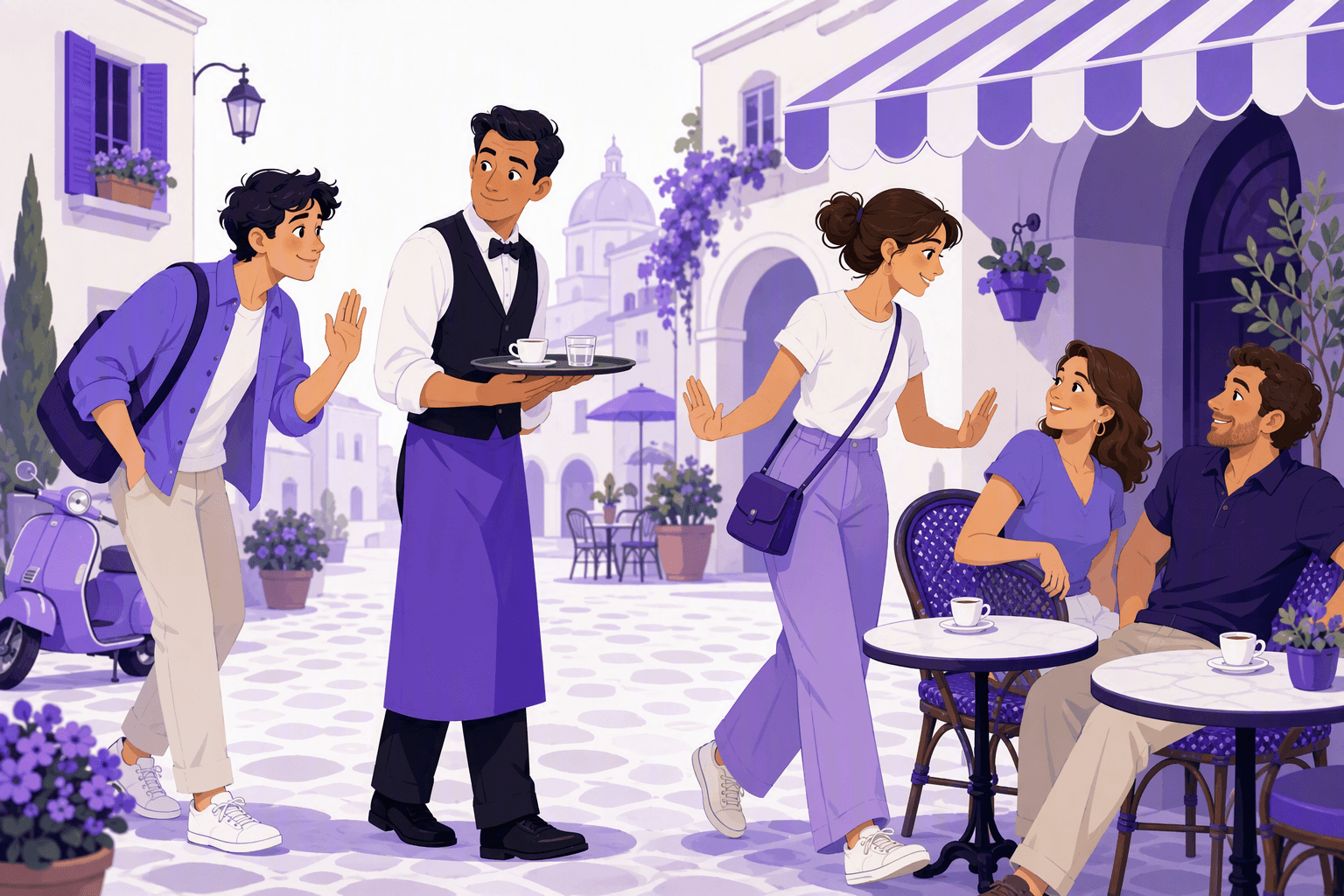
The three meanings of "excuse me" in Italian
English uses "excuse me" for several different speech acts. Italian tends to choose different words depending on which one you mean.
Getting someone’s attention (without apologizing)
This is the "Excuse me, do you know what time it is?" meaning. You’re not saying you did something wrong, you’re opening a channel.
In Italian, Scusi (/ˈsku.zi/) or Scusa (/ˈsku.za/) are typical, depending on formality.
Asking to pass or enter
This is the "Excuse me, can I get by?" meaning. In Italian, Permesso (/perˈmes.so/) is the classic choice, especially in tight spaces.
It can also be used when entering a room, like a soft "may I?" before stepping in.
Apologizing for a small mistake
This is the "Excuse me!" after bumping someone, interrupting, or misunderstanding. Italians often use Mi scusi (/mi ˈsku.zi/) or add Mi dispiace (/mi disˈpja.tʃe/) to sound more clearly apologetic.
Treccani’s dictionary entries for scusare and scusa show the core idea: asking to be excused, justified, or forgiven, which maps closely to how Italians hear these phrases in context (Treccani, accessed 2026).
Scusi vs Scusa: the formality switch that matters
The fastest way to sound natural is to match your "excuse me" to the relationship, not to the situation.
Italian has a strong T-V distinction: tu for informal, Lei for formal. The Accademia della Crusca discusses how Lei functions as the standard polite address in contemporary Italian, especially with strangers and in service contexts (Accademia della Crusca, accessed 2026).
Scusi
Scusi (/ˈsku.zi/) is the polite form, tied to Lei. Think: strangers, older people, staff, formal settings.
It’s also the safest default when you’re unsure.
/SKOO-zee/
Literal meaning: Polite 'excuse me' linked to Lei address.
“Scusi, sa che ore sono?”
Excuse me, do you know what time it is?
Common with strangers. In many everyday interactions, Italians prefer a quick scusi over longer polite formulas.
Scusa
Scusa (/ˈsku.za/) is informal, tied to tu. Use it with friends, classmates, coworkers you’re on first-name terms with, and people your age in casual contexts.
It can sound too familiar if you use it with a stranger in a formal environment.
/SKOO-zah/
Literal meaning: Informal 'excuse me' linked to tu address.
“Scusa, hai un attimo?”
Excuse me, do you have a second?
Very common among peers. In Italy, switching to tu is a social step, so scusa can feel overly familiar if you haven't established it.
Scusate
Scusate (/skuˈza.te/) is what you say to a group when you’re being informal, or when you’re addressing multiple people at once.
If you’re squeezing past two friends in a cinema row, scusate fits better than repeating scusa twice.
Permesso: the most Italian choice in crowds
If there’s one word that makes learners sound instantly more local in Italy, it’s Permesso (/perˈmes.so/).
It’s not a direct synonym of "sorry". It’s closer to "may I?" or "permission?" and it’s used when your body is about to cross someone’s space.
Permesso
Use it when you want to pass, enter, or reach something behind someone.
In a busy bar, you might say it quietly while moving, rather than stopping the whole flow with a long apology.
/pehr-MEHSS-soh/
Literal meaning: Permission.
“Permesso, devo passare.”
Excuse me, I need to get through.
Very common on public transport, in shops, and in crowded streets. It signals intention to move through, not guilt.
💡 A practical rule
If your goal is movement, start with "Permesso". If your goal is attention, start with "Scusi/Scusa". If you caused a problem, add "Mi scusi" or "Mi dispiace".
Mi scusi: when you want to sound clearly apologetic
Mi scusi (/mi ˈsku.zi/) adds a personal object, literally "excuse me". In practice, it often feels more like an apology than plain scusi.
It’s useful when you interrupted, misunderstood, or made a small mistake that affects someone.
Mi scusi
Use it in service situations, formal interactions, or when you want to soften a request.
It’s also common when you’re about to ask a question that takes effort from the other person.
/mee SKOO-zee/
Literal meaning: Excuse me.
“Mi scusi, ho capito male.”
Excuse me, I misunderstood.
Slightly heavier than scusi. Italians use it for small accountability moments: interrupting, mishearing, or correcting themselves.
Mi scusi un attimo
Mi scusi un attimo (/mi ˈsku.zi un atˈti.mo/) is a polite way to interrupt briefly, like "excuse me for a second".
It’s common in offices, shops, and customer service contexts.
Disturbo? and other "may I bother you?" openers
Italian has a set of polite openers that are less about apology and more about respecting the other person’s time.
These are especially useful when you’re asking a stranger for help.
Disturbo?
Disturbo? (/disˈtur.bo/) means something like "Am I bothering you?" It’s short, polite, and slightly formal.
You’ll hear it when someone approaches a desk, a neighbor, or a professional.
Mi scusi per il disturbo
Mi scusi per il disturbo (/mi ˈsku.zi per il disˈtur.bo/) is more formal and can sound a bit stiff in casual settings.
Use it when you’re interrupting someone who is clearly busy, or when you’re writing a message or email.
Choosing the right phrase by situation
A good way to stop guessing is to map Italian phrases to specific situations you’ll actually face.
In a shop or café
If you need to get the server’s attention: Scusi. If you’re apologizing for a mistake: Mi scusi.
If you’re trying to reach the counter through people: Permesso.
On public transport
Buses and metros are where permesso shines. It’s the standard "I’m moving through" signal.
If you step on someone’s foot, mi scusi plus a quick mi dispiace is natural.
In a meeting or classroom
To interrupt politely: mi scusi un attimo works well.
If you’re among peers and already on tu: scusa un attimo is the informal equivalent.
On the street asking for directions
Start with Scusi or Mi scusi, then your question.
If you want to sound especially courteous, add a softener like per favore or mi può dire....
Pronunciation details that change how polite you sound
Even when your grammar is correct, pronunciation affects how your tone lands.
Scusi
IPA: /ˈsku.zi/
The s is clear, and the stress is on the first syllable. Keep it crisp, not drawn out.
Scusa
IPA: /ˈsku.za/
Same rhythm as scusi, but with /a/ at the end. The final vowel is audible in Italian, so don’t swallow it.
Permesso
IPA: /perˈmes.so/
Double consonants matter in Italian. The ss in permesso is longer than a single s, and that length is part of sounding natural.
Luca Serianni’s work on Italian grammar and usage is often cited in Italian language education for its clarity on standard forms and register, and this is one of those moments where "standard" matches what you actually hear: short, situation-specific politeness markers, not long formulas.
Common learner mistakes (and what Italians actually hear)
Using scusa with strangers
Many Italians will still understand you, but it can feel too familiar. In some contexts it reads as abrupt, especially with older people or formal staff.
When in doubt, default to scusi.
Overusing mi dispiace
Mi dispiace is real and common, but it’s closer to "I’m sorry" than "excuse me". If you use it to get attention, it can sound odd, like you’re apologizing before anything happened.
Use mi dispiace when you caused inconvenience, not as a door-opener.
Forgetting plural forms
If you address a group with scusi or scusa, it can sound mismatched. Scusate is the easy fix for informal groups.
For polite groups, Italians often still use scusate in practice, but in very formal contexts you may hear scusino.
⚠️ A quick safety default
If you only remember two words, make them "Scusi" and "Permesso". They cover most tourist and everyday situations without sounding overly casual.
Mini-dialogues you can copy into real life
Short, reusable patterns are what stick, especially if you’re learning through clips and scenes.
Getting attention politely
Scusi, posso farle una domanda?
IPA for key word: scusi /ˈsku.zi/
This is a standard street-question opener.
Passing through a crowd
Permesso, grazie.
IPA for key word: permesso /perˈmes.so/
Adding grazie after you pass is common and keeps the interaction friendly.
Correcting yourself
Mi scusi, intendevo dire domani.
IPA for key word: mi scusi /mi ˈsku.zi/
This is a natural "sorry, I meant tomorrow".
Cultural notes: why Italians sound "direct" but still polite
Visitors sometimes interpret Italian as blunt because requests can be short. Often, the politeness is carried by the right form (Lei vs tu) and the right opener (scusi/permesso), not by long hedging.
This aligns with what pragmatics researchers like Penelope Brown and Stephen Levinson discuss in their work on politeness strategies: languages distribute "face-saving" work differently across grammar, word choice, and context. In Italian, choosing Lei forms and the right micro-phrase often does most of the work.
🌍 Service interactions are fast
In busy Italian bars and cafés, efficiency is part of the culture. A quick "Scusi" plus your request can be more appropriate than a long apology, especially when staff are moving quickly and the line is tight.
Practice with movie and TV clips (the fastest way to stop translating)
The reason "excuse me" is tricky is that you can’t translate it once and reuse it. You need to hear the situations.
When you watch Italian scenes, listen for what happens right before the phrase:
- someone approaches a stranger: scusi
- someone slips through a doorway: permesso
- someone interrupts or corrects themselves: mi scusi
If you’re learning with video, our guide on how to learn a language with movies explains how to loop short moments until the phrase becomes automatic.
A note on intensity and what not to say
Sometimes learners look for a stronger "excuse me" and accidentally drift into rude territory. Italian does have sharper ways to complain, but they are not "excuse me" equivalents.
If you’re curious about what crosses the line, see our Italian swear words guide. It helps you recognize tone without copying something that will backfire.
Putting it all together: a simple decision tree
Use this as a mental shortcut until it becomes instinct.
- Need attention?
- Polite: Scusi
- Casual: Scusa
- Need to pass or enter?
- Permesso
- You made a mistake or inconvenienced someone?
- Mi scusi (polite) or Scusa (casual)
- Add Mi dispiace if you want to sound warmer or more apologetic
If you want more everyday building blocks, continue with how to say hello in Italian, then how to say goodbye in Italian, and for affectionate language, how to say I love you in Italian.
The Short Answer (recap)
Scusi (/ˈsku.zi/) is the safest polite "excuse me", Scusa (/ˈsku.za/) is the informal version, and Permesso (/perˈmes.so/) is what you say when you’re trying to pass through. Add Mi scusi (/mi ˈsku.zi/) or Mi dispiace (/mi disˈpja.tʃe/) when you’re clearly apologizing, not just opening a conversation.
If you want to train these in real context, Wordy’s clip-based practice makes it easier to hear the difference between scusi and permesso the way Italians actually use them.
Frequently Asked Questions
What is the most common way to say 'excuse me' in Italian?
Is 'mi scusi' more polite than 'scusi'?
When do Italians say 'permesso'?
How do you say 'excuse me' informally in Italian?
How do you apologize for bumping into someone in Italian?
Sources & References
- Treccani, Vocabolario Treccani online, entries for 'scusa', 'scusare', and 'permesso' (accessed 2026)
- Accademia della Crusca, articles on 'Lei' vs 'tu' usage and Italian politeness norms (accessed 2026)
- Ethnologue: Languages of the World, Italian language entry (27th edition, 2024)
- Council of Europe, Common European Framework of Reference for Languages (CEFR), Companion Volume (accessed 2026)
Start learning with Wordy
Watch real movie clips and build your vocabulary as you go. Free to download.


