Quick Answer
The standard way to say cheers in Korean is 건배, pronounced /kʌn.bɛ/. Use it for a group toast, while 짠 /t͡ɕ͈an/ is the casual sound people say as glasses touch. Learn which phrase fits a business dinner, celebration, or relaxed night with friends.
| English | Korean | Pronunciation | Formality |
|---|---|---|---|
| Cheers! | 건배! | guhn-BEH | polite |
| Cheers! (casual clink) | 짠! | JJAHN | casual |
| To your health! | 건강을 위하여! | guhn-GAHNG-eul wee-hah-YUH | formal |
| For our friendship! | 우정을 위하여! | oo-JUHNG-eul wee-hah-YUH | formal |
| Let's make a toast. | 건배합시다. | guhn-BEH-hahp-shee-dah | formal |
| One shot! | 원샷! | wuhn-SHAHT | slang |
The usual way to say cheers in Korean is 건배! /kʌn.bɛ/, a toast used before drinking together. With close friends, you will often hear 짠! /t͡ɕ͈an/ as glasses touch. The difference matters: 건배 is a toast for the group, while 짠 is the casual clinking sound.
Korean is spoken by roughly 82 million people worldwide, primarily on the Korean Peninsula and across large diaspora communities. Whether you are sharing Korean barbecue, attending a work dinner, or watching a K-drama scene, knowing how to toast politely helps you understand an important social ritual.
A toast is not only about alcohol. It can mark a birthday, a reunion, a successful project, a wedding, or a simple meal among friends. If you are learning everyday conversation, pair these phrases with our guide to Korean greetings so you can join a table naturally from the first hello to the final toast.
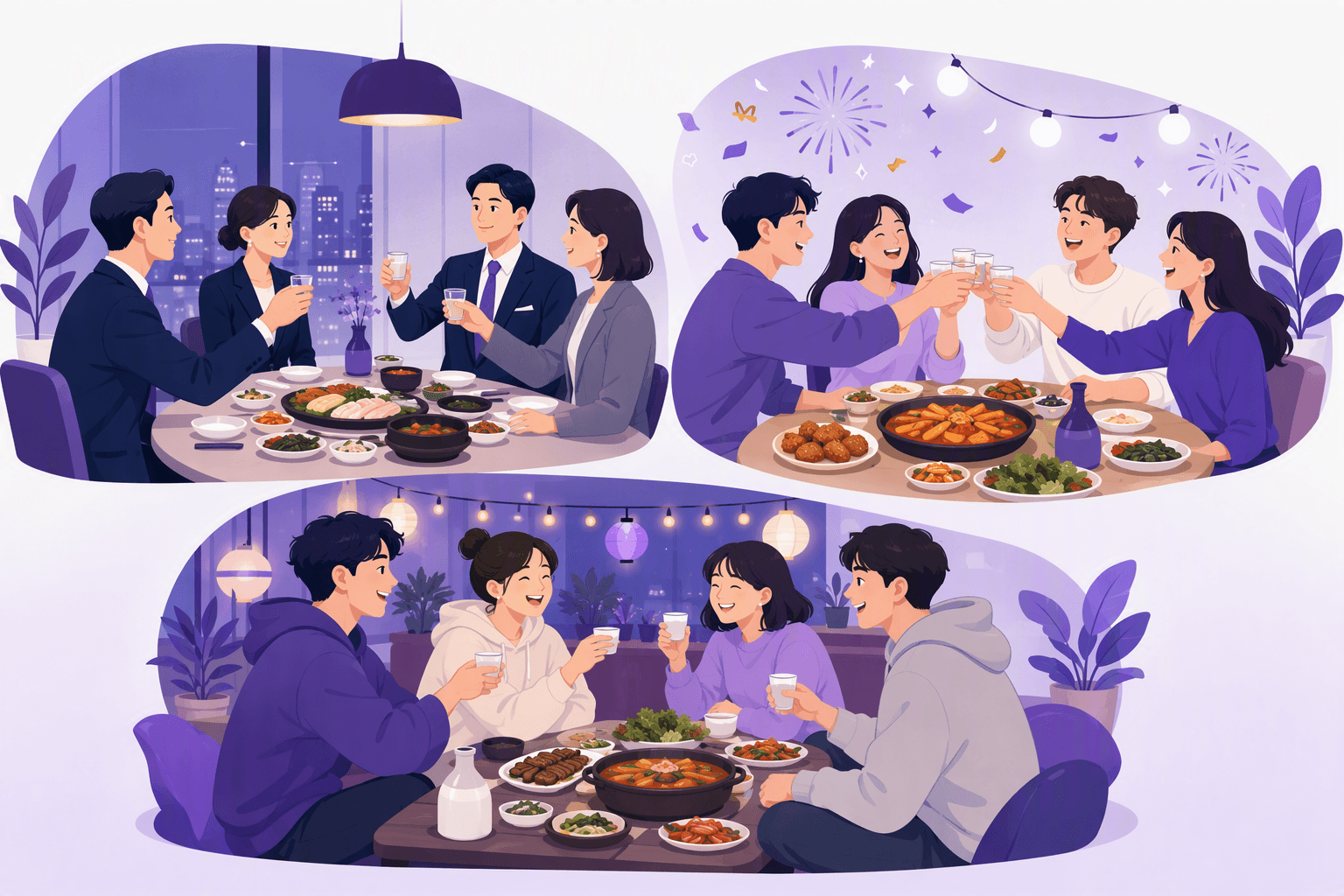
The essential Korean word for cheers
건배
건배 /kʌn.bɛ/ is the safest and most widely useful Korean equivalent of cheers. It comes from the Sino-Korean characters 乾杯, traditionally associated with emptying a cup, but in current everyday use it simply announces a toast.
Say 건배! /kʌn.bɛ/ just before people drink. At a formal dinner, the person leading the toast may speak first, then finish with 건배. Everyone raises their glasses, repeats the word, clinks or gestures toward each other, and takes a sip.
/guhn-BEH/
Literal meaning: A toast, historically connected to 'empty cup'
“오늘을 위해서, 건배!”
To today, cheers!
The standard toast for almost any adult social setting, from a family meal to a company dinner.
The consonant ㄱ at the beginning is softer than English hard g. Aim for /kʌn.bɛ/, with a short first syllable and a clear final syllable. Avoid turning it into three syllables, because 건배 has two Korean syllable blocks: 건 and 배.
Korean grammar specialist Ho-min Sohn describes Korean speech as highly sensitive to social relationships and relative status. That principle is especially visible at a shared table. The word itself is easy, but who begins the toast, how you hold your glass, and whether you use honorific behavior can carry as much meaning as the toast phrase.
The casual sound friends use
짠
짠! /t͡ɕ͈an/ is the cheerful sound people make when glasses meet. It is informal, lively, and extremely common in relaxed scenes with friends, couples, or peers. Think of it as the sound-effect version of cheers.
/JJAHN/
Literal meaning: A clinking sound
“우리 짠!”
Cheers, us!
Best for close friends. It is often said at the precise moment glasses touch.
The doubled consonant ㅉ creates a tense sound. The IPA /t͡ɕ͈an/ shows that it is not the same as a plain English j. You do not need to master the phonetic detail immediately, but make the opening crisp and short rather than stretching it into a long word.
You can hear 짠 /t͡ɕ͈an/ in variety shows, restaurant scenes, and social media videos. It is also common when people toast with coffee, sparkling water, or juice, so it is not restricted to alcohol.
A useful distinction is this:
| Situation | Best expression | Why |
|---|---|---|
| A birthday dinner with friends | 짠! /t͡ɕ͈an/ | Relaxed and playful |
| A family celebration | 건배! /kʌn.bɛ/ | Respectful and universal |
| A company dinner | 건배! /kʌn.bɛ/ | Appropriate for mixed ages and ranks |
| A formal speech before drinking | 건배합시다 /kʌn.bɛ.ɦap̚.ɕ͈i.da/ | Invites the group to toast |
| A toast honoring someone | 위하여 /wi.ɦa.jʌ/ | Means for the sake of someone or something |
Toasting to a person, event, or idea
위하여
위하여 /wi.ɦa.jʌ/ means for the sake of, or in honor of. It is the key word in longer Korean toasts. Put the person, group, or purpose before it, then finish with 건배! /kʌn.bɛ/.
For example, 건강을 위하여! /kʌŋ.ɡaŋ.ɯl wi.ɦa.jʌ/ means to health, while 우정을 위하여! /u.d͡ʑʌŋ.ɯl wi.ɦa.jʌ/ means to friendship. These are appropriate at a wedding, farewell, reunion, or work celebration.
/guhn-GAHNG-eul wee-hah-YUH/
Literal meaning: For health
“모두의 건강을 위하여, 건배!”
To everyone's health, cheers!
A warm, safe choice for formal dinners and multigenerational gatherings.
The object marker 을 /ɯl/ follows 건강 /kʌŋ.ɡaŋ/, health. You do not need to build long speeches to sound natural. A brief purpose plus 위하여 and 건배 is enough.
Here are several toast models you can adapt:
| Korean toast | IPA | Natural meaning |
|---|---|---|
| 우리 우정을 위하여! | /u.ɾi u.d͡ʑʌŋ.ɯl wi.ɦa.jʌ/ | To our friendship! |
| 새로운 시작을 위하여! | /sɛ.ɾo.un ɕi.d͡ʑa.ɡɯl wi.ɦa.jʌ/ | To a new beginning! |
| 성공을 위하여! | /sʌŋ.ɡoŋ.ɯl wi.ɦa.jʌ/ | To success! |
| 행복을 위하여! | /hɛŋ.bo.ɡɯl wi.ɦa.jʌ/ | To happiness! |
For a larger group, 건배합시다 /kʌn.bɛ.ɦap̚.ɕ͈i.da/ means let us make a toast. It uses the formal group invitation ending -ㅂ시다 /p͡ɕ͈i.da/, which is ideal when addressing colleagues, guests, or people you do not know closely.
축배
축배 /t͡ɕʰuk̚.p͈ɛ/ means a celebratory toast. It is more literary and ceremonial than 건배, so you may see it in wedding speeches, formal writing, song lyrics, or news reports.
You do not need to use 축배 in everyday conversation. Recognize it as a useful cultural word, but choose 건배 when you want the natural spoken default.
Korean drinking etiquette that affects a toast
A Korean toast is often tied to age hierarchy and group harmony. These customs vary by family, generation, workplace, and personal preference, but observing them thoughtfully shows consideration.
Use two hands around elders
When giving or receiving a drink from someone older or senior, many Koreans use two hands. One hand holds the glass while the other lightly supports the wrist, forearm, or bottom of the glass.
This is not a rigid rule for every setting. Among close friends of the same age, a one-handed clink is normal. At a formal meal, however, two hands are an easy and respectful choice.
🌍 A toast is social, not a test
Korean drinking culture has changed substantially, especially among younger adults. You can join the mood of a toast without drinking alcohol, drinking quickly, or matching anyone else's amount. A polite sip, a soft drink, or a clear refusal is acceptable.
Turn slightly away when drinking with seniors
A traditional custom is to turn your head slightly away from an older person when taking a drink. You may see this in historical dramas and family or workplace scenes. It signals deference, not secrecy.
In modern casual settings, people may follow the custom loosely or not at all. If you are unsure, observe the people around you rather than performing an exaggerated gesture.
Never confuse a toast with pressure to drink
원샷
원샷! /wʌn.ɕat̚/ is a Koreanized expression from English one shot. It means drink the whole glass in one go. You may hear it shouted jokingly in media or at lively gatherings.
/wuhn-SHAHT/
Literal meaning: One shot
“원샷 말고 천천히 마실게요.”
I'll drink slowly, not all at once.
Often playful, but you never need to comply. It is fine to sip or decline alcohol.
A useful response is 천천히 마실게요 /t͡ɕʰʌn.t͡ɕʰʌn.ɦi ma.ɕil.ɡe.jo/, meaning I will drink slowly. If you want to decline alcohol, 술은 못 마셔요 /su.ɾɯn mot ma.ɕʌ.jo/ means I cannot drink alcohol.
💡 The safest first toast
At a mixed-age table, wait for the host or senior person to initiate. Raise your glass, say 건배 /kʌn.bɛ/, make gentle eye contact, and take a sip. This works even if your glass contains water or soda.
For more practical social language, learn how to say goodbye in Korean, since a meal often ends with warm farewell phrases after the last round.
What to say in common situations
With friends at a restaurant
Say 짠! /t͡ɕ͈an/ as you clink glasses. You can also say 우리 우정을 위하여! /u.ɾi u.d͡ʑʌŋ.ɯl wi.ɦa.jʌ/, to our friendship, if the moment is sentimental.
If your friends are joking around, a simple 건배! /kʌn.bɛ/ still works perfectly. The distinction is about tone, not strict correctness.
At a Korean barbecue meal
At a barbecue restaurant, wait until everyone has a drink. Someone may say 건배합시다 /kʌn.bɛ.ɦap̚.ɕ͈i.da/, then lead into 건배! /kʌn.bɛ/.
If an older host pours for you, receive the glass respectfully with two hands. You can return the kindness by offering to pour for others when their glasses are low, but do not force drinks on anyone.
At a birthday or celebration
Use a purpose-based toast: 생일을 축하하며, 건배! /sɛŋ.i.ɾɯl t͡ɕʰukʰa.ɦa.mjʌ kʌn.bɛ/, meaning celebrating the birthday, cheers. For a simpler option, say 행복을 위하여! /hɛŋ.bo.ɡɯl wi.ɦa.jʌ/, to happiness.
For romantic occasions, you can combine a toast with phrases from our guide to saying I love you in Korean. Keep the language sincere and match the relationship rather than copying dramatic lines from television.
At a work dinner
Use 건배 /kʌn.bɛ/ or 건배합시다 /kʌn.bɛ.ɦap̚.ɕ͈i.da/. Avoid slangy 짠 /t͡ɕ͈an/ unless the team atmosphere is clearly casual and younger colleagues are using it first.
At formal gatherings, a short toast is stronger than a complicated one. You can say 모두의 건강을 위하여, 건배! /mo.du.ɰi kʌŋ.ɡaŋ.ɯl wi.ɦa.jʌ kʌn.bɛ/, to everyone's health, cheers.
Learn the phrase from real scenes
Toasts are useful listening practice because the words are brief but the social cues are rich. Notice who initiates, whether the group says 건배 together, how glasses are held, and whether people say 짠 afterward.
The King Sejong Institute Foundation’s learning materials emphasize that Korean communication relies on context, relationship, and politeness choices, not word-for-word translation alone. A restaurant scene can teach all three at once.
Watch a short scene, pause before the toast, and predict whether the characters will use 건배 /kʌn.bɛ/ or 짠 /t͡ɕ͈an/. Then repeat the line at the same speed and rhythm. This kind of focused listening makes small phrases stick far better than memorizing isolated vocabulary.
For more Korean phrases used in real meals and travel situations, explore our Korean travel phrases guide. And if a drama scene becomes unexpectedly heated, recognize that Korean swear words have very different social risks from a friendly toast.
The phrase to remember
If you memorize only one expression, make it 건배! /kʌn.bɛ/. It is polite, clear, and appropriate in nearly every toast. Add 짠! /t͡ɕ͈an/ for casual clinking with friends, and use 건강을 위하여! /kʌŋ.ɡaŋ.ɯl wi.ɦa.jʌ/ when you want to make the moment more meaningful.
Raise your glass, follow the group’s tone, and take only the sip you want. That is enough to join in naturally.
Frequently Asked Questions
What is the most common way to say cheers in Korean?
What does 짠 mean in Korean?
Do Koreans have to finish their drink after saying cheers?
Should I use two hands when drinking in Korea?
Can I say cheers in Korean without drinking alcohol?
Sources & References
- National Institute of Korean Language, Standard Korean Language Dictionary, accessed 2026
- King Sejong Institute Foundation, Korean Language and Culture Learning Materials, accessed 2026
- Ethnologue, Korean, 27th edition, 2024
- Sohn, Ho-min, Korean: A Descriptive Grammar, Routledge
Start learning with Wordy
Watch real movie clips and build your vocabulary as you go. Free to download.


