Quick Answer
The usual way to say cheers in German is Prost /pʁoːst/. Say it as you raise your glass and make eye contact with the people you are toasting. Zum Wohl /tsʊm voːl/ is a slightly more formal alternative, while several regions have their own lively beer-hall toasts.
| English | German | Pronunciation | Formality |
|---|---|---|---|
| Cheers! | Prost! | PROHST | casual |
| To your health! | Zum Wohl! | tsoom VOHL | polite |
| To our friendship! | Auf unsere Freundschaft! | owf OON-zuh-ruh FROYND-shahft | polite |
| Cheers, everyone! | Prost zusammen! | PROHST tsoo-ZAH-men | casual |
| The barrel is tapped! | O'zapft is! | OHTS-ahpft iss | slang |
The standard way to say cheers in German is Prost! /pʁoːst/. Use it when you raise your glass with friends, colleagues, or strangers at a casual table. If the occasion is more formal, Zum Wohl! /tsʊm voːl/ is an excellent choice. In both cases, make brief eye contact before drinking.
German is spoken by roughly 130 million people worldwide, according to the Goethe-Institut. It is an official language in six countries, including Germany, Austria, Switzerland, Belgium, Luxembourg, and Liechtenstein, so toast traditions vary by region. Still, Prost! /pʁoːst/ will serve you well in nearly every German-speaking setting.
If you are meeting people before the first round, pair your toast with a natural greeting from our guide to saying hello in German. The social rhythm matters as much as the vocabulary: wait until everyone has a drink, raise your glass, acknowledge the group, and then sip.
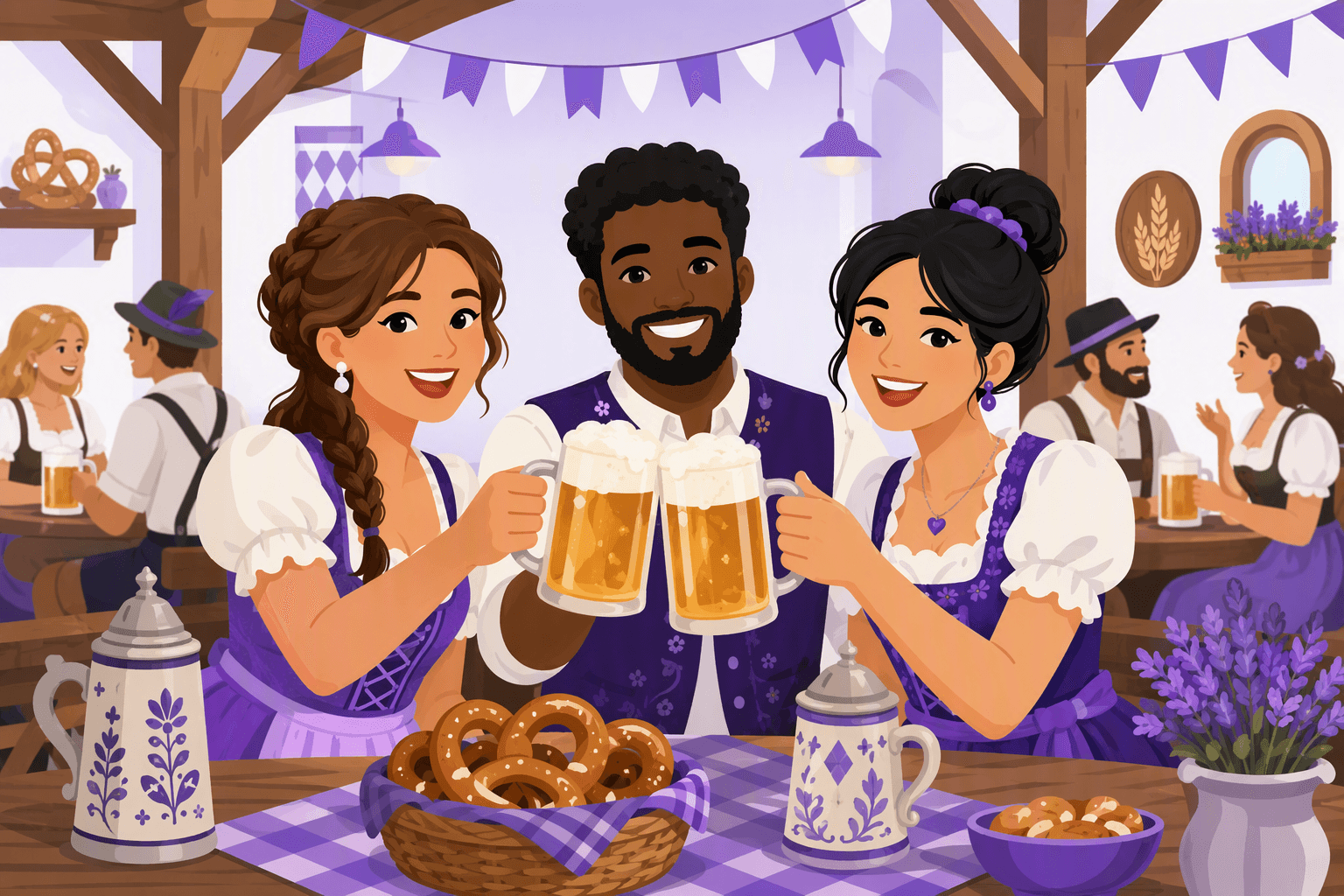
The two essential German cheers
Prost
Prost! /pʁoːst/ is short, friendly, and universal. It is the phrase you will hear most often in pubs, at house parties, during football viewing, and around a restaurant table.
The word is linked historically to the Latin expression prosit, meaning something like may it be beneficial. Modern speakers do not analyze it that way, though. For most Germans, Prost! /pʁoːst/ is simply the normal sound of glasses meeting.
/PROHST/
Literal meaning: A conventional toast, historically connected to Latin 'prosit'.
“Prost! Auf einen schönen Abend!”
Cheers! To a lovely evening!
The default choice for informal drinking occasions. It works with beer, wine, cocktails, and non-alcoholic drinks.
Pronounce Prost /pʁoːst/ in one clean syllable. The vowel is long, and the final st is crisp. A close English approximation is PROHST, but the German r is usually produced farther back in the throat than an English r.
You can say Prost zusammen! /pʁoːst tsuˈzamən/ when addressing a table or group. It means cheers, everyone. This is especially natural if you are the person proposing the first toast but do not want to make a long speech.
Zum Wohl
Zum Wohl! /tsʊm voːl/ literally means to well-being. It has a warmer, more traditional tone than Prost! /pʁoːst/, though it is not stiff or old-fashioned.
Use it at a family dinner, a restaurant meal with older relatives, a wedding reception, or a business meal where you want to sound polished. It is also common in wine settings, but it is never wrong with beer.
/tsoom VOHL/
Literal meaning: To well-being.
“Zum Wohl, auf den Geburtstag!”
Cheers, to the birthday!
A traditional, courteous toast that fits family dinners, celebrations, and restaurant meals.
The z in Zum /tsʊm/ sounds like /ts/, not like the English z in zoo. The w in Wohl /voːl/ sounds like English v. These two sound changes make the phrase much clearer to a German listener.
Duden records both Prost /pʁoːst/ and zum Wohl /tsʊm voːl/ as established toast formulas. Choosing between them is less about strict grammar and more about the mood you want to create.
How German toasting etiquette works
Saying the right word is useful, but German toast etiquette relies on a sequence of small actions. Follow it once or twice, and you will look much more at ease at a shared table.
Make eye contact
In many German social settings, people make eye contact while clinking glasses. If there are four people at the table, you briefly meet each person’s gaze as you touch glasses or move your glass toward theirs.
A popular superstition says that failing to make eye contact while toasting causes seven years of bad sex. Treat this as playful folklore, not a rule to recite at a formal dinner. The practical point is simpler: eye contact shows that you are including the other person in the toast.
Cultural historian Hermann Bausinger examined how everyday rituals carry social meaning in Volkskultur in der technischen Welt. A German toast is one such compact ritual: its words are brief, but it marks belonging, goodwill, and shared attention.
Say the toast before you drink
Do not drink first and say Prost! /pʁoːst/ afterward. Raise your glass, say the phrase, make eye contact, clink if appropriate, then take the first sip.
At a large table, trying to physically clink with everyone can become awkward. Raise your glass toward people farther away, say Prost zusammen! /pʁoːst tsuˈzamən/, and drink. No one expects you to lean across a table full of food.
Clink gently
A heavy beer stein may invite enthusiastic clinking, but a delicate wine glass does not. Touch glasses lightly around the bowl rather than striking the thin rim, especially with stemware.
The gesture itself is optional in some settings. At a formal dinner or a large reception, a raised glass and Zum Wohl! /tsʊm voːl/ can be enough.
🌍 Do not cross arms while clinking
If two people reach across each other and their arms form an X while glasses touch, many Germans will notice it as a small etiquette mistake. It is not a disaster, but simply wait, reposition, and toast normally. The same folk belief often connects crossed arms with bad luck.
Useful German toasts for different occasions
A one-word toast is enough most of the time. When there is a birthday, farewell, engagement, promotion, or reunion, add a short phrase after Prost! /pʁoːst/ or Zum Wohl! /tsʊm voːl/.
Auf dich
Auf dich! /aʊf dɪç/ means to you. Say it directly to one person on their birthday, after good news, or when celebrating something they achieved.
The final sound in dich /dɪç/ is the light German ch, not an English k sound. It is similar to the soft sound in ich /ɪç/.
/owf dikh/
Literal meaning: To you.
“Auf dich und deinen neuen Job!”
To you and your new job!
Use this friendly personal toast for a birthday, achievement, or good news from one person.
Auf uns
Auf uns! /aʊf ʊns/ means to us. It suits a close friend group, a team that has completed something difficult, or a couple celebrating an anniversary.
The phrase can sound affectionate without being overly sentimental. For a romantic setting, you might expand it to Auf uns beide! /aʊf ʊns ˈbaɪdə/, meaning to the two of us.
Auf unsere Freundschaft
Auf unsere Freundschaft! /aʊf ˈʊnzəʁə ˈfʁɔɪntʃaft/ means to our friendship. It is warmer and more deliberate than Auf uns! /aʊf ʊns/, so it works well when reconnecting with old friends or offering a heartfelt toast.
German compound words can look intimidating, but Freundschaft /ˈfʁɔɪntʃaft/ breaks into Freund /fʁɔɪnt/, friend, and -schaft /ʃaft/, a suffix used to form abstract nouns. Learn more everyday social vocabulary alongside our guide to how to say I love you in German.
Auf einen schönen Abend
Auf einen schönen Abend! /aʊf ˈaɪnən ˈʃøːnən ˈaːbənt/ means to a lovely evening. It is an ideal opening toast when people have just arrived for dinner or a night out.
This is friendly but not intimate. Use it with colleagues, new friends, neighbors, or a mixed group where Auf unsere Freundschaft! /aʊf ˈʊnzəʁə ˈfʁɔɪntʃaft/ would feel too personal.
Auf die Liebe
Auf die Liebe! /aʊf diː ˈliːbə/ means to love. You may hear it at weddings, anniversaries, or romantic celebrations. It is sincere, but it can also be said playfully among friends.
For a wedding speech, a speaker may make the toast longer: Auf das Brautpaar! /aʊf das ˈbʁaʊtpaːɐ̯/, meaning to the newlyweds. Keep your glass raised until the toast has ended, then join the group in drinking.
Regional German cheers you may hear
Germany has 16 federal states, and local identity often appears most visibly in food, dialect, and drinking culture. Regional cheers are fun to recognize, but visitors do not need to force them. A well-timed Prost! /pʁoːst/ is always safer than using dialect inaccurately.
O'zapft is
O'zapft is! /ˈoːtsapft ɪs/ is a Bavarian dialect phrase meaning the barrel is tapped. Munich’s mayor traditionally says it to open Oktoberfest after tapping the first beer keg.
It is not the standard phrase you say each time you clink glasses. Instead, it announces that beer service has officially begun. At Oktoberfest, visitors may repeat it enthusiastically, then use Prost! /pʁoːst/ for the actual toast.
Gsuffa
In parts of Bavaria and Austria, you may hear Gsuffa! /ˈɡzʊfa/. It is a dialectal drinking toast connected to the idea of drinking up.
Use it only if you hear locals using it first and the atmosphere is relaxed. It is regional and strongly informal, so it does not belong in a business dinner or a formal restaurant toast.
Prosit
Prosit! /ˈpʁoːzɪt/ is another traditional toast, close in origin to Prost! /pʁoːst/. It can sound more ceremonial or old-fashioned in modern standard German, but you may hear it in songs, traditional gatherings, and Austria.
The Institut für Deutsche Sprache documents the wide range of regional and historical forms in German usage. Toast language is a good reminder that standard German is shared across borders, while local speech carries a strong sense of place.
🌍 Beer is important, but not every toast is about beer
Germany is strongly associated with beer, yet the country also has major wine regions along the Rhine, Mosel, Main, and Neckar. Germans toast with wine, sparkling wine, juice, and mineral water too. The social ritual matters more than what is in the glass.
What not to say when toasting
Avoid translating English phrases word for word. Saying Cheers! in English may be understood, especially in international cities, but Prost! /pʁoːst/ is more natural and takes no effort to learn.
Do not use Gesundheit! /ɡəˈzʊnthaɪt/ as a drinking toast. It means health and is the standard response when someone sneezes. It can appear in longer formal wishes, but by itself it sounds like you are responding to a sneeze.
Also avoid treating every drink as an invitation to shout a long toast. In everyday German life, a quick Prost! /pʁoːst/ is usually the most authentic option. Save speeches for birthdays, weddings, farewells, or a host-led occasion.
If a night becomes especially informal, you may encounter more colorful language. Our German swear words guide explains which expressions are genuinely offensive and which ones are merely frustrated exclamations. They are not substitutes for a friendly toast.
Practice a natural German toast
Start with this short script:
- Wait until everyone has a glass.
- Raise your glass slightly.
- Make eye contact.
- Say Prost! /pʁoːst/.
- Clink gently if the situation allows it.
- Take a sip.
For a dinner invitation, use this version:
Zum Wohl, auf einen schönen Abend! /tsʊm voːl aʊf ˈaɪnən ˈʃøːnən ˈaːbənt/
It means: Cheers, to a lovely evening.
For a farewell party, try:
Auf deinen neuen Anfang! /aʊf ˈdaɪnən ˈnɔʏən ˈanfang/
It means: To your new beginning.
The best German toast is rarely the most complicated one. Say Prost! /pʁoːst/ with clear eye contact and an easy smile, and you will sound natural. When the evening ends, use one of the phrases from our guide to saying goodbye in German, then keep the cultural rhythm of the conversation going with real German clips on Wordy’s German learning page.
Frequently Asked Questions
What is the most common way to say cheers in German?
What does Zum Wohl mean in German?
Do Germans make eye contact when saying Prost?
Can I say Prost with wine in Germany?
What do people say for cheers in Bavaria?
Sources & References
- Goethe-Institut, German Language Facts, accessed 2026
- Duden, entry for 'Prost', accessed 2026
- Duden, entry for 'zum Wohl', accessed 2026
- Institut für Deutsche Sprache, German language information resources, accessed 2026
- Hermann Bausinger, Volkskultur in der technischen Welt, Campus Verlag
Start learning with Wordy
Watch real movie clips and build your vocabulary as you go. Free to download.


