Quick Answer
Yes, you can learn two languages at once if you give each language a distinct purpose, schedule, and input source. Start with one priority language, keep the second lighter, and avoid treating two beginner courses as identical daily tasks.
Yes, you can learn two languages at once, but only if you stop treating them as two equal full-time projects. Make one language your priority, give the other a lighter but regular role, and separate them through different times, media, and goals. The most reliable setup is a 70/30 time split, with one language for serious progress and the second for steady exposure.
This approach works especially well when your reason for learning each language is different. You might study English for work and Japanese for anime, travel, or family. Clear purposes make it easier to decide what to practice when your schedule gets busy.
Ethnologue’s 27th edition lists more than 7,000 living languages worldwide, and multilingualism is a normal reality for a huge share of the global population. Learning two languages is not unusual. The challenge is not whether the human brain can handle it, but whether your study system protects your time and attention.
If you are still creating a sustainable routine, begin with these language learning tips for beginners. Then use the plan below to add a second language without turning every study session into a stressful comparison.
Start with a primary language and a secondary language
The main mistake in learning two languages simultaneously is giving both the same vague goal: become fluent. That creates two large, undefined workloads.
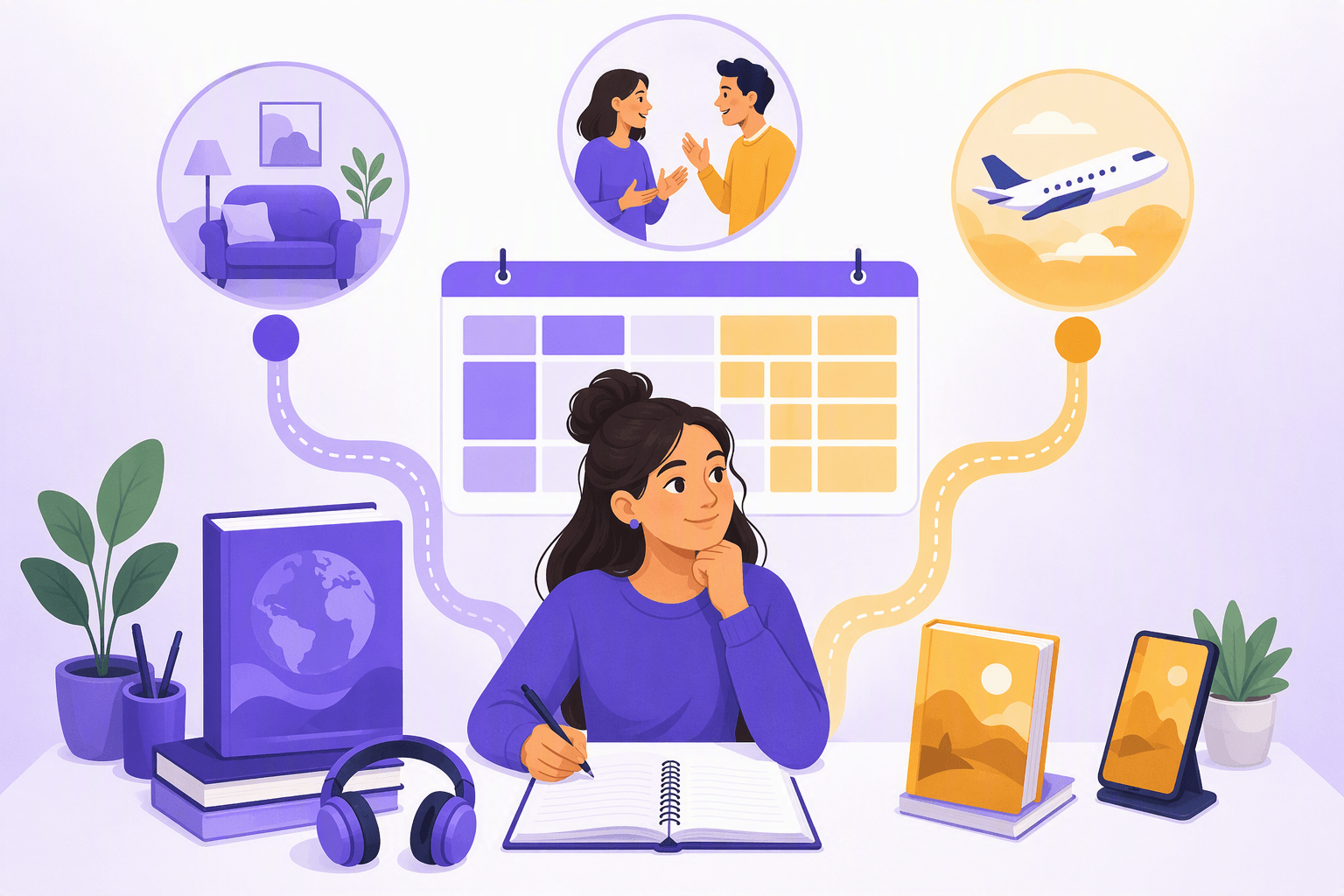
Instead, name one language your primary language. It receives your hardest work: grammar, speaking practice, writing feedback, and focused listening. Your secondary language receives shorter, lower-pressure sessions built around vocabulary, easy listening, reading, or an enjoyable show.
A realistic weekly division might look like this:
| Study area | Primary language | Secondary language |
|---|---|---|
| Focused study | 5 to 7 hours | 2 to 3 hours |
| Listening and reading | 3 to 5 hours | 2 to 4 hours |
| Speaking or writing | 2 to 3 sessions | 1 session |
| Main goal | Active progress | Consistency and familiarity |
The Council of Europe’s CEFR framework separates receptive skills, listening and reading, from productive skills, speaking and writing. That distinction is useful here. Your secondary language can progress through plentiful receptive input before you demand confident conversation from yourself.
Choose your priority by consequences
Ask a practical question: which language would cost you more to pause for six months? That is usually your priority language.
For example, English may be primary if you need it for university, work, immigration, or an exam. A second language can still be meaningful, but it should not take the time reserved for deadlines and real-world needs.
Your priority can change later. Treat the arrangement as a season, not a permanent ranking.
Pick a pairing that fits your attention
You can study any two languages, but some pairings require more careful planning. Similar languages offer shortcuts in vocabulary and grammar, yet they also create more interference.
Spanish and Italian learners may accidentally use the wrong article, ending, or word because the languages have related forms. Japanese and English learners tend to mix fewer individual words, but each language may demand very different skills and learning materials.
Similar languages: useful, but easy to blur
Related languages are not a bad choice. In fact, cognates can speed up early reading. The risk appears when you study matching grammar chapters back to back.
Do not study Spanish past tense at 7 p.m. and Italian past tense at 7:30 p.m. on the same day. Give each language a different context. You could use Spanish for conversation tutoring and Italian for cooking videos, music, or travel reading.
Keep separate notebooks, separate flashcard decks, and separate browser bookmark folders. These small boundaries reduce the feeling that both languages are competing for the same mental space.
Distant languages: less interference, more task switching
A distant pair, such as English and Korean, usually produces fewer look-alike words. However, you may have to switch between very different grammar patterns, scripts, and pronunciation systems.
That can be mentally tiring. Rather than forcing equal study blocks, give the more demanding language your best concentration window. If Korean writing practice needs fresh attention, do it before work or school, not after a long day.
💡 Use different sensory cues
Assign each language a different location, notebook color, playlist, or time of day. These cues do not magically create memory, but they make it easier to enter the right language mode and reduce accidental switching.
Build a schedule you can repeat
A good two-language plan does not require a perfect two-hour daily routine. It requires repeatable contact with both languages across a normal week.
Try this baseline schedule:
| Day | Primary language | Secondary language |
|---|---|---|
| Monday | Grammar and speaking | Short vocabulary review |
| Tuesday | Listening and shadowing | Easy video or podcast |
| Wednesday | Reading and writing | Flashcards and one sentence |
| Thursday | Conversation practice | Short reading |
| Friday | Review weak points | Music, clips, or casual input |
| Saturday | Longer immersion session | Light recap |
| Sunday | Rest or catch-up | Rest or enjoyable exposure |
For the primary language, aim for sessions with a visible output: a recording, corrected paragraph, completed exercise, or conversation. For the secondary language, success can be simpler: finish a five-minute clip, recognize ten useful words, or read a short dialogue.
This protects motivation. You are not failing the secondary language because you did not complete a textbook chapter. You are building a habit that will be ready for more intensity later.
Give each language a different job
Two languages feel overwhelming when both demand every skill every day. Assign each one a specific role in your life instead.
For example, make English your professional language. Read news, write emails, practice meetings, and watch workplace scenes. If you are building English from the beginning, movies for learning English can provide repeated exposure to natural rhythm, emotion, and everyday dialogue.
Make your second language personal or cultural. Use it for a favorite musician, food channel, game, sports league, or drama. Motivation becomes more durable when the language gives you access to something you already care about.
François Grosjean’s work on bilingualism argues against measuring bilingual people against an unrealistic standard of equal mastery in every domain. A person can use one language at work, another at home, and a third for travel. Your two languages do not need identical strengths to be useful.
🌍 Different identities can support different languages
Many multilingual people do not use every language in every setting. One language may belong to friends, another to family, another to work, and another to entertainment. Creating those boundaries as a learner is practical, not artificial.
Prevent mix-ups without fearing them
Mixing words is a normal part of multilingual processing. It happens to experienced bilingual speakers too, especially when both languages are active in the same setting.
Judith Kroll and Paola Dussias describe bilingual language processing as interactive rather than as two sealed systems. In simple terms, knowing one language does not switch the other one completely off. The goal is not zero interference. The goal is being able to select the right language when needed.
Use separate input streams
Do not rely on the same generic app, same lesson format, and same time slot for both languages. Make the input distinct.
For one language, use a structured course and audio lessons. For the other, use subtitles, short videos, graded readers, or flashcards. Different formats make the languages easier to retrieve as separate habits.
If English is one of your languages, choose a narrow content category for it. You might learn informal expressions through English slang, then practice recognizing them in scenes. Keep your other language connected to a different genre or medium.
Avoid translation chains
A translation chain is when you try to move through multiple languages before reaching meaning. For instance, you see a Japanese word, remember its Spanish equivalent, then retrieve English. That is slow and fragile.
Instead, connect new words directly to a picture, situation, gesture, or simple definition. If you learn a word for a number, connect it to the quantity itself. Resources such as English numbers can help you build direct associations with dates, prices, times, and amounts rather than isolated translations.
Keep mistakes visible
Create a small error log for each language. Write down recurring problems, such as confusing Spanish ser and estar, dropping English articles, or using the wrong Korean politeness ending.
Review the log once a week. This is more useful than rereading every note you have ever made. It turns mistakes into a short, personal curriculum.
Do not double your beginner workload
Two languages at A0 or A1 can be exciting for a week and exhausting by week four. Both demand basic vocabulary, pronunciation practice, grammar explanations, and confidence-building at the same time.
If you must begin both from zero, reduce the second language to an exposure phase for the first eight to twelve weeks. Learn its sound system, a few survival phrases, high-frequency words, and cultural context. Save serious grammar study until your primary language has a stable routine.
A stable routine means you know what to do without constantly searching for new resources. You can review vocabulary, understand beginner material, and complete a short practice session even on a low-energy day.
Use retrieval and spacing across both languages
Time management matters, but memory design matters too. Robert and Elizabeth Bjork’s work on desirable difficulties shows why effortful retrieval, bringing information back to mind rather than simply rereading it, supports durable learning.
For two languages, this means short recall sessions are powerful. Cover the answer, say the phrase aloud, write a sentence from memory, or pause a clip and predict the next line.
Spaced repetition is especially helpful because it prevents both languages from demanding all your review at once. Set separate decks and daily limits. A pile of 300 due cards in two languages is not discipline, it is a warning that your system needs fewer new items.
For a clearer method, read our guide to spaced repetition for language learning. The key principle is simple: add new material slowly enough that future reviews remain manageable.
Measure progress in two different ways
Do not use one metric for both languages. Your primary language may need CEFR-style goals: hold a 15-minute conversation, write a work email, or understand a news report.
Your secondary language may need habit goals: watch three short clips weekly, recognize 100 core words, or send one message to a language partner. Both forms of progress count.
Use a monthly check-in with these questions:
- Can I understand more than I could four weeks ago?
- Can I produce a few new sentences without notes?
- Is my schedule still realistic?
- Which language is being neglected?
- Do I need to reduce new vocabulary or add more listening?
If you miss a week, restart with the smallest useful action. Watch one clip, review ten cards, or read one paragraph. Consistency is built by restarting quickly, not by waiting for a perfect Monday.
When learning two languages at once is a bad idea
Studying two languages simultaneously is not always the right choice. Choose one language first if you have an imminent exam, a move abroad, a demanding job requirement, or very limited study time.
It may also be wise to wait if your first language routine keeps collapsing. Adding another language will not fix a lack of time, unclear goals, or burnout. Address those problems first.
⚠️ Watch for overload, not ordinary confusion
Pause or reduce the secondary language if you routinely skip both, dread study sessions, or cannot remember material because you are rushing through it. Occasional word mix-ups are normal. Persistent exhaustion is a scheduling problem.
A sustainable two-language plan
Learning two languages at once works when you make one language active and urgent, while the other stays alive through enjoyable, low-pressure contact. Give them separate goals, separate materials, separate contexts, and unequal time.
After three months, reassess. If the secondary language habit is stable, increase it gradually. If the primary language needs more attention, scale the second back without guilt. Languages are long-term skills, and your plan should adapt to your real life.
For more ways to make input enjoyable and repeatable, explore how to learn a language with movies. A few well-chosen scenes, revisited often, can support either language without adding another heavy course to your week.
Frequently Asked Questions
Can a beginner learn two languages at once?
Will I mix up two languages if I study them together?
Which two languages are easiest to learn together?
How much time do I need to learn two languages at once?
Should I reach a certain level in one language before starting another?
Sources & References
- Ethnologue, Ethnologue: Languages of the World, 27th edition, 2024
- Council of Europe, Common European Framework of Reference for Languages: Companion Volume
- François Grosjean, Bilingual: Life and Reality, Harvard University Press
- Judith F. Kroll and Paola E. Dussias, The Comprehension of Words and Sentences in Two Languages
- Robert A. Bjork and Elizabeth L. Bjork, Making Things Hard on Yourself, But in a Good Way
Start learning with Wordy
Watch real movie clips and build your vocabulary as you go. Free to download.


