Quick Answer
English is moderately difficult to learn: grammar is relatively simple (no gendered nouns, limited verb endings), but spelling, pronunciation, phrasal verbs, and idioms make real fluency challenging. Most learners can reach everyday conversational ability in months, but strong listening and natural-sounding speaking usually take years of consistent exposure to real speech.
English is moderately difficult to learn: the grammar is friendlier than many European languages, but pronunciation, spelling, and everyday “spoken” English (phrasal verbs, reductions, idioms, slang) make it hard to sound natural. If your goal is basic conversation, English can feel fast to pick up, but if your goal is confident listening and fluent speaking, expect a longer climb.
English is also a special case because it is a global language. Ethnologue estimates about 1.5 billion English speakers worldwide when you include both native and second-language speakers (Ethnologue, 27th edition, 2024), which means you will hear many accents and local varieties from day one.
If you want a practical next step, pair structured study with real listening. Movie and TV clips are especially effective for training your ear, and our list of the best movies to learn English is built for that.

How hard is English, really?
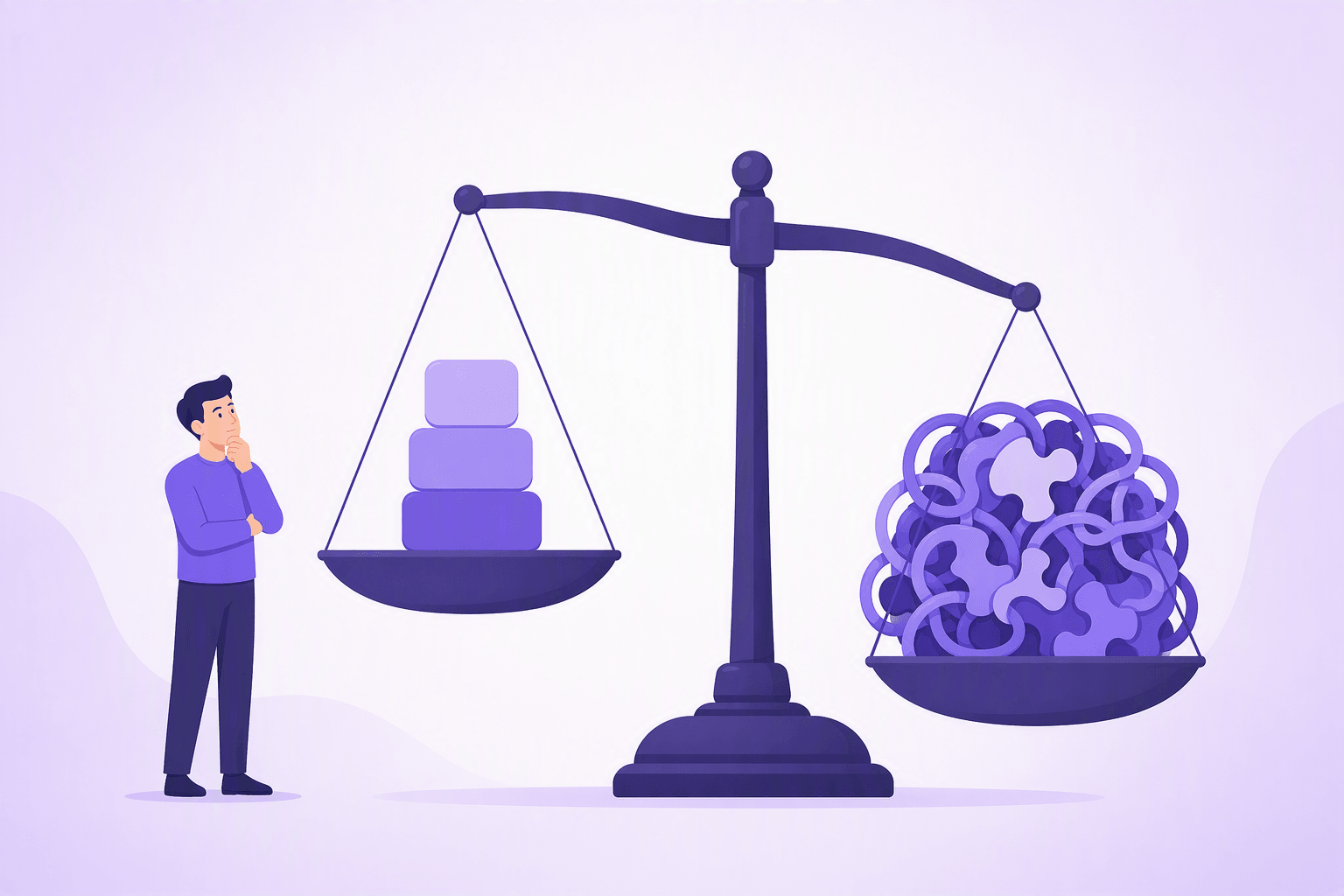
English is “easy to start, hard to finish.” You can form useful sentences quickly, but reaching the point where you understand fast speech and respond naturally is where most learners get stuck.
A good way to measure difficulty is the CEFR scale (A1 to C2). Many learners can reach A2 or B1 with consistent study, but moving from B1 to B2 often takes longer than going from A1 to B1, because B2 requires automatic listening, vocabulary depth, and flexible grammar control (Council of Europe, CEFR Companion Volume, accessed 2026).
What makes English easier than you expect
English has several learner-friendly features:
- No grammatical gender for most nouns. You do not have to memorize “the table is feminine” like in French or Spanish.
- Limited verb conjugation. In the present tense, only the third-person singular adds an -s (he runs).
- Simple adjective agreement. Adjectives do not change for gender or number (a big house, two big houses).
- A huge amount of learning material. Because English is global, you have endless graded readers, podcasts, shows, and communities.
This is why English often feels “fast” in the first months.
What makes English harder than it looks
English becomes difficult in four main areas:
- Pronunciation does not match spelling.
- Listening is full of reductions (gonna, wanna, kinda) and connected speech.
- Vocabulary is massive and layered (Germanic everyday words plus Latinate formal words).
- Phrasal verbs and idioms are everywhere in real conversation.
David Crystal, in The Cambridge Encyclopedia of the English Language (Cambridge University Press), highlights how English’s history of contact and borrowing shaped its vocabulary and spelling. That history is a big reason learners feel English is “full of exceptions.”
The global reality: English has many “correct” versions
English is spoken as an official or widely used language across dozens of countries and regions. Even within one country, accents and everyday vocabulary can vary sharply.
That variety is not a problem, but it changes what “learning English” means. You are not learning one single sound system and one single set of everyday words.
🌍 Pick an anchor accent early
Choose one anchor accent for pronunciation (General American, RP, General Australian, etc.), then learn to understand other accents later. This reduces confusion and helps you build consistent muscle memory for speaking.
If you are curious about variation inside English, our American vs British English guide shows how spelling, pronunciation, and everyday words diverge in predictable ways.
The hardest parts of English (and how to beat them)
Most learners do not fail because English is “too complex.” They fail because they train the wrong things: they over-focus on written exercises and under-train listening and speaking.
Pronunciation: the spelling trap
English spelling is not a reliable pronunciation guide. Compare:
- though (THOH)
- through (THROO)
- tough (TUHF)
- thought (THAWT)
These are not random. English spelling reflects older pronunciations and multiple source languages, and dictionaries preserve spellings even when sounds shift over time (Oxford English Dictionary, accessed 2026).
What to do instead: learn pronunciation from audio first, then connect it to spelling. Use a learner dictionary with audio (Cambridge Dictionary, accessed 2026) and shadow short clips.
Listening: reductions and connected speech
Spoken English often compresses words:
- going to becomes gonna (GUH-nuh)
- want to becomes wanna (WAH-nuh)
- did you becomes didja (DIH-juh)
- I don’t know becomes I dunno (eye DUH-noh)
Learners who only study “clean” textbook audio often understand the teacher but not a real conversation.
Fix: train with real dialogue and repeat the same clip until it becomes easy. If you want a structured way to do this, start with the English pronunciation guide and then add daily clip practice.
Vocabulary: English has many near-synonyms
English often offers multiple choices with different tone levels:
- ask (neutral)
- request (formal)
- inquire (formal, sometimes stiff)
- wonder (soft, indirect)
This is partly because English mixes Germanic roots (short, everyday words) with French and Latin borrowings (often more formal). Steven Pinker, in The Language Instinct (William Morrow), discusses how language structure interacts with cognition and usage, and English vocabulary is a clear example of how usage and history shape what sounds “natural.”
Fix: learn vocabulary in pairs with context: “word + situation,” not “word + translation.”
Phrasal verbs: the real everyday engine
Phrasal verbs are combinations like pick up, run into, figure out, put off. They are extremely common in speech, and they often do not map neatly to a single word in other languages.
Two problems make them hard:
- The particle changes meaning (up, out, off).
- Some are separable (pick the kids up).
Fix: learn high-frequency phrasal verbs through scenes, not lists. A single clip can teach you meaning, tone, and grammar placement in one go.
Idioms and “set phrases”
English has many fixed expressions that do not mean what the words literally say:
- It depends.
- No worries.
- You’ve got this.
- That makes sense.
- I’m down. (I agree, I’m interested)
Idioms are not decoration. They are how people speak quickly and socially.
Fix: collect a small bank of high-utility phrases and reuse them until they become automatic. Our English idioms and expressions list is a good starting point.
Grammar: simpler than you think, but full of “small” problems
English grammar is not the main difficulty, but it has a lot of small traps that add up.
Articles: a, an, the
Many languages do not use articles the same way English does. Learners often say “I went to store” or overuse “the.”
Articles are hard because they encode shared knowledge and specificity, not just “a vs the.” If you want a clear system, use our English articles guide.
Tense and aspect: “I did” vs “I have done”
English tense is not only about time, it is also about viewpoint. The present perfect (I have seen it) often signals relevance to now, not simply “past.”
Bernard Comrie’s work on aspect (Cambridge University Press) is a useful lens here: languages package time and viewpoint differently, and English learners often need practice thinking in “completed vs ongoing vs relevant-now” frames.
If this is a pain point, our English past tense guide breaks it down with real examples.
Word order: strict in the basics, flexible in style
English relies heavily on word order because it has limited case marking. That is why “The dog bit the man” is different from “The man bit the dog.”
At the same time, English becomes flexible for emphasis:
- What I need is sleep.
- Sleep is what I need.
Fix: master the default patterns first, then learn stylistic variations from reading and listening.
How long does it take to learn English?
Time depends on your starting point, your native language, and how much real input you get. But you can still plan realistically.
A practical timeline (with CEFR milestones)
These ranges assume consistent study plus regular listening practice:
- A1 to A2: 2 to 4 months
- A2 to B1: 4 to 10 months
- B1 to B2: 8 to 18 months
- B2 to C1: 12 to 24+ months
The jump from B1 to B2 is often the “plateau,” because B2 requires fast comprehension and fewer pauses.

💡 The plateau is usually a listening problem
If you can read and do grammar exercises but struggle in conversation, your bottleneck is probably listening speed and phrase recognition. Fix that with daily short clips, repeated often, rather than longer content you barely understand.
Your native language matters
Learners whose first language is closer to English (Dutch, German, Scandinavian languages) often find vocabulary and sentence structure more familiar.
Learners from languages with very different sound systems or writing systems may find pronunciation and spelling more demanding. This is not about intelligence, it is about distance between systems.
What “fluent” means in real life
Many learners chase a vague idea of fluency and feel discouraged. Use a functional definition instead.
Functional fluency vs native-like fluency
Functional fluency means you can:
- handle daily life without translating in your head
- follow movies with occasional misses
- work or study with manageable friction
Native-like fluency is a different target. It can be achievable, but it usually requires years of immersion-level exposure and social use.
The British Council’s reporting on English as a global skill emphasizes that English is used for international communication in many contexts, and “good English” often means clear, effective communication, not sounding like a specific native speaker (British Council, accessed 2026).
A realistic method that works (without burning out)
If you want the fastest path to confident English, combine three tracks.
Track 1: Build a core vocabulary you actually use
Start with high-frequency words and phrases, then expand. A frequency-based list helps you avoid rare words that feel impressive but do not unlock conversation.
Our 100 most common English words list is a strong base, and you can pair it with practical sets like English numbers so you stop hesitating on dates, prices, and times.
Track 2: Train listening every day with short, repeatable audio
Ten minutes daily beats one long session weekly. Short clips let you repeat the same material until your brain stops “decoding” and starts recognizing.
If you want a structured approach to learning through scenes, Wordy focuses on real movie and TV clips with interactive subtitles and review tools. The key is not the app name, it is the method: repeated, level-appropriate input.
Track 3: Speak early, but speak with constraints
Free conversation is hard at A2 or B1 because you do not have enough automatic phrases. Use constraints:
- retell a short clip in your own words
- answer the same question in three ways
- practice a “safe” set of conversation starters
If you need building blocks for natural conversation, English travel phrases are useful even if you are not traveling, because they cover requests, clarifying, and polite interaction.
Cultural friction points: what surprises learners in English-speaking contexts
Language difficulty is not only grammar. It is also social expectations.
Indirectness and softening
In many English-speaking workplaces, direct commands can sound rude unless softened:
- “Send me the file.” (can sound sharp)
- “Could you send me the file when you get a chance?” (polite, normal)
This is not “fake politeness.” It is a common face-saving pattern in English interaction, similar to what politeness research describes in many cultures (Brown & Levinson, Politeness: Some Universals in Language Usage, Cambridge University Press).
Small talk is a skill, not fluff
In the US, Canada, and the UK, short small talk often functions as social glue. Weather, weekend plans, and light opinions are common.
If you skip it entirely, you can seem cold even if your English is correct. If you overdo it, you can seem intrusive. The balance is cultural.
Slang and swearing: recognition matters more than production
You do not need to use slang or swear words, but you should recognize common ones so you do not misread tone.
If you want to understand what you hear without accidentally sounding aggressive, use these as reference guides:
⚠️ Do not copy what you hear in movies blindly
Movies exaggerate sarcasm, insults, and banter. Learn to understand these styles first, then choose what fits your personality and context. What sounds funny on screen can sound hostile in real life.
The bottom line: is English hard to learn?
English is not the hardest language to learn, but it is harder than its simple grammar suggests. If you treat English as a written school subject, you will plateau. If you treat it as a listening and speaking skill, and train with real input, you can progress steadily and reach strong fluency.
If you want a practical way to build that “real speech” ability, start with the best movies to learn English and make daily listening non-negotiable. Consistency beats intensity, especially for pronunciation and comprehension.
Frequently Asked Questions
Is English harder than Spanish or French?
How long does it take to become fluent in English?
What is the hardest part of English for most learners?
Do I need to learn slang to speak good English?
Why is English spelling so inconsistent?
Sources & References
- Ethnologue, 27th edition, 2024
- British Council, The English Effect (accessed 2026)
- Cambridge Dictionary, pronunciation and usage entries (accessed 2026)
- Oxford English Dictionary, etymology notes and headwords (accessed 2026)
- Council of Europe, Common European Framework of Reference for Languages (CEFR) Companion Volume (accessed 2026)
Start learning with Wordy
Watch real movie clips and build your vocabulary as you go. Free to download.


