Quick Answer
Use simple past for finished actions at a finished time (I saw it yesterday). Use present perfect for past actions connected to now (I have seen it). Use past continuous for background actions in progress (I was watching). Use past perfect to show an earlier past (I had left).
English past tenses are easiest when you choose based on time and connection to the present: use simple past for finished actions in a finished time (I saw it yesterday), present perfect for past actions that matter now (I have seen it), past continuous for actions in progress in the background (I was watching), and past perfect to show an earlier past before another past moment (I had left).
English is also the world’s most widely learned second language, and it has roughly 1.5 billion total speakers when you combine native and second-language users (Ethnologue, 27th edition, 2024). That means these tense choices are not just “grammar”, they are daily clarity tools in global work, travel, and media.
If you want more everyday context, pair this guide with real listening: our picks for the best movies to learn English make tense differences easier to hear.
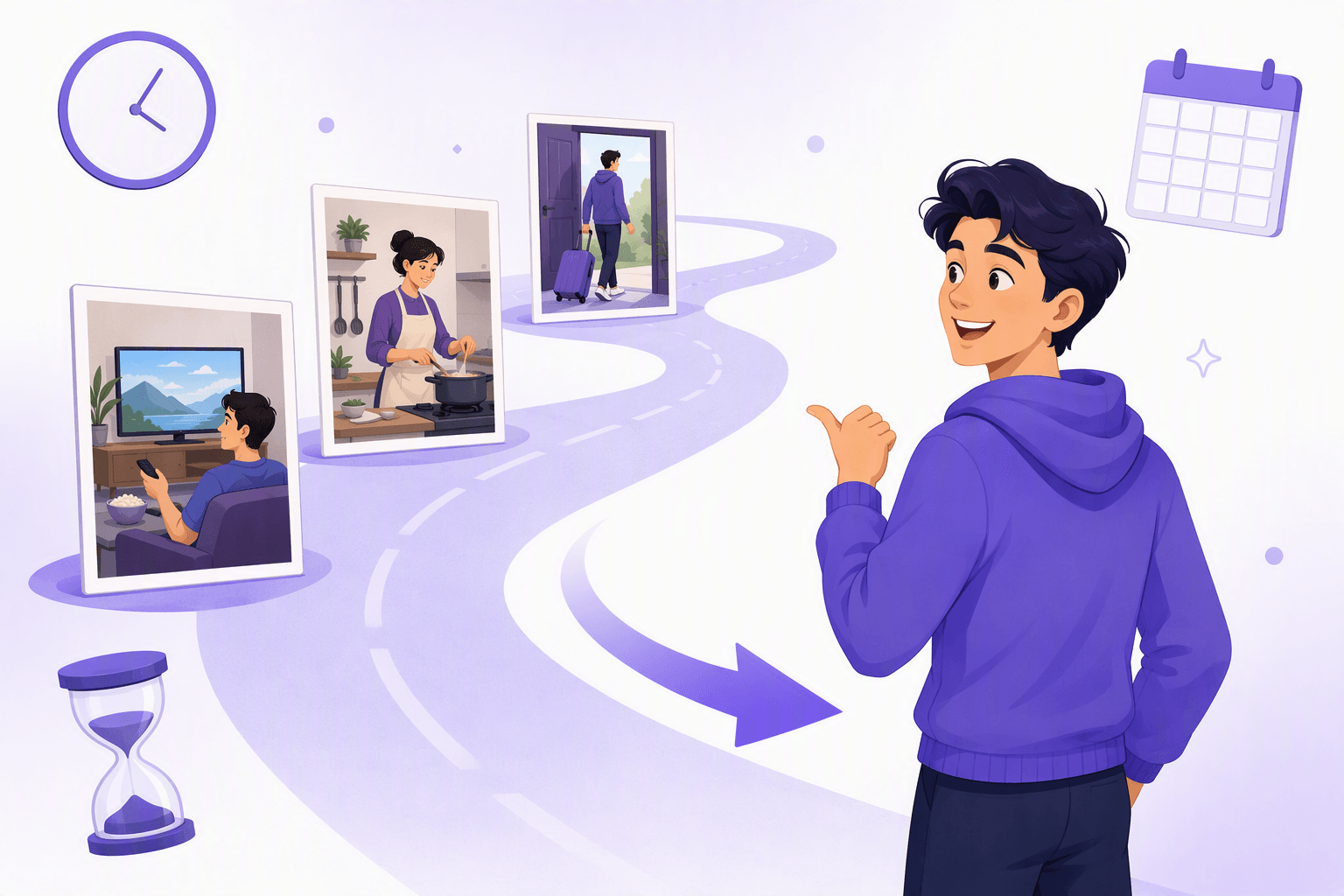
The four past forms you actually need (most of the time)
English has more than one way to talk about the past, but most real conversations rely on four core forms. The trick is to stop thinking “past equals -ed” and start thinking “timeline”.
Here are the forms you will see in this guide:
- Simple past: I watched, I went, I saw
- Present perfect: I have watched, I have gone, I have seen
- Past continuous: I was watching, I was going
- Past perfect: I had watched, I had gone
You will also hear used to and would for past habits, and past perfect continuous (I had been watching) in storytelling, but you can speak very well without overusing them.
Simple past: finished action, finished time
Simple past is the default tense for telling what happened. If the time is finished, or you name a finished time, simple past is usually the correct choice.
Form (regular and irregular)
- Regular verbs: verb + -ed
watch → watched (WAHCHT), work → worked (WURKT) - Irregular verbs: change form
go → went (WEHNT), see → saw (SAW), buy → bought (BAWT)
If you need a refresher on irregular patterns, our English irregular verbs guide helps you stop guessing.
When to use it
Use simple past for:
- A completed action: “I finished the report.”
- A completed series: “We ate, talked, and left.”
- A finished time marker: “I saw it yesterday.”
Time words that strongly signal simple past
These words usually push you to simple past:
- yesterday
- last night / last week / last year
- in 2019
- two days ago
- when I was a kid (finished period)
Examples:
- “I met her last year.”
- “They moved here in 2020.”
- “We watched it two days ago.”
⚠️ Avoid this common error
In standard English, do not combine present perfect with a finished time word: avoid "I have seen it yesterday." Prefer "I saw it yesterday."
Pronunciation note: -ed endings
The -ed ending has three common pronunciations:
- /t/ like “watched” (WAHCHT)
- /d/ like “played” (PLAYD)
- /ɪd/ like “wanted” (WAHN-tid)
This matters for listening. In fast speech, “worked” can sound almost like “workt”.
Present perfect: past with a connection to now
Present perfect (have/has + past participle) is not “a past tense” in the same way as simple past. It is a bridge between past and present.
In Practical English Usage (Michael Swan, Oxford University Press), the key idea is that present perfect is used when the past action is relevant to the present, and the time is not treated as finished.
Form
- I/you/we/they have + past participle: “I have eaten” (eye hav EE-tn)
- he/she/it has + past participle: “She has eaten” (shee haz EE-tn)
Past participle is often the same as simple past for regular verbs (watched), but can differ for irregular verbs (go → gone, see → seen).
Three high-frequency uses
1) Life experience (no specific time)
- “I have been to Japan.”
- “Have you ever tried sushi?”
You are not saying when. You are saying it happened at least once in your life.
2) Result now
- “I have lost my keys.” (Result: I don’t have them now.)
- “They have finished.” (Result: it’s done now.)
3) Unfinished time period
- “I have worked a lot this week.”
- “We have had three meetings today.”
“This week” and “today” are still open time periods.
Yet, already, just: US vs UK feel
In British English, present perfect is especially common with just, already, and yet:
- UK-leaning: “I’ve just eaten.”
- US often allows simple past: “I just ate.”
Both are widely understood. If you are writing formally, present perfect is a safe choice when the time is not finished.
For more on regional differences, see American vs British English.
Past continuous: background action in progress
Past continuous (was/were + -ing) describes an action that was in progress at a specific past moment. It often sets the scene.
In The Cambridge Grammar of the English Language (Huddleston and Pullum, Cambridge University Press), aspect is treated as a core way English shows how an event unfolds, not just when it happens. Past continuous is one of the most practical aspect choices for storytelling.
Form
- I/he/she/it was + -ing: “I was driving” (eye wuz DRY-ving)
- you/we/they were + -ing: “They were talking” (thay wur TAW-king)
The most useful pattern: interruption
- “I was watching TV when you called.”
- “She was sleeping when the alarm went off.”
Past continuous is the background. Simple past is the interrupting event.

Two actions in progress at the same time
- “While I was cooking, he was cleaning.”
- “They were arguing all night.”
“All night” here describes duration, not a finished point like “yesterday at 3”.
What not to do
Do not use past continuous for a completed action with a clear finished time:
- Odd: “I was cooking dinner last night.” (Possible, but it focuses on the process.)
- Better if completed: “I cooked dinner last night.”
Choose based on what you want the listener to imagine: the action as a whole (simple past) or the action in progress (past continuous).
Past perfect: the past before the past
Past perfect (had + past participle) is a sequencing tool. It tells your listener: “This happened earlier than the past moment we’re talking about.”
Form
- “I had left.” (eye had LEHFT)
- “They had seen it.” (thay had SEEN it)
When you need it
Use past perfect when two past events could be confusing without it:
- “When I arrived, they had already left.”
- “I had never tried it before that day.”
If you say “When I arrived, they left,” it can sound like they left after you arrived. Past perfect removes that ambiguity.
When you can skip it
If you tell events in order, simple past is usually enough:
- “I woke up, got dressed, and left.”
Past perfect is most helpful when you jump backward in time inside a story.
A practical timeline: how to choose fast
When you are speaking, you do not have time to run grammar rules in your head. Use these quick questions instead:
-
Did you say a finished time? (yesterday, last week, in 2019)
→ Use simple past. -
Is the time unfinished, or is the past relevant now? (today, this week, result now, life experience)
→ Use present perfect. -
Are you describing an action in progress at a past moment?
→ Use past continuous. -
Are you comparing two past events and need to show which came first?
→ Use past perfect.
This is also why movie dialogue is so useful: characters constantly switch tenses to manage what the listener knows right now. If you want a structured way to practice that, combine this with how to learn a language with movies.
Real examples you will hear in movies and TV
Native dialogue uses tense choices to manage social meaning, not just time. Here are patterns that show up constantly.
“Did you…?” vs “Have you…?”
- “Did you see that?” often means a specific moment, usually very recent, and the speaker thinks it happened.
- “Have you seen that movie?” often means life experience, up to now.
In American casual speech, “Did you eat yet?” is extremely common, even though “Have you eaten yet?” is also correct. If you learn only one, learn the version you hear most in your target accent.
Present perfect for “news”
English often uses present perfect to announce new information with a current result:
- “They have arrested him.”
- “I have found it.”
Then the story switches to simple past for details:
- “They arrested him last night at 11.”
This “headline then details” pattern is common in journalism and police-procedural shows.
Past continuous for politeness and softening
Past continuous can make a question feel less direct:
- “I was wondering if you could help.” (eye wuz WUHN-der-ing)
It is not literally about the past. It is a politeness strategy that makes the request feel less sharp, which aligns with classic politeness theory in pragmatics (Brown and Levinson, Politeness: Some Universals in Language Usage, Cambridge University Press).
Common learner problems (and the fixes)
Problem 1: Overusing present perfect
Many learners try to use present perfect for any past event. English does not work that way.
Fix: if you can answer “When?” with a finished time, switch to simple past.
- Correct: “I saw him yesterday.”
- Correct: “I have seen him recently.” (no finished time)
Problem 2: Mixing up “been” and “gone”
- “He has gone to the store.” (He is there now, not here.)
- “He has been to the store.” (He went at some point, and came back, or it is just experience.)
This is a frequent listening trap because both sound similar in fast speech.
Problem 3: Using past perfect everywhere in stories
Past perfect is not “more advanced simple past”. It is a tool for a specific job.
Fix: use past perfect only when you jump back to an earlier event, or when order is unclear.
Problem 4: Confusing “used to” with simple past
- “I used to live here.” (habit or state in the past, not true now)
- “I lived here in 2020.” (fact, could still be true or not, depends on context)
“Used to” is excellent for background in personal stories.
Mini tables: forms you can copy
Simple past vs present perfect (same verb)
| Meaning | Example | Pronunciation |
|---|---|---|
| Finished past | I watched it yesterday. | eye WAHCHT it YES-ter-day |
| Experience/result | I have watched it. | eye hav WAHCHT it |
Past continuous with interruption
| Background (in progress) | Interrupting event | Pronunciation |
|---|---|---|
| I was driving | when you called | eye wuz DRY-ving, when yoo KAWLD |
| They were talking | when she walked in | thay wur TAW-king, when shee WAWKT in |
Past perfect for earlier past
| Earlier event | Later past moment | Pronunciation |
|---|---|---|
| They had left | when I arrived | thay had LEHFT, when eye uh-RYVD |
| I had never seen it | before that day | eye had NEH-ver SEEN it |
A culture note: “time words” are social words
In real English, time words often carry social meaning.
Saying “I have sent it” can imply “and you should have it now,” which can sound slightly pushy in work chat. Saying “I sent it” is often more neutral, especially if the other person might not have checked yet.
This is why tense choice matters in emails, customer support, and teamwork, not just exams. If you also want to sound natural in informal settings, learn how tense mixes with slang and tone in our English slang guide. (And if you are curious how strong language behaves in past narratives, our English swear words guide covers context and register.)
🌍 Why native speakers correct 'I have seen it yesterday' so fast
Native speakers treat words like "yesterday" and "last year" as a closed box. Once you put an event inside a closed time box, English usually wants simple past. Present perfect feels like the box is still open, like "today" or "this week", or like you are talking about experience without a box at all.
Practice method: learn past tenses through scenes, not sentences
If you only do isolated exercises, you can “know the rule” and still freeze in conversation. Scenes force you to choose tenses at speed.
A simple routine:
- Watch a short clip and write down every past verb you hear.
- Label each one: finished time, result now, background in progress, earlier past.
- Rewatch and shadow the line with the same rhythm and stress.
If you like structured repetition, combine clip learning with spaced review. Our Anki guide for language learning explains how to turn real sentences into flashcards without memorizing junk.
Quick checklist for writing and speaking
- If you said yesterday/last/in 2019/ago, use simple past.
- If you mean experience/result/unfinished time, use present perfect.
- If you are painting the scene, use past continuous.
- If you need “earlier than that,” use past perfect.
To keep your practice grounded in real usage, add numbers and time expressions too, because they trigger tense choices constantly. Our English numbers guide is a good companion for dates, years, and quick time phrases.
Final takeaway
English past tenses are not about memorizing names, they are about choosing the listener’s timeline: simple past for completed events in a finished time, present perfect for past connected to now, past continuous for actions in progress, and past perfect for an earlier past. Once you start noticing time markers and story order in real dialogue, the “right tense” becomes a fast, automatic choice.
Frequently Asked Questions
What is the difference between simple past and present perfect?
Can I say 'I have seen him yesterday'?
When do I use past perfect (had + past participle)?
What is the most common mistake with past continuous?
Do Americans and Brits use past tenses differently?
Sources & References
- Cambridge Dictionary, 'past tense' and tense entries, accessed 2026
- Oxford Learner's Dictionaries, verb tense and grammar entries, accessed 2026
- British Council, LearnEnglish: past tenses explanations and exercises, accessed 2026
- Ethnologue, 27th edition, 2024
Start learning with Wordy
Watch real movie clips and build your vocabulary as you go. Free to download.


