Quick Answer
German weather vocabulary begins with das Wetter for weather, Sonne for sun, Regen for rain, Wind for wind, and Schnee for snow. This guide gives you practical German forecast words, temperature phrases, and natural expressions for everyday conversation.
German weather vocabulary starts with das Wetter /ˈvɛtɐ/, meaning weather. For daily conversation, learn die Sonne /ˈzɔnə/ for sun, der Regen /ˈʁeːɡn̩/ for rain, der Wind /vɪnt/ for wind, der Schnee /ʃneː/ for snow, and die Wolke /ˈvɔlkə/ for cloud. With these words and a few sentence patterns, you can understand a German forecast, make small talk, and plan a trip confidently.
Weather is an unusually practical topic in German-speaking countries. German has roughly 135 million total speakers worldwide according to Ethnologue, and it is an official or co-official language in six countries: Germany, Austria, Switzerland, Liechtenstein, Luxembourg, and Belgium. Conditions differ dramatically across those places, from North Sea wind to Alpine snow, so weather talk is never just filler.
For a useful foundation beyond weather, begin with German greetings for real conversations. Then use the vocabulary below to turn a simple greeting into an actual exchange.
| English | German | Pronunciation | Note |
|---|---|---|---|
| weather | das Wetter | dahs VET-ter | Neuter noun. |
| sun | die Sonne | dee ZON-nuh | Feminine noun. |
| rain | der Regen | dehr RAY-gen | Masculine noun. |
| wind | der Wind | dehr VINT | Masculine noun. |
| snow | der Schnee | dehr SHNAY | Masculine noun. |
| cloud | die Wolke | dee VOL-kuh | Feminine noun. |
| fog | der Nebel | dehr NAY-bel | Masculine noun. |
| storm | der Sturm | dehr SHTOORM | Masculine noun. |
| thunderstorm | das Gewitter | dahs guh-VIT-ter | Neuter noun. |
| lightning | der Blitz | dehr BLITS | Masculine noun. |
| thunder | der Donner | dehr DON-ner | Masculine noun. |
| ice | das Eis | dahs ICE | Neuter noun. |
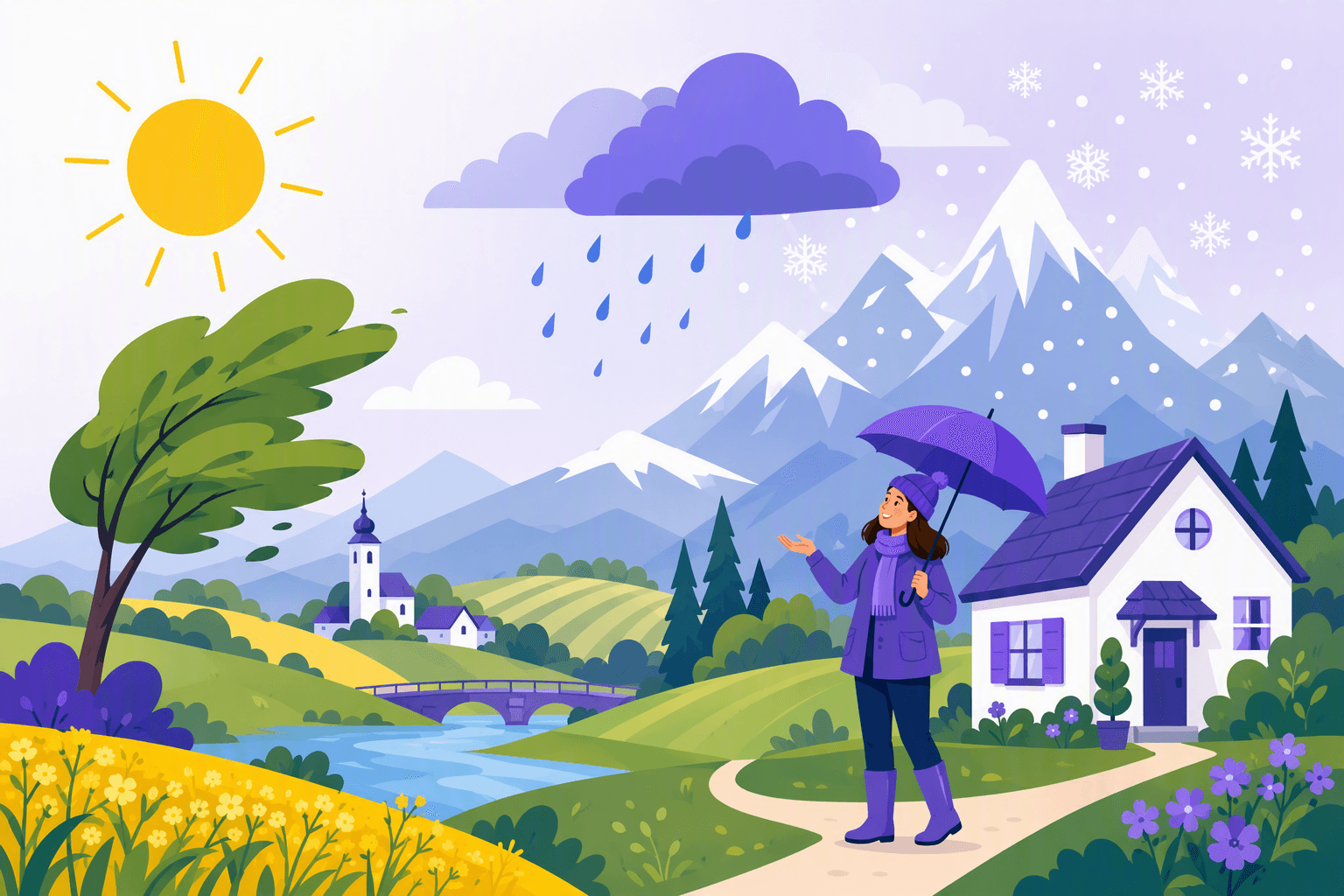
The essential German weather nouns
German nouns have grammatical gender, so learn every weather noun with its article. You may not need to produce perfect grammar on day one, but recognizing der, die, and das makes forecasts much easier to follow.
Wetter
Das Wetter /ˈvɛtɐ/ is the general word for weather. The direct question is Wie ist das Wetter? /viː ɪst das ˈvɛtɐ/, meaning “How is the weather?”
You will also hear Was macht das Wetter? /vas maxt das ˈvɛtɐ/, literally asking what the weather is doing. It is conversational and common when people are deciding whether to walk, cycle, or sit outside.
Sonne
Die Sonne /ˈzɔnə/ means sun. The adjective sonnig /ˈzɔnɪç/ means sunny, while Sonnenschein /ˈzɔnənʃaɪn/ means sunshine.
German speakers distinguish between seeing the sun and having genuinely warm weather. A bright winter day can be sonnig, yet still kalt /kalt/, cold.
Regen
Der Regen /ˈʁeːɡn̩/ means rain. The verb is regnen /ˈʁeːɡnən/, so Es regnet /ɛs ˈʁeːɡnət/ means “It is raining.”
For lighter rain, use der Nieselregen /ˈniːzl̩ˌʁeːɡn̩/, drizzle. A Regenschauer /ˈʁeːɡn̩ˌʃaʊɐ/ is a rain shower, often brief and intermittent.
Schnee
Der Schnee /ʃneː/ means snow, and es schneit /ɛs ʃnaɪt/ means “It is snowing.” The noun der Schneefall /ˈʃneːfal/ refers to snowfall.
On winter forecasts, listen for Schneeregen /ˈʃneːˌʁeːɡn̩/, sleet or rain mixed with snow. It often indicates unpleasant wet cold rather than snow that settles.
Gewitter
Das Gewitter /ɡəˈvɪtɐ/ means thunderstorm. This is one word to take seriously: German weather alerts often use Unwetter /ˈʊnvɛtɐ/ for severe weather, which may include heavy rain, hail, dangerous wind, or thunderstorms.
The Deutscher Wetterdienst, Germany’s national meteorological service, maintains a detailed weather glossary that distinguishes everyday terms from alert terminology. It is useful background when watching German news or reading travel notices.
Weather conditions and forecast adjectives
Weather forecasts use adjectives more often than long descriptive sentences. Learn these forms and you will recognize the core message of most radio, TV, and app forecasts.
| English | German | Pronunciation | Note |
|---|---|---|---|
| sunny | sonnig | ZON-nig | From die Sonne. |
| cloudy | bewölkt | buh-VURLKT | Common forecast adjective. |
| overcast | bedeckt | buh-DEKT | Cloud cover across the sky. |
| rainy | regnerisch | RAYG-neh-rish | Describes a rainy period. |
| windy | windig | VIN-dig | The final g is soft. |
| stormy | stürmisch | SHTUUR-mish | Uses the umlaut ü. |
| foggy | neblig | NAY-blig | Related to der Nebel. |
| icy | eisig | EYE-zig | Can mean bitterly cold too. |
| humid | schwül | SHVUUL | Warm, close, humid weather. |
| dry | trocken | TROK-en | Also used for dry clothes. |
| changeable | wechselhaft | VEK-sel-hahft | Rapidly changing conditions. |
| mild | mild | MILT | Warmer than expected for the season. |
Bewölkt and bedeckt
Bewölkt /bəˈvœlkt/ means cloudy. There are clouds, but the sky may still have bright gaps.
Bedeckt /bəˈdɛkt/ means overcast. It suggests more continuous cloud cover, with little or no visible blue sky. Forecasts may say stark bewölkt /ʃtaʁk bəˈvœlkt/ for very cloudy.
Schwül
Schwül /ʃvyːl/ is one of the most useful summer words. It means humid, close, or oppressively warm, particularly before a storm.
Do not confuse it with warm /vaʁm/, warm. A dry 25°C afternoon can be warm, but a sticky 25°C day before rain may be schwül.
Wechselhaft
Wechselhaft /ˈvɛksl̩haft/ means changeable. You will often see it in spring and autumn forecasts: sun, wind, showers, then sun again.
This word reflects a real cultural habit. In much of Germany, people check the forecast and dress in layers because conditions can shift several times in one day. A jacket, scarf, and compact umbrella are often practical, even in months associated with warmer weather.
💡 A forecast pattern to recognize
German forecasts frequently use the pattern: morgens, mittags, nachmittags, abends. These mean in the morning, at midday, in the afternoon, and in the evening. Listen for the condition after each time word.
Temperature words and how Germans state degrees
Germany, Austria, Switzerland, and other German-speaking regions use Celsius in ordinary conversation. When the temperature is 18°C, say Es sind achtzehn Grad /ɛs zɪnt ˈaxttseːn ɡʁaːt/.
Unlike English, German commonly uses plural sind with a number of degrees. You will also hear Wir haben zwanzig Grad /viːɐ̯ haːbn̩ ˈtsvant͡sɪç ɡʁaːt/, literally “we have 20 degrees,” in casual speech.
| English | German | Pronunciation | Note |
|---|---|---|---|
| warm | warm | VARM | Comfortably warm. |
| hot | heiß | HICE | Uses ß, pronounced like ss. |
| cool | kühl | KUEHL | Uses the umlaut ü. |
| cold | kalt | KALT | Common basic adjective. |
| freezing | eiskalt | ICE-kalt | Literally ice-cold. |
| degrees | Grad | GRAHT | Usually used without plural ending after numbers. |
| below zero | unter null | OON-ter nooll | For sub-zero temperatures. |
| above zero | über null | UE-ber nooll | For temperatures over zero. |
| frost | der Frost | dehr FROST | Freezing conditions. |
| black ice | das Glatteis | dahs GLAT-ice | Dangerous ice on roads. |
| heatwave | die Hitzewelle | dee HIT-suh-vel-luh | Feminine noun. |
| cold snap | der Kälteeinbruch | dehr KEL-tuh-ine-brookh | A sudden sharp cooling. |
Useful temperature sentences
Use these phrases exactly as templates:
- Es sind fünf Grad. /ɛs zɪnt fyːnf ɡʁaːt/ means “It is five degrees.”
- Es sind minus drei Grad. /ɛs zɪnt ˈmiːnʊs dʁaɪ ɡʁaːt/ means “It is minus three degrees.”
- Heute wird es heiß. /ˈhɔʏtə vɪʁt ɛs haɪs/ means “It will get hot today.”
- Morgen wird es kühler. /ˈmɔʁɡn̩ vɪʁt ɛs ˈkyːlɐ/ means “It will be cooler tomorrow.”
- Nachts gibt es Frost. /naxts ɡɪpt ɛs fʁɔst/ means “There will be frost at night.”
The adjective heiß /haɪs/ means hot, and the letter ß represents the same sound as ss. For more help with German spelling and sound patterns, see our German pronunciation guide.
Natural phrases for weather small talk
Weather opens conversations without demanding personal information, which makes it a safe topic with colleagues, neighbors, and people you have just met. German small talk is often more direct than English small talk, but weather comments are entirely normal.
Schönes Wetter heute, oder? /ˈʃøːnəs ˈvɛtɐ ˈhɔʏtə ˈoːdɐ/ means “Nice weather today, right?” It invites a brief agreement.
Ganz schön kalt heute. /ɡants ʃøːn kalt ˈhɔʏtə/ means “Pretty cold today.” Here ganz schön intensifies the adjective, often with mild surprise.
Nimm einen Regenschirm mit. /nɪm ˈaɪnən ˈʁeːɡn̩ˌʃɪʁm mɪt/ means “Take an umbrella with you.” The verb mitnehmen separates in this command, a typical German feature.
Es sieht nach Regen aus. /ɛs ziːt naːx ˈʁeːɡn̩ aʊs/ means “It looks like rain.” This is a natural observation when dark clouds are building.
Hoffentlich bleibt es trocken. /ˈhɔfn̩tlɪç blaɪpt ɛs ˈtʁɔkn̩/ means “Hopefully it stays dry.” It is especially useful before an outdoor event.
🌍 Why weather warnings matter
Germany's weather vocabulary includes precise practical terms because weather can affect rail travel, cycling, mountain routes, and driving. Watch for Glatteis /ˈɡlatˌaɪs/ in winter: it means black ice, a hazardous thin layer that can be difficult to see. An Unwetterwarnung /ˈʊnvɛtɐˌvaʁnʊŋ/ is an official severe-weather warning, not merely a prediction of bad weather.
Seasons and regional weather
The four seasons are der Frühling /ˈfʁyːlɪŋ/, spring, der Sommer /ˈzɔmɐ/, summer, der Herbst /hɛʁpst/, autumn, and der Winter /ˈvɪntɐ/, winter.
Spring is often described as wechselhaft, while summers can alternate between dry heat and intense thunderstorms. Autumn brings Nebel /ˈneːbl̩/ and cooler mornings. Winter conditions vary considerably: northern lowlands may be rainy and windy, while Alpine areas in southern Germany and Austria receive regular snow.
German-speaking Switzerland adds a mountain-weather dimension. A valley can be grey and foggy while a nearby higher elevation is sunny. This is why weather reports may mention Hochnebel /ˈhoːxˌneːbl̩/, high fog, and Föhn /føːn/, a warm, dry downslope wind associated with the Alps.
The linguist Peter Auer’s work on German variation emphasizes that Standard German exists alongside regional ways of speaking. You may hear different accents and local terms, but weather vocabulary in national broadcasts and forecasts is highly standardized. The Duden and Deutscher Wetterdienst glossary are reliable anchors for the standard forms in this guide.
Learn German weather words from real scenes
Weather words stick when they appear with an image: rain against a window, a character pulling on a coat, a sunny park, or a storm interrupting travel. That visual context helps you connect meaning, sound, and situation rather than memorizing isolated translations.
Try this routine with a German film or series:
- Pause when you hear a weather word.
- Repeat the full sentence aloud, not just the noun.
- Notice the visual evidence, such as wet streets or visible breath.
- Save one sentence you could use yourself.
- Review it the next day in a new context.
This approach matches the emphasis on meaningful exposure in the Goethe-Institut’s learning resources. It also avoids a frequent vocabulary mistake: learning nouns without the verbs and adjectives that make them usable.
For seasonal conversation practice, pair weather sentences with German ways to say hello and natural German goodbyes. A short exchange such as Guten Morgen, ganz schön windig heute /ˈɡuːtn̩ ˈmɔʁɡn̩ ɡants ʃøːn ˈvɪndɪç ˈhɔʏtə/ sounds much more natural than a memorized word list alone.
A practical German weather checklist
Before your next trip or viewing session, make sure you can understand these high-value ideas:
- sonnig /ˈzɔnɪç/, sunny
- bewölkt /bəˈvœlkt/, cloudy
- Regen /ˈʁeːɡn̩/, rain
- Schauer /ˈʃaʊɐ/, shower
- Gewitter /ɡəˈvɪtɐ/, thunderstorm
- windig /ˈvɪndɪç/, windy
- kalt /kalt/, cold
- heiß /haɪs/, hot
- Frost /fʁɔst/, frost
- wechselhaft /ˈvɛksl̩haft/, changeable
Once you know these, you can follow the main point of most German weather reports. Add one phrase such as Es regnet /ɛs ˈʁeːɡnət/ or Morgen wird es sonnig /ˈmɔʁɡn̩ vɪʁt ɛs ˈzɔnɪç/, and you are ready to talk about the forecast rather than only recognize it.
German weather talk is practical, social, and rich in useful daily language. Learn the nouns with their articles, use Celsius phrases for temperatures, and pay special attention to warnings involving storms, ice, and heavy rain. Then reinforce the words through scenes where the weather visibly changes, because that is where vocabulary becomes automatic.
Frequently Asked Questions
How do you say weather in German?
What is the German word for rain?
How do Germans talk about temperature?
What does wechselhaft mean in a German weather forecast?
Is German weather vocabulary different in Austria and Switzerland?
Sources & References
- Duden, Wetter and weather vocabulary entries, accessed 2026
- Deutscher Wetterdienst, Wetterlexikon, accessed 2026
- Goethe-Institut, German language information and learning resources, accessed 2026
- Ethnologue, German, 27th edition, 2024
- Helmut Glück and Michael Rödel, Metzler Lexikon Sprache, J. B. Metzler
Start learning with Wordy
Watch real movie clips and build your vocabulary as you go. Free to download.


