Quick Answer
German tongue twisters (Zungenbrecher) are short, tricky sentences that train real pronunciation problems like the German R, ich/ach 'ch', and consonant clusters. Start slow, clap the rhythm, and only speed up after you can say each line clearly three times in a row. This guide gives 25 classics with English-friendly pronunciation help and a practice plan.
German tongue twisters, called Zungenbrecher (TSOONG-en-BREH-kher), are one of the fastest ways to sharpen German pronunciation because they repeatedly hit the exact sounds that trip learners up, especially R, ch, and dense consonant clusters. Use them as short daily drills: slow, clear, rhythmic, then gradually faster only after you can say each line cleanly.

German is spoken by roughly 90 million native speakers and well over 100 million total speakers worldwide (Ethnologue, 27th edition, 2024). That means your pronunciation goal is not one single accent, but clear, standard speech that works across Germany, Austria, and Switzerland.
If you want warm-up phrases for real conversations (not drills), pair this with how to say hello in German and how to say goodbye in German. Tongue twisters build the mouth mechanics that make those phrases sound natural.
Quick note on pronunciation style in this guide
The pronunciations below are English-friendly approximations, not IPA. They are designed to help you get close enough to be understood, then refine with listening.
When you see ch, remember German has two common versions: the softer ich-Laut (after i/e) and the throatier ach-Laut (after a/o/u). The Goethe-Institut’s pronunciation materials explain this contrast clearly and are worth using as a reference (Goethe-Institut, accessed 2026).
💡 How to use this article
Pick 5 tongue twisters that target your weak sound, practice them for 3 minutes a day, and rotate weekly. Record yourself at the start and end of the week so you can hear progress.
Why German tongue twisters work (when you do them right)
Tongue twisters are not magic, they are high-repetition articulation practice with built-in error feedback. You immediately feel where your tongue or lips fail.
This matches what acting and speech training has used for decades: repetition under controlled tempo. In phonetics, the point is not speed, it is stable coordination.
For a practical linguistic lens, J. C. Catford’s work on articulatory settings (in A Practical Introduction to Phonetics, Pearson) is useful here: languages have default mouth and tongue “postures.” Zungenbrecher push you into German’s posture quickly.
The 25 best German tongue twisters (Zungenbrecher)
Each entry includes: the German line, a pronunciation guide, and what it trains. Meanings are kept simple because the goal is sound, not poetry.
Fischers Fritze fischt frische Fische
German: Fischers Fritze fischt frische Fische; frische Fische fischt Fischers Fritze.
Pronunciation: FISH-ers FRIT-tsuh fisht FRI-shuh FISH-uh
Trains: sch, fr, fisch rhythm, clean final consonants.
Say it like a metronome. German clarity comes from crisp consonant timing, not from stretching vowels.
Blaukraut bleibt Blaukraut
German: Blaukraut bleibt Blaukraut und Brautkleid bleibt Brautkleid.
Pronunciation: BLOW-krowt blypt BLOW-krowt oont BROWT-klyte blypt BROWT-klyte
Trains: bl, br, au diphthong, consonant clusters.
This one is famous because it looks easy and then collapses at speed. Keep the t at the end of bleibt.
In Ulm, um Ulm und um Ulm herum
German: In Ulm, um Ulm und um Ulm herum.
Pronunciation: in OOLM, oom OOLM oont oom OOLM heh-ROOM
Trains: um/um, nasal timing, steady vowel length.
It is short, so it is perfect for speed ladders. Do 5 slow, 5 medium, 5 fast.
Zehn zahme Ziegen ziehen zehn Zentner Zucker zum Zoo
German: Zehn zahme Ziegen ziehen zehn Zentner Zucker zum Zoo.
Pronunciation: tsayn TSAH-muh TSEE-gen TSEE-hen tsayn TSENT-ner TSOO-ker tsoom TSOH
Trains: z (ts), zieh-, repeated ts onset.
German z is usually ts, which is why this is such a good drill.
Der Cottbuser Postkutscher putzt den Cottbuser Postkutschkasten
German: Der Cottbuser Postkutscher putzt den Cottbuser Postkutschkasten.
Pronunciation: dair KOT-boo-ser POST-koot-sher pootst den KOT-boo-ser POST-kootsh-KAH-sten
Trains: long compounds, tsch, pst clusters.
German compounds are normal in real life, not just in jokes. This trains endurance and segmentation.
Wenn Fliegen hinter Fliegen fliegen, fliegen Fliegen Fliegen nach
German: Wenn Fliegen hinter Fliegen fliegen, fliegen Fliegen Fliegen nach.
Pronunciation: ven FLEE-gen HIN-ter FLEE-gen FLEE-gen, FLEE-gen FLEE-gen FLEE-gen nahkh
Trains: repeated fl, sentence rhythm, breath control.
Keep the commas as real pauses. German prosody often uses clear phrase boundaries.
Braune Brötchen braten im Bratofen
German: Braune Brötchen braten im Bratofen.
Pronunciation: BROW-nuh BRUERT-khen BRAH-ten im BRAHT-oh-fen
Trains: br, ö vowel, repeated bra.
The hard part is ö in Brötchen. Aim for “oo with a smile,” as a rough cue.
Rhabarberbarbara
German: Rhabarberbarbara barbart Rhabarberkuchen.
Pronunciation: rah-BAHR-ber-bahr-BAH-rah bahr-BAHRT rah-BAHR-ber-KOO-khen
Trains: German r consistency, stress placement.
This has become a modern meme, but it is still useful. Keep the stress stable: BAHR, BAH, KOO.
Es klapperten die Klapperschlangen, bis ihre Klappern schlapper klangen
German: Es klapperten die Klapperschlangen, bis ihre Klappern schlapper klangen.
Pronunciation: es KLAH-per-ten dee KLAH-per-shlahng-en, bis EE-reh KLAH-pern SHLAH-per KLAHNG-en
Trains: kl, schl, alternating syllables.
This is a classic articulation warm-up. It is also a good test of whether you swallow syllables under pressure.
Drei dicke Dackel decken dicke Decken
German: Drei dicke Dackel decken dicke Decken.
Pronunciation: dry DIK-uh DAK-el DEK-en DIK-uh DEK-en
Trains: d vs t, short vowels, doubled consonants.
German learners often soften consonants. This forces clean, repeated stops.
Schnecken erschrecken, wenn Schnecken an Schnecken schlecken
German: Schnecken erschrecken, wenn Schnecken an Schnecken schlecken.
Pronunciation: SHNEK-en air-SHREK-en, ven SHNEK-en ahn SHNEK-en SHLEK-en
Trains: sch, schr, schl clusters.
If you can say erschrecken cleanly, your German consonant control is improving fast.
Der kleine plappernde Kaplan klatscht klappernd klare Klapperschlangen
German: Der kleine plappernde Kaplan klatscht klappernd klare Klapperschlangen.
Pronunciation: dair KLY-nuh PLAH-pern-duh KAH-plahn KLATSHT KLAH-pernt KLAH-reh KLAH-per-shlahng-en
Trains: kl repetition, consonant timing.
This is intentionally overloaded. Use chunking: der kleine | plappernde Kaplan | klatscht klappernd | klare Klapperschlangen.
Zwei Zwetschgenzweige
German: Zwei Zwetschgenzweige zwitschern zwischen zwei Zweigen.
Pronunciation: tsvy TSVET-shgen-TSVY-guh TSVIT-shern TSVISH-en tsvy TSVY-gen
Trains: zw/tsv, tsch, dense consonant starts.
This is a good “German mouth” drill. It forces tight front-of-mouth work.
Hinter Hermann Hannes hängen hundert Hemden
German: Hinter Hermann Hannes hängen hundert Hemden.
Pronunciation: HIN-ter HAIR-mahn HAH-nes HENG-en HOON-dert HEM-den
Trains: h onset, ng ending, vowel contrast.
German h is usually pronounced, so keep it audible.
Der Whiskymixer mixt Whisky
German: Der Whiskymixer mixt Whisky.
Pronunciation: dair VIS-kee-MIK-ser mikst VIS-kee
Trains: ks clusters, short punchy syllables.
It is modern and simple, which makes it great for warming up quickly.
Kleine Kinder können keine Kirschkerne knacken
German: Kleine Kinder können keine Kirschkerne knacken.
Pronunciation: KLY-nuh KIN-der KUR-nen KY-nuh KEERSH-kair-nuh KNAK-en
Trains: k clarity, kn onset, umlaut in können.
Use the canonical German learner cue: können = KUR-nen.
Ich koche köstlichen Kaffee
German: Ich koche köstlichen Kaffee.
Pronunciation: ikh KOKH-uh KURST-lee-khen KAH-fay
Trains: ich-Laut ch in ich, ö in köstlich.
This is a targeted drill for the ich-sound. Keep ich light, not like “itch.”
Ach, ich mache acht
German: Ach, ich mache acht.
Pronunciation: ahkh, ikh MAH-khuh ahkht
Trains: ach-Laut vs ich-Laut, final t.
This is minimal-pair training in sentence form. Switch cleanly between the two ch sounds.
Frische Frösche fischen frische Fische
German: Frische Frösche fischen frische Fische.
Pronunciation: FRI-shuh FRUR-shuh FISH-en FRI-shuh FISH-uh
Trains: fr, ö in Frösche, repeated fisch.
If you struggle with ö, slow down and exaggerate the lip rounding.
Sieben Schneeschipper schippen sieben Schippen Schnee
German: Sieben Schneeschipper schippen sieben Schippen Schnee.
Pronunciation: ZEE-ben SHNAY-SHIP-er SHIP-en ZEE-ben SHIP-en SHNAY
Trains: sch, long vowel in Schnee, rhythm.
German long vowels matter for meaning and clarity. Keep Schnee long.
Der dicke Dieter trinkt dünnen Tee
German: Der dicke Dieter trinkt dünnen Tee.
Pronunciation: dair DIK-uh DEE-ter trinkt DUEN-en TAY
Trains: ü in dünn, t/d contrast.
This is a clean vowel drill. Dünn should not sound like “done.”
Besserwisser wissen besser, was besser ist
German: Besserwisser wissen besser, was besser ist.
Pronunciation: BES-er-VIS-er VIS-en BES-er, vahs BES-er ist
Trains: ss, w/v mapping, sentence melody.
German spelling-pronunciation mapping is mostly regular, and this line rewards that regularity.
Zwischen zwei Zwergen zwitschern zwei Schwalben
German: Zwischen zwei Zwergen zwitschern zwei Schwalben.
Pronunciation: TSVISH-en tsvy TSVair-gen TSVIT-shern tsvy SHVAHL-ben
Trains: zw/tsv, schw, repeated starts.
Schwalben gives you the German w sound, closer to English v.
Der Potsdamer Postmeister putzt den Potsdamer Postkasten
German: Der Potsdamer Postmeister putzt den Potsdamer Postkasten.
Pronunciation: dair POTS-dah-mer POST-my-ster pootst den POTS-dah-mer POST-kah-sten
Trains: pst, st, compound rhythm.
If you can keep putzt crisp, your consonant endings are in good shape.
Streichholzschächtelchen
German: Streichholzschächtelchen.
Pronunciation: SHTRYKH-holts-SHEKH-tel-khen
Trains: str onset, ch variants, diminutive ending -chen.
This is the famous single-word tongue twister. It is also a great “German sound check” in one word.
Schweizer Schafe schwimmen schweigend
German: Schweizer Schafe schwimmen schweigend.
Pronunciation: SHVY-tsair SHAH-fuh SHVIM-en SHVY-gent
Trains: schw, schw repetition, Swiss-flavored consonant feel.
Even outside Switzerland, this trains a cluster Germans use constantly (schw-).
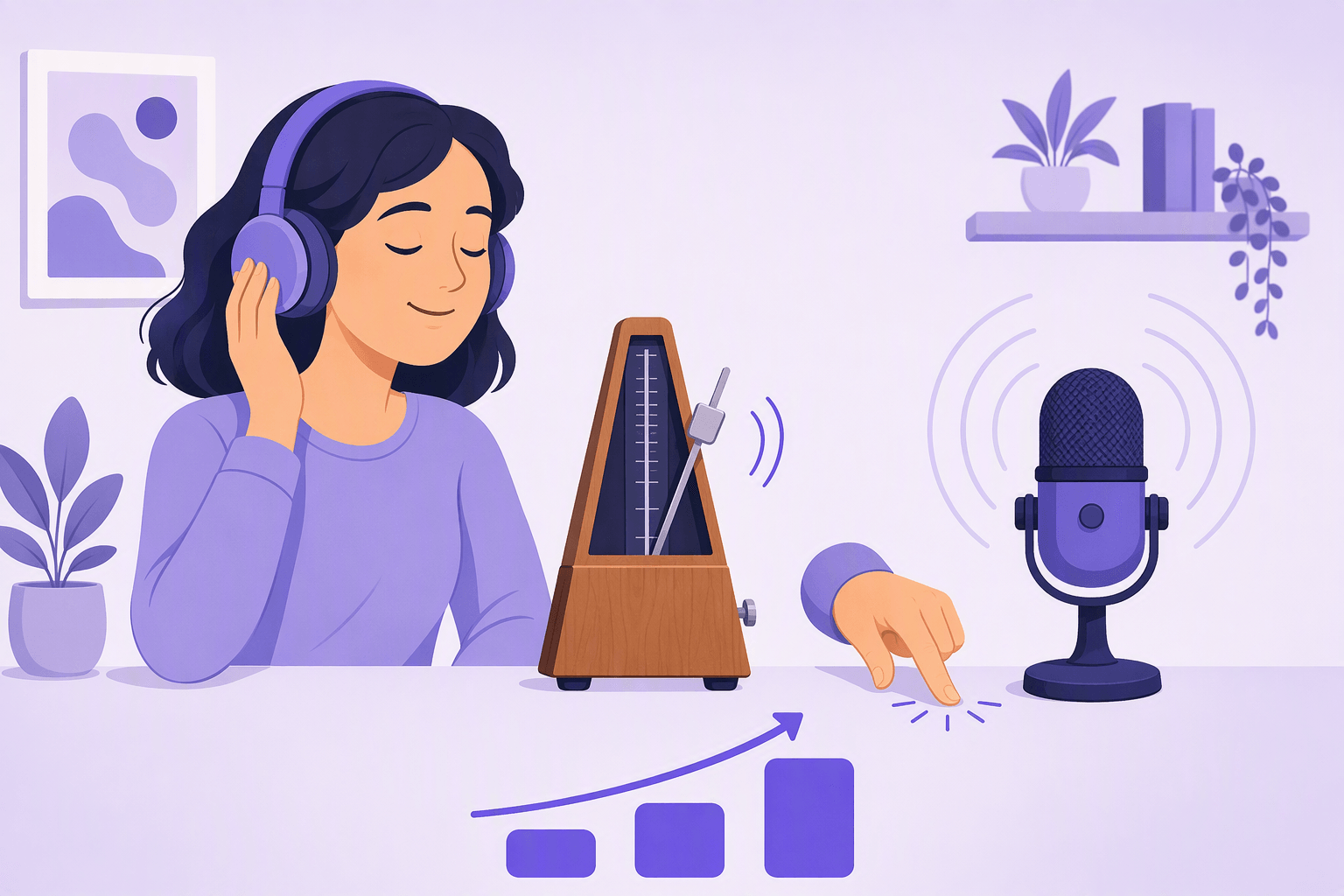
A simple 7-minute practice routine (that avoids bad habits)
Speed is fun, but speed without control builds the wrong muscle memory. Treat tongue twisters like scales on a piano.
Step 1: Mark the “danger sounds”
Circle the sound you are training: ch, r, ü/ö, or a cluster like str. One drill, one goal.
If you want a structured overview of German sounds, the Institut für Deutsche Sprache has accessible phonetics resources that help you name what you are hearing (IDS, accessed 2026).
Step 2: Chunk the sentence
Split into 2 to 4 chunks and master each chunk first. German compounds and long lines become easy when you stop treating them as one breath.
Step 3: Use a steady beat
Clap or tap at a comfortable tempo. David Abercrombie’s classic work on rhythm (in Elements of General Phonetics, Edinburgh University Press) is a useful reminder that timing is a core part of intelligibility, not decoration.
Step 4: Record and correct one thing
Do not try to fix everything at once. Fix the one sound you chose, then re-record.
⚠️ Speed is the last step
If you race early, you will blur endings and vowels. German listeners rely heavily on those cues. Build clarity first, then speed will come automatically.
What German tongue twisters reveal about German pronunciation
Tongue twisters are like a map of what native speakers find “articulatorily interesting.” The patterns are not random.
Consonant clusters are normal, not advanced
German allows dense onsets like Str- and Schw-. Learners often insert extra vowels (uh sounds) to make them easier.
Zungenbrecher punish that habit, which is why they are so effective.
The two ch sounds matter
Many learners use one ch for everything. In real German, ich and ach are noticeably different, and mixing them can make you sound foreign even when grammar is perfect.
Use Ich koche köstlichen Kaffee for ich-Laut, and Ach, ich mache acht for switching.
Umlauts are not “fancy vowels,” they are meaning contrasts
ü vs u and ö vs o can separate words. Tongue twisters that repeat ö/ü force consistent lip shape.
If you want more targeted sound work beyond tongue twisters, pair this with the drills in German pronunciation guide: sounds, stress, and common mistakes.
Cultural notes: where you actually hear Zungenbrecher
Zungenbrecher are not only for learners. They are part of German-speaking pop culture.
Kids’ language play
In Germany and Austria, tongue twisters show up in school as playful articulation challenges. They also appear in children’s radio and TV segments, where clarity is part of the fun.
Acting, choir, and public speaking
Actors use articulation drills in rehearsal, and tongue twisters are an easy, memorable format. Choir warmups often include similar consonant-heavy lines to coordinate diction.
Party challenges, plus the “clean” alternative to swearing games
At gatherings, people sometimes trade tongue twisters the way English speakers trade riddles. If you want the opposite end of the “fun language” spectrum, see our guide to German swear words, but tongue twisters are the safe version you can do anywhere.
🌍 Why so many tongue twisters mention fish, posts, and cabbage
A lot of classic German tongue twisters use everyday nouns with strong consonants: Fisch, Post, Kraut, Kutsche. They are not deep stories, they are sound playgrounds built from common, concrete words.
Common mistakes (and quick fixes)
Swallowing final consonants
German often devoices final consonants, so Tag is closer to “TAHK.” If you drop the final sound entirely, words blur together.
Fix: over-articulate the last consonant at slow speed, then relax slightly.
Making German R into an English R
Many standard accents use a uvular R (back of the throat). An English R can still be understood, but it often clashes with the surrounding vowel quality.
Fix: aim for a light “gargle-like” friction, not a hard growl. Keep it consistent.
Turning ü/ö into u/o
This is the most common umlaut issue. Your lips must round, but your tongue position stays more forward.
Fix: smile slightly while keeping rounded lips, then say dünn and Brötchen slowly.
Turning tongue twisters into real conversation gains
Tongue twisters help most when you connect them to phrases you actually use.
After a week of schw/str drills, go practice greetings and farewells out loud: hello in German and goodbye in German. If you want a pronunciation challenge with emotion, try how to say I love you in German and focus on clean vowels and endings.
If you learn German with authentic audio, tongue twisters also make native dialogue easier to parse because your brain starts expecting German’s consonant timing. That is one reason movie-based listening practice works well when paired with short articulation drills.
💡 One-week challenge
Day 1-2: Pick 3 tongue twisters and master them slow. Day 3-5: Add 2 more and start medium speed. Day 6-7: Record all 5, then compare to your Day 1 recording. You should hear clearer endings and fewer extra vowels.
If you want more fun, high-signal German practice ideas, browse the Wordy blog and mix tongue twisters with short daily listening clips so your pronunciation and comprehension improve together.
Frequently Asked Questions
What is a German tongue twister called?
Do tongue twisters actually help German pronunciation?
Which German sounds should I target with tongue twisters?
Are German tongue twisters used in schools or theater?
What is the best way to practice a Zungenbrecher without learning it wrong?
Sources & References
- Ethnologue, 27th edition, 2024
- Goethe-Institut, Deutsch lernen: Aussprache (accessed 2026)
- Duden, 'Zungenbrecher' entry (accessed 2026)
- Institut für Deutsche Sprache (IDS), resources on German phonetics and pronunciation (accessed 2026)
Start learning with Wordy
Watch real movie clips and build your vocabulary as you go. Free to download.


