Quick Answer
German separable verbs (trennbare Verben) split into two parts in many sentences: the main verb stem stays in the verb position, while the prefix moves to the end (Ich stehe um). The same verbs stay together in infinitives and in subordinate clauses (weil ich umstehe). This guide shows the patterns, the stress rule, and the most common traps.
German separable verbs (Trennbare Verben) are verbs with a prefix that often “splits off” in main clauses: the verb stem is conjugated in the normal verb position, and the prefix moves to the end of the clause (Ich rufe dich an). The same verb stays together in infinitives and subordinate clauses (anrufen, weil ich dich anrufe), so once you learn the three sentence types, the pattern becomes predictable.
German is spoken by roughly 90 million native speakers worldwide (Ethnologue, 27th ed., 2024), and separable verbs show up constantly in everyday speech because they build practical meanings like “call back,” “stand up,” “go out,” and “come in.” If you want German that sounds real, you cannot avoid them, especially in dialogue-heavy content like the clips you will hear while learning on Wordy’s German page.
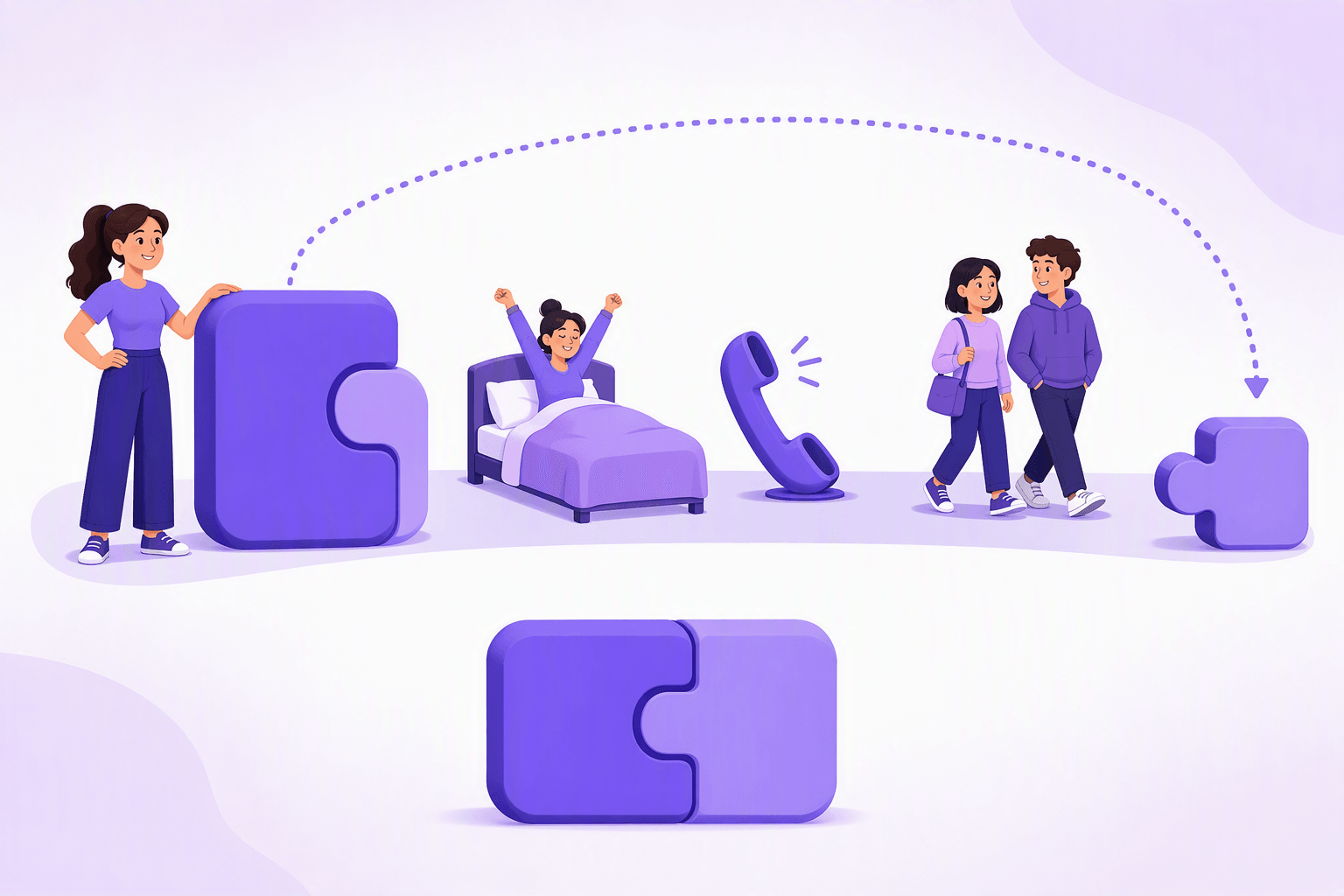
What separable verbs are (and why German uses them)
A separable verb is typically a base verb plus a prefix, for example stehen + auf = aufstehen (OWF-shtay-en). In many main clauses, German treats the prefix like a detachable “verb particle” that can move to the end.
This is not random. German word order has a strong “verb-second” tendency in main clauses, and separable prefixes are one of the places where you can see the system working: the conjugated part satisfies verb-second, and the leftover prefix waits at the end.
The stress rule that saves you
A practical diagnostic is stress. Separable verbs usually stress the prefix: AUFstehen, ANrufen, EINkaufen.
Inseparable verbs usually stress the stem: verstehen (fer-SHTAY-en), besuchen (beh-ZOO-khen), erzählen (ehr-TSAY-len). Duden’s grammar notes this stress contrast as a key difference between trennbar and untrennbar (Duden, accessed 2026).
💡 Listen for stress in real speech
If you hear the prefix strongly stressed, treat it as separable until proven otherwise. In movie and TV dialogue, that stress is often clearer than any written rule.
The core word-order rule (main clause)
In a main clause, the conjugated verb stem goes in the verb position, and the prefix goes to the end.
Example with anrufen (AHN-roo-fen):
- Ich rufe dich an. (ikh ROO-fuh dikh AHN)
“I’m calling you.”
If you start the sentence with something other than the subject, the verb still stays second, and the prefix still goes to the end:
- Heute rufe ich dich an. (HOY-tuh ROO-fuh ikh dikh AHN)
- Dich rufe ich später an. (dikh ROO-fuh ikh SHPAY-ter AHN)
This is where learners often panic, but the logic is consistent: German keeps the conjugated verb early, and pushes other verb material late.
The three environments where separable verbs behave differently
You can predict separable verb behavior by asking one question: is the verb conjugated in a main clause, or is it sitting at the end as an infinitive or subordinate-clause verb?
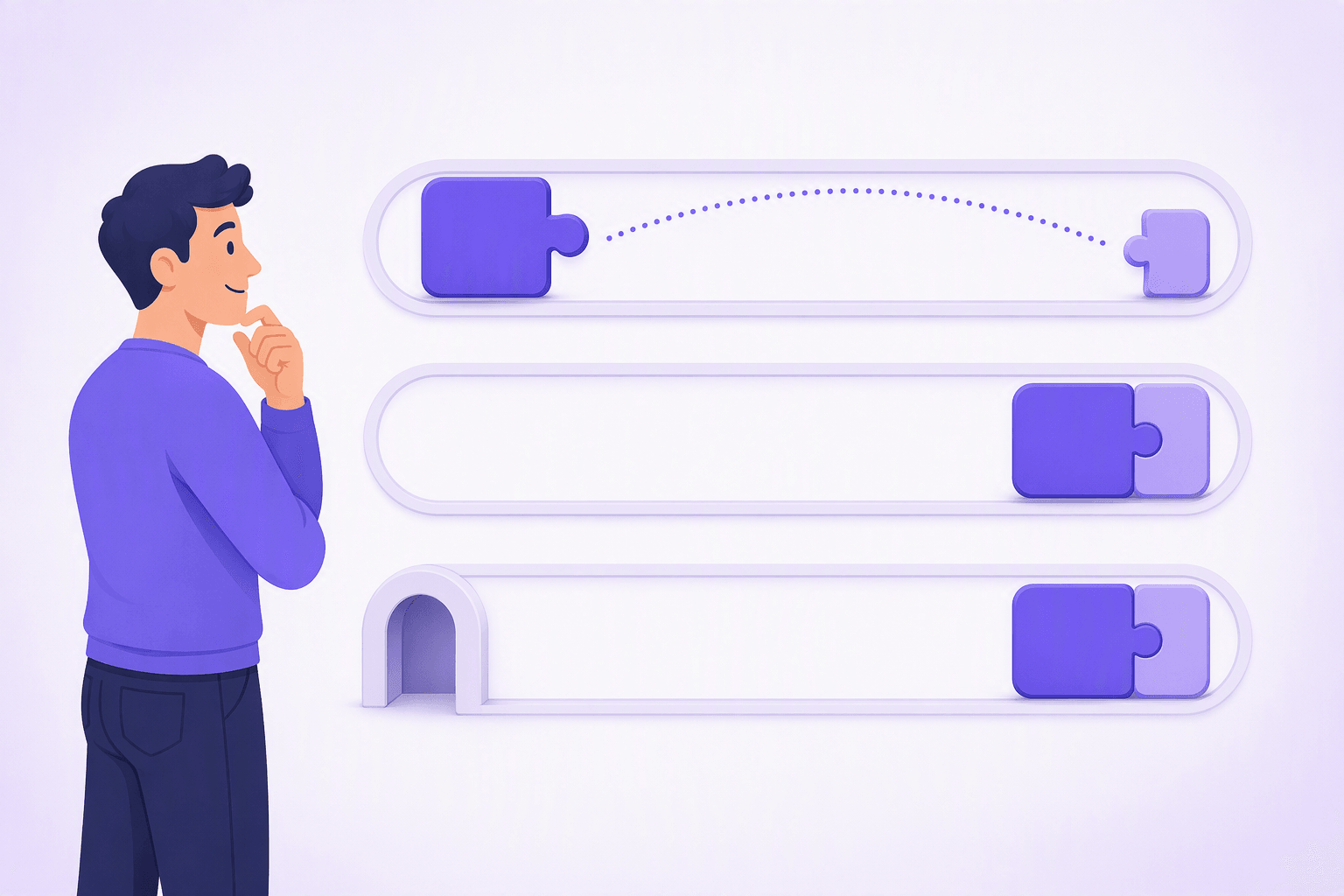
1) Main clauses: split
- Ich stehe um sechs Uhr auf. (ikh SHTAY-uh oom ZEKS oor OWF)
- Wir kommen morgen an. (veer KOM-men MOR-gen AHN)
2) Infinitives: stay together
- Ich will um sechs Uhr aufstehen. (ikh vill oom ZEKS oor OWF-shtay-en)
- Er versucht anzukommen. (ehr fer-ZOOKHT AHN-tsoo-KOM-men)
3) Subordinate clauses: stay together (verb-final)
- weil ich um sechs Uhr aufstehe (vyle ikh oom ZEKS oor OWF-shtay-uh)
- dass wir morgen ankommen (dass veer MOR-gen AHN-kom-men)
The IDS Grammis site treats this as an interaction between separable prefixes and general clause structure: subordinate clauses force the verb complex to the end, so there is no “slot” for the prefix to split into (IDS Grammis, accessed 2026).
The prefixes you meet first (and what they usually do)
Many common prefixes are almost always separable in modern German. Here are the ones you will see in beginner and intermediate dialogue:
- ab- (AP): abfahren (AP-fah-ren), “depart”
- an- (AHN): anrufen (AHN-roo-fen), “call”
- auf- (OWF): aufstehen (OWF-shtay-en), “get up”
- aus- (OWS): ausgehen (OWS-gay-en), “go out”
- ein- (INE): einkaufen (INE-kow-fen), “shop”
- mit- (MIT): mitkommen (MIT-kom-men), “come along”
- nach- (NAHKH): nachfragen (NAHKH-frah-gen), “ask again, inquire”
- vor- (FOR): vorstellen (FOR-shtel-len), “introduce, imagine”
- zu- (TSOO): zumachen (TSOO-mah-khen), “close”
Notice how “small” these prefixes are. German uses them to create very specific everyday meanings without inventing a completely new verb.
If you are also working on greetings, you will hear separable verbs immediately in real interactions, for example in how to say hello in German and how to say goodbye in German, where verbs like anrufen, vorbeikommen, and mitkommen show up naturally.
Pronunciation: why separable verbs often sound clearer than you expect
Separable prefixes are usually stressed, which makes them easier to catch in fast speech. That stress is functional: it signals meaning.
Compare:
- umfahren (oom-FAH-ren) can mean “drive around” (inseparable stress pattern in some uses)
- UMfahren (OOM-fah-ren) can mean “run over” (separable stress pattern in some uses)
You do not need to memorize this pair right away, but it shows why German learners are taught to pay attention to stress. In his work on German phonology and prosody, J. C. Wells discusses how stress patterns carry lexical contrasts across languages, and German separable prefixes are a clean example of that idea in daily speech.
Separable verbs with modal verbs (must, can, want)
With modal verbs, the separable verb is an infinitive at the end, so it stays together.
- Ich muss jetzt aufstehen. (ikh mooss yetst OWF-shtay-en)
- Wir können später anrufen. (veer KUR-nen SHPAY-ter AHN-roo-fen)
- Sie will heute ausgehen. (zee vill HOY-tuh OWS-gay-en)
This is also why German sentences can feel like they “save the real action for last.” The modal takes the conjugated slot, and the full meaning verb waits at the end.
⚠️ Common learner mistake
Do not split the prefix with a modal: avoid "Ich muss stehe auf." The correct form is "Ich muss aufstehen."
Separable verbs in the Perfekt (present perfect)
In the Perfekt, the prefix reattaches to the participle.
- anrufen → angerufen (AHN-guh-roo-fen): Ich habe dich angerufen.
- aufstehen → aufgestanden (OWF-guh-SHTAHN-den): Ich bin aufgestanden.
Two things matter here:
- The ge- often appears between prefix and stem: an + ge + rufen = angerufen.
- The auxiliary (haben vs sein) depends on the verb, and separable verbs follow the same auxiliary logic as other verbs.
Goethe-Institut learning materials emphasize learning the auxiliary with the verb, because it is not reliably predictable from English translation (Goethe-Institut, accessed 2026).
A fast auxiliary heuristic (not perfect, but useful)
- Often sein: verbs of movement or change of state, especially with “arrival/departure” meanings (ankommen, aufstehen, ausgehen in the “go out” sense can vary by construction).
- Often haben: actions directed at an object (anrufen, einkaufen, zumachen).
When in doubt, check a reliable entry, Duden and IDS are both solid starting points.
Separable verbs with zu (and the “glued” spelling)
When you use zu with an infinitive, German inserts zu between prefix and stem, and writes it as one word:
- anrufen → anzurufen (AHN-tsoo-roo-fen)
- aufstehen → aufzustehen (OWF-tsoo-shtay-en)
- mitkommen → mitzukommen (MIT-tsoo-KOM-men)
Examples:
- Ich habe vergessen, dich anzurufen.
- Es ist schwer, früh aufzustehen.
This is one of the most testable rules in German writing. If you see zu in the middle of a long verb, it is often a separable verb in disguise.
Subordinate clauses: the “no split” zone
In subordinate clauses, the verb goes to the end, and the separable verb stays together:
- weil ich dich anrufe
- obwohl er früh aufsteht
- wenn wir morgen ankommen
If you are learning German through dialogue, this shows up constantly in emotional explanations and reasons. Characters say “weil…” all the time.
A useful connection: once you master subordinate clauses, separable verbs become easier, not harder, because you stop trying to split them everywhere.
The prefixes that are usually inseparable (and what they signal)
Some prefixes are typically inseparable:
- be-: besuchen (beh-ZOO-khen)
- ge-: gehören (guh-HUR-ren)
- er-: erklären (ehr-KLARE-en)
- ver-: verstehen (fer-SHTAY-en), verlieren (fer-LEE-ren)
- zer-: zerstören (tsehr-SHTUR-ren)
These often create more abstract meanings, and they do not detach in main clauses.
This is also a cultural detail of German vocabulary building: separable prefixes are extremely productive for concrete, everyday actions, while inseparable prefixes are common in more formal or abstract verbs. You can feel this difference in register when you compare casual talk to workplace German.
Tricky case: prefixes that can be separable or inseparable
Some prefixes can be either, depending on meaning and stress, including unter-, über-, um-, durch-, hinter-.
You do not need to master all of these at once. What matters is recognizing that German sometimes uses stress to distinguish meanings that English would separate into different verbs.
If you want a realistic learning strategy, focus on high-frequency separable verbs first, then learn the ambiguous ones as vocabulary items with example sentences.
A practical mini-list: separable verbs you will actually hear
These are common in everyday scenes: apartments, relationships, work, transport.
aufstehen
Pronunciation: OWF-shtay-en
Meaning: to get up, to stand up.
Examples:
- Ich stehe um sieben auf.
- Steh auf! (shtay OWF) “Get up!”
anrufen
Pronunciation: AHN-roo-fen
Meaning: to call (on the phone).
Examples:
- Ruf mich später an.
- Ich rufe dich gleich an.
einkaufen
Pronunciation: INE-kow-fen
Meaning: to shop for groceries.
Examples:
- Ich kaufe schnell ein.
- Wir gehen einkaufen.
ausgehen
Pronunciation: OWS-gay-en
Meaning: to go out (socially), also “to go out” (a light goes out) depending on context.
Examples:
- Wollen wir heute Abend ausgehen?
- Das Licht geht aus. (dass likht gayt OWS)
mitkommen
Pronunciation: MIT-kom-men
Meaning: to come along.
Examples:
- Kommst du mit?
- Du kannst mitkommen.
aufmachen / zumachen
Pronunciation: OWF-mah-khen / TSOO-mah-khen
Meaning: open / close (a door, window, container).
Examples:
- Mach die Tür auf.
- Mach bitte das Fenster zu.
These verbs are also common in romantic and relationship dialogue. If you are learning phrases like in how to say I love you in German, you will often hear separable verbs around plans, calls, and coming over (vorbeikommen, anrufen, aufmachen).
How separable verbs show up in real German conversation
In spoken German, people often shorten sentences, but separable prefixes still behave the same way. You will hear:
- Ich komm gleich vorbei. (vorbeikommen)
- Ruf kurz an. (anrufen)
- Mach zu. (zumachen)
This is one reason movie and TV clips are so useful: you get the “compressed” versions that textbooks underrepresent, while still seeing the same grammar rules.
If you are also curious about how tone and taboo language work in German dialogue, you will notice separable verbs inside insults and commands too. Our guide to German swear words focuses on meaning and severity, but grammatically, the same word order rules apply.
Common mistakes (and how to fix them fast)
Putting the prefix in the wrong place
Wrong: Ich anrufe dich.
Right: Ich rufe dich an.
Fix: build the sentence frame first: Subject + conjugated verb, then fill the middle, then attach the prefix at the end.
Splitting in subordinate clauses
Wrong: weil ich rufe dich an
Right: weil ich dich anrufe
Fix: when you see weil/dass/wenn, mentally switch to “verb-final mode.”
Forgetting that “zu” goes in the middle
Wrong: Ich habe vergessen, zu anrufen.
Right: Ich habe vergessen, anzurufen.
Fix: treat anzurufen as one spelling unit you learn as vocabulary.
Stressing the wrong part
If you say verSTEHen with strong stress on ver-, it can sound unnatural. Stress is part of meaning and part of “native-like” rhythm.
For a deeper pronunciation foundation, pair this topic with the broader sound system: consonants like ch, vowel length, and stress timing. Word order and pronunciation reinforce each other in German because the stressed prefix is also the information you are “saving” for the clause end.
A simple study plan that works with real clips
Step 1: Learn verbs as two-part chunks
Write them as prefix + stem: an + rufen, auf + stehen. This keeps the split visible in your memory.
Step 2: Practice three sentence templates
- Main clause: Ich rufe dich an.
- Modal: Ich will dich anrufen.
- Subordinate: weil ich dich anrufe.
Rotate the same verb through all three until it feels automatic.
Step 3: Train your ear for the prefix at the end
When watching German scenes, listen for the final word. Very often, it is the prefix that completes the meaning.
This is also a good place to use spaced repetition. If you already use flashcards, connect this with your workflow from our Anki guide: store the verb with one main-clause example and one subordinate-clause example, not just a translation.
Cultural note: why Germans love these “verb endings”
German separable prefixes make the end of a sentence meaningful. In conversation, this creates a subtle rhythm: you often wait for the last word to know whether someone is “calling,” “calling back,” “calling in,” or “calling off.”
In everyday German politeness, this also affects how requests land. Compare the feel of:
- Mach bitte die Tür zu.
- Kannst du bitte die Tür zumachen?
Both are normal, but the second delays the key action word (zumachen), which can sound softer and more indirect in certain contexts. Research on German conversation and pragmatics, including work by linguists like Helga Kotthoff on interactional style, highlights how grammar choices can shape perceived directness without changing the literal request.
Wrap-up: the rule set to remember
If you remember only this, you will be right most of the time:
- Main clause: split (Ich rufe an).
- Infinitive and with zu: together (anrufen, anzurufen).
- Subordinate clause: together at the end (weil ich anrufe).
When you want more real listening practice, use short dialogue clips and actively predict where the prefix will appear. That one habit turns separable verbs from “German chaos” into a pattern you can hear coming.
If you want structured listening with subtitles that match real speech speed, start with beginner-friendly clips on Wordy and focus on high-frequency verbs like anrufen, aufstehen, and mitkommen.
Frequently Asked Questions
How do separable verbs work in German?
How do I know if a German verb is separable or inseparable?
Where does the prefix go with modal verbs?
What happens to separable verbs in the Perfekt (present perfect)?
Do separable verbs separate in subordinate clauses?
Sources & References
- Duden, 'Trennbare und untrennbare Verben' (online), accessed 2026
- Institut für Deutsche Sprache (IDS), grammis: 'Verbzusatz / trennbare Verben' (online), accessed 2026
- Goethe-Institut, Deutsch lernen: grammar resources on separable verbs (online), accessed 2026
- Ethnologue, 27th edition, 2024
Start learning with Wordy
Watch real movie clips and build your vocabulary as you go. Free to download.


