Quick Answer
German sentence structure is predictable once you learn three rules: the conjugated verb is in position 2 in most main clauses (V2), the verb goes to the end in subordinate clauses, and extra verbs stack at the end. Add the time-manner-place order for details, and you can build natural German sentences without translating word-for-word.
German sentence structure follows a small set of word-order rules: in most main clauses the conjugated verb is in position 2 (V2), in subordinate clauses the conjugated verb goes to the end, and when you have multiple verbs they stack at the end in a predictable order.
German is spoken by roughly 90 million native speakers and is an official language in multiple European countries, including Germany, Austria, Switzerland, Belgium, Luxembourg, and Liechtenstein (Ethnologue, 27th edition, 2024). That wide use is one reason German has strong standardization, and word order is one of the most standardized parts, as described in reference grammars like Duden and the IDS Grammis system.
If you want quick spoken examples to copy, pair this guide with how to say hello in German and how to say goodbye in German. Those phrase patterns are where word order becomes automatic.
The one-sentence model: German is a "verb-position" language
English learners often try to memorize German as Subject-Verb-Object. That works sometimes, but it breaks as soon as you start a sentence with anything other than the subject.
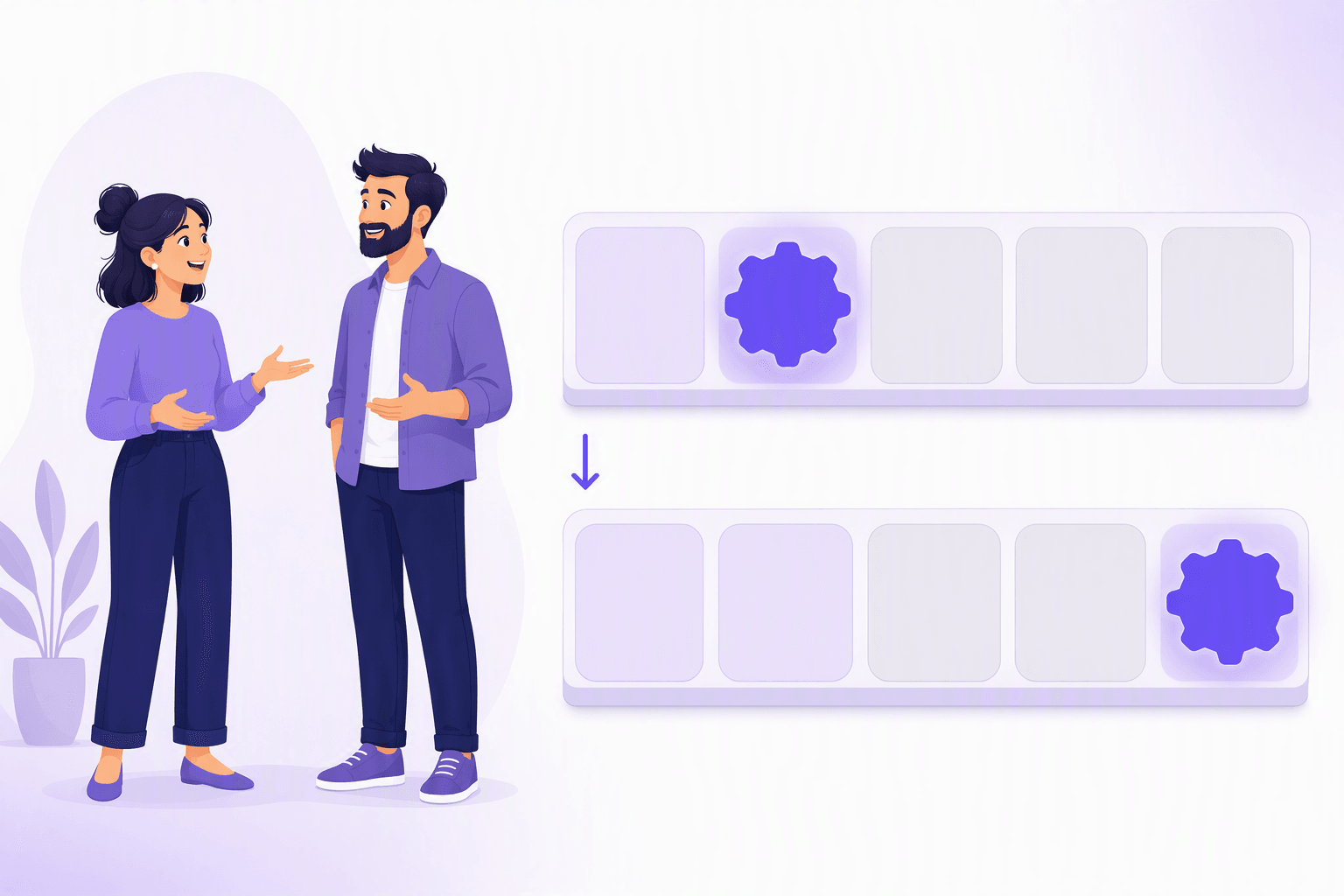
A more reliable model is: German cares about where the verb sits. In a main clause, the conjugated verb is second. In a subordinate clause, the conjugated verb is last.
This is the core idea behind the traditional description of German as a V2 language in main clauses, a framing you will also see in major grammars (Duden; IDS Grammis).
Main clauses: the V2 rule (verb in position 2)
In a typical statement, German places the conjugated verb in the second position, not necessarily the second word. Position means "slot" or "chunk."
That chunk can be the subject, a time phrase, a place phrase, or even an object. Whatever you put first, the verb comes next.
The simplest V2 sentence
- Ich komme heute.
Pronunciation: ikh KOH-meh HOY-teh
Meaning: I am coming today.
Here, the first chunk is "Ich," and the verb "komme" is second.
Starting with time or place (still V2)
- Heute komme ich.
Pronunciation: HOY-teh KOH-meh ikh - In Berlin arbeite ich.
Pronunciation: in behr-LEEN AHR-bye-teh ikh
Notice what changes: the subject moves after the verb. This is the most common "German word order surprise" for English speakers, but it is actually consistent.
💡 A practical V2 shortcut
If you start with anything other than the subject, do not panic. Put the conjugated verb next, then put the subject right after it. This one move fixes a huge percentage of beginner word-order mistakes.
Yes-no questions: verb in position 1
In yes-no questions, German typically puts the conjugated verb first.
- Kommst du heute?
Pronunciation: kohmst doo HOY-teh
Meaning: Are you coming today?
This is similar to English auxiliary inversion, but German does it with the main verb too.
W-questions: question word first, verb second
- Wo wohnst du?
Pronunciation: voh vohnst doo
Meaning: Where do you live?
The question word is the first chunk, and the verb stays second.
The "middle field": where the rest of the sentence goes
Once you place the first chunk and the conjugated verb, you have a flexible middle area where you put objects, adverbs, and other details.
German grammar descriptions often talk about sentence fields (Vorfeld, Mittelfeld, Nachfeld). You do not need the terminology to use the logic, but the idea is useful: the verb positions create a frame, and everything else fits inside it.
Time, manner, place: a default order that sounds neutral
A very teachable default for adverbial information is:
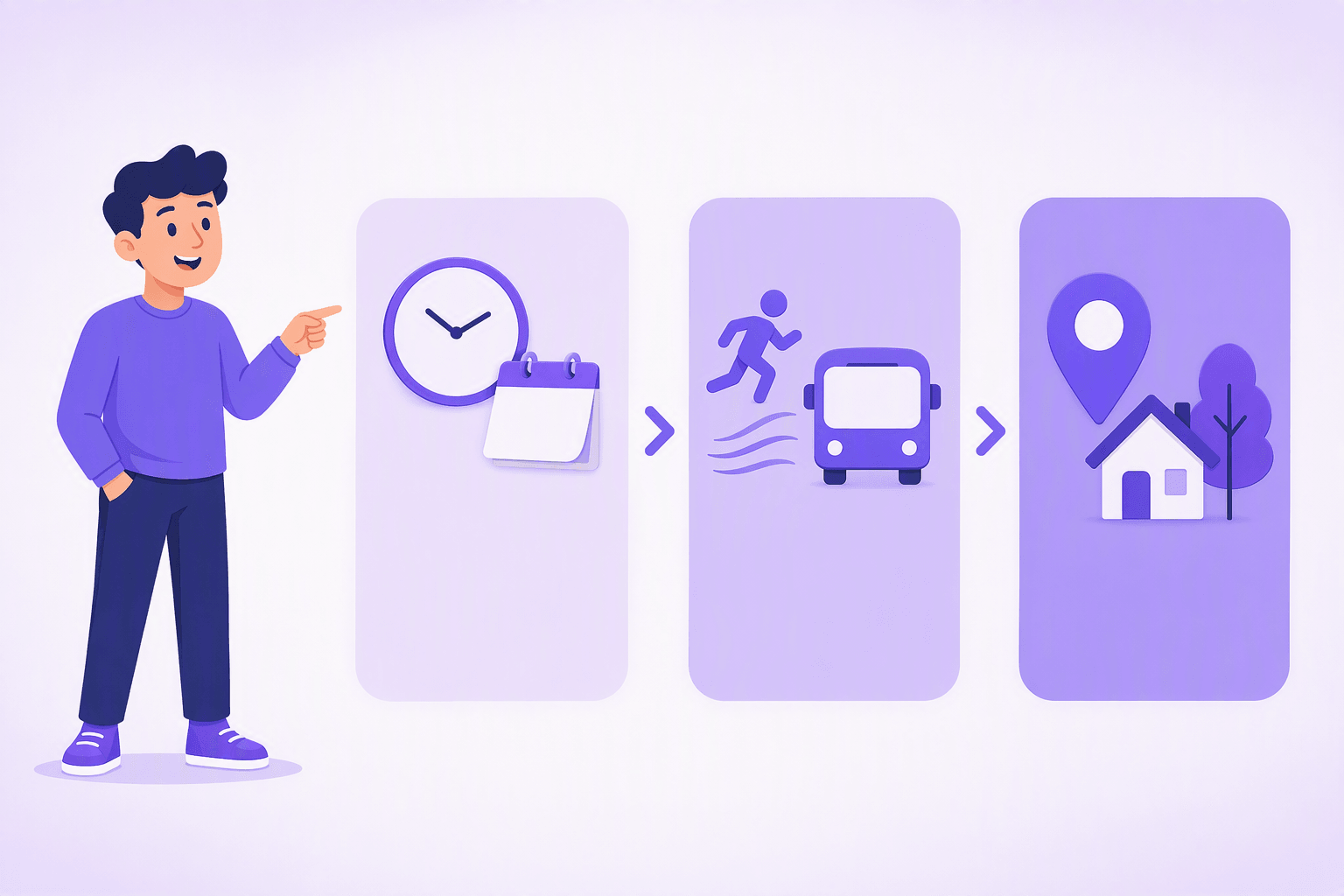
Time, then manner, then place.
You will see this taught in many German learning materials, including Goethe-Institut explanations of word order.
Time
Words like:
- heute (HOY-teh)
- morgen (MOR-gen)
- am Montag (ahm MOHN-tahk)
Manner
How something happens:
- gern (gehrn)
- schnell (shnel)
- mit dem Bus (mit dehm boos)
Place
Where:
- hier (heer)
- dort (dohrt)
- in der Stadt (in dehr shtat)
A full example
- Ich lerne heute gern zu Hause.
Pronunciation: ikh LEHR-neh HOY-teh gehrn tsoo HOW-zeh
Meaning: I like learning at home today.
If you swap the order, it is not always "wrong," but it can sound marked, like you are emphasizing a different part.
🌍 Why Germans move time to the front so often
In everyday German, it is very common to start with a time phrase, especially when making plans: "Heute..." "Morgen..." "Am Wochenende..." It matches the social habit of anchoring the conversation to scheduling and logistics, then filling in details.
Objects: accusative vs dative affects word order
German has case marking, so word order is more flexible than English. But there are still strong preferences.
A common neutral preference is:
- pronouns before nouns
- dative before accusative when both are nouns
- accusative pronoun before dative noun is also common, depending on information focus
Pronoun before noun
- Ich sehe ihn heute.
Pronunciation: ikh ZEH-uh een HOY-teh
Meaning: I see him today.
Dative and accusative together
- Ich gebe dem Mann das Buch.
Pronunciation: ikh GAY-beh dehm mahn dahs bookh
Meaning: I give the man the book.
Here "dem Mann" (dative) comes before "das Buch" (accusative). Duden and IDS descriptions treat these as strong tendencies rather than absolute laws, but for learners, copying the default gets you natural results faster.
⚠️ Do not translate English word order
English often relies on word order to show who did what to whom. German often relies on case endings and articles. If you force English order onto German, you will still be understood sometimes, but you will sound tense and unnatural, especially with two objects.
Separable verbs: the verb splits, but the rule stays the same
Separable-prefix verbs are where German word order starts to feel like a puzzle. The trick is that only the conjugated stem stays in the verb position, and the prefix goes to the end of the clause.
Ankommen
- Ich komme um acht an.
Pronunciation: ikh KOH-meh oom akht ahn
Meaning: I arrive at eight.
The verb is still in position 2: "komme" is second. The prefix "an" waits at the end.
Aufstehen
- Morgen stehe ich früh auf.
Pronunciation: MOR-gen SHTAY-uh ikh froo owf
Meaning: Tomorrow I get up early.
This is one reason German learners benefit from learning verbs as whole units, not just stems. If you want more spoken, everyday examples, movie dialogue is full of separable verbs because it is action-heavy.
Two-verb structures: infinitives and participles go to the end
When German uses a modal verb, a future construction, or a perfect tense, you often get a "verb cluster" at the end of the clause.
The conjugated verb still obeys V2 in main clauses. The other verb forms go to the end.
Modal + infinitive
- Ich kann heute nicht kommen.
Pronunciation: ikh kahn HOY-teh nikht KOH-men
Meaning: I cannot come today.
"KANN" is conjugated and sits in position 2. "kommen" goes to the end.
Perfekt: auxiliary + past participle
- Ich habe das schon gesehen.
Pronunciation: ikh HAH-beh dahs shohn geh-ZAY-en
Meaning: I have already seen that.
"Habe" is conjugated and second. "gesehen" goes to the end.
Modal + infinitive + extra info
- Ich will morgen mit dir ins Kino gehen.
Pronunciation: ikh vil MOR-gen mit deer ins KEE-noh GAY-en
Meaning: I want to go to the cinema with you tomorrow.
A good habit is to build German sentences like a bracket: put the conjugated verb early, and expect the "action word" (infinitive or participle) at the end.
Subordinate clauses: verb-final word order
Subordinate clauses are usually introduced by a subordinating conjunction, such as:
- weil (vyle) because
- dass (dahs) that
- wenn (ven) if/when
- obwohl (oh-VOHL) although
In these clauses, the conjugated verb goes to the end.
weil
- Ich bleibe zu Hause, weil ich krank bin.
Pronunciation: ikh BLAY-beh tsoo HOW-zeh, vyle ikh krahnk bin
Meaning: I am staying home because I am sick.
dass
- Ich glaube, dass er heute kommt.
Pronunciation: ikh GLOW-beh, dahs ehr HOY-teh kohmt
Meaning: I think that he is coming today.
If you only memorize one subordinate-clause move, memorize this: once you say "weil" or "dass," you are committing to a verb at the end.
Two verbs in a subordinate clause
- ..., weil ich heute arbeiten muss.
Pronunciation: vyle ikh HOY-teh AHR-bye-ten mooss
Meaning: because I have to work today.
Both verbs appear at the end, with the conjugated modal last.
Main clause plus subordinate clause: punctuation and rhythm
German writing uses commas to separate subordinate clauses more consistently than English. In speech, you will hear a small pause.
This matters for learners because the comma is a visual cue that the verb is about to move.
Try reading German subtitles with this in mind: when you see a comma plus "weil/dass/wenn," your brain should automatically expect verb-final. That is one reason learning through clips can be effective, you repeatedly see the same punctuation and hear the same cadence.
The "verb-last surprise": relative clauses
Relative clauses also push the verb to the end. They are introduced by relative pronouns like:
- der/die/das
- den/dem/deren, etc.
Example:
- Das ist der Film, den ich gestern gesehen habe.
Pronunciation: dahs ist dehr film, den ikh GES-tern geh-ZAY-en HAH-beh
Meaning: That is the movie that I watched yesterday.
In a relative clause, you often get a full verb cluster at the end, and the auxiliary can be the very last word.
Negation: where "nicht" and "kein" go
Negation is another area where English habits cause errors.
kein
Use "kein" to negate a noun with an indefinite sense.
- Ich habe kein Geld.
Pronunciation: ikh HAH-beh kyn gelt
Meaning: I have no money.
nicht
Use "nicht" to negate verbs, adjectives, adverbs, or specific parts of the sentence. A practical learner rule is: "nicht" usually comes before what it negates, and often near the end of the middle field.
-
Ich komme heute nicht.
Pronunciation: ikh KOH-meh HOY-teh nikht
Meaning: I am not coming today. -
Ich komme nicht heute, sondern morgen.
Pronunciation: ikh KOH-meh nikht HOY-teh, ZON-dehrn MOR-gen
Meaning: Not today, but tomorrow.
The position changes because the meaning changes. This is where sentence structure becomes communication, not just grammar.
Emphasis: what you put first is what you highlight
Because German allows many different first-position chunks, you can use word order to steer the listener.
Compare:
- Ich gehe heute ins Kino.
Neutral: I am going to the cinema today. - Heute gehe ich ins Kino.
Emphasis: Today (not another day). - Ins Kino gehe ich heute.
Emphasis: To the cinema (not somewhere else).
This is a powerful tool for sounding natural, and it is also why German can feel "free" while still being rule-governed.
Common learner mistakes (and the fixes that work)
Mistake 1: putting the verb third in a main clause
Wrong pattern:
- Heute ich gehe ins Kino.
Fix:
- Heute gehe ich ins Kino.
If you remember nothing else, remember: in a main clause, the conjugated verb is second.
Mistake 2: forgetting verb-final after "weil/dass"
Wrong pattern:
- ..., weil ich bin müde.
Fix:
- ..., weil ich müde bin.
Pronunciation: vyle ikh MOO-deh bin
Mistake 3: splitting separable verbs incorrectly
Wrong pattern:
- Ich ankomme um acht.
Fix:
- Ich komme um acht an.
How this shows up in real speech (and why movies help)
Textbook German often uses short, clean sentences. Real German stacks clauses, drops repeated information, and uses particles like "doch," "halt," and "mal" to manage tone.
That is why sentence structure practice should include listening. If you are learning through media, you will hear V2 and verb-final patterns thousands of times, and your brain starts predicting the verb position before it arrives.
For example, romantic lines often rely on clean V2 statements, while emotional arguments in dramas pile up subordinate clauses. If you want a fun contrast, compare polite greetings in how to say hello in German with emotionally loaded lines in how to say I love you in German. The grammar frame is the same, but the sentence packaging changes.
🌍 German word order and 'saving the verb for last'
German listeners are comfortable waiting for the final verb because it is a normal part of processing long clauses. In formal writing and careful speech, speakers often build suspense by stacking details before the verb. For learners, this is not a flaw, it is a cue: keep listening, the action word is coming.
A minimal practice plan you can do daily
Step 1: Build 10 V2 sentences
Use a template:
- [Time] + [verb] + [subject] + [rest]
Examples:
- Heute gehe ich arbeiten.
Pronunciation: HOY-teh GAY-uh ikh AHR-bye-ten - Morgen sehe ich dich.
Pronunciation: MOR-gen ZEH-uh ikh dikh
Step 2: Add one subordinate clause
Pick one conjunction and reuse it:
- ..., weil ...
Example:
- Ich gehe heute nicht aus, weil ich arbeiten muss.
Pronunciation: ikh GAY-uh HOY-teh nikht ows, vyle ikh AHR-bye-ten mooss
Step 3: Shadow a clip and write one sentence you heard
Shadowing means you repeat immediately, copying rhythm and word order. Then write the sentence and mark:
- first chunk
- conjugated verb
- end-of-clause verb(s)
If you want more structured vocabulary support alongside listening, you can also use a spaced repetition workflow like the one in our Anki for language learning guide, but keep the grammar focus on verb position, not on memorizing labels.
How polite vs casual speech affects structure (less than you think)
German politeness changes pronouns (du vs Sie) and vocabulary, but the core word order rules remain stable.
That is good news: once you can build a correct V2 sentence, you can swap in Sie forms and still be correct. For example, the difference between casual and formal greetings is mostly in pronoun choice and set phrases, not in sentence structure.
If you are curious about tone extremes, see German swear words. Even there, the word order is usually perfectly standard, which is part of why those lines can sound so sharp.
A quick checklist for self-correcting German word order
- Is this a main clause or a subordinate clause?
- Where is the conjugated verb, position 2 or at the end?
- If there are extra verbs, are they stacked at the end?
- Did I start with time or place, and if so, did I move the subject after the verb?
- Did I place "nicht" to negate the right thing?
These questions match how German reference descriptions treat word order: not as one rigid template, but as a small set of constraints that create many natural options (Duden; IDS Grammis).
Learn sentence structure the way natives use it
German sentence structure is not random, it is a system built around verb placement. Master V2, master verb-final, and treat extra verbs as an end-of-clause stack, then your sentences will start sounding German even before your vocabulary is huge.
When you are ready, practice with real dialogue and subtitles, and keep a running list of sentences you can reuse. For more everyday input, browse the Wordy blog and pair this guide with how to say goodbye in German so you can turn grammar into speech quickly.
Frequently Asked Questions
What is the basic German sentence structure?
Why does the verb go to the end in German?
What is the difference between V2 and verb-final?
Where do time, manner, and place go in German?
How can I practice German word order effectively?
Sources & References
- Institut fur Deutsche Sprache (IDS), Grammis: Informationssystem Grammatik (accessed 2026)
- Dudenredaktion, Duden: Die Grammatik (accessed 2026)
- Goethe-Institut, Deutsch lernen: Grammatik und Wortstellung (accessed 2026)
- Ethnologue, 27th edition, 2024
Start learning with Wordy
Watch real movie clips and build your vocabulary as you go. Free to download.


