German Holidays and Festivals: 14 Celebrations You’ll Actually See (and What to Say)
Quick Answer
Germany’s holidays mix nationwide public days like Tag der Deutschen Einheit with regional festivals like Karneval and Oktoberfest. The key to enjoying them is knowing what each event celebrates, what’s typical (parades, markets, fireworks), and a few natural phrases Germans actually say in the moment.
Germany’s most important holidays and festivals include nationwide public holidays like Tag der Deutschen Einheit (German Unity Day) and Weihnachten (Christmas), plus huge regional events like Karneval in the Rhineland and Oktoberfest in Munich. If you know what each celebration is for, what usually happens, and a few phrases locals actually say, you can follow along even when the crowd is loud and the dialect is strong.
German is also a major travel language: Ethnologue estimates about 90 million native speakers worldwide (Ethnologue, 27th edition, 2024). That means holiday vocabulary pays off, because you will hear it not only in Germany, but also in Austria, Switzerland, and German-speaking communities elsewhere.
If you want a quick warm-up on greetings before you hit a festival crowd, start with how to say hello in German and how to say goodbye in German. Then come back here and match the phrases to the season.
How German holidays work (and why dates can be confusing)
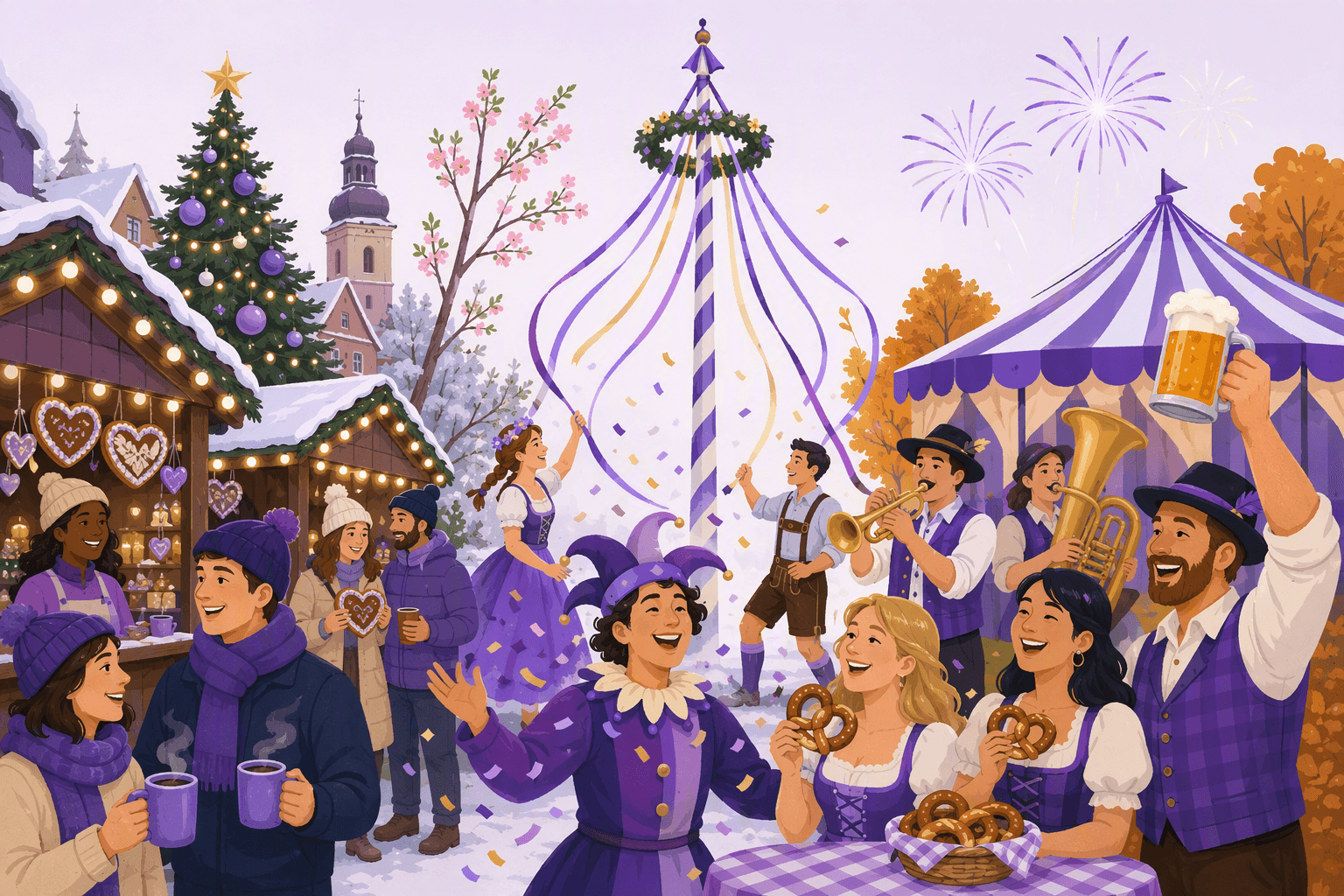
Germany has 16 federal states, and not every public holiday is observed everywhere. A holiday like Fronleichnam is public in some states and a normal workday in others, so the same week can feel completely different depending on where you are.
Another reason dates feel confusing is that many major holidays are tied to the Christian calendar. Easter moves each year, and with it Karfreitag, Ostermontag, Christi Himmelfahrt, and Pfingsten.
In everyday German, you will hear two useful umbrella words:
- Feiertag (FY-er-tahk): a public holiday, often with closed shops.
- Fest (FEHST): a celebration or festival, not always a day off.
Duden’s usage notes are helpful here because Germans often say Feiertag for the official calendar day, and Fest for the event itself (Duden, accessed 2026).
💡 A practical travel rule
If it is a gesetzlicher Feiertag (geh-SEHTS-lee-kher FY-er-tahk, legal public holiday), expect quieter streets and limited shopping. If it is a Stadtfest or Volksfest, expect crowds, food stalls, and loud music, but normal weekday schedules may still apply.
Winter holidays and festivals (November to February)
Winter is when Germany’s public life moves outdoors into markets, lights, and hot drinks. The weather matters too: the Deutscher Wetterdienst’s climate normals show that much of Germany sits in a cool-temperate pattern, with short days and frequent overcast in many regions (DWD, accessed 2026). That is one reason Christmas markets are built around warmth: mugs, fire pits, and cozy foods.
Advent
Advent (AH-vent) is the four-week lead-up to Christmas. You will see Adventskalender (AH-vent-skah-LEN-der, Advent calendar) and Adventskranz (AH-vents-krahnts, wreath) everywhere.
What to say:
- Schönen Advent! (SHUR-nen AH-vent, polite): a seasonal wish, especially in shops or emails.
- Einen schönen ersten Advent! (EYE-nen SHUR-nen ERS-ten AH-vent): on the first Advent Sunday.
Cultural detail: In many families, Advent is when the “small rituals” start, candles on Sundays, baking, and the first market visit. This is a good example of what linguist Anna Wierzbicka calls culturally patterned scripts for everyday life: the words and routines reinforce each other without needing a big speech.
Nikolaustag
Nikolaustag (nee-KOH-lows-tahk) is on December 6. Children often put out boots the night before.
What to say:
- Alles Gute zum Nikolaus! (AH-les GOO-teh tsoom nee-KOH-lows): common with kids.
- Hast du was im Stiefel gehabt? (hahst doo vahss im SHTEE-fel geh-HAHPT, casual): “Did you get anything in your boot?”
Weihnachten
Weihnachten (VYE-nahkh-ten) is Christmas. The main family moment is usually Heiligabend (HY-likh-AH-bent, Christmas Eve), with Bescherung (beh-SHEH-roong, gift-giving) often that night.
What to say:
- Frohe Weihnachten! (FROH-eh VYE-nahkh-ten, polite)
- Schöne Feiertage! (SHUR-neh FY-er-tah-geh, polite): useful if you are not sure what someone celebrates.
Cultural detail: Germans often distinguish between the religious frame and the family frame. You can say Frohe Weihnachten safely in most contexts, but Schöne Feiertage is a neutral alternative in workplaces.
Silvester
Silvester (sil-VES-ter) is New Year’s Eve. Fireworks can be intense in big cities.
What to say:
- Guten Rutsch! (GOO-ten ROOTSH, casual): said before New Year, meaning roughly “have a good slide into the new year.”
- Frohes neues Jahr! (FROH-es NOI-es YAHR, polite): at midnight and for days after.
- Prosit! (PROH-zit) or Prost! (PROHST): toasts.
⚠️ Fireworks reality check
In some neighborhoods, fireworks are loud and close. If you are sensitive to noise, choose a quieter viewpoint or a more controlled public display. Ask locals: "Wo ist es an Silvester eher ruhig?" (voh ist ess ahn sil-VES-ter EH-er ROO-ikh).
Karneval / Fasching / Fastnacht
Carnival season peaks before Lent, but the vocabulary changes by region.
- Karneval (kar-neh-VAHL): common in Cologne and the Rhineland.
- Fasching (FAH-shing): common in Bavaria.
- Fastnacht (FAHST-nahkht): common in parts of the southwest.
What to say:
- Alaaf! (ah-LAHF): Cologne.
- Helau! (heh-LOW): Düsseldorf and other areas.
- Kölle Alaaf! (KUR-leh ah-LAHF): very Cologne-coded.
Cultural detail: This is where “German” becomes very regional very fast. If you want to understand why, it helps to read about dialect geography and identity, topics that sociolinguist Peter Auer has explored extensively in his work on European dialects and everyday speech.
Spring holidays (March to May)
Spring is when Germany’s calendar starts to feel “public” again: parades, long weekends, and outdoor gatherings.
Ostern
Ostern (OSS-tern) is Easter. Even if you are not religious, you will notice Ostereier (OSS-ter-EYE-er, decorated eggs) and Osterhase (OSS-ter-HAH-zeh, Easter bunny).
What to say:
- Frohe Ostern! (FROH-eh OSS-tern, polite)
- Schöne Ostertage! (SHUR-neh OSS-ter-tah-geh, polite)
Tag der Arbeit
Tag der Arbeit (tahk dehr AR-bite) is May 1, Labor Day. In many places there are demonstrations, speeches, or local festivals.
What to say:
- Schönen ersten Mai! (SHUR-nen ERS-ten MYE, casual): common in some regions.
- Schönen Feiertag! (SHUR-nen FY-er-tahk): safe and general.
Maibaum and Tanz in den Mai
In many towns you will see a Maibaum (MYE-bowm, maypole). The night before May 1 is often Tanz in den Mai (tahnts in den MYE, dance into May), basically a party night.
What to say:
- Gehst du heute tanzen? (gayst doo HOY-teh TAHN-tsen, casual)
- Viel Spaß! (feel SHPAHSS, casual): “Have fun!”
Cultural detail: The maypole tradition is strongly local. In some places it is a community symbol, in others it is a student party marker, and in some villages it is tied to club life and fundraising.
Summer holidays and festivals (June to August)
Summer is peak festival season. You will see Stadtfest (SHTAHT-fehst, town festival), Weinfest (VINE-fehst, wine festival), and open-air concerts.
Pfingsten
Pfingsten (PFING-sten, Pentecost) brings another long weekend, with Pfingstmontag (PFINGST-mohn-tahk) as the Monday holiday.
What to say:
- Schöne Pfingsten! (SHUR-neh PFING-sten, polite): common in messages.
Fronleichnam
Fronleichnam (FROHN-lyke-nahm) is a public holiday only in some states. In places where it is observed, you may see processions.
What to say:
- Schönen Feiertag! (SHUR-nen FY-er-tahk): you do not need a special phrase unless you are part of the community.
Christopher Street Day (CSD)
Christopher Street Day is the German term widely used for Pride events, often shortened to CSD. Major parades happen in cities like Berlin, Cologne, and Hamburg.
What to say:
- Schönen CSD! (SHUR-nen tseh-ess-DEH, casual)
- Viel Spaß auf der Demo! (feel SHPAHSS owf dehr DEH-moh): if someone is attending the march.
Cultural detail: The English name is not used as-is. Germans often keep the historical reference but translate it into a local event label, then abbreviate it heavily. That is a very German pattern in public-life vocabulary.
Autumn highlights (September to November)
Autumn is when Germany’s “big brand” festivals happen, plus several major public holidays.
Oktoberfest
Oktoberfest (ok-TOH-ber-fehst) is the famous Munich beer festival, usually starting in September. It is a specific event on the Theresienwiese, but many towns use “Oktoberfest” as a theme for local parties.
What to say:
- O’zapft is! (oh-tsahpft iss): Bavarian phrase meaning “It’s tapped!”, said at the opening.
- Ein Bier, bitte. (ine BEER, BIT-teh): simple and effective.
- Prost! (PROHST)
Cultural detail: Oktoberfest German is not “textbook German.” You will hear Bavarian pronunciation, clipped endings, and lots of set phrases. If you want to avoid sounding too intense, keep it simple and polite.
Erntedankfest
Erntedankfest (ERN-teh-dahnk-fehst) is a harvest thanksgiving festival, often connected to churches and local communities.
What to say:
- Schönes Erntedankfest! (SHUR-nes ERN-teh-dahnk-fehst): more common in community contexts than in big cities.
Tag der Deutschen Einheit
Tag der Deutschen Einheit (tahk dehr DOY-tshen EYE-nite) is on October 3 and commemorates German reunification. The German Federal Government maintains public-facing explanations and official programming information (Bundesregierung, accessed 2026).
What to say:
- Schönen Tag der Deutschen Einheit! (SHUR-nen tahk dehr DOY-tshen EYE-nite): formal, not super common in casual talk.
- Genieß den Feiertag. (geh-NEESS den FY-er-tahk, casual): “Enjoy the holiday.”
Cultural detail: Many Germans experience this day less as a “patriotic” holiday and more as a free day with occasional official events. That tone can differ by generation and region.
Reformationstag
Reformationstag (reh-for-MAH-tsee-ohns-tahk) is October 31 and is a public holiday in several states. It is linked to the Protestant Reformation and Martin Luther.
What to say:
- Schönen Feiertag! is usually enough unless you are in a church context.
What to say at festivals: small talk that actually fits
Knowing one perfect phrase is less useful than knowing the “shape” of festival talk. Research on politeness by Penelope Brown and Stephen Levinson (in their work Politeness: Some Universals in Language Usage, Cambridge University Press) is a good lens here: in crowded public settings, people prefer low-effort, face-saving talk that does not demand too much intimacy.
Here are patterns that work across most German events:
- Friendly opener: Na, wie ist’s? (nah, vee ists, casual)
- Quick positive reaction: Klingt gut! (klingt goot, casual)
- Exit line: Ich muss weiter. (ikh mooss VYE-ter, casual)
If you want more greeting options for different levels of formality, use how to say hello in German as a base and then add the holiday noun.
Regional culture: why one “German holiday list” is never enough
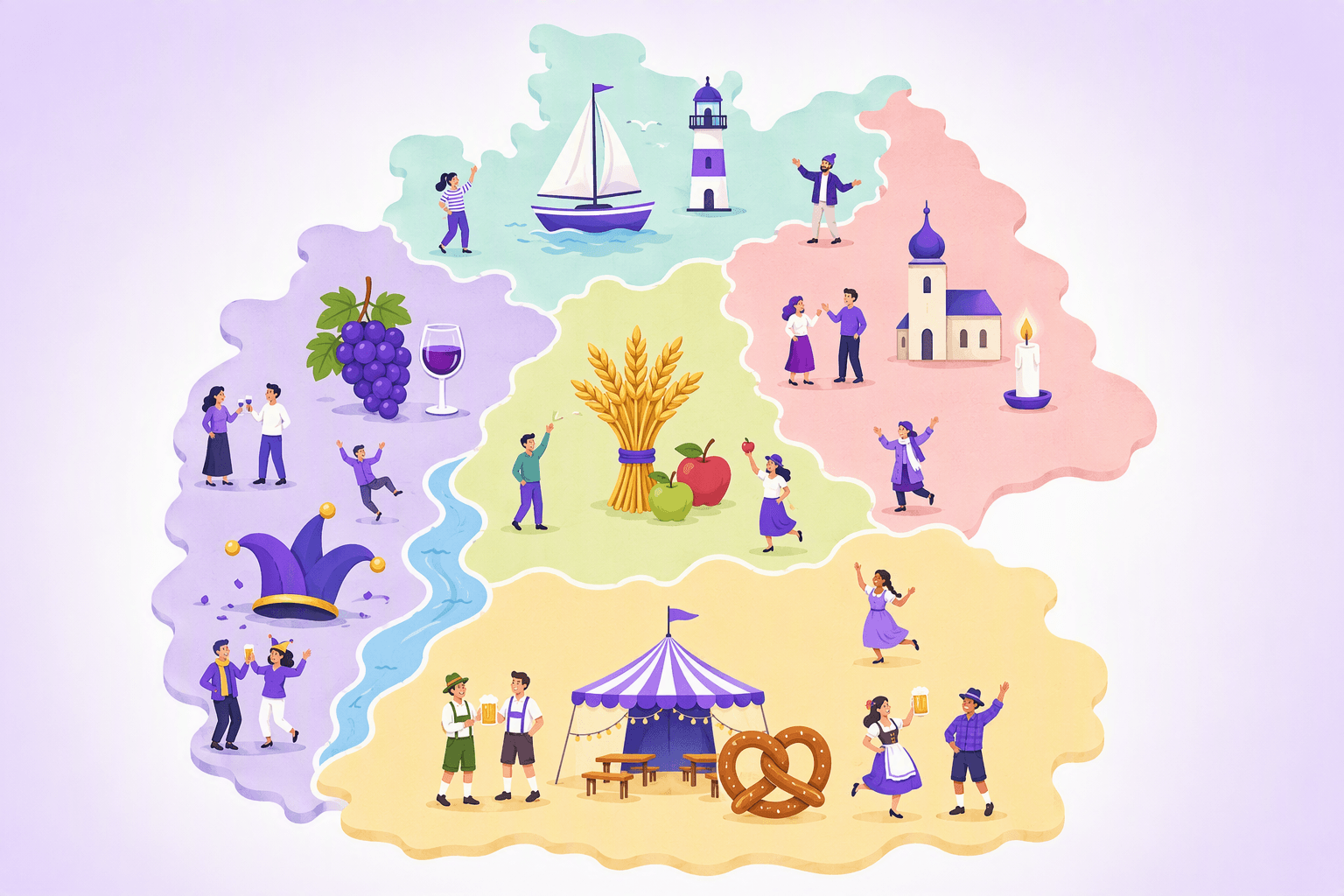
Germany’s festival map is shaped by religion, history, and local identity. Catholic-majority regions tend to keep holidays like Fronleichnam as public days, while Protestant-majority regions are more likely to observe Reformationstag.
Local festivals also reflect what a region produces. Wine regions run Weinfeste, hop-growing areas have beer culture, and coastal areas have maritime festivals. UNESCO’s Intangible Cultural Heritage lists for Germany are a useful reminder that “culture” is often about practices and community knowledge, not only monuments (UNESCO, accessed 2026).
🌍 A useful mindset for learners
Treat each festival as a listening lab. You get repeated phrases (toasts, greetings, chants), predictable scripts (ordering, paying, thanking), and strong emotional context. That combination makes vocabulary stick faster than isolated study.
A mini phrase kit for holidays (pronunciation included)
You can cover a surprising number of situations with a few flexible lines. If you want more romantic language for holiday messages, see how to say I love you in German.
- Schönen Feiertag! (SHUR-nen FY-er-tahk): “Have a nice holiday.”
- Viel Spaß! (feel SHPAHSS): “Have fun!”
- Guten Rutsch! (GOO-ten ROOTSH): before New Year.
- Frohes neues Jahr! (FROH-es NOI-es YAHR): after midnight and in early January.
- Prost! (PROHST): toast.
💡 If you only learn one structure
Learn "Schönen X!" and swap in the event: Schönen Advent, Schöne Feiertage, Schönen Feiertag. Germans do this constantly, and it sounds natural without being overly familiar.
Common mistakes visitors make (and how to avoid them)
Overusing very intimate language
At festivals, people are friendly, but not automatically close. Save strong intimacy for close friends and partners. If you are unsure, stay with Sie-level politeness or neutral wishes.
If you want to understand what crosses the line fast, skim German swear words. Even mild insults can land harder in German than learners expect.
Assuming every shop is open
On major public holidays, many stores close, and Sundays can already be limited. Plan food and transport ahead, especially around Christmas and New Year.
Forgetting that “German” can mean dialect
Karneval slogans, Bavarian festival speech, and Swiss German on the border can sound like different languages. Do not panic. Listen for the repeated “script” phrases and the nouns you already know.
Learn holidays faster with real clips
Holiday language is repetitive by design: the same greetings, toasts, and announcements come back every year. That makes it perfect for learning through short scenes from movies and TV, because you hear the phrase with the right emotion and timing.
If you are building a broader plan, combine this guide with the German language overview and then practice listening with festival scenes, street interviews, and holiday episodes. For more learning methods, browse the blog.
Frequently Asked Questions
What are the most important public holidays in Germany?
Is Oktoberfest only in Munich?
What is the difference between Karneval, Fasching, and Fastnacht?
Do all German states have the same holidays?
What do Germans say on New Year’s Eve and New Year’s Day?
Sources & References
- Ethnologue, 27th edition, 2024
- Duden, 'Feiertag' and holiday usage notes, accessed 2026
- Bundesregierung (German Federal Government), 'Tag der Deutschen Einheit' overview, accessed 2026
- Deutscher Wetterdienst (DWD), climate normals and seasonal conditions in Germany, accessed 2026
- UNESCO Intangible Cultural Heritage lists (Germany), accessed 2026
Start learning with Wordy
Watch real movie clips and build your vocabulary as you go. Free to download.


