Quick Answer
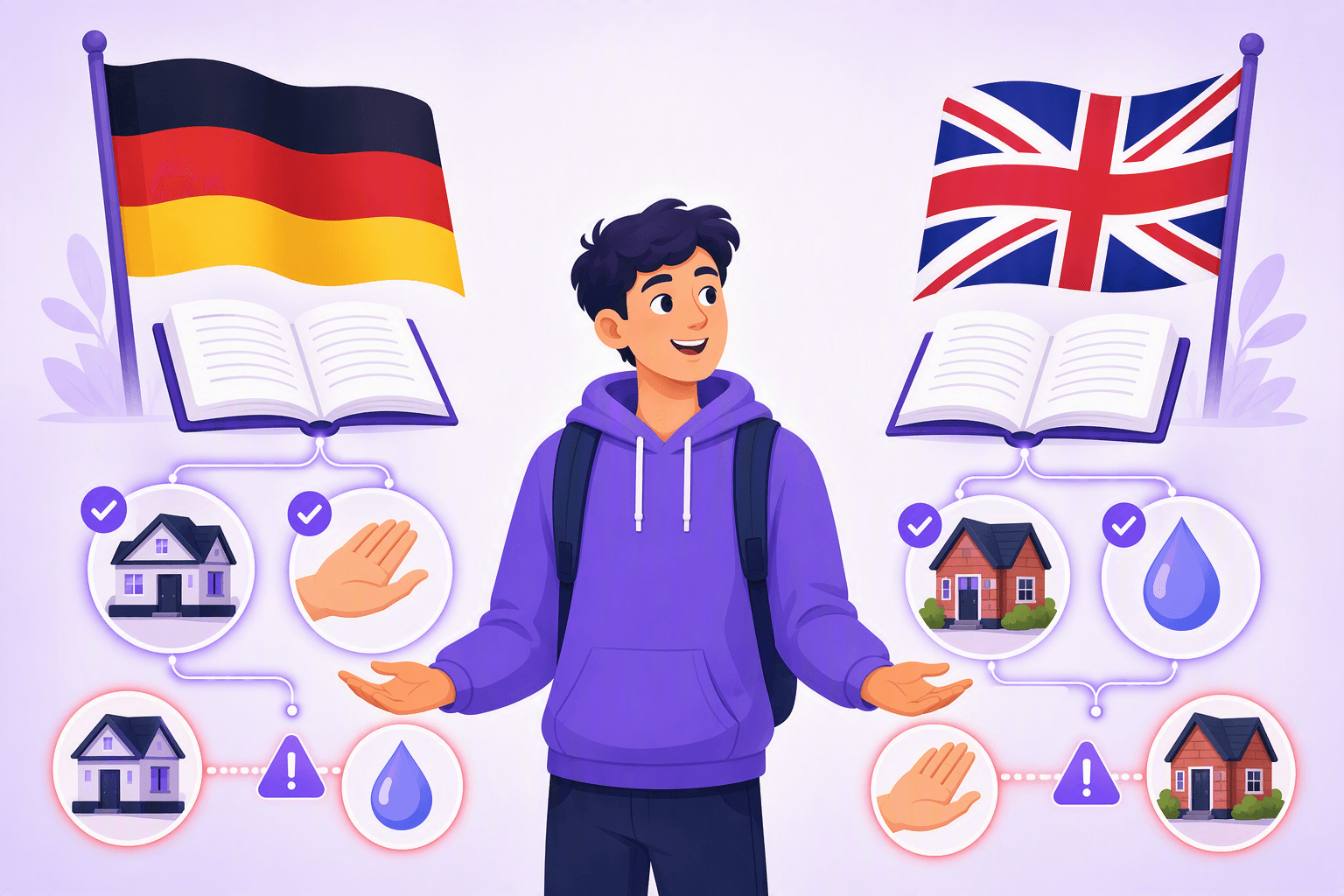
German cognates are words that share a historical origin with English, such as Haus and house, Hand and hand, and Wasser and water. Learning their predictable sound patterns gives English speakers a fast, reliable vocabulary foundation, but false friends still require care.
German cognates are German words that English speakers can often recognize because the two languages are closely related. Words such as Haus /haʊs/ and “house,” Hand /hant/ and “hand,” or Wasser /ˈvasɐ/ and “water” come from shared Germanic roots. Learning these links can give you a useful early vocabulary boost, provided you also learn the sound patterns and watch for deceptive false friends.
German is spoken by roughly 135 million people worldwide when first- and second-language speakers are counted, according to Ethnologue. It is the official language of Germany, Austria, and Liechtenstein, and one of the official languages of Switzerland, Belgium, and Luxembourg. That reach makes learning German useful for travel, work, study, and European media.
English and German are not close enough for effortless conversation, but their relationship is visible everywhere. Use cognates as clues, then confirm each word through real sentences, audio, and the kind of everyday dialogue covered in our guide to German greetings.
| English | German | Pronunciation | Note |
|---|---|---|---|
| house | Haus | HOWSS | A close spelling and meaning match. |
| hand | Hand | hahnt | Same core meaning, but German final d is devoiced. |
| water | Wasser | VAH-ser | German w is pronounced like English v. |
| fish | Fisch | fish | Very close in sound and meaning. |
| mother | Mutter | MOO-ter | A common family-word cognate. |
| father | Vater | FAH-ter | German v is usually pronounced like f. |
| brother | Bruder | BROO-der | Related through an older Germanic root. |
| winter | Winter | VIN-ter | Same season, different w sound. |
| summer | Sommer | ZOM-mer | German initial s before a vowel sounds like z. |
| name | Name | NAH-muh | The final e is pronounced. |
| finger | Finger | FING-er | Near-identical everyday noun. |
| book | Buch | bookh | The ch is a back-throat sound here. |
| salt | Salz | zahlts | Related word with a German z sound. |
| milk | Milch | milksh | The final ch is softer than English k. |
| come | kommen | KOM-men | An infinitive verb ending in -en. |
| drink | trinken | TRINK-en | A highly useful verb cognate. |
| swim | schwimmen | SHVIM-men | German sch sounds like English sh. |
| help | helfen | HEL-fen | The word and meaning remain very close. |
Why English and German share so many words
English and German both belong to the West Germanic branch of the Indo-European language family. They are linguistic relatives, alongside Dutch, Afrikaans, Yiddish, and several smaller languages.
Their shared ancestry goes back long before modern Germany or England existed. English later absorbed large amounts of French, Latin, Norse, and Greek vocabulary, while German developed its own writing traditions and regional varieties. Yet fundamental Germanic vocabulary remained recognizable in both languages.
Joseph C. Salmons, in A History of German, traces how German developed from earlier Germanic varieties while preserving many links that English speakers can still recognize. Basic words are especially likely to survive because people use them constantly across generations.
Compare these pairs:
- Tag /taːk/ and “day”
- gut /ɡuːt/ and “good”
- alt /alt/ and “old”
- neu /nɔʏ/ and “new”
- Maus /maʊs/ and “mouse”
- Brot /bʁoːt/ and “bread”
- Apfel /ˈapfl̩/ and “apple”
- Hund /hʊnt/ and “hound”
Not every pair is equally obvious. “Hound” is now more specific in English than Hund /hʊnt/, which means “dog” in general. Cognates show family history, not always identical modern usage.
The sound patterns that make cognates easier to spot
Cognates become much more useful when you stop treating them as random similarities. English and German developed recurring sound correspondences. You do not need historical linguistics to benefit from them, but noticing a few patterns makes unfamiliar words easier to decode.
German w often matches English w, but sounds like v
German Wasser /ˈvasɐ/ corresponds to English “water,” and Winter /ˈvɪntɐ/ corresponds to “winter.” The spelling looks familiar, but German w /v/ is pronounced like English “v.”
This is why wer /veːɐ̯/, meaning “who,” does not sound like English “where.” Build the spelling-sound link early, then reinforce it with dialogue rather than isolated lists. The German pronunciation guide can help you establish the main sound system.
German v often matches English f
A second important pattern is German v /f/. Vater /ˈfaːtɐ/ resembles “father,” while Vogel /ˈfoːɡl̩/ relates historically to English “fowl.”
The difference is not random. It reflects sound shifts that separated German from English over many centuries. If a familiar-looking German word begins with v, test an English word beginning with “f.”
German z often matches English t
German Zehn /tseːn/, meaning “ten,” belongs with English “ten.” German z /ts/ is a combined sound, like the ending of English “cats.”
You can see related patterns in zwei /tsvaɪ/, “two,” and Zunge /ˈtsʊŋə/, “tongue.” German spelling is relatively consistent once you learn its letter-sound rules, which is one reason it is often easier to read than English.
German sch often matches English sh
German Schiff /ʃɪf/, “ship,” and schwimmen /ˈʃvɪmən/, “to swim,” are useful examples. The letter group sch /ʃ/ consistently represents the “sh” sound.
This makes many words more transparent than they first appear: Schnee /ʃneː/ is “snow,” Schmerz /ʃmɛʁts/ is “pain,” and Schule /ˈʃuːlə/ is related to “school,” though that pair also has Greek and Latin history behind it.
Cognates you will hear in daily German
A cognate is most valuable when you can recognize it in a real sentence. The following examples show how familiar-looking words function in ordinary German.
Das Haus ist alt. /das haʊs ɪst alt/ means “The house is old.” Here, das /das/ means “the,” Haus /haʊs/ is “house,” and alt /alt/ corresponds to “old.”
Mein Bruder trinkt Wasser. /maɪn ˈbʁuːdɐ tʁɪŋkt ˈvasɐ/ means “My brother drinks water.” You can recognize Bruder /ˈbʁuːdɐ/, trinkt /tʁɪŋkt/, and Wasser /ˈvasɐ/ even before knowing every grammar rule.
Im Winter schwimmen wir nicht. /ɪm ˈvɪntɐ ˈʃvɪmən viːɐ̯ nɪçt/ means “We do not swim in winter.” Notice that nicht /nɪçt/ is not a cognate, but the sentence still offers several recognition anchors.
This is the practical benefit: cognates reduce the number of completely new items in a sentence. They free attention for grammar, pronunciation, and context.
💡 Learn cognates as sentence pieces
Do not memorize only Haus equals house. Learn useful chunks such as Das Haus ist alt and Ich komme später. A cognate becomes easier to recall when it has a pronunciation, a grammar pattern, and a situation attached to it.
The false friends that can cause real mistakes
A false friend looks familiar but means something different. English speakers should learn them early because guessing can lead to awkward, funny, or serious misunderstandings.
Gift /ɡɪft/ means “poison,” not a present. If you want to say “gift,” use Geschenk /ɡəˈʃɛŋk/.
bekommen /bəˈkɔmən/ means “to receive” or “to get,” not “to become.” “I become tired” is Ich werde müde /ɪç ˈveːɐ̯də ˈmyːdə/.
Chef /ʃɛf/ means “boss,” not a person who cooks professionally. A chef in the English culinary sense is usually a Koch /kɔx/ or Köchin /ˈkœçɪn/.
aktuell /akˈtʊɛl/ means “current” or “up to date,” not “actual.” For “actual,” German often uses tatsächlich /ˈtaːtˌzɛçlɪç/.
eventuell /ɛvɛntuˈɛl/ means “possibly” or “if necessary,” not “eventually.” “Eventually” is more often schließlich /ˈʃliːslɪç/ or letztendlich /ˈlɛts(t)ʔɛntlɪç/, depending on context.
The Duden dictionary is a strong first check when a German word feels suspiciously easy. The Institut für Deutsche Sprache also provides evidence-based resources on German usage and vocabulary. A dictionary lookup takes seconds and prevents a false friend from becoming a habit.
🌍 Why false friends feel so convincing
False friends exploit the brain's pattern-recognition system. English speakers see a familiar spelling and predict a familiar meaning before context has time to correct it. This is why a short, deliberate false-friend list is more effective than waiting to encounter errors by chance.
Cognates do not remove German grammar
Recognizing Mutter /ˈmʊtɐ/ is helpful, but you still need to know that it is feminine: die Mutter /diː ˈmʊtɐ/. Recognizing Haus /haʊs/ does not automatically teach you its plural, Häuser /ˈhɔʏzɐ/.
German case endings can also change familiar vocabulary. The word Hund /hʊnt/ appears as den Hund /deːn hʊnt/ in the accusative and dem Hund /deːm hʊnt/ in the dative. Cognates make the noun easier to recognize, but articles and endings still carry grammatical information.
This is why vocabulary and grammar should support each other. After learning cognates, study how German articles work with our guide to der, die, and das, then practice the words in full sentences.
Mark Durrell’s Hammer's German Grammar and Usage is especially useful for seeing how familiar vocabulary behaves inside German sentence patterns. The grammar may be new, but cognates give you recognizable content while you learn it.
A practical method for learning German cognates
Start with high-frequency vocabulary rather than hunting for obscure similarities. Core nouns, adjectives, and verbs appear repeatedly in conversation, TV dialogue, news, and everyday signs.
First, make three groups: obvious cognates, changed-sound cognates, and false friends. Put Hand /hant/ in the obvious group, Vater /ˈfaːtɐ/ in the changed-sound group, and Gift /ɡɪft/ in the false-friend group.
Second, listen before you assume a word sounds like English. German Buch /buːx/ is related to “book,” but its final ch /x/ requires a back-throat sound. Understanding the spelling connection is useful, but copying English pronunciation will make recognition harder in real speech.
Third, collect cognates from media you actually enjoy. While watching German clips, pause only for high-value words that recur. A familiar word heard in an emotional scene or repeated joke is easier to retain than a disconnected flashcard.
Finally, use cognates to create your own short sentences. Begin with statements such as Ich habe Hunger /ɪç haːbə ˈhʊŋɐ/, “I am hungry,” then add known nouns and verbs. The goal is not to prove that German resembles English. The goal is to use German without translating every word.
Build recognition, then build range
German cognates offer English speakers a genuine advantage, especially in early reading and listening. They reveal a shared linguistic past and make many common words less intimidating.
Still, reliable German comes from checking meaning, hearing pronunciation, and learning grammar in context. Treat cognates as clues, not guarantees. As your vocabulary grows, you can also explore practical phrases for saying goodbye in German and more personal language in our guide to saying I love you in German.
Frequently Asked Questions
What are German cognates?
How many German cognates are there in English?
Are German and English mutually understandable?
What are common German false friends for English speakers?
Is German easier for English speakers because of cognates?
Sources & References
- Goethe-Institut, German language information, accessed 2026
- Duden, Deutsches Universalwörterbuch and online dictionary, accessed 2026
- Institut für Deutsche Sprache, German language resources, accessed 2026
- Ethnologue, German, 27th edition, 2024
- Joseph C. Salmons, A History of German, Oxford University Press
Start learning with Wordy
Watch real movie clips and build your vocabulary as you go. Free to download.


