French Holidays and Festivals: 12 Celebrations You’ll Actually See (and What People Say)
Quick Answer
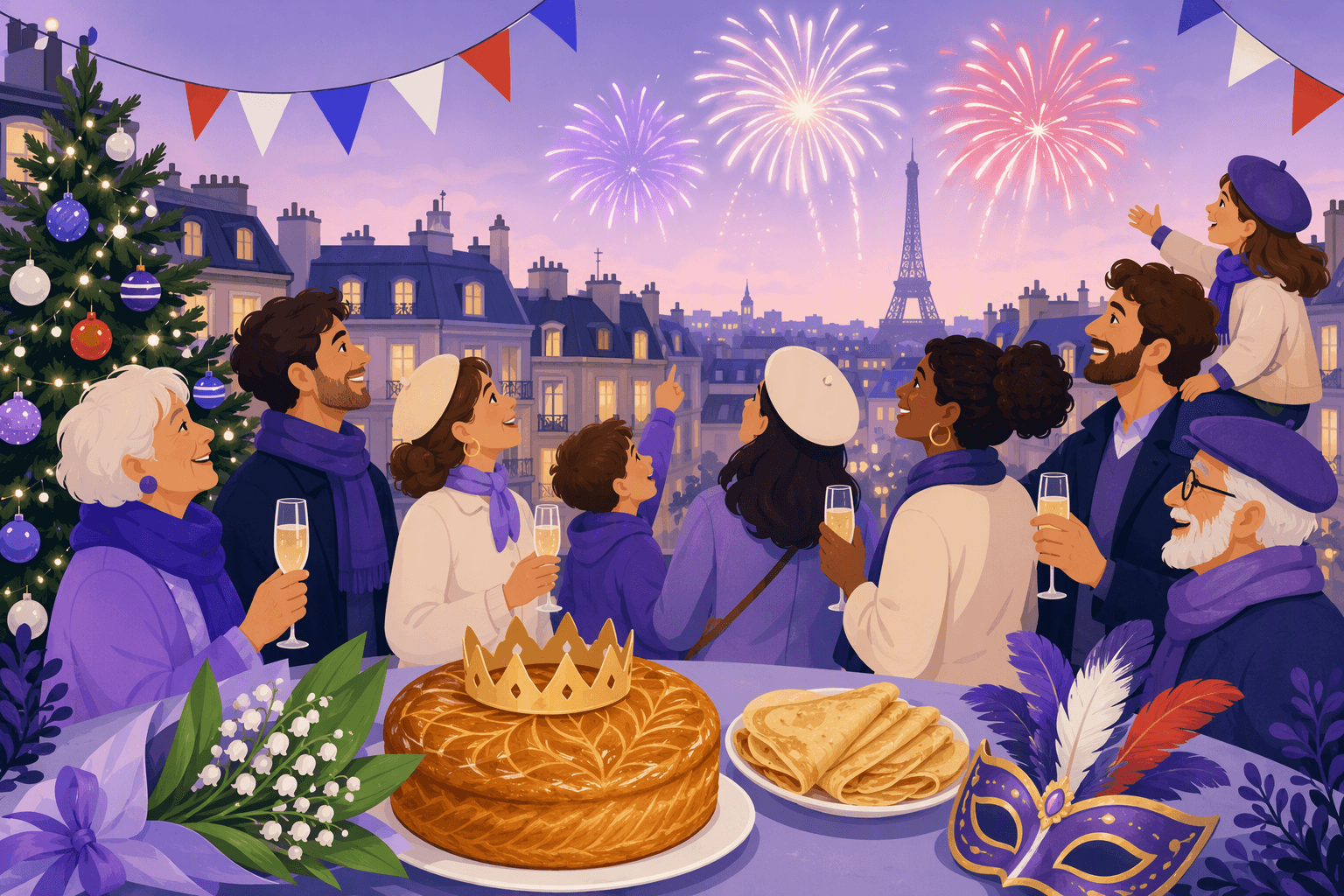
France’s biggest holidays and festivals include Noël, Pâques, la Fête nationale (14 juillet), la Toussaint, and regional events like la Fête des Lumières in Lyon. This guide explains what each celebration is for, what actually happens, and the French phrases you will hear and can safely use, with pronunciation help.
French holidays and festivals are a mix of national public holidays (jours fériés) like Noël, Pâques, and 14 juillet, plus big local events like Lyon’s Fête des Lumières and famous carnivals. If you know what each celebration is for and a few safe phrases, you can follow the social rules, avoid awkward timing, and sound natural in conversations and messages.
French is also a global language, not just a France thing. The OIF estimates about 321 million French speakers worldwide, across more than 30 countries and territories where French has official status, so many of these greetings travel well, even when the traditions differ.
If you want the basics for everyday interactions before you jump into holiday talk, start with how to say hello in French and how to say goodbye in French.
How French holidays work (so you do not get surprised)
France has a set of nationwide public holidays, and many workplaces and schools close on those days. Official lists are published by the French state, and you will see them summarized on Service-Public.fr and in INSEE resources.
A key cultural detail is that “holiday” and “vacation” are not the same word. A public holiday is a jour férié, while your personal vacation time is les vacances. Mixing them up is common for learners.
The social rule: greetings matter more than speeches
On many French holidays, you do not need a long message. A short, correct wish is enough, especially with colleagues or neighbors.
This fits what sociolinguists call “ritual” language. In Language and Social Relations, Asif Agha describes how routine formulas signal belonging and shared expectations, even when the literal content is simple.
Pronunciation note you can rely on
French has silent letters and liaison, but you can still be understood if you keep the rhythm and nasal vowels consistent. If you want a structured refresher, Wordy pairs holiday clips with pronunciation-focused listening, which helps you hear the difference between bon (nasal) and bonne (not nasal) in real speech.
The 12 French holidays and festivals you will actually see
Below are the celebrations that show up in calendars, conversations, and media every year. For each one, you get: what it is, what typically happens, and what you can say without sounding strange.
Noël
Noël (noh-EHL) is Christmas, celebrated on 25 December, with Christmas Eve often being the main family moment. The big meal is le réveillon (ruh-vay-YOHN), and it can run late.
In many families, gifts are opened either on the 24th at night or on the 25th morning. In workplaces, you may also see a small secret Santa style exchange, but it is not universal.
What to say:
- Joyeux Noël ! (zhwah-YUH noh-EHL): the standard wish.
- Bonnes fêtes ! (bohn FET): neutral “happy holidays,” useful when you are not sure what someone celebrates.
💡 A safe December message
If you are writing to colleagues or clients in December, "Bonnes fêtes" is often safer than assuming "Joyeux Noël". It is friendly, correct, and widely used in professional emails.
Le Jour de l’An
Le Jour de l’An (zhur duh lahn) is New Year’s Day, 1 January. The celebration itself usually happens the night before, on le réveillon du Nouvel An (ruh-vay-YOHN dew noo-VEHL ahn).
The most common wish is short and direct:
- Bonne année ! (bohn ah-NAY)
- Bonne santé ! (bohn sahn-TAY), often paired with Bonne année.
A very French detail is the extended window for New Year wishes. In many workplaces, people keep saying Bonne année well into January.
L’Épiphanie et la galette des rois
L’Épiphanie (ay-pee-fah-NEE) is Epiphany, associated with la galette des rois (gah-LET day rwah), usually eaten in early January. Inside is a small charm, la fève (FEV).
Whoever finds the fève becomes king or queen for the moment and wears a paper crown. In offices, this is a common, low-stakes social ritual.
What to say:
- On tire les rois ? (ohn TEER lay rwah): “Are we doing the kings?” meaning “Are we sharing galette?”
- J’ai eu la fève ! (zhay oo lah FEV): “I got the fève!”
La Chandeleur
La Chandeleur (shahn-duh-LUR) is 2 February, known in everyday life as “crêpe day.” People make and eat crêpes at home, and some schools or workplaces do small crêpe events.
This is a great small talk holiday because it is light and food-based:
- Tu fais des crêpes ? (TOO feh day KREP): “Are you making crêpes?”
- On se fait une soirée crêpes. (ohn suh feh oon swah-RAY KREP): “Let’s do a crêpe night.”
For food vocabulary that shows up around these holidays, French food culture is a useful companion.
Mardi gras et le Carnaval
Mardi gras (mahr-dee GRAH) is the last big “rich foods” day before Lent in the Christian calendar. In France, it often blends into local carnival traditions, especially in places with strong parade culture.
In everyday life, you will mostly hear it as a reason to dress up, eat beignets or waffles, and do something with kids or friends:
- On se déguise ? (ohn suh day-GEEZ): “Are we dressing up?”
- C’est Mardi gras ! (seh mahr-dee GRAH): said to justify sweets.
If you are traveling, note that “the Carnival” people talk about is often a city-specific event. Nice is the best-known in France, but many towns have their own.
Pâques
Pâques (PAHK) is Easter. For many families, it is less about church and more about a long weekend, spring food, and chocolate.
The classic children’s activity is the egg hunt, la chasse aux œufs (lah shahs ohz UHF). A simple seasonal wish works:
- Joyeuses Pâques ! (zhwah-YUHZ PAHK): “Happy Easter!”
- Bon week-end de Pâques ! (bohn wee-KEHND duh PAHK): “Have a good Easter weekend!”
Le 1er mai (Fête du Travail)
1er mai (prem-YAY meh) is Labour Day, a public holiday with a strong place in French civic culture. You will also see a specific tradition: giving du muguet (dew mew-GAY), lily of the valley, as a good-luck token.
In messages, people often write:
- Bon 1er mai ! (bohn prem-YAY meh)
- Plein de bonheur ! (plehn duh boh-NUR): “Lots of happiness!”
🌍 Why you see muguet everywhere
On 1er mai, street stands selling lily of the valley are common. It is one of those traditions that is simple but socially visible, so even people who do not care about the holiday itself may still mention it.
La Fête nationale (14 juillet)
14 juillet (kah-TORZ zhwee-YAY) is France’s national day, often called Bastille Day in English. In Paris, the military parade on the Champs-Élysées is the headline event, and many towns do fireworks and a public dance, le bal des pompiers (luh bahl day pohn-PYAY).
What to say depends on context. In casual talk, people often just mention the fireworks:
- On va voir le feu d’artifice ? (ohn vah vwah luh fuh dahr-tee-FEESS): “Are we going to see the fireworks?”
- Bonne fête nationale ! (bohn FET nah-syoh-NAHL): safe in writing and formal contexts.
For a deeper cultural breakdown, see Bastille Day in France.
L’Assomption (15 août)
L’Assomption (lah-sohnp-SYOHN) on 15 août is a public holiday tied to the Catholic calendar. In practice, many people experience it mainly as a mid-August day off during les vacances.
You might hear it referenced as a scheduling fact:
- On est fériés le 15 août. (ohn eh fay-ree-ay luh kenz oot): “We’re off on August 15.”
- Tout est fermé. (too eh fehr-MAY): “Everything’s closed.”
La rentrée
La rentrée (lah rohn-TRAY) is not a public holiday, but it is one of the most important calendar moments in France. It is the return to school and work after summer, usually in early September, and it shapes media, politics, and everyday planning.
It is also a conversation starter:
- Bonne rentrée ! (bohn rohn-TRAY): “Happy back-to-school/back-to-work.”
- Tu reprends quand ? (too ruh-PRAHN kahn): “When do you go back?”
La Toussaint (1er novembre)
La Toussaint (lah too-SAHN) is All Saints’ Day on 1 November. Many families visit cemeteries and bring flowers, especially des chrysanthèmes (day kree-zahn-TEM).
The tone is calm and respectful. You usually do not “wish” someone a happy Toussaint unless you know they observe it, but you will hear it as a date marker:
- On se voit après la Toussaint. (ohn suh vwah ah-PRAY lah too-SAHN): “We’ll see each other after Toussaint.”
- On va au cimetière. (ohn vah oh see-meh-TYEHR): “We’re going to the cemetery.”
L’Armistice (11 novembre)
11 novembre (ohnz noh-VAHN-bruh) marks the Armistice ending World War I. It is a public holiday with official ceremonies, especially at monuments and war memorials.
In everyday conversation, it is often treated as a long weekend:
- On fait le pont ? (ohn feh luh pohn): “Are we bridging the holiday?” meaning taking an extra day off to make a long weekend.
- C’est férié lundi. (seh fay-ree-ay luhn-DEE): “It’s a holiday on Monday.”
La Fête des Lumières (Lyon)
La Fête des Lumières (lah FET day lew-MYER) is Lyon’s famous light festival, typically in early December. It is a city-wide event with installations, projections, and huge crowds.
If you are in Lyon, you will hear practical talk more than ceremonial phrases:
- On va dans le Vieux Lyon ? (ohn vah dahn luh vyuh LYOHN): “Are we going to Old Lyon?”
- Il y a trop de monde. (eel yah troh duh mohnd): “There are too many people.”
UNESCO’s Intangible Cultural Heritage lists are a useful reference point for how festivals are documented globally, but many of France’s most visible events are local and modern, not “heritage” in the UNESCO sense.
How to talk about holidays without sounding awkward
Knowing the holiday is only half the job. The other half is choosing a phrase that fits your relationship and the setting.
Use the shortest correct wish
With colleagues and neighbors, French often prefers short formulas over long messages. If you are unsure, Bonnes fêtes in December and Bonne année in January cover a lot of ground.
This connects with how pragmatic meaning works in context. Anna Wierzbicka’s work on cross-cultural pragmatics is helpful here: languages package “what is appropriate to say” differently, and French tends to value the right formula at the right moment.
Avoid translating English greetings word-for-word
English “Happy holidays” maps well to Bonnes fêtes, but English “Enjoy your holiday” does not map cleanly to Joyeuses vacances (which sounds odd). Use Bonnes vacances ! (bohn vah-KAHNS) when someone is leaving for vacation.
If you want more on what counts as polite vs too direct, French etiquette and customs gives you the everyday rules that show up in greetings, invitations, and thank-yous.
A quick note on regional differences
France has nationwide holidays, but local identity matters. Alsace and Moselle have special public-holiday rules, and major cities have signature festivals that feel “obvious” to locals.
If you are learning French for travel or work, it helps to treat holidays as cultural vocabulary: you are learning when people are available, what closes, and what kind of message is expected.
Learn holiday French the way you actually hear it
Holiday phrases are short, but they are said fast, with real rhythm and real vowel quality. That is why learning from native clips is so effective: you hear the same wish in different voices, speeds, and contexts.
If you want more listening-first French, browse the Wordy blog or start with how to say hello in French to lock in the everyday basics before you add seasonal phrases.
Frequently Asked Questions
What are the main holidays in France?
Is Bastille Day a public holiday everywhere in France?
What do French people say for New Year’s?
What is the difference between Noël and le réveillon?
Do French holidays change by region?
Sources & References
- Organisation internationale de la Francophonie (OIF), La langue française dans le monde (accessed 2026)
- INSEE, Jours fériés en France (accessed 2026)
- Service-Public.fr, Jours fériés (accessed 2026)
- UNESCO, Intangible Cultural Heritage Lists (accessed 2026)
- Académie française, Dictionnaire et ressources sur la langue française (accessed 2026)
Start learning with Wordy
Watch real movie clips and build your vocabulary as you go. Free to download.


