Quick Answer
Bastille Day, celebrated on 14 July, is France’s national holiday marking the French Revolution and the founding ideals of the Republic. Today it’s known for the Paris military parade on the Champs-Élysées, fireworks, public dances (bals), and local ceremonies across France. This guide explains what the day means, what actually happens, and the French you will hear.
Bastille Day, celebrated on 14 July, is France’s national holiday: it commemorates the Revolution era and the Republic’s founding ideals, and today it’s marked by ceremonies across the country, a major Paris parade, fireworks, and public dances called bals. If you want to understand what the day means (and not just watch the fireworks), the key is that 14 July blends history, civic ritual, and local street-level celebration.
If you are also building practical French for travel, pair this with our French travel phrases and French idioms and expressions so you can handle the small talk that comes with crowds, cafés, and late-night fireworks.
What Bastille Day actually celebrates (and why the date matters)
Most English explanations reduce 14 July to the storming of the Bastille. That event matters, but the holiday’s meaning is broader.
1789: the storming of the Bastille
On 14 July 1789, Parisians stormed the Bastille, a medieval fortress-prison that had become a symbol of royal authority. In popular memory, it represents the moment when political power stopped being untouchable.
You will hear French people refer to it as la prise de la Bastille (lah preez duh lah bah-STEE). In everyday conversation, many simply say la Révolution (lah ray-voh-loo-SYOHN, nasal).
1790: the Fête de la Fédération
Less known outside France is 14 July 1790, the Fête de la Fédération (fet duh lah fay-day-rah-SYOHN, nasal). It was designed as a national unity celebration, not a riot anniversary.
That matters because modern 14 July is not only about rebellion, it is also about civic cohesion and the state’s public ritual. Historians like François Furet, in his work on the French Revolution, argues that the Revolution’s legacy is repeatedly reinterpreted in political life, and 14 July is one of the most visible annual reinterpretations.
Why it is called "la Fête nationale"
In France, the holiday is commonly called la Fête nationale (lah fet nah-syoh-NAHL). That phrasing keeps the focus on the nation-state and republican identity, not only one dramatic day in Paris.
In English, "Bastille Day" is a convenient label, but it can mislead visitors into expecting a single, uniform script. In reality, the day is national, but the vibe is often local.
What happens on 14 July in France today
France is highly centralized in administration, but celebrations are not identical everywhere. The shared elements are civic ceremony, popular festivity, and a strong visual culture: flags, uniforms, fireworks.
The Paris military parade: symbolism and spectacle
The morning parade on the Champs-Élysées is the most internationally recognized event. It is a state ceremony with a clear message: continuity of the Republic, legitimacy of institutions, and public visibility of the armed forces.
Official information is published by the French presidency and the Ministry of the Armed Forces (see citations). Even if you are not interested in military culture, it is useful for language learners because the broadcast is packed with clear, formal French and repeated phrases.
Common words you will hear include le défilé (duh-fee-LAY), les troupes (lay troop), and la patrouille (lah pah-TROO-ee).
Fireworks: the shared national ritual
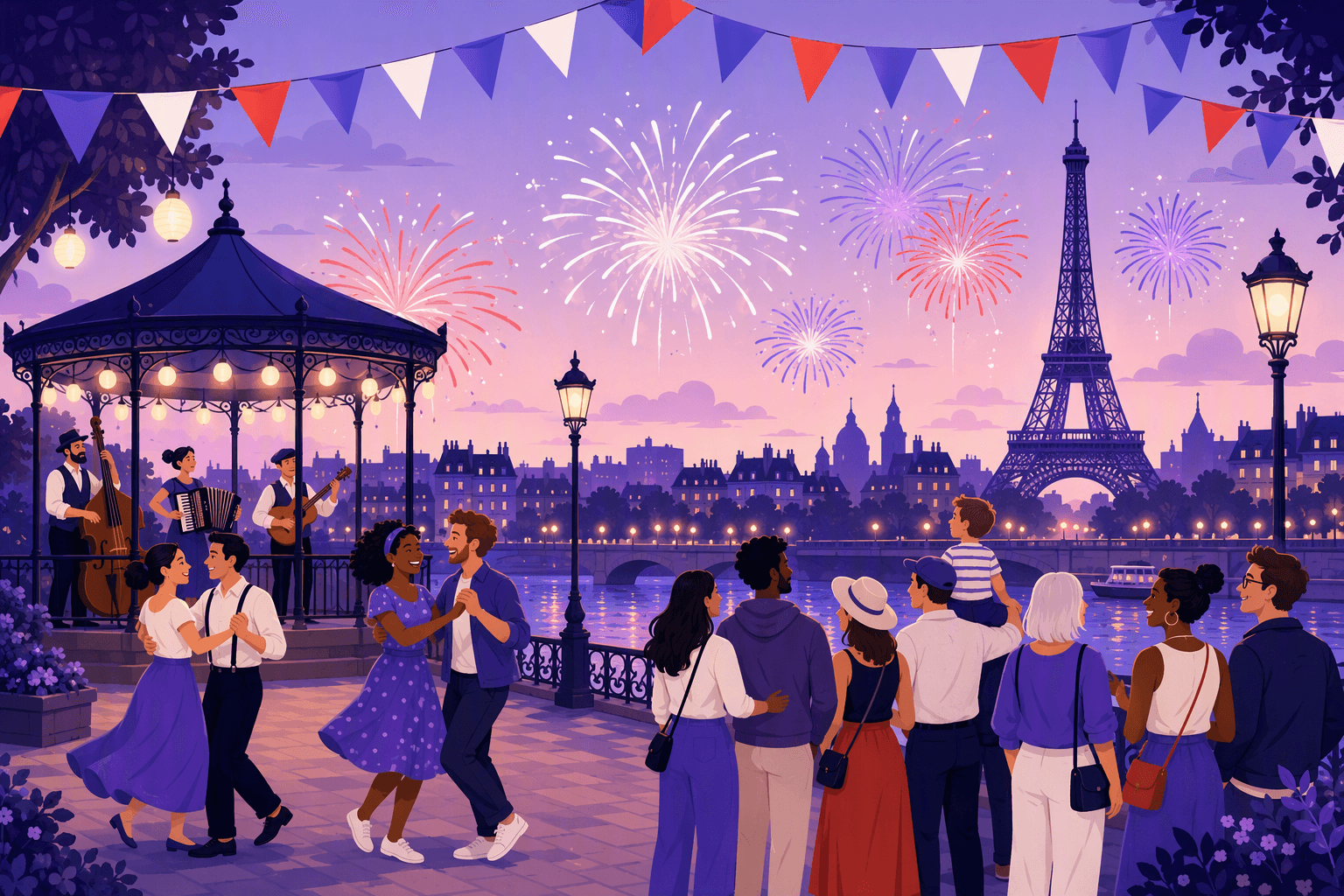
Fireworks are the evening anchor across France. Paris has a major show near the Eiffel Tower, but almost every town has its own, often near a river, a park, or a stadium.
Expect dense crowds and a lot of practical French: asking where to stand, whether a street is blocked, and what time things start.
💡 A small but useful cultural detail
In many towns, fireworks are paired with a public dance or concert. If you only plan for the fireworks, you miss the part where locals actually mingle.
Bals and the bal des pompiers
A classic tradition is the bal des pompiers (bahl day pohm-PYAY), a dance hosted by firefighters, often on 13 July and sometimes on 14 July. It can be a neighborhood party, a fundraiser, or both.
If you want to experience a French 14 July rather than a tourist checklist, this is often the most social option.
Local ceremonies: monuments, mayors, and civic memory
Many towns hold ceremonies at war memorials or city halls. You might see wreath-laying, speeches, and the Marseillaise (mahr-say-YEZ).
This is where 14 July feels like a civic holiday, not just a party. The language is also more formal, with set phrases about the Republic and public service.
Useful French you will actually hear on 14 July
You do not need revolutionary-era French to enjoy the day. You need crowd French: greetings, logistics, and polite questions.
le 14 Juillet
Le 14 Juillet (luh kah-TORZ zhwee-YEH) is the most common way to name the holiday in France. It is neutral and works everywhere, on posters, in news broadcasts, and in conversation.
You can use it in a simple question: Vous faites quoi pour le 14 Juillet ? (voo fet KWAH poor luh kah-TORZ zhwee-YEH), meaning "What are you doing for 14 July?"
la Fête nationale
La Fête nationale (lah fet nah-syoh-NAHL) is slightly more official. You will see it in municipal announcements and formal invitations.
If you are speaking to staff at a museum, hotel, or city office, this is the label that fits the register.
le feu d'artifice
Le feu d'artifice (luh fuh dahr-tee-FEESS) means "fireworks." In fast speech, you will often hear people shorten it to le feu d'artifice with the middle syllables blurred, but the spelling stays the same.
A practical question is: C'est à quelle heure, le feu d'artifice ? (seh tah KEHL UR, luh fuh dahr-tee-FEESS).
le bal
Le bal (luh bahl) is a public dance. On 14 July, it often means an outdoor dance with music, sometimes organized by the mairie (city hall) or firefighters.
If you see a sign for bal populaire (bahl poh-pyoo-LEHR), it is a community dance aimed at everyone, not a formal ballroom event.
la mairie
La mairie (lah meh-REE) is the town hall. For holiday logistics, it is the institution that posts schedules, road closures, and official announcements.
If you are traveling, checking the mairie website or posters can save you time, especially in smaller towns.
How to sound polite in crowds (without overdoing it)
French politeness is not about being stiff, it is about using the right small signals. Linguist Kerbrat-Orecchioni, in her work on French interaction and politeness, treats these signals as part of how French conversation manages social distance in everyday life.
Bonjour and excusez-moi still matter
Start with bonjour (bohn-ZHOOR) in daytime interactions, even if you are only asking a quick question. It is the simplest way to avoid sounding abrupt.
For moving through a crowd or getting someone’s attention, excusez-moi (ehk-skoo-ZAY mwah) is the safe default.
If you want a focused practice set, our how to say hello in French guide pairs well with holiday travel.
S'il vous plaît vs s'il te plaît
Use s'il vous plaît (seel voo PLEH) with strangers, staff, and anyone you do not know. Use s'il te plaît (seel tuh PLEH) with friends or people your age when you are clearly in an informal setting.
On a national holiday with crowds, defaulting to vous is rarely wrong.
Food and drink: what you will see and how to order
14 July is not a single national menu, but food is part of the social rhythm. UNESCO’s listing of the French gastronomic meal highlights how French eating is often structured as a social event, and holidays amplify that.
apéro
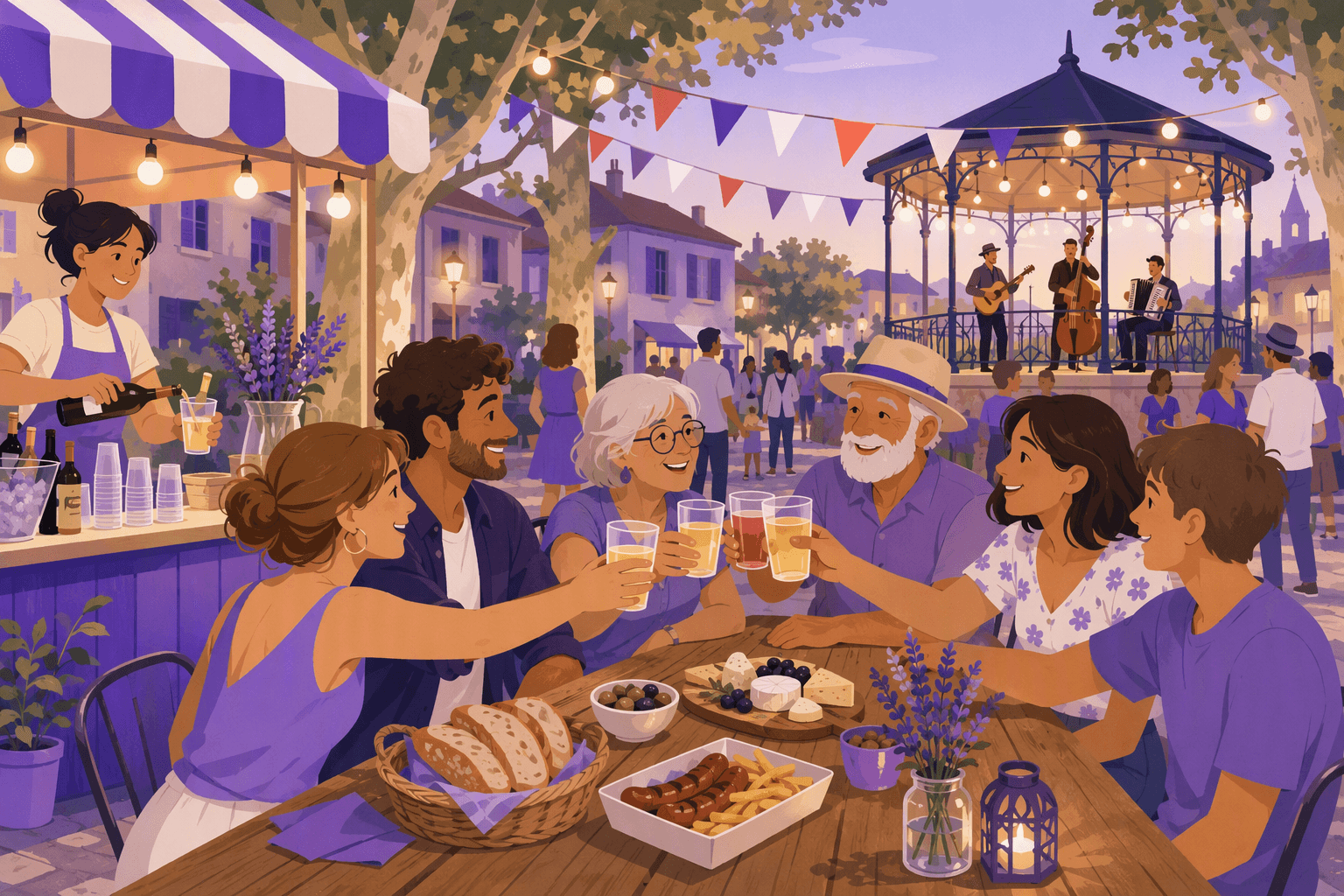
L'apéro (lah-pay-ROH) is the pre-meal drink and snack moment. On 14 July, it can happen in parks, on balconies, or before heading to fireworks.
A natural line is: On se fait un apéro ? (ohn suh feh uhn ah-pay-ROH), meaning "Shall we do an apéro?"
buvette
A buvette (boo-VET) is a temporary drink stand, often run by local associations at festivals. You will see it at concerts, town events, and sometimes near fireworks viewing areas.
If you are unsure what they have, ask: Vous avez quoi à boire ? (voo zah-VAY KWAH ah BWAHR).
saucisse-frites
Saucisse-frites (soh-SEESS freet) is a common simple festival meal: sausage and fries. It is not fancy, but it is reliable, fast, and very typical at local events.
If you hear barquette (bar-KET), it is the little tray they serve it in.
Bastille Day outside France, and why French still sounds "French" there
Bastille Day events happen worldwide, but the language environment changes. Announcements may be bilingual, and the French you hear may be more formal and scripted.
The Organisation internationale de la Francophonie (OIF) regularly reports French as a global language with hundreds of millions of speakers across multiple continents (see citations). That matters on 14 July because many events are organized through embassies, Alliances Françaises, and Francophone communities, not only French nationals.
If you want a bigger picture of where French is used and how it varies, see our French language overview.
A practical way to learn French from 14 July broadcasts and clips
Holiday broadcasts are useful because they repeat key vocabulary and show clear context. You can treat them like a mini listening unit.
Use the parade for formal French
The parade commentary is slower, carefully articulated, and full of repeated nouns and titles. That makes it good for beginners who want clean audio.
Listen for recurring frames like Mesdames et messieurs (meh-dahm ay meh-SYUR) and institutional vocabulary.
Use street interviews for real speed
Local news segments and street interviews are faster and messier, but they teach you what people actually say when they are excited, distracted, or standing in a crowd.
That is the kind of speech you will hear if you travel, and it is also the kind of speech that movie and TV clips capture well.
💡 Clip-based practice that stays realistic
If you learn French through short scenes, you get the full package: pronunciation, pacing, and the little politeness routines that textbooks often flatten. That is why clip learning pairs well with holidays, where language is tied to action.
Closing thought: what to remember when you show up
Bastille Day is not one event, it is a national frame that each town fills in differently. If you remember the three anchors, civic ceremony, fireworks, and social dancing, you will understand what you are seeing.
For language, keep it simple: bonjour, excusez-moi, s'il vous plaît, and a couple of logistics questions about the feu d'artifice. Then you can spend the rest of the night listening, watching, and picking up the rhythm of real French in the crowd.
Frequently Asked Questions
What is Bastille Day and why is it celebrated?
Do French people call it 'Bastille Day'?
What happens on 14 July in Paris?
Is everything closed on Bastille Day?
Is Bastille Day celebrated outside France?
Sources & References
- Présidence de la République, 'Le 14 Juillet' (official program), accessed 2026
- Ministère des Armées, 'Défilé du 14 juillet' (information pages), accessed 2026
- Encyclopaedia Britannica, 'Bastille Day', accessed 2026
- Organisation internationale de la Francophonie (OIF), 'La langue française dans le monde' (speaker estimates), accessed 2026
- UNESCO, 'French gastronomic meal' (Intangible Cultural Heritage), accessed 2026
Start learning with Wordy
Watch real movie clips and build your vocabulary as you go. Free to download.


