Quick Answer
The most common way to say good night in French is 'Bonne nuit' (bun NWEE). Use it when someone is heading to bed. But 'Bonne nuit' is just one of three evening expressions you need to know: 'Bonsoir' greets someone in the evening, 'Bonne soirée' wishes them a good rest of the evening, and 'Bonne nuit' specifically means the night is over and it is time to sleep.
The Short Answer
The most common way to say good night in French is Bonne nuit (bun NWEE). Use it when someone is heading to bed or when the night is ending. But French has a three-part evening system that trips up nearly every learner, and getting it wrong can sound awkward or confusing to native speakers.
French distinguishes sharply between greeting someone in the evening (Bonsoir), wishing someone a good remaining evening (Bonne soirée), and saying good night at bedtime (Bonne nuit). English collapses all of these into "good night," which is why this is one of the trickiest areas for anglophone French learners.
"The distinction between nuit and soirée reflects a fundamental feature of French temporal vocabulary: the language encodes not merely the time of day, but the social activity expected during that time."
(Alain Rey, Dictionnaire historique de la langue française, 2016)
This guide covers 16 essential good-night expressions organized by category: the core evening trio, bedtime phrases, romantic expressions, and casual ways to say good night. Each entry includes pronunciation, cultural context, and a real-world example so you know exactly when to use it.
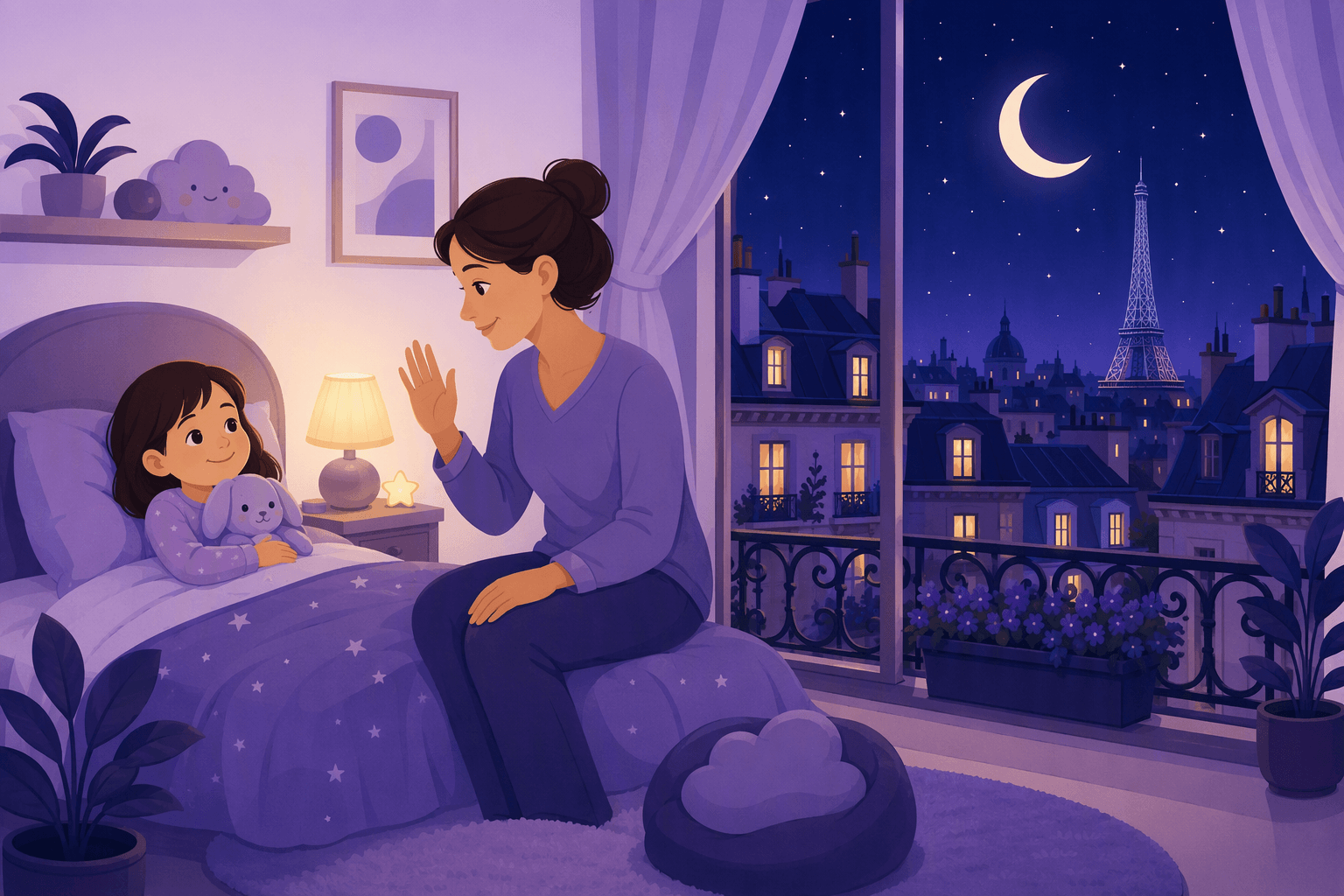
Quick Reference: French Good Night Expressions at a Glance
| English | French | Pronunciation | Formality |
|---|---|---|---|
| Good night (bedtime) | Bonne nuit | bun NWEE | polite |
| Good evening (greeting) | Bonsoir | bohn-SWAHR | polite |
| Have a good evening | Bonne soirée | bun swah-RAY | polite |
| Sweet dreams | Fais de beaux rêves | feh duh boh REHV | casual |
| Sleep well | Dors bien | dohr BYEH̃ | casual |
| Good night, my love | Bonne nuit, mon amour | bun NWEE mohn ah-MOOR | casual |
| See you tomorrow | À demain | ah duh-MEH̃ | polite |
| Have a good night | Passe une bonne nuit | pahs ewn bun NWEE | casual |
| Good night, sweetheart | Bonne nuit, mon cœur | bun NWEE mohn KUHR | casual |
| Good night, darling (f.) | Bonne nuit, ma chérie | bun NWEE mah shay-REE | casual |
| Sleep tight | Dors du sommeil du juste | dohr dew soh-MAY dew ZHEWST | polite |
| Rest well | Repose-toi bien | ruh-POHZ twah BYEH̃ | casual |
| Sweet dreams (short) | Doux rêves | doo REHV | casual |
| Until next time | À la prochaine | ah lah proh-SHEN | polite |
| Good night, everyone | Bonne nuit à tous | bun NWEE ah TOO | polite |
| I'm off to bed | Je vais me coucher | zhuh veh muh koo-SHAY | casual |
The Evening Trio: Bonsoir, Bonne soirée, Bonne nuit
Understanding these three expressions is the single most important thing in this guide. They divide the French evening into distinct social moments, and using the wrong one marks you immediately as a non-native speaker.
Think of it this way: Bonsoir opens the evening, Bonne soirée closes a social interaction while the evening continues, and Bonne nuit closes the entire day. Master this and you have the French evening figured out.

Bonne nuit
/bun NWEE/
Literal meaning: Good night
“Bonne nuit, tout le monde. Je suis épuisé, je monte me coucher.”
Good night, everyone. I'm exhausted, I'm heading up to bed.
Used exclusively when someone is going to sleep. Unlike English 'good night,' which can be a general evening farewell, French 'Bonne nuit' specifically signals bedtime. Saying it at 8 PM to someone who is still out would sound strange.
Bonne nuit combines bonne (good, feminine) with nuit (night, also feminine). The pronunciation requires the French "u" sound: round your lips as if saying "oo" but try to say "ee" instead. The result, somewhere between the two, is the French u in nuit: bun NWEE.
The key cultural point: Bonne nuit means the day is over. You are going to sleep, or the person you are speaking to is going to sleep. It is not a casual evening farewell. If you leave a dinner party at 9 PM and the hosts are staying up, you say Bonne soirée, not Bonne nuit.
🌍 When to Use Bonne nuit
Reserve Bonne nuit for actual bedtime. A parent says it to a child being tucked in. Roommates say it before retiring to their rooms. A couple texts it before falling asleep. If the evening still has social activity ahead, use Bonne soirée instead.
Bonsoir
/bohn-SWAHR/
Literal meaning: Good evening
“Bonsoir, madame. Votre table est prête, suivez-moi.”
Good evening, ma'am. Your table is ready, follow me.
The evening equivalent of 'Bonjour.' Used as a greeting when arriving or meeting someone after approximately 6 PM. Can also serve as a polite farewell in the evening, though 'Bonne soirée' is more specific for parting.
Bonsoir is an arrival greeting. You use it when you walk into a restaurant in the evening, greet someone at a dinner party, or run into a neighbor after dark. It functions exactly like Bonjour but for the evening hours.
The transition from Bonjour to Bonsoir in France typically happens around 6 PM (18h00). According to the Académie française, there is no fixed rule; it depends on the season, region, and personal habit. In winter, when the sun sets before 5 PM in northern France, people switch to Bonsoir earlier. In the long summer evenings of Provence, Bonjour can linger past 7 PM.
💡 The Bonsoir Transition
Not sure whether to say Bonjour or Bonsoir? If it is clearly dark outside, go with Bonsoir. If there is still daylight, Bonjour is always safe. Native speakers rarely judge the timing strictly. The social gesture matters more than the exact hour.
Bonne soirée
/bun swah-RAY/
Literal meaning: Good evening (wish)
“Merci pour le dîner, c'était délicieux. Bonne soirée !”
Thanks for dinner, it was delicious. Have a good evening!
A farewell wish for someone whose evening is still ongoing. You say it when leaving a gathering, a restaurant, or ending a phone call in the evening. It implies the other person still has evening plans or activities ahead.
Bonne soirée is the expression that has no clean English equivalent, which is precisely why it confuses learners. It means "have a good (rest of the) evening" and is used when parting ways while the night is still young.
Here is the critical distinction: soirée refers to the social, active part of the evening: dinner, drinks, a party. Nuit refers to nighttime and sleep. When a waiter says Bonne soirée as you leave the restaurant, they are wishing you a good time for whatever you do next. When you finally get home and tell your partner you are going to bed, that is when Bonne nuit takes over.
| Expression | When to Use | Social Function |
|---|---|---|
| Bonsoir | Arriving in the evening | Greeting (hello) |
| Bonne soirée | Leaving while evening continues | Farewell (enjoy your evening) |
| Bonne nuit | Going to sleep | Farewell (sleep well) |
Bedtime Expressions
These are the phrases French speakers use at home, in text messages, and on phone calls when the night is winding down. They range from practical to poetic.
Fais de beaux rêves
/feh duh boh REHV/
Literal meaning: Make beautiful dreams
“Bonne nuit, ma puce. Fais de beaux rêves.”
Good night, sweetie. Sweet dreams.
The standard French 'sweet dreams.' Very common between parents and children, romantic partners, and close friends. Uses the informal 'tu' conjugation (fais). For formal contexts, use 'Faites de beaux rêves.'
The French version of "sweet dreams" is beautifully literal: make beautiful dreams. It is one of the most affectionate bedtime phrases and is used widely with children, partners, and close friends. Note that rêves uses the circumflex accent (ê), which signals a historical "s" that disappeared from Old French.
The tu form (Fais) is standard in intimate contexts. If you were addressing someone formally (though it would be unusual to say "sweet dreams" formally) the vous form is Faites de beaux rêves.
Dors bien
/dohr BYEH̃/
Literal meaning: Sleep well
“Tu as l'air crevé. Allez, dors bien.”
You look exhausted. Go on, sleep well.
A straightforward, warm way to wish someone a good sleep. Very common in everyday use, slightly less poetic than 'Fais de beaux rêves' but equally affectionate. The 's' in 'dors' is silent.
Dors bien is the practical, everyday "sleep well." It comes from dormir (to sleep), and the final "s" is silent (say "dohr," not "dorss"). It is less poetic than Fais de beaux rêves but just as warm, and it is probably used more frequently in daily life because of its simplicity.
You will often hear it combined with Bonne nuit: Bonne nuit, dors bien is one of the most natural bedtime sequences in French.
Passe une bonne nuit
/pahs ewn bun NWEE/
Literal meaning: Spend a good night
“On se voit demain matin. Passe une bonne nuit !”
See you tomorrow morning. Have a good night!
A slightly more elaborate way to say good night that emphasizes the wish for the entire night ahead. Common in text messages and phone calls. The formal version is 'Passez une bonne nuit.'
This expression adds a verb to the basic Bonne nuit, turning it from a static phrase into an active wish. It translates roughly to "have a good night" and feels slightly warmer because it takes more effort to say. The vous form, Passez une bonne nuit, works well in professional contexts, for example when ending a late business call.
Repose-toi bien
/ruh-POHZ twah BYEH̃/
Literal meaning: Rest yourself well
“Tu travailles trop dur ces jours-ci. Repose-toi bien ce soir.”
You've been working too hard lately. Rest well tonight.
More than just 'sleep well'; it conveys genuine concern for someone's rest and recovery. Often used when someone is tired, stressed, or unwell. The formal version is 'Reposez-vous bien.'
Repose-toi bien carries more weight than Dors bien. It suggests you are not just wishing someone sleep but genuine rest and recovery. Use it when someone has had a long day, is feeling ill, or is clearly exhausted. The reflexive construction (se reposer) is characteristic of French, where many body-related actions use reflexive pronouns.
Dors du sommeil du juste
/dohr dew soh-MAY dew ZHEWST/
Literal meaning: Sleep the sleep of the righteous
“Tu as bien mérité ton repos. Dors du sommeil du juste.”
You've earned your rest. Sleep the sleep of the just.
A literary, almost biblical expression meaning to sleep peacefully with a clear conscience. More commonly written than spoken. It adds a poetic, slightly humorous tone to a good-night wish.
This elegant expression has biblical roots, referring to the peaceful sleep of someone with a clear conscience. In modern use, it is somewhat literary and can carry a gentle, humorous tone, as if to say "you have earned your rest." You will encounter it more in writing than in speech, but it is a beautiful phrase that native speakers recognize and appreciate.
Romantic Good Night Expressions
French has a well-earned reputation for romance, and bedtime is one of the moments where the language shines. These expressions are for partners, lovers, and anyone you want to make feel special at the end of the day.
Bonne nuit, mon amour
/bun NWEE mohn ah-MOOR/
Literal meaning: Good night, my love
“Je t'aime. Bonne nuit, mon amour.”
I love you. Good night, my love.
The most common romantic good-night phrase. 'Mon amour' is gender-neutral, men and women both use it for their partners regardless of gender. Natural in person, on the phone, and in text messages.
Mon amour (my love) is the most universal French term of endearment, and it is gender-neutral: both mon amour for a man and mon amour for a woman. This makes it different from terms like mon chéri / ma chérie, which change based on the gender of the person addressed. Bonne nuit, mon amour is the standard romantic good-night and is used daily by millions of French-speaking couples.
Bonne nuit, mon cœur
/bun NWEE mohn KUHR/
Literal meaning: Good night, my heart
“Dors bien, mon cœur. Je serai là demain matin.”
Sleep well, my heart. I'll be there tomorrow morning.
Deeply tender and intimate. Also used by parents toward young children. 'Mon cœur' is among the most personal French endearments, it gives more emotional weight than 'mon amour.'
Calling someone mon cœur (my heart) is one of the most intimate things you can say in French. It is used between romantic partners and also by parents speaking to young children. The word cœur contains the œ ligature (o-e joined together), pronounced like the "u" in English "fur." According to the Académie française, this term of endearment dates back to medieval French poetry.
Bonne nuit, ma chérie
/bun NWEE mah shay-REE/
Literal meaning: Good night, my darling (f.)
“Tu me manques déjà. Bonne nuit, ma chérie.”
I miss you already. Good night, my darling.
Gendered: 'ma chérie' for a woman, 'mon chéri' for a man. One of the most recognizable French endearments worldwide. Warm, affectionate, and used in both romantic and familial contexts.
Chéri(e) comes from the verb chérir (to cherish) and is perhaps the most internationally recognized French term of endearment. Unlike mon amour, it is gendered: mon chéri for a man, ma chérie for a woman. It works for romantic partners and also for close family members. A mother might say Bonne nuit, ma chérie to her daughter.
Doux rêves
/doo REHV/
Literal meaning: Sweet dreams
“À demain. Doux rêves.”
See you tomorrow. Sweet dreams.
A shorter, more poetic alternative to 'Fais de beaux rêves.' Particularly popular in text messages and late-night conversations. Feels slightly more literary and tender.
The compact version of Fais de beaux rêves, consisting of just two words: doux (sweet, soft) and rêves (dreams). It is particularly popular in text messages where brevity matters, and it carries a gentle, poetic quality. You will see it frequently in French novels and films as a whispered bedtime farewell.
Casual and Practical Farewells
These expressions pair naturally with good-night phrases and are essential for wrapping up evening conversations smoothly.
À demain
/ah duh-MEH̃/
Literal meaning: Until tomorrow
“Bonne nuit, tout le monde. À demain !”
Good night, everyone. See you tomorrow!
The standard way to say 'see you tomorrow.' Works in all registers, casual, professional, romantic. Very commonly paired with 'Bonne nuit' when you know you will see the person the next day.
À demain is one of the most useful phrases in the French evening vocabulary. It works in every setting: say it to your colleagues when leaving the office, to friends after a dinner, or to your partner before bed. The à (until) pattern extends to other time frames: À lundi (see you Monday), À ce soir (see you tonight), À bientôt (see you soon).
À la prochaine
/ah lah proh-SHEN/
Literal meaning: Until the next (time)
“C'était super de te revoir. Bonne nuit, et à la prochaine !”
Great seeing you again. Good night, and until next time!
Used when you don't know exactly when you'll see the person again. Warmer than 'Au revoir' but less specific than 'À demain.' Works well as an evening farewell when the next meeting is uncertain.
When you do not know exactly when you will see someone next, À la prochaine (until next time) is the perfect parting phrase. It is warmer than the standard Au revoir and pairs naturally with Bonne nuit or Bonne soirée depending on the hour.
Je vais me coucher
/zhuh veh muh koo-SHAY/
Literal meaning: I'm going to put myself to bed
“Il est minuit, je vais me coucher. Bonne nuit !”
It's midnight, I'm heading to bed. Good night!
The natural way to announce you are going to bed. Often precedes 'Bonne nuit' as an explanation for leaving. The reflexive 'se coucher' (to put oneself to bed) is one of the first reflexive verbs French learners encounter.
This is how you announce you are going to bed before saying Bonne nuit. The reflexive verb se coucher (to put oneself to bed) is one of the first reflexive verbs taught in French courses. In conversation, Je vais me coucher functions as a polite signal that you are wrapping up for the night.
Bonne nuit à tous
/bun NWEE ah TOO/
Literal meaning: Good night to all
“Merci pour cette soirée magnifique. Bonne nuit à tous !”
Thanks for this wonderful evening. Good night, everyone!
Used when saying good night to a group, at a family gathering, a party, or in a group chat. 'À tous' (to all) is masculine/mixed; for an all-female group, use 'à toutes.'
The group version of Bonne nuit. Use it when leaving a dinner party, signing off from a group chat, or heading to bed at a family gathering. Note the gendered distinction: à tous for a mixed or all-male group, à toutes for an all-female group.
How to Respond to Good Night Wishes
Knowing what to say back is just as important as initiating the farewell.
| They Say | You Say | Notes |
|---|---|---|
| Bonne nuit ! | Bonne nuit ! / Toi aussi ! | Echo or add "you too" |
| Bonsoir ! | Bonsoir ! | Mirror the greeting |
| Bonne soirée ! | Merci, vous aussi ! | Works in all settings |
| Fais de beaux rêves | Toi aussi / Merci, toi aussi | Informal, warm |
| Dors bien | Toi aussi, dors bien | Echo with warmth |
| Bonne nuit, mon amour | Bonne nuit, mon cœur | Reply with endearment |
| À demain | À demain ! / Oui, à demain | Confirm the plan |
💡 The 'Toi aussi' Response
When in doubt, Toi aussi (you too, informal) or Vous aussi (you too, formal) works as a response to nearly any good-night wish. It is the safest default when you are unsure what to say back.
Practice With Real French Content
The best way to internalize these expressions is to hear them spoken naturally by native speakers. French films are full of evening and bedtime scenes: Amélie for poetic nighttime monologues, Les Intouchables for casual between-friends goodnights, and Blue Is the Warmest Color for intimate romantic dialogue.
Wordy lets you watch French movies and shows with interactive subtitles, where you can tap any phrase to see its meaning, pronunciation, and context instantly. Instead of memorizing Bonne nuit from a list, you absorb it from a scene where two characters are actually saying good night, with authentic emotion, intonation, and body language.
For more French content, browse our blog for guides including the best movies to learn French. You can also visit our French learning page to start practicing today.
Frequently Asked Questions
What is the difference between 'Bonne nuit' and 'Bonsoir'?
When should I use 'Bonne soirée' instead of 'Bonne nuit'?
How do you say 'sweet dreams' in French?
What time does evening start in France?
Is 'Bonne nuit' romantic in French?
How do you respond when someone says 'Bonne nuit'?
Sources & References
- Académie française, Dictionnaire de l'Académie française, 9th edition
- Organisation internationale de la Francophonie (OIF), La langue française dans le monde, 2022 report
- Ethnologue: Languages of the World, French language entry (2024)
- Rey, A. (2016). Dictionnaire historique de la langue française. Le Robert.
Start learning with Wordy
Watch real movie clips and build your vocabulary as you go. Free to download.


