Quick Answer
The most common French names include classics like Marie, Jean, Pierre, Sophie, and Nicolas, plus modern favorites like Emma and Léo. In real life, using the right title (Monsieur, Madame, Mademoiselle) and knowing how surnames, accents, and nicknames work matters as much as the name itself, especially in formal contexts.
French has a deep pool of widely used names, and the “common French names” you will hear most often include classics like Marie, Jean, Pierre, Sophie, and Nicolas, plus modern favorites like Emma, Louise, Léo, and Gabriel. The key is that French names are also social signals: they can hint at generation, formality, and sometimes region, and knowing how to address people (Monsieur, Madame) is as important as memorizing lists.
French is spoken by hundreds of millions of people worldwide, across dozens of countries and territories, so you will also see French names in Belgium, Switzerland, Canada, and across much of Africa. Ethnologue estimates about 80 million native speakers of French and hundreds of millions of total speakers (Ethnologue, 27th edition, 2024), and the OIF tracks French as a global language used across many member states (OIF, accessed 2026).
If you want the basics of greeting people once you know their name, pair this guide with how to say hello in French and how to say goodbye in French.

How French names work in real life
French naming is straightforward on paper, but social usage has rules. You will see a first name (prénom) and a family name (nom de famille), and sometimes one or more additional given names on official documents.
First name vs surname
In most everyday situations, French people introduce themselves with their first name. In formal settings, the surname comes with a title: Monsieur Dupont, Madame Martin.
French forms can look similar to English, but the rhythm is different. French is syllable-timed, so names often sound “even” across syllables, which matters for pronunciation practice.
Titles and politeness
The safest default is Monsieur (muh-SYUR) for men and Madame (mah-DAHM) for women, followed by the surname. Guidance on civilities and formal address is discussed by the Académie française in its usage notes (Académie française, accessed 2026).
Mademoiselle (mahd-mwah-ZEHL) exists, but it is increasingly avoided in administrative and professional contexts. In many workplaces, Madame is the neutral option for adult women.
💡 A simple rule that keeps you safe
Start with Monsieur or Madame plus surname until the person invites first-name use, especially with teachers, doctors, clients, and older adults.
Generational signals: why some names feel “older”
If you watch French films from different decades, you will notice name trends shift. A Jean-Pierre or Monique often reads as older than a Léo or Inès.
This is one reason learning through real dialogue helps. Hearing names in context, with tone and social distance, is as valuable as the spelling.
Common French first names (with pronunciation)
The lists below focus on names you will repeatedly encounter in France and in Francophone media. Popularity changes over time, but these are high-recognition names that travel well across regions.
| French | Pronunciation | Note |
|---|---|---|
| Marie | mah-REE | Classic, widely used across generations. |
| Jean | ZHAHN | Very classic, also used in hyphenated names. |
| Pierre | PYEHR | Classic male name, common in older generations. |
| Paul | POHL | Short, traditional, pan-European. |
| Michel | mee-SHEHL | Common for men born mid-20th century. |
| Louis | loo-EE | Very common today, also historical. |
| Lucas | loo-KAH | Modern favorite across Francophone areas. |
| Léo | LAY-oh | Very common among younger generations. |
| Gabriel | gah-bree-EHL | Popular modern classic. |
| Thomas | toh-MAH | Final 's' is silent in French. |
| Nicolas | nee-koh-LAH | Often shortened to 'Nico'. |
| Julien | zhoo-lee-EHN | Common in late 20th-century cohorts. |
| Antoine | ahn-TWAHN | Classic, elegant register. |
| Hugo | yoo-GOH | Common modern name. |
| Emma | EH-mah | Very popular in recent decades. |
| Louise | loo-EEZ | Strong comeback as a classic. |
| Camille | kah-MEE | Often unisex in France. |
| Sophie | soh-FEE | Stable, widely used. |
| Claire | KLEHR | Classic, common in professional settings. |
| Julie | zhoo-LEE | Very common for women born 1980s-1990s. |
| Sarah | sah-RAH | International, common in France. |
| Chloé | kloh-AY | Accents matter in spelling. |
| Élodie | ay-loh-DEE | Very recognizable French name. |
| Inès | ee-NESS | Common and modern. |
| Nina | nee-NAH | Short, international. |
Pronunciation shortcuts that actually help
French spelling-to-sound rules are consistent once you know what to ignore. Final consonants are often silent, and nasal vowels are common.
A practical reference point comes from phonetics work by Pierre Léon (in his writings on French pronunciation and rhythm): French learners improve faster when they stop “reading every letter” and start listening for syllables and vowel quality.
💡 Two quick pronunciation fixes
If a name ends in -s, -t, or -d, try it without the final consonant first (Thomas, Bernard). If you see an -on or -an, expect a nasal vowel (Antoine, Simon).
Hyphenated and double first names
Hyphenated names are a visible part of French naming culture, especially in older generations. You will still meet people named Jean-Pierre, Jean-Luc, Anne-Sophie, or Marie-Claire.
In conversation, people may use the full hyphenated form or shorten it. Jean-Pierre might go by Jean, JP, or Pierre depending on preference.
Jean-
Jean- names are a category on their own. Jean is extremely productive in compounds: Jean-Paul, Jean-Michel, Jean-François.
Pronunciation stays the same: Jean is ZHAHN, then the second name follows normally.
Marie-
Marie- compounds are also common, especially in Catholic-influenced naming traditions: Marie-Claire, Marie-France, Marie-Laure.
In everyday life, many people drop the Marie and use the second element, but not always. Follow what the person uses.
Common French surnames and what they often mean
French surnames are often tied to occupations, geography, or descriptive nicknames. INSEE publishes datasets on surnames and their distribution (INSEE, accessed 2026), and you will see the same names repeatedly in news, sports, and film credits.
| French | Pronunciation | Note |
|---|---|---|
| Martin | mahr-TAHN | One of the most frequent surnames in France. |
| Bernard | behr-NAHR | Final 'd' is silent. |
| Thomas | toh-MAH | Also common as a surname. |
| Petit | puh-TEE | Originally 'small' as a descriptor. |
| Robert | roh-BEHR | Final 't' is silent. |
| Richard | ree-SHAHR | French pronunciation differs from English. |
| Durand | doo-RAHN | Very common across regions. |
| Dubois | doo-BWAH | Literally 'from the woods'. |
| Moreau | moh-ROH | Common surname, multiple regional roots. |
| Laurent | loh-RAHN | Final 't' is silent. |
| Lefèvre | luh-FEHV-ruh | From an occupation, 'smith'. |
| Leroy | luh-RWAH | Historically 'the king' as a byname. |
What surname patterns tell you
Many surnames start with Le- (Lefèvre, Legrand, Leroy) or De-/Du- (Dubois, Dupont). These often reflect older naming patterns: “the” plus a descriptor, or “from/of” plus a place.
Linguist Albert Dauzat’s classic work on French family names is still a useful lens here: surnames are historical snapshots of jobs, landscapes, and nicknames that became fixed over time.
Regional and Francophone variation (beyond France)
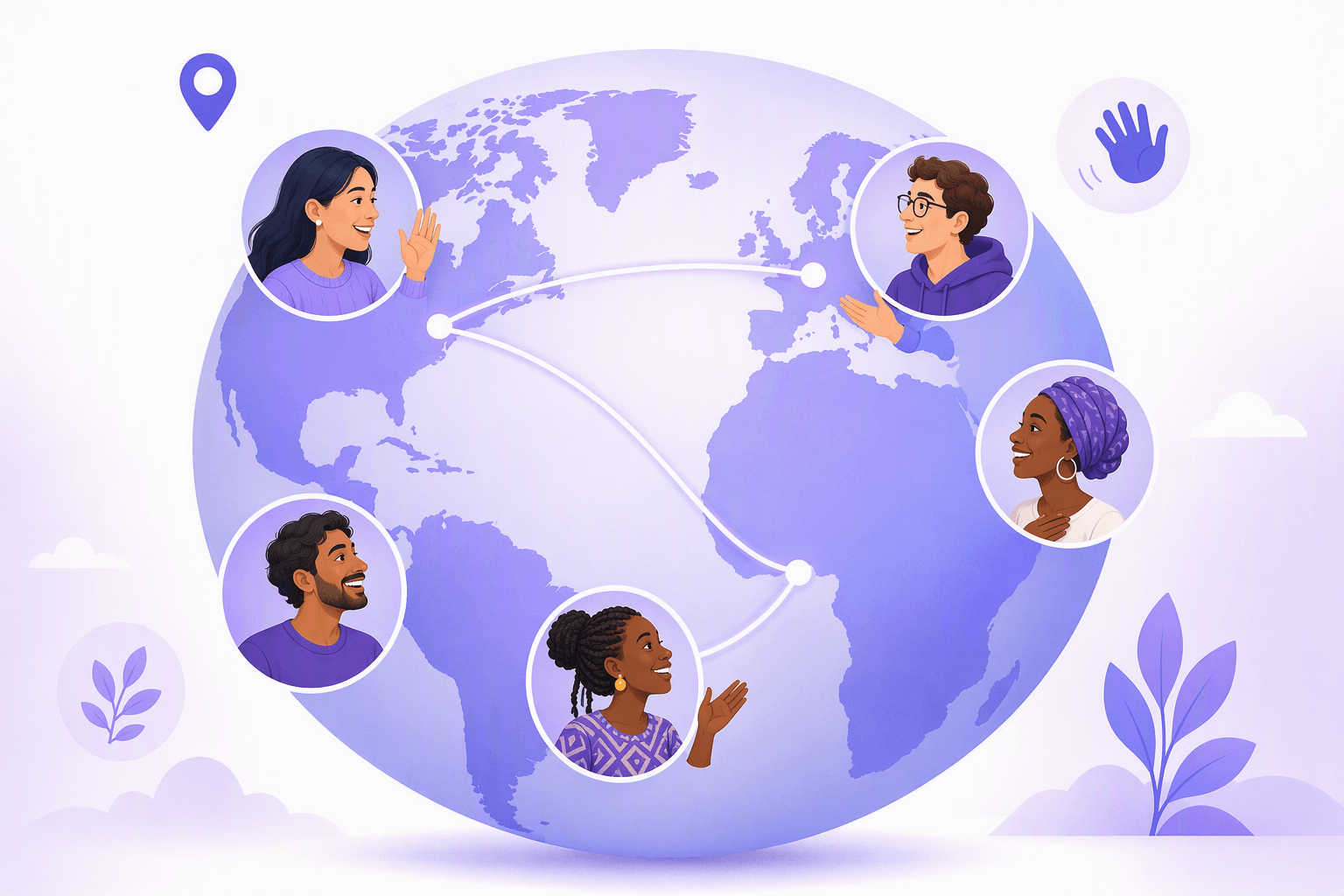
French is not only France. Names shift with local languages, colonial history, and immigration patterns.
Canada (Québec)
In Québec, you will see many classic French names, plus naming traditions influenced by Catholic history and English contact. Some older naming conventions (including multiple given names) are more visible in records than in daily speech.
If you are learning for travel, it helps to practice greetings that fit both formality and warmth. Start with how to say hello in French and keep a polite closer from how to say goodbye in French.
Belgium and Switzerland
Belgium and Switzerland share many common names with France, but you will also see local favorites and spelling preferences. In Switzerland, German and Italian contact can influence name choices depending on canton.
Francophone Africa
Across Francophone Africa, you will meet French first names alongside Arabic, Amazigh, Wolof, Lingala, and many other naming systems. The OIF’s reporting emphasizes how widely French is used as a shared language across member states (OIF, accessed 2026), and naming reflects that multilingual reality.
🌍 A practical mindset for Francophone names
If you are speaking French in Dakar, Abidjan, Montreal, or Brussels, treat names as personal, not “French-only.” Ask how to pronounce it, repeat it back, and do not assume spelling.
Nicknames, diminutives, and what people actually say
French nicknames are often shorter, softer, or more playful. They can come from clipping, adding a sound, or using a pet form.
Common nickname patterns
- Nico for Nicolas (nee-koh-LAH).
- Alex for Alexandre or Alexandra (ah-lek-SAHN-druh).
- Flo for Florence or Florian (floh).
- Ju for Julie or Julien (zhoo).
Nicknames are context-sensitive. In professional settings, people may stick to the full name even if friends use a nickname.
Terms of address with names
French uses a lot of small social markers. You might hear:
- Monsieur + surname in formal contexts.
- Prénom only among peers.
- Prénom + surname in semi-formal introductions, especially when clarity matters.
If you are speaking to someone you are dating, affectionate language can move fast, but it is still culture-bound. For romantic phrasing, see how to say I love you in French.
Writing French names correctly: accents, capitalization, and email reality
Accents are part of the name. Élodie is not the same spelling as Elodie, and Noël is not the same as Noel.
Accents in systems that drop them
Some booking systems and email addresses strip accents. That does not mean the accent is optional in the person’s name.
When you can, write the name as the person writes it. This is especially important in invitations, certificates, and formal messages.
Capitalization
In French typography, surnames are sometimes written in all caps in administrative contexts (DUPONT) to reduce confusion. In normal writing, use standard capitalization: Dupont.
Names in movies and TV: what you will hear most
French dialogue tends to use names less often than some English-language scripts, but names show up in:
- Greetings and introductions.
- Getting someone’s attention.
- Emotional emphasis, especially arguments or reconciliations.
A useful learning trick is to notice when a character switches from tu to vous, or from first name to title, because that signals relationship dynamics. This aligns with pragmatic work on address forms and social distance, including the classic sociolinguistic framing by Roger Brown and Albert Gilman on pronouns of power and solidarity (in their well-known work on T/V distinctions).
🌍 A subtle signal in French dialogue
If someone suddenly uses your first name in a tense moment, it can sound intimate or serious. If they switch to Monsieur or Madame, it can create distance, even if they are angry politely.
What not to do with French names
Small mistakes are normal, but a few habits can create awkwardness.
Do not over-Anglicize pronunciation
French speakers usually appreciate an honest attempt at French sounds. If you say Pierre like “peer,” people will still understand, but it can slow the conversation.
Aim for the vowel quality and the French r where relevant, and keep syllables clean.
Do not guess gender from spelling every time
Some names are strongly gendered, but others are not. Camille can be used for men and women in France.
If you are unsure, avoid assumptions and listen for context, or ask politely.
Do not use slangy language too early
French has plenty of strong language, but it is not “bonding” in every context. If you are curious about what you might hear in films, read our guide to French swear words, but treat it as recognition-first, not a starter kit.
A simple practice plan for learners
You do not need to memorize 200 names. You need to recognize common ones and use them politely.
Step 1: Learn 15 first names and 10 surnames
Use the tables above and pick names you actually hear in your favorite shows. Repeat them out loud with the pronunciation guides.
Step 2: Practice introductions with a greeting
Combine a greeting with a name and a polite follow-up. If you need a refresher, use how to say hello in French.
Example pattern: Bonjour, Monsieur Martin. Enchanté.
Step 3: Train your ear with real clips
Names are great listening anchors because they are repeated and emotionally marked. If you learn French through movie and TV clips, you will hear how names compress in fast speech, and how intonation changes meaning.
If you want more structured listening practice, explore learning French with short scenes that repeat high-frequency words and natural address forms.
Quick etiquette recap (the part that saves you)
- Use Monsieur or Madame plus surname in formal contexts.
- Follow the other person’s lead on first names and nicknames.
- Keep accents when writing names whenever possible.
- Treat Francophone naming as multilingual and personal, not “one French standard.”
When you can say someone’s name clearly and address them appropriately, your French instantly sounds more natural, even with simple grammar.
Frequently Asked Questions
What are the most common French names?
Do French people have middle names?
How do you politely address someone in French?
Are accents important in French names?
What is a very French-sounding last name?
Sources & References
- INSEE, Fichier des prénoms (données sur les prénoms), accessed 2026
- INSEE, Fichier des noms de famille (données sur les noms), accessed 2026
- Organisation internationale de la Francophonie (OIF), La langue française dans le monde, accessed 2026
- Ethnologue, French, 27th edition, 2024
- Académie française, recommandations et usages (civilité et titres), accessed 2026
Start learning with Wordy
Watch real movie clips and build your vocabulary as you go. Free to download.


