Quick Answer
French cafe culture is built around taking your time: you choose your seat (often before ordering), order at the table, and linger without being rushed. Knowing the difference between a cafe, brasserie, and bar-tabac, plus a few polite French phrases, helps you avoid common tourist mistakes and feel at home.
French cafe culture is built around a simple idea: greet first, order simply, and then take your time. In most cafes you can sit down before ordering (especially on the terrace), and you are not expected to rush, but you do need to follow the small politeness rituals that make service feel smooth and friendly.
If you want the basics of polite greetings first, read our how to say hello in French guide, it maps perfectly onto cafe interactions.
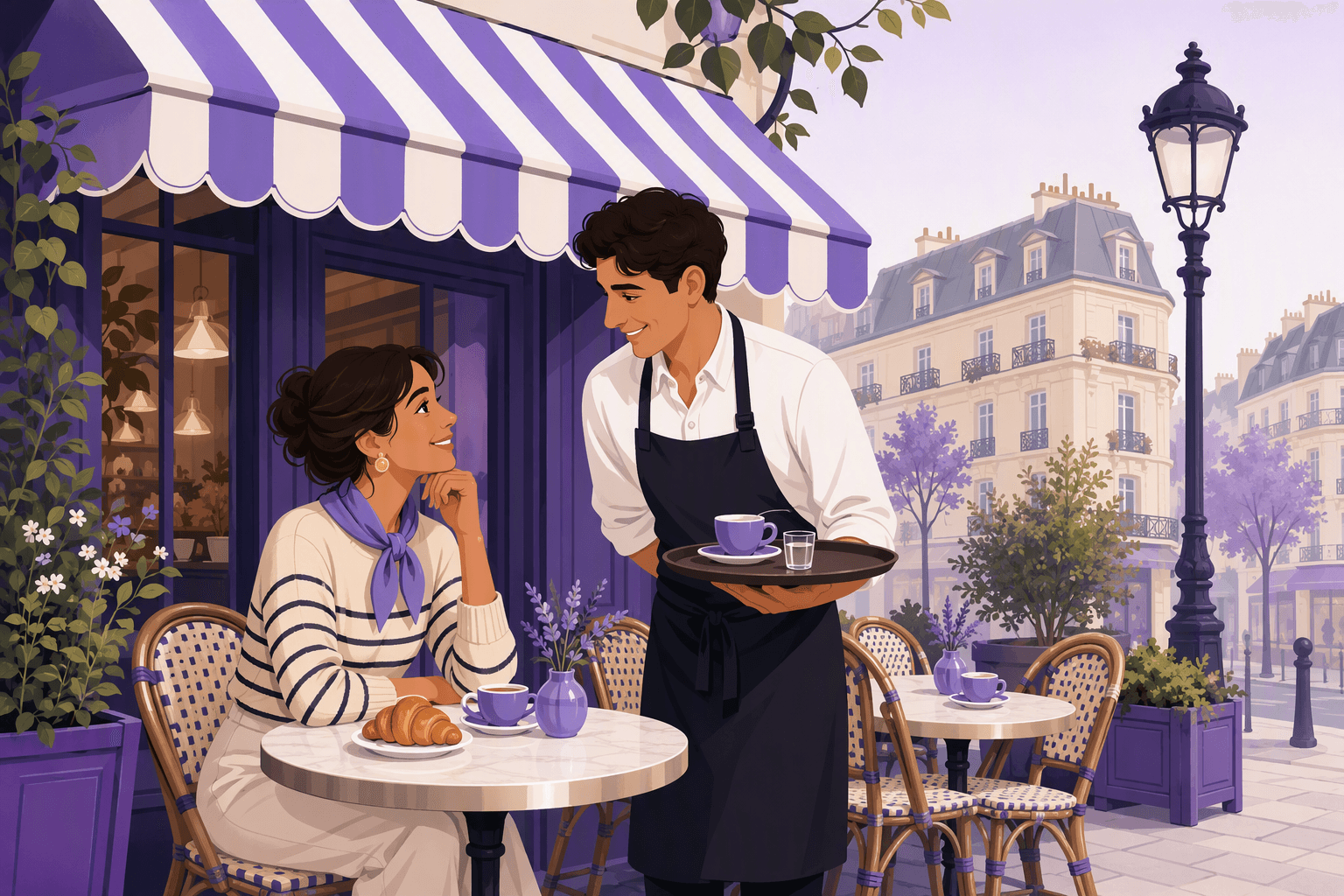
Why cafes matter in France (and why they feel different)
Cafes are not only about caffeine. They are a public living room where you can read, meet friends, watch the street, or do nothing at all, and that is the point.
This is partly cultural, and partly economic. Table service and terrace seating are priced into the experience, so you are paying for time and space as much as for a drink.
French is also a global language, which helps explain why cafe etiquette gets copied worldwide. The OIF describes French as spoken across dozens of countries and territories, and visitors bring their expectations into French spaces, sometimes clashing with local norms.
The cafe as a social stage
Sociologist Erving Goffman, in The Presentation of Self in Everyday Life, analyzes everyday interaction as a set of roles and rituals. A French cafe is a clear example: greeting, ordering, and paying follow a script, and when you follow it, service becomes warmer and smoother.
Linguist Deborah Tannen’s work on conversational style is also useful here. Cafes reward small, polite exchanges that signal respect, even when the interaction is brief.
Cafe, brasserie, bistro, bar-tabac: what these places really are
The sign outside does not always tell the full story. Still, these labels help you predict what will happen inside.
Café
A café is primarily for drinks: coffee, soft drinks, beer, wine, and sometimes simple snacks. Many cafes also serve breakfast items, like a croissant or tartine.
In everyday speech, people still say café even when the place serves full meals. Context matters more than the label.
Brasserie
A brasserie is closer to an all-day restaurant. You can usually get a full meal at lunch and dinner, and often in between.
Brasseries tend to have larger menus, more staff, and a faster meal rhythm than a tiny neighborhood café.
Bistro
A bistro is typically smaller and more food-focused than a café, often with a short menu. The word is loaded with imagery, and businesses use it for branding.
In practice, you will see "bistro" used for everything from casual dining to trendy wine bars.
Bar-tabac
A bar-tabac is a bar that also sells tobacco products, and often lottery tickets and phone top-ups. It can feel more utilitarian than a café.
If you see "PMU" or "FDJ" signage, it often signals betting or lottery services.
🌍 The terrace is its own category
In many French towns, the terrace is not just outdoor seating, it is the main attraction. Prices can be higher "en terrasse" because you are paying for the view and the seat time. If you want a cheaper coffee, ask to sit "au comptoir" (oh kohm-TWAHR), at the counter.
The golden rule: always greet first
In France, starting an interaction without a greeting can read as abrupt. A simple Bonjour (bohn-ZHOOR) is the social key that unlocks everything else.
This is why tourists sometimes feel service is "cold" at first. They walked up and said "One coffee" without the ritual opening.
What to say when you arrive
Use Bonjour in the daytime, and Bonsoir (bohn-SWAHR) in the evening. Add Monsieur (muh-SYUR) or Madame (mah-DAHM) if you want extra politeness, especially in smaller towns.
If you are with friends, you can still greet the staff first, then greet your friends. It sets the tone.
What to say when you leave
A quick goodbye matters too. If you want options that sound natural, see how to say goodbye in French.
Seating: do you sit first or order first?
This is one of the biggest points of confusion. The answer depends on the place and the time of day, but there are patterns.
When you can sit first
At many cafes, especially with terrace seating, you can choose a table and sit down. A server will come to you.
If the place is quiet, sitting first is normal. If it is crowded, try to make eye contact with staff so they know you are not taking a reserved table.
When you should wait
If there is a host stand, a "Please wait" sign, or a clear flow of people being seated, then wait. This is more common in brasseries and restaurants.
A common French sign is Veuillez attendre (vuh-YAY ah-TON-druh), meaning "please wait".
Counter vs table vs terrace
In many places you can order at the counter, called au comptoir (oh kohm-TWAHR), and drink standing or on a stool. This is often cheaper than table service.
Table service inside is en salle (ohn SAHL). Terrace seating is en terrasse (ohn teh-RAHSS).
Ordering coffee like a local (without accidentally ordering the wrong thing)
Coffee vocabulary is where visitors get tripped up. The words are simple, but the defaults are different from North America, and sometimes from the UK.
A key point: in most of France, un café means an espresso by default. If you want a big mug, you need to say so.
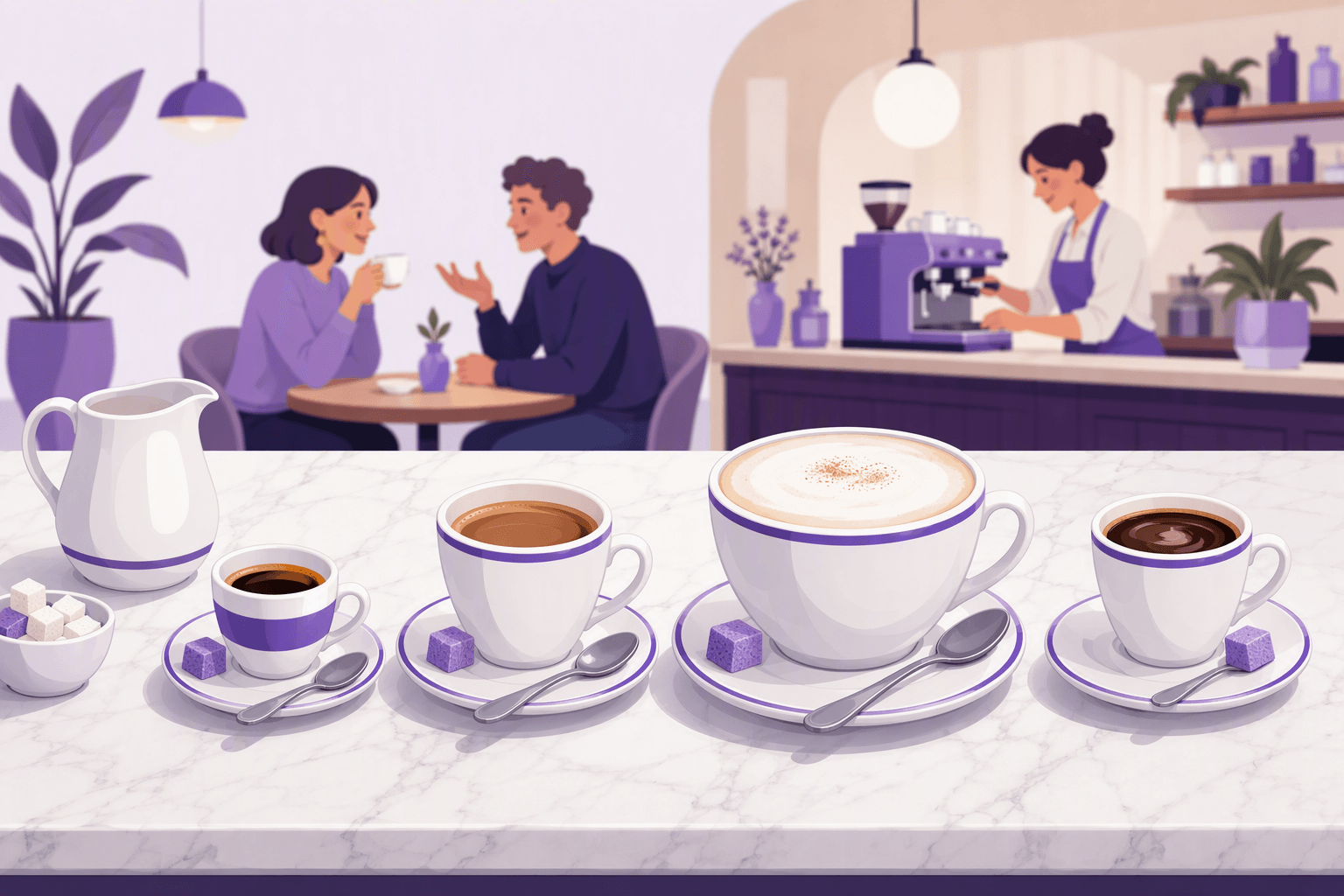
Un café
Un café (uhn kah-FEH) is an espresso. It is small, strong, and usually served with sugar packets on the side.
If you want to sound natural, add the politeness frame: Un café, s'il vous plaît (uhn kah-FEH seel voo PLEH).
Un allongé
Un allongé (uhn ah-lohn-ZHAY) is an espresso "lengthened" with hot water. Think of it as closer to an Americano, but often smaller than what US cafes serve.
If you want it very light, you can ask bien allongé (byen ah-lohn-ZHAY), meaning extra diluted.
Un café crème
Un café crème (uhn kah-FEH KREHM) is coffee with hot milk, closer to a latte, but the exact ratio depends on the place. At breakfast, it is one of the most common orders.
In some cafes, you will also see café au lait (kah-FEH oh LEH). That phrase is common, but café crème is often the safer cafe order.
Un noisette
Un noisette (uhn nwah-ZEHT) is an espresso with a small splash of milk. The name comes from the hazelnut color.
If you like macchiato-style coffee, noisette is the word you want.
Décaféiné
Un décaféiné (uhn day-kah-fay-AY-nay) is decaf. In fast speech, you might hear un déca (uhn day-KAH).
If you are sensitive to caffeine, this is a normal request, not a weird one.
💡 The one word that prevents most cafe misunderstandings
If you only memorize one ordering phrase, make it "s'il vous plaît" (seel voo PLEH). In French politeness research, Brown and Levinson’s framework in Politeness: Some Universals in Language Usage is often used to explain why small face-saving markers matter. In cafes, that marker is the difference between blunt and normal.
How to get the server’s attention (without sounding rude)
French service norms are different from the "check-in every two minutes" style some visitors expect. Servers often give you space, which can feel invisible if you are not used to it.
The trick is to use short, respectful attention-getters.
Excusez-moi
Excusez-moi (ehk-skoo-ZAY mwah) is the standard way to get attention politely. Use it with eye contact, and keep your volume moderate.
If you want more options, our how to say excuse me in French guide breaks down the nuance between excusez-moi, pardon, and désolé.
S’il vous plaît
You can also say s'il vous plaît (seel voo PLEH) on its own, especially when the server is already looking your way. It is not a demand, it is a polite signal.
Avoid snapping, waving aggressively, or calling "garçon". That last one exists historically, but it is widely perceived as outdated and rude in modern service settings.
Paying: asking for the bill, splitting, and card etiquette
Paying is another place where visitors accidentally break the script. In many French cafes, you are expected to ask for the bill, and the server will not bring it until you do.
L’addition, s’il vous plaît
L'addition, s'il vous plaît (lah-dee-SYOHN seel voo PLEH) means "the bill, please". It is the most standard phrase for cafes and brasseries.
You can shorten it to L'addition, s'il vous plaît with a small nod, and it will sound perfectly normal.
Paying at the table vs at the counter
In many places, you pay at the table when the server brings the card terminal. In others, especially smaller cafes, you may be asked to pay at the counter.
If you are unsure, ask: Je peux payer ici ? (zhuh puh pay-YAY ee-SEE), meaning "Can I pay here?"
Splitting the bill
Splitting can be tricky. Many places can do separate checks, but it is not always smooth during busy hours.
Useful phrases:
- On peut payer séparément ? (ohn puh pay-YAY say-pah-ray-MAHN), "Can we pay separately?"
- On partage ? (ohn par-TAHZH), "Shall we split?"
If you are a group, it can be simpler to pay together and settle up among yourselves afterward.
Tipping: what people actually do in cafes
In France, service is typically included, so tipping is not required. CNRTL’s entry for pourboire reflects the basic meaning: money given in addition for service, not an obligation.
In practice, many people leave small change, especially on a terrace. Rounding up is common.
When tipping is most common
Tipping is most common when:
- you had table service for a while
- the server was notably friendly or helpful
- you are in a tourist-heavy area where staff deal with a lot of stress
If you pay by card, you can still leave coins on the table after the transaction.
⚠️ Do not confuse 'service compris' with 'no gratitude'
Because service is included, some visitors tip nothing and also skip the goodbye. In a cafe, the goodbye is part of the social payment. Even if you leave zero coins, say "Merci, au revoir" (mehr-SEE oh ruh-VWAHR).
Food expectations: what cafes serve (and when)
Not every cafe is a restaurant, and meal timing matters. If you walk in at 3 pm expecting a full lunch menu, you might be disappointed.
A brasserie is more likely to serve full meals all day. A neighborhood cafe might only have sandwiches, salads, or pastries outside peak hours.
Breakfast basics
Breakfast cafe orders are often simple:
- coffee
- croissant or pain au chocolat
- tartine (bread with butter and jam)
- orange juice
If you want a deeper food context, our French food culture guide explains the rhythms of meals and why lunch and dinner have different expectations.
Lunch and the formule
At lunch, many places offer a formule (for-MOOL), a set menu like starter plus main, or main plus dessert. It is often better value than ordering everything separately.
If you see plat du jour (plah doo ZHOOR), that is the dish of the day.
The language choices that signal you understand the culture
You do not need perfect grammar to sound respectful. You need the right openings and closings, and a few softeners.
Bonjour + merci + au revoir
This trio does most of the work:
- Bonjour (bohn-ZHOOR)
- Merci (mehr-SEE)
- Au revoir (oh ruh-VWAHR)
David Crystal, in The Cambridge Encyclopedia of the English Language, points out how much social meaning rides on routine formulas in everyday speech. French cafe talk is a clear parallel: the formulas are not filler, they are the interaction.
Using vous vs tu
In cafes, default to vous with staff. It signals respectful distance.
If you are a regular and the staff uses tu with you, you can mirror it, but do not start there. If you want a clean explanation of formality, our French etiquette and customs article covers the social logic behind these choices.
Common tourist mistakes (and the easy fixes)
Small changes prevent most awkward moments.
Mistake: ordering without greeting
Fix: say Bonjour first, then order. Even a one-second greeting changes the tone.
Mistake: expecting the bill to arrive automatically
Fix: ask for it with L'addition, s'il vous plaît (lah-dee-SYOHN seel voo PLEH).
Mistake: sitting on the terrace and being surprised by the price
Fix: check whether prices differ en terrasse vs au comptoir. Many menus list both.
Mistake: trying to customize like a specialty coffee shop
Fix: keep it simple. French cafes can do adjustments, but the default menu is designed to be ordered as-is.
How to practice cafe French with real clips (so it sticks)
Cafe interactions are short, repetitive, and perfect for learning from TV and movies. You hear the same phrases again and again, but with different accents, speeds, and moods.
If you are learning French through scenes, focus on:
- greetings and closings
- ordering frames like je voudrais (zhuh voo-DRAY), "I would like"
- paying phrases like je peux payer (zhuh puh pay-YAY), "I can pay"
For more listening-first practice, explore learning French and build your cafe vocabulary from real dialogue instead of textbook lines.
Frequently Asked Questions
Do you seat yourself in a French cafe?
Is it rude to stay a long time at a cafe in France?
Do you tip in French cafes?
What is the difference between cafe, brasserie, and bar in France?
How do you order a normal coffee in France?
Sources & References
- Organisation internationale de la Francophonie (OIF), La langue française dans le monde (accessed 2026)
- Institut national de la statistique et des études économiques (INSEE), Données sur la restauration et les débits de boissons (accessed 2026)
- CNRTL, Centre National de Ressources Textuelles et Lexicales, entries for 'café', 'brasserie', 'pourboire' (accessed 2026)
- Ministère de la Culture (France), Pratiques culturelles et sociabilités (accessed 2026)
Start learning with Wordy
Watch real movie clips and build your vocabulary as you go. Free to download.


