Quick Answer
French food culture is less about fancy ingredients and more about structure: set meal times, shared courses, and table etiquette that signals respect. If you understand how a French meal is paced, how to order in a café, and a few key phrases like 'Bon appétit' and 'L'addition, s'il vous plaît', you will feel at home fast, even with basic French.
French food culture is built around a predictable rhythm: light breakfast, structured lunch and dinner, and table manners that prioritize conversation and shared pace over speed. If you learn the basic meal format (courses, bread rules, when to ask for the check) and a handful of polite phrases, you can eat confidently in France and in many Francophone settings.
French is also a global language, which matters for dining. Ethnologue estimates about 321 million French speakers worldwide (27th edition, 2024), and the OIF documents French use across dozens of countries and territories. The habits below are strongly France-coded, but you will recognize many of them in Belgium, Switzerland, Luxembourg, Québec, and parts of Francophone Africa, with local twists.
For ready-to-use restaurant lines, start with French travel phrases. For the broader social rules behind politeness, see French etiquette and customs.
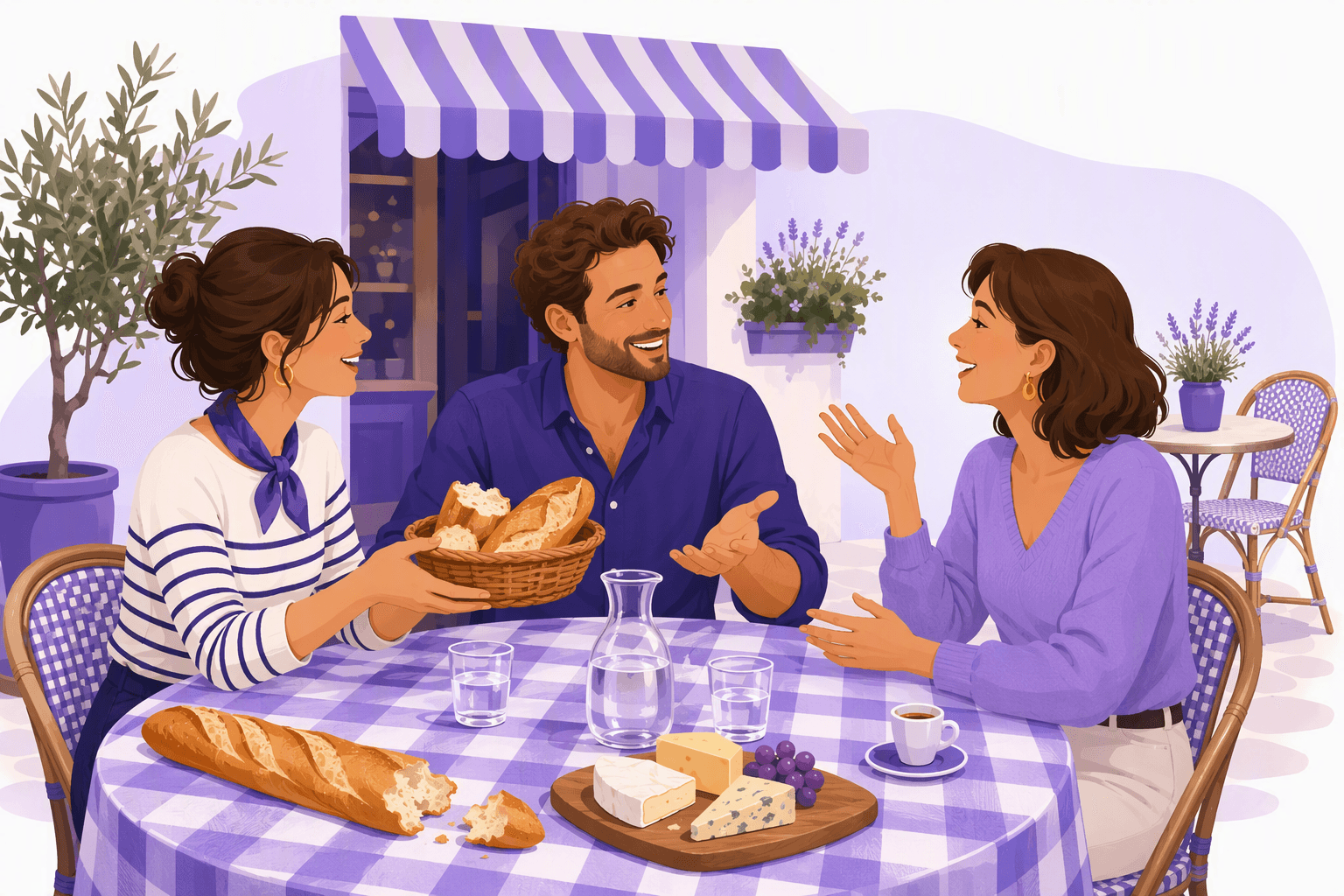
Why French food culture feels different (even if the food is simple)
French dining often feels formal to visitors because the rules are implicit. The point is not stiffness, it is coordination: everyone knows when the meal starts, how it flows, and what counts as respectful behavior.
Sociologist Pierre Bourdieu, in Distinction (Harvard University Press), analyzes how everyday preferences and habits can signal belonging. In France, food is one of the most visible places where those habits show up, from how you treat bread to how long you stay at the table.
There is also a strong cultural emphasis on meals as social time. UNESCO even lists the gastronomic meal of the French as Intangible Cultural Heritage, focusing on ritual, pairing, and togetherness rather than luxury ingredients.
The daily rhythm: what the French eat, and when
Breakfast (le petit-déjeuner)
A typical French breakfast is light and sweet: coffee, bread, butter, jam, maybe a pastry. It is often eaten quickly, especially on weekdays.
If you ask for a big savory breakfast in a classic café, you might find options, but it will not be the default. In many places, brunch exists, but it is more of a weekend city trend than a national routine.
Lunch (le déjeuner)
Lunch is traditionally the anchor meal, especially outside major business districts. In smaller towns, lunch can still be the main hot meal of the day.
A practical travel detail: many restaurants serve lunch only during a set window, often around noon to 14:00. After that, kitchens may close until dinner service.
Dinner (le dîner)
Dinner is later than many visitors expect, commonly starting around 19:30 or later. It is also paced: people talk between courses, and finishing quickly can feel like you are rushing the group.
💡 Restaurant timing tip
If you arrive mid-afternoon expecting a full menu, you may only find bakeries, kebab shops, or brasseries serving limited items. Plan your day around service hours, not just hunger.
The classic French meal structure (and what each course signals)
A common sit-down format is: apéritif, starter, main, cheese and or dessert, coffee, and sometimes a digestif. Not every meal includes everything, but the order matters.
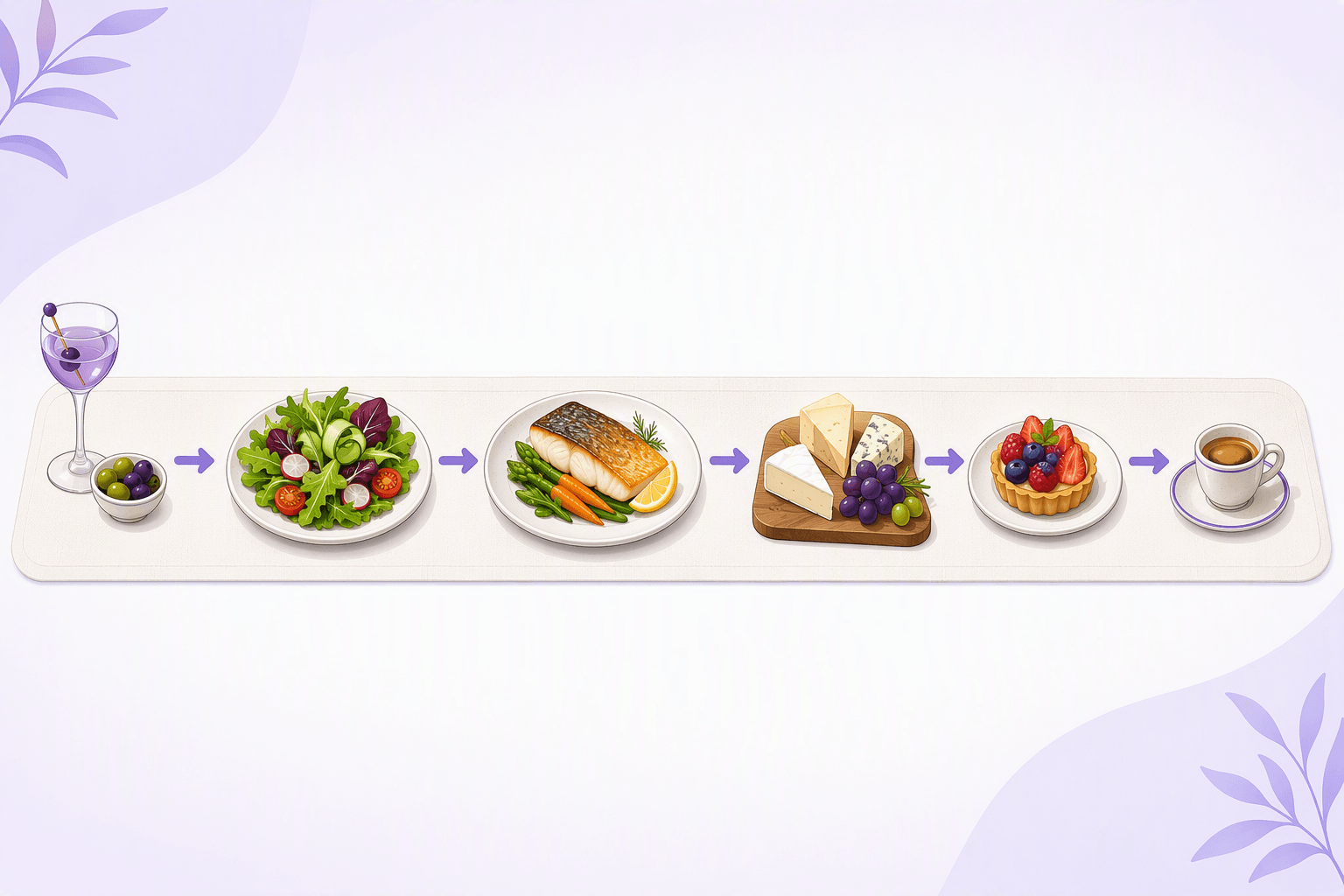
Apéritif (l'apéro)
An apéro is a pre-meal drink, often with small snacks. It is social, and it can happen at home more than in restaurants.
You might hear "On prend l'apéro ?" (ohn prahN lah-PEH-roh), which is an invitation to slow down and chat before eating. In many friend groups, apéro time is where the real conversation starts.
Starter (l'entrée)
In French menus, entrée means starter, not the main dish. This confuses English speakers constantly.
Starters are often lighter, designed to open the meal: salad, soup, charcuterie, or a small hot dish.
Main (le plat)
The main dish is the center of the meal and typically comes with fewer customizable sides than in some countries. The plate is meant to be balanced as served.
If you want changes, ask politely and keep it simple. A good strategy is to choose a different dish rather than redesigning one.
Cheese (le fromage)
Cheese can be a course, not just an ingredient. It is often served after the main dish, sometimes before dessert.
A small cultural signal: cheese is not automatically a snack while drinking wine. It can be, but in many families it is part of the meal's closing rhythm.
Dessert (le dessert)
Dessert is common, but portions may be smaller than American restaurant desserts. Fruit, yogurt, or a simple tart can be typical at home.
In restaurants, dessert menus can be excellent, but ordering dessert is still optional. If you are full, "Je vais prendre un café" (zhuh vay prahN-druh uhN kah-FEH) is a very normal way to end.
Coffee and digestif (le café, le digestif)
Coffee is often taken after dessert, not with it. In many places, it is a small espresso, even if you ordered a long meal.
A digestif is an after-meal drink, more common in long family meals or traditional settings than in quick restaurant dinners.
Café culture: what a café is (and what it is not)
A French café is not automatically a laptop workspace with unlimited refills. It is a social place where you can sit, watch the street, talk, and take your time.
The same drink can cost different amounts depending on where you sit. At the counter is usually cheapest, at a table inside costs more, and on the terrace can cost the most.
🌍 Lingering is normal
In many French cafés, you are paying for the seat as much as the coffee. Staff will not rush you out, and they also may not check on you repeatedly. If you need something, make eye contact and say "S'il vous plaît" (seel voo pleh).
Ordering in France: the polite, efficient way
French service often feels hands-off to visitors. That is not coldness, it is a different model: you are expected to signal when you want something.
If you want a smooth interaction, use clear openings and closings, and keep requests compact. For more ready-made lines, see how to say excuse me in French.
Key table phrases (with pronunciation)
These are the phrases that do the most work, especially if your French is basic.
- "Bonjour" (bohn-ZHOOR): say it when you enter, always.
- "S'il vous plaît" (seel voo pleh): polite attention-getter and "please."
- "Merci" (mehr-SEE): use it constantly, it is expected.
- "Je voudrais ..." (zhuh voo-DRAY): "I would like...", softer than "Je veux."
- "L'addition, s'il vous plaît" (lah-dee-SYOHN, seel voo pleh): asking for the check.
⚠️ Do not wait for the check
In France, servers often do not bring the check until you ask. This protects your time at the table, but it can surprise visitors who are used to being handed the bill automatically.
Bread, hands, and the table: small rules that matter
Bread is treated differently in France than in many countries. It is not automatically an appetizer with butter, and it is not usually served on a side plate.
A common habit is to place a piece of baguette directly on the tablecloth, to the left of your plate. In casual places, you will see this constantly.
What to do with bread
Use bread to accompany food, not to replace utensils. Tearing off a small piece is more common than biting directly from a large chunk.
If you are sharing, avoid reaching across plates. Ask for the basket to be passed: "Vous pouvez me passer le pain ?" (voo poo-VAY muh pah-SAY luh pahN).
What not to do with bread
Do not use bread as a sponge to clean the plate in formal settings. You may see people do it at home, but in restaurants it can read as sloppy.
Also, do not expect butter automatically at lunch or dinner. In many places, butter is a breakfast thing.
Wine and water: how drinks are handled
Wine is part of many meals, but it is not mandatory, and plenty of French people do not drink alcohol. What matters is that you order in the local categories.
For water, you have two common options:
- "Une carafe d'eau, s'il vous plaît" (ewn kah-RAHF doh, seel voo pleh): tap water in a carafe.
- "Une bouteille d'eau" (ewn boo-TAY doh): bottled water.
If you want sparkling, ask for "gazeuse" (gah-ZUHZ): "Une eau gazeuse" (ewn oh gah-ZUHZ).
The menu: how to read French restaurant formats
French restaurants often organize choices by course, not by a long list of mains plus sides. You will also see set menus.
Menu vs carte
"Le menu" is often a set-price option (for example, starter plus main, or main plus dessert). "La carte" is ordering items individually.
If you want value and a typical experience, the set menu is often the most French choice.
Formule
A "formule" is a fixed combination, often at lunch. Think of it as a bundle: "plat du jour + café" or "entrée + plat."
In busy areas, ordering a formule can also be faster because the kitchen is set up for it.
Plat du jour
"Plat du jour" (plah doo zhoor) is the dish of the day. It is often a good bet in traditional places because it matches what the kitchen is actively cooking.
If you are unsure what to order, ask: "C'est quoi, le plat du jour ?" (seh KWAH, luh plah doo zhoor).
Conversation and pace: the real heart of the meal
The biggest cultural difference is pacing. A French meal is designed to create time for talk, not to minimize time spent eating.
Linguist Deborah Tannen, in her work on conversational style (for example, Conversational Style: Analyzing Talk Among Friends, Oxford University Press), shows how different cultures structure talk, overlap, and turn-taking. At a French table, conversation is part of the meal's structure, so silence can feel heavier than it does elsewhere.
If you want to fit in, match the group's tempo. Eat at roughly the same pace, and do not treat finishing first as a victory.
Paying and leaving: how to end the meal naturally
When you are ready, ask for the check rather than waiting. The standard line is "L'addition, s'il vous plaît" (lah-dee-SYOHN, seel voo pleh).
If you are splitting, say it early: "On peut payer séparément ?" (ohn puh pay-YAY seh-pah-ray-MAHN). Some places can do it easily, others prefer one payment.
When you leave, a simple "Merci, au revoir" (mehr-SEE, oh ruh-VWAHR) is perfect.
French food culture beyond France
Many of these habits travel, but they change. In Québec, for example, you will still hear "Bon appétit," but service rhythms and tipping expectations can differ.
In parts of Francophone Africa, meal structure may be different, but the politeness basics hold: greet first, use "s'il vous plaît" and "merci," and respect the shared pace of eating.
A practical way to learn this fast with real dialogue
If you want these phrases to feel automatic, learn them in context, not as isolated flashcards. Movie and TV dialogue teaches you timing: when people say "Bonjour," how they call a server, and how they soften requests.
Wordy teaches French through short, real clips with interactive subtitles, pronunciation help, and review that brings the same restaurant lines back until they stick. Pair that with a phrase list like French travel phrases, and your next café order will feel much less stressful.
Frequently Asked Questions
What are typical meal times in France?
Is it rude to ask for substitutions in France?
Do you tip in France?
What does 'bon appétit' actually mean and when do you say it?
How do you ask for the check politely in French?
Sources & References
- Organisation internationale de la Francophonie (OIF), La langue française dans le monde
- UNESCO, Intangible Cultural Heritage: Gastronomic meal of the French
- Ethnologue, 27th edition, 2024
- Institut national de la statistique et des études économiques (INSEE), data on household food consumption (accessed 2026)
- Académie française, online dictionary and usage notes (accessed 2026)
Start learning with Wordy
Watch real movie clips and build your vocabulary as you go. Free to download.


