Quick Answer
French etiquette is built around greeting properly, using polite forms (especially vous), and showing consideration in shared spaces. If you master a few habits, saying bonjour first, adding s'il vous plaît and merci, and following basic dining and invitation norms, you will come across as respectful in France and other French-speaking communities.
French etiquette and customs are mainly about one thing: showing respect through small, predictable rituals, especially greeting first, choosing the right level of formality (vous vs tu), and behaving considerately in shared spaces like shops, public transport, and the dinner table.
French is also a global language, so these norms matter beyond France. Ethnologue estimates about 321 million French speakers worldwide (27th edition, 2024), and the OIF regularly documents French use across dozens of countries and territories, from Europe to Africa and the Americas.
If you are also learning the language side, start with how to say hello in French and then come back here to understand why that first bonjour changes everything.
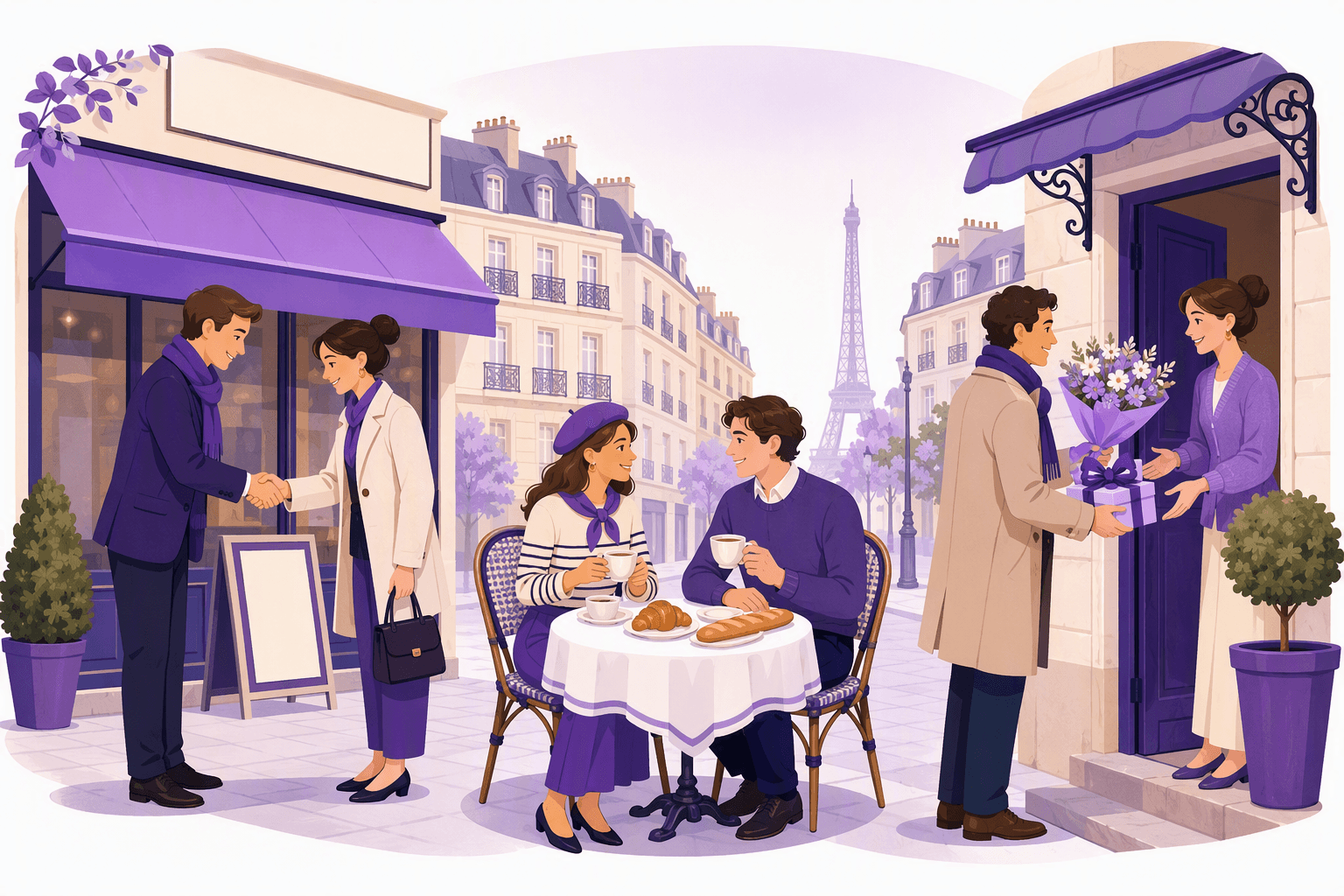
Why French etiquette feels strict (and why it is not)
French politeness can feel rule-heavy because many interactions follow a set opening and closing. You greet, you ask, you thank, you say goodbye.
This is not about being cold. It is about making social boundaries clear, which reduces ambiguity with strangers.
Linguist Penelope Brown and Stephen Levinson’s work on politeness frames this as face-management: people protect each other’s social dignity through small acts like greetings, indirect requests, and formal address. French everyday life makes those acts visible.
The greeting rule: always say bonjour first
In France, the greeting is not optional. It is the key that unlocks the rest of the interaction.
Say Bonjour (bohn-ZHOOR) when you enter a shop, approach a counter, step into a small waiting room, or start speaking to someone you do not know. In the evening, use Bonsoir (bohn-SWAHR).
If you skip straight to a request, even a simple question, you can sound like you are issuing an order. This is one of the most common “my French is fine but people seem annoyed” problems.
Quick scripts you can rely on
Use these as safe defaults:
- Bonjour, excusez-moi… (bohn-ZHOOR, ehk-skoo-zay-MWAH)
- Bonjour Madame / Monsieur (bohn-ZHOOR mah-DAHM / muh-SYUR)
- Merci, au revoir (mehr-SEE, oh ruh-VWAHR)
For more greeting options and when to use each, see how to say goodbye in French after you finish this guide.
💡 A small trick that works
If you are nervous, treat bonjour like knocking on a door. You do not start the conversation until the other person “opens” it with a response, even a quick bonjour back.
Vous vs tu: the formality switch people notice
French has a built-in politeness dial. Choosing vous vs tu is not just grammar, it is social positioning.
Use vous in these situations:
- With strangers and service staff
- At work, with clients, and in administrative settings
- With older adults you do not know well
- In formal emails and official messages
Use tu with friends, close colleagues (depending on workplace culture), classmates, and people who explicitly invite it.
On peut se tutoyer ?
If you want to move to tu, there is a standard way to ask: On peut se tutoyer ? (ohn puh suh too-TWAH-yay). It is polite because it gives the other person control.
If someone starts with tu to you, you can usually mirror it. If they keep using vous, stay with vous.
Titles and last names still matter
In many everyday contexts, Madame and Monsieur are normal, not stiff. Pairing “Bonjour Monsieur” with a calm tone often gets you better service than trying to sound casual too early.
La bise, handshakes, and personal space
French greeting customs vary by region, age, and setting, so the goal is not to memorize a fixed number of kisses. The goal is to read the room.
La bise
La bise is common among friends, family, and sometimes colleagues. It is less common with strangers, and it is often skipped in very formal professional contexts.
If you are unsure, pause half a beat. If the other person leans in, follow. If they extend a hand, shake hands.
Handshakes
A handshake is a safe default in professional settings. Keep it brief and light.
Personal space and volume
In many French public spaces, speaking loudly can be read as intrusive. This is especially true on trains, in queues, and in small shops.
Polite French is not only words, it is structure
English can sound polite through tone alone. French often signals politeness through the shape of the sentence.
Use softeners
Instead of a bare request, add:
- S'il vous plaît (seel voo PLEH)
- Excusez-moi (ehk-skoo-zay-MWAH)
- Je voudrais… (zhuh voo-DRAY), “I would like…”
Even if you are fluent, these markers keep you from sounding blunt.
The “bonjour + request” sandwich
A very French pattern is:
Bonjour + excusez-moi + question/request + merci + au revoir
It can feel long at first. In practice, it takes two seconds and changes the mood of the exchange.
🌍 Why direct translations can backfire
Anna Wierzbicka’s work on cultural scripts highlights that languages encode different “default expectations” for how to ask, refuse, and disagree. In French, a request that is grammatically correct but missing the ritual framing can still feel socially incorrect.
In shops, bakeries, and markets: the micro-rituals
Service interactions in France are often less “chatty” than in the US, but they are not unfriendly. They are structured.
Entering and leaving
- On entry: Bonjour (bohn-ZHOOR)
- On exit: Merci, au revoir (mehr-SEE, oh ruh-VWAHR)
In a small bakery, greeting the whole room with a general bonjour is normal.
Queues and turn-taking
Queue etiquette is usually strict. Cutting, even by accident, can trigger sharp reactions.
If you are unsure who is last, ask: C'est à qui ? (SEH tah KEE), meaning “Who’s turn is it?”
The “Bonjour” test in English
If you need English, start in French:
Bonjour, excusez-moi, parlez-vous anglais ? (bohn-ZHOOR, ehk-skoo-zay-MWAH, par-lay-VOO ahn-GLAY)
This opener is often the difference between “No” and “Yes, a little.”
Invitations: arriving, gifts, and the art of not overdoing it
French invitations can be warm, but they often come with unspoken expectations.
Timing
For a dinner at someone’s home, arriving exactly on time can be slightly early. Being 5 to 15 minutes late is often acceptable, unless the host says otherwise.
For restaurants or tickets, be on time.
Gifts
If you are invited to someone’s home, bring something small:
- Flowers (avoid chrysanthemums, which are strongly associated with cemeteries in France)
- Chocolates
- A bottle of wine (unless you know the host does not drink)
Do not bring an enormous gift. It can create pressure to reciprocate.
Shoes
Shoe customs vary. Many homes keep shoes on, but some families prefer shoes off. Watch what the host does and follow.
Dining etiquette: what locals notice at the table
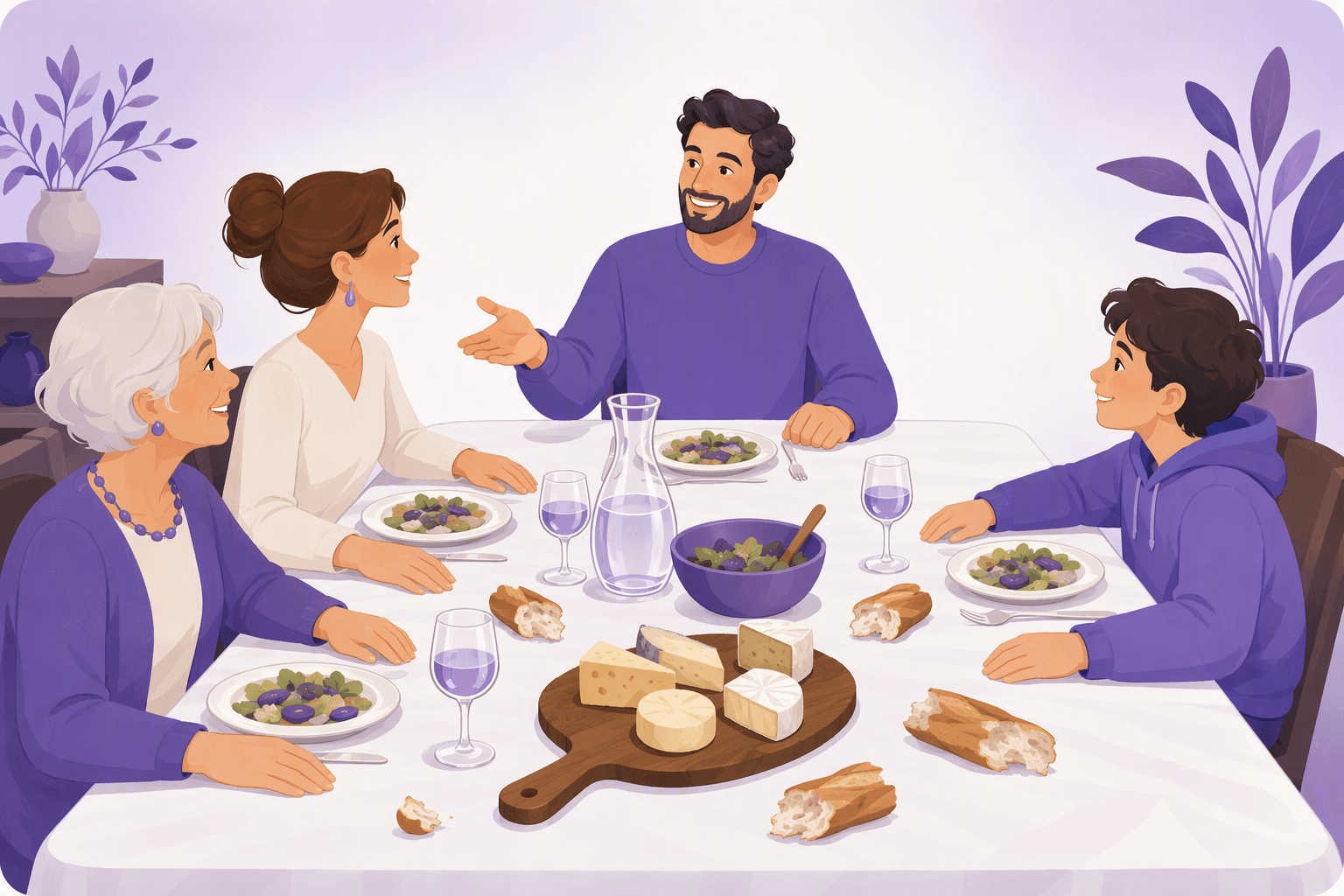
French dining etiquette is less about “fancy” and more about respecting the shared meal.
Starting and finishing
Wait until everyone is served, or until the host signals to start. Saying Bon appétit (bohn ah-pay-TEE) is common.
Do not rush. Meals can be long, especially at home.
Hands and posture
A classic difference: in France, keeping hands visible at the table is normal. You do not need to place elbows on the table, but hiding hands in your lap can look odd in formal settings.
Bread, cheese, and small habits
Bread often sits directly on the tablecloth, not on a side plate. Tear off a piece rather than biting into a whole baguette.
Cheese is usually served near the end of the meal. If you are unsure, take a small portion and follow others.
Asking for changes
In many restaurants, heavy customization can be seen as disrespectful to the kitchen. Asking for a small adjustment is possible, but do it politely and accept “non” without pushing.
⚠️ A common tourist trap
Avoid snapping fingers, waving aggressively, or calling “garçon.” Instead, make eye contact and say “Excusez-moi” (ehk-skoo-zay-MWAH). It is both more effective and more respectful.
Compliments, flirting, and the “romantic French” stereotype
French culture is often stereotyped as effortlessly romantic. In reality, compliments can be more restrained, and context matters.
Compliments
Complimenting someone’s style is common, but keep it simple:
- J'aime bien votre veste. (zhem byehn VOH-truh vest), “I like your jacket.”
Overly personal compliments to strangers can feel intrusive.
Terms of affection are not casual
French has affectionate language, but it is not automatically intimate with strangers. If you are learning romantic phrases, treat them as high-stakes vocabulary.
If you want a realistic guide to what sounds sweet vs intense, see how to say I love you in French.
Disagreeing and debating: direct, but not rude
French conversation can include more open disagreement than some English-speaking cultures. That does not automatically mean conflict.
The key is to keep the tone controlled and the language framed.
Useful softeners
- Je ne suis pas sûr. (zhuh nuh swee pah SOOR), “I’m not sure.”
- Peut-être. (puh-ETR), “Maybe.”
- Je vois ce que vous voulez dire. (zhuh vwah suh kuh voo voo-LAY DEER), “I see what you mean.”
Sociologist Pierre Bourdieu, in his work on language and symbolic power, argues that “legitimate” ways of speaking can signal education and status. In France, being able to argue calmly, with structure, can be part of that social signaling.
Public spaces: elevators, transport, and apartment life
French etiquette is especially visible in shared spaces.
Elevators and small enclosed spaces
A quick bonjour in a small elevator is common, especially in apartment buildings. Silence is also possible, but a greeting is rarely wrong.
Public transport
Keep phone calls short and quiet. Offer seats to elderly people, pregnant people, and those with disabilities.
Apartment buildings
Noise complaints are taken seriously. If you are hosting, be mindful of volume late at night.
Work and school: emails, meetings, and formality
French professional etiquette is often more formal at the start than in some other cultures.
Email openings and closings
Open with:
- Bonjour Madame / Monsieur,
- Bonjour [First name], (if you are already on first-name terms)
Close with a polite formula. These can be long, but you can keep it simple and still correct:
- Cordialement,
- Bien à vous,
Meetings and turn-taking
Interruptions can happen more than you expect, especially in debate-heavy environments. Do not assume it is hostile. Wait for a gap and re-enter calmly.
If you want to understand the language mechanics behind polite questions and requests, pair this guide with French question words and French pronouns explained.
Swearing and taboo language: what not to copy from movies
Movies and TV make French swearing sound casual and funny. In real life, it can land badly, especially if your accent marks you as a learner.
If you are curious, use a guide that ranks severity and explains context, rather than copying a subtitle. Start with French swear words and treat it as recognition vocabulary first.
French etiquette across the wider Francophone world
French is spoken across many countries and regions, and etiquette is not identical everywhere.
In parts of Francophone Africa, greetings can be longer and more relational, with more time spent asking about family and wellbeing. In Quebec, you will hear different everyday politeness patterns and vocabulary, even though the core logic of greeting and respect remains.
The safest approach is to keep the universal basics: greet first, use vous until invited otherwise, and mirror the other person’s level of formality.
How to learn etiquette fast using real scenes
Etiquette is easier to learn when you see it happening, not when you memorize rules.
What to listen for in dialogue
- Does the character say bonjour before asking?
- Do they use vous or tu, and when does it switch?
- How do they soften requests, with excusez-moi, s'il vous plaît, or je voudrais?
- How do they exit, with merci and au revoir?
This is why movie and TV clips work well: you hear the ritual language in context, with facial cues and timing. If you are building listening skill at the same time, explore best movies to learn French and pick scenes set in shops, offices, and family dinners.
💡 A two-minute daily drill
Pick one short scene and shadow only the “frame” language: bonjour, excusez-moi, s'il vous plaît, merci, au revoir. You are training the social rhythm, not just vocabulary.
A practical checklist for your first week in France
Use this as a quick behavior guide:
- Say bonjour before any request.
- Start with vous, switch to tu only when invited.
- Use excusez-moi to get attention, not loud calling.
- Keep public volume low, especially on transport.
- Bring a small gift when invited to a home.
- At meals, wait, pace yourself, and follow the host.
If you do these six things, you will already be “polite enough” in most everyday situations, even with beginner French.
Wrap-up: the goal is not perfection, it is predictability
French etiquette rewards predictable signals of respect. You do not need to become formal or stiff, you just need to show you understand the basic social choreography.
When you combine these habits with real spoken input, your French starts to sound natural because it is socially well-formed, not just grammatically correct. If you want more culture and language guides, browse the Wordy blog or jump into French practice at /learn/french.
Frequently Asked Questions
What is the most important etiquette rule in France?
When should I use vous vs tu?
Do French people really do la bise?
Is it rude to speak English in France?
What are common dining etiquette mistakes foreigners make in France?
Sources & References
- Organisation internationale de la Francophonie (OIF), La langue française dans le monde (latest edition)
- Ethnologue, 27th edition, 2024
- Institut français, Resources on French language and culture (accessed 2026)
- CNRTL, Dictionnaire (Centre National de Ressources Textuelles et Lexicales), entries for key politeness terms (accessed 2026)
Start learning with Wordy
Watch real movie clips and build your vocabulary as you go. Free to download.


