Quick Answer
The most important French travel phrase is 'Excusez-moi' (ehk-skew-ZAY mwah), always say it before asking anything. Combine it with 'Bonjour' at the start of every interaction, and you will immediately be treated better than 90% of tourists. This guide covers 50+ phrases organized by situation: getting around, hotels, restaurants, shopping, and emergencies.
Why Learning French Travel Phrases Matters
France is the most visited country on Earth. According to the World Tourism Organization (UNWTO), France welcomed over 90 million international tourists in 2023, more than any other nation. Yet the majority of these visitors arrive without a single French phrase beyond merci.
That is a missed opportunity. French is spoken by approximately 321 million people across 29 countries, according to the Organisation internationale de la Francophonie (OIF). Whether you are navigating the Paris Métro, ordering bouillabaisse in Marseille, or haggling at a Brussels flea market, even a handful of well-placed phrases transforms your experience from tourist to traveler.
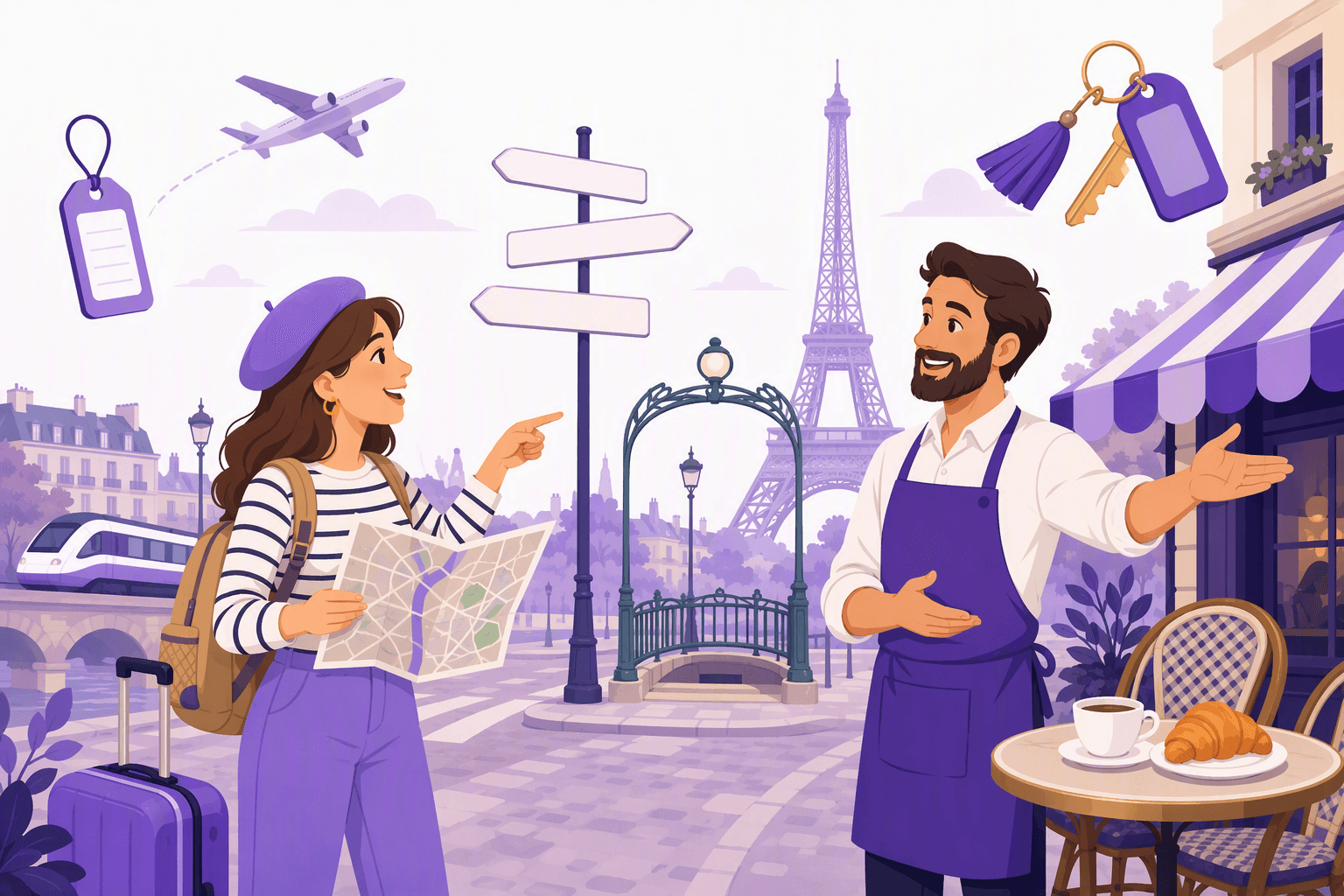
"In French culture, language is inseparable from politeness. A visitor who begins with Bonjour and Excusez-moi is not merely speaking French; they are demonstrating respect for the social fabric itself."
(Kramsch, C., Language and Culture, Oxford University Press)
The golden rule is simple: always say Bonjour before anything else. Before asking for directions, before ordering, before requesting a room key. Skipping Bonjour is the single most common mistake tourists make in France, and it immediately marks you as someone who does not understand the culture.
This guide covers 50+ phrases organized by real travel situations: getting around, hotels, restaurants, shopping, and emergencies. Every phrase includes pronunciation so you can use them immediately.
Quick Reference: Top 10 French Travel Phrases
| English | French | Pronunciation | Formality |
|---|---|---|---|
| Hello / Good day | Bonjour | bohn-ZHOOR | polite |
| Excuse me | Excusez-moi | ehk-skew-ZAY mwah | polite |
| Please | S'il vous plaît | seel voo PLEH | polite |
| Thank you | Merci | mehr-SEE | polite |
| Do you speak English? | Parlez-vous anglais ? | par-LAY voo ahn-GLEH | polite |
| Where is...? | Où est... ? | oo EH | polite |
| How much does it cost? | Combien ça coûte ? | kohm-BYEH̃ sah KOOT | polite |
| The check, please | L'addition, s'il vous plaît | lah-dee-SYOHN seel voo PLEH | polite |
| I don't understand | Je ne comprends pas | zhuh nuh kohm-PRAHN pah | polite |
| Help! | Au secours ! | oh suh-KOOR | casual |
Getting Around
Navigation is where most tourists first need French. Whether you are finding the Métro, hailing a taxi, or walking through a new neighborhood, these phrases cover the essentials. According to the Lonely Planet French Phrasebook, transportation-related questions are the most frequently used phrases among travelers in France.
Où est... ?
/oo EH/
Literal meaning: Where is...?
“Excusez-moi, où est la station de métro ?”
Excuse me, where is the metro station?
Always begin with 'Excusez-moi' or 'Bonjour' before asking. Never start cold with 'Où est...', it comes across as demanding.
This is the most versatile navigation phrase in your travel toolkit. Plug in any destination: Où est la gare ? (the train station), Où est la pharmacie ? (the pharmacy), Où est l'aéroport ? (the airport). For plural locations, use Où sont: Où sont les toilettes ? (where are the restrooms?).
Remember: Excusez-moi or Pardon should always precede this question. Walking up to a stranger and immediately saying Où est... without a greeting feels abrupt in French culture. The full pattern is: Excusez-moi (pause) + Bonjour (pause) + your question.
À droite / À gauche / Tout droit
/ah DRWAHT / ah GOHSH / too DRWAH/
Literal meaning: To the right / To the left / Completely straight
“Continuez tout droit, puis tournez à gauche.”
Continue straight ahead, then turn left.
When a local gives you directions, listen for these three phrases. 'Tout droit' is especially important, it sounds similar to 'à droite' but means the opposite (straight, not right).
A common trap: tout droit (straight ahead) and à droite (to the right) sound similar to untrained ears. Pay careful attention to the tout at the beginning, it makes all the difference between walking straight and turning right.
Combien coûte le billet ?
/kohm-BYEH̃ KOOT luh bee-YEH/
Literal meaning: How much costs the ticket?
“Bonjour, combien coûte le billet pour Lyon ?”
Hello, how much is the ticket to Lyon?
Use 'le billet' for transport tickets (train, bus, metro). For museum or event tickets, you can also use 'l'entrée' (the entry): 'Combien coûte l'entrée ?'
At train stations, you will encounter both guichets (staffed ticket windows) and automates (machines). The machines often have an English language option, but knowing this phrase helps at smaller stations where machines may not be available.
Je voudrais aller à...
/zhuh voo-DREH ah-LAY ah/
Literal meaning: I would like to go to...
“Bonjour, je voudrais aller à la Tour Eiffel, s'il vous plaît.”
Hello, I would like to go to the Eiffel Tower, please.
'Je voudrais' (I would like) is the polite conditional form. It is much more appropriate than 'je veux' (I want), which sounds blunt and demanding in French.
💡 Je voudrais vs. Je veux
Never say je veux (I want) to service staff, it sounds like a child's demand. Je voudrais (I would like) is the polite conditional form and the one you should always use. This small distinction makes a real difference in how people respond to you.
Pouvez-vous m'aider ?
/poo-VAY voo meh-DAY/
Literal meaning: Can you help me?
“Excusez-moi, pouvez-vous m'aider ? Je suis perdu(e).”
Excuse me, can you help me? I'm lost.
Add 'Je suis perdu' (I'm lost, masculine) or 'Je suis perdue' (feminine) after this phrase when you cannot find your way. Most French people are happy to help once you've shown the courtesy of asking in French.
At the Hotel
Checking in and communicating basic needs at your accommodation requires a specific set of vocabulary. Even in hotels where staff speak English, beginning in French sets a positive tone for your entire stay. This applies to everything from five-star Parisian hotels to countryside chambres d'hôtes (bed and breakfasts) where English may be limited.
J'ai une réservation
/zhay ewn reh-zehr-vah-SYOHN/
Literal meaning: I have a reservation
“Bonjour, j'ai une réservation au nom de Martin.”
Hello, I have a reservation under the name Martin.
'Au nom de' (under the name of) is the standard way to identify your booking. Even at luxury hotels where English is spoken, starting with 'Bonjour, j'ai une réservation' shows respect.
Avez-vous une chambre ?
/ah-VAY voo ewn SHAHMB-ruh/
Literal meaning: Do you have a room?
“Bonsoir, avez-vous une chambre pour deux personnes ?”
Good evening, do you have a room for two people?
Useful for spontaneous travel. Add 'pour ce soir' (for tonight) or 'pour deux nuits' (for two nights) to specify your stay. In France, hotel rooms are often smaller than American or Asian equivalents.
La clé, s'il vous plaît
/lah CLAY seel voo PLEH/
Literal meaning: The key, please
“Bonjour, la clé de la chambre 12, s'il vous plaît.”
Hello, the key for room 12, please.
Many smaller French hotels, guesthouses, and B&Bs still use physical keys rather than key cards. 'La clé' works for both. You may also hear 'la carte' for a key card.
Le petit-déjeuner est à quelle heure ?
/luh puh-TEE day-zhuh-NAY eh tah kell UHR/
Literal meaning: The breakfast is at what hour?
“Excusez-moi, le petit-déjeuner est à quelle heure demain ?”
Excuse me, what time is breakfast tomorrow?
In France, 'petit-déjeuner' means breakfast. In Québec, 'déjeuner' means breakfast, the same word means 'lunch' in France. This is one of the most confusing vocabulary differences between the two regions.
🌍 France vs. Québec: Meal Vocabulary
The word déjeuner means completely different meals depending on where you are. In France: petit-déjeuner (breakfast), déjeuner (lunch), dîner (dinner). In Québec: déjeuner (breakfast), dîner (lunch), souper (dinner). In Belgium and Switzerland, usage varies but generally follows the France pattern. Confirm which meal you are discussing if traveling between regions.
Ordering Food and Drinks
French cuisine is central to the travel experience. According to the UNWTO, food tourism is the primary motivation for 30% of visitors to France. Knowing how to order confidently makes dining far more enjoyable, and prevents accidental orders.
Une table pour deux, s'il vous plaît
/ewn TAH-bluh poor DUH seel voo PLEH/
Literal meaning: A table for two, please
“Bonsoir, une table pour deux, s'il vous plaît.”
Good evening, a table for two, please.
In France, you do not seat yourself at restaurants. Wait to be seated or ask this phrase at the entrance. At brasseries and cafés, you can typically choose your own table.
French dining etiquette is different from many other countries. Never seat yourself unless you see a clear sign saying installez-vous (seat yourself). At restaurants, a host or waiter will guide you. At brasseries and cafés, it is generally acceptable to choose your own table, but always greet the staff with Bonjour as you enter.
Qu'est-ce que vous recommandez ?
/kess-kuh voo ruh-koh-mahn-DAY/
Literal meaning: What is it that you recommend?
“Tout a l'air délicieux. Qu'est-ce que vous recommandez ?”
Everything looks delicious. What do you recommend?
French waiters take genuine pride in their menu knowledge. Asking for recommendations shows respect and often leads to the best dishes, especially daily specials not on the printed menu.
Je suis allergique à...
/zhuh swee ah-lehr-ZHEEK ah/
Literal meaning: I am allergic to...
“Excusez-moi, je suis allergique aux noix.”
Excuse me, I'm allergic to nuts.
Critical safety phrase. Common allergens: 'aux noix' (nuts), 'au gluten' (gluten), 'aux fruits de mer' (seafood), 'aux produits laitiers' (dairy). French restaurants take allergies seriously, always mention them clearly.
L'addition, s'il vous plaît
/lah-dee-SYOHN seel voo PLEH/
Literal meaning: The addition, please
“Excusez-moi, l'addition, s'il vous plaît.”
Excuse me, the check, please.
In France, the waiter will never bring the check until you ask. Lingering at your table after a meal is expected, not a sign to leave. This is the opposite of American dining culture, where the check arrives unsolicited.
One of the biggest culture shocks for visitors: in France, the waiter considers it rude to rush you. The check never arrives until requested. After finishing your meal, you are welcome to sit as long as you like, your table is yours for the evening. Simply make eye contact, raise your hand slightly, and say this phrase when you are ready to leave.
Un café, s'il vous plaît
/uh̃ kah-FAY seel voo PLEH/
Literal meaning: A coffee, please
“Bonjour, un café et un croissant, s'il vous plaît.”
Hello, a coffee and a croissant, please.
'Un café' in France always means an espresso, small, strong, and black. For coffee with milk, ask for 'un café crème.' For a larger Americano-style coffee, ask for 'un café allongé.' Ordering 'un latte' will often get you a glass of plain milk.
⚠️ Comptoir vs. Terrasse Prices
In many French cafés, prices vary by where you sit. A coffee at the comptoir (standing at the bar counter) can cost half the price of the same coffee on the terrasse (outdoor terrace). Prices must be posted by law, check the sign near the entrance before choosing your spot. This is not a scam; it is standard French café culture.
Shopping
Whether browsing Parisian boutiques or provincial markets, these phrases cover the essentials for making purchases and navigating transactions. France has both fixed-price stores (where haggling is inappropriate) and open-air markets (marchés) where negotiation is part of the experience.
C'est combien ?
/seh kohm-BYEH̃/
Literal meaning: It's how much?
“Excusez-moi, c'est combien, cette écharpe ?”
Excuse me, how much is this scarf?
The most direct way to ask a price. Works at markets, shops, and boutiques. For more formal settings, use 'Combien ça coûte ?' (how much does it cost?).
Avez-vous quelque chose de moins cher ?
/ah-VAY voo kell-kuh SHOHZ duh mweh̃ SHEHR/
Literal meaning: Do you have something of less expensive?
“C'est joli, mais avez-vous quelque chose de moins cher ?”
It's nice, but do you have something cheaper?
Perfectly acceptable at markets and mid-range shops. At luxury boutiques, this phrase may be met with a polite smile but little flexibility. Haggling is common at flea markets (marchés aux puces) but not at fixed-price stores.
Acceptez-vous les cartes ?
/ahk-sep-TAY voo lay KART/
Literal meaning: Do you accept the cards?
“Bonjour, acceptez-vous les cartes bancaires ?”
Hello, do you accept bank cards?
France uses chip-and-PIN cards almost exclusively. Contactless payment ('sans contact') is widespread. However, small businesses and markets may be cash-only. Always carry some euros as backup.
Je regarde, merci
/zhuh ruh-GARD mehr-SEE/
Literal meaning: I'm looking, thank you
“Je regarde, merci. Je vous appellerai si j'ai besoin d'aide.”
I'm just browsing, thanks. I'll call you if I need help.
French shop assistants often greet you and offer help. This phrase politely declines without being dismissive. It is the socially expected response when you want to browse independently.
Emergencies
Hopefully you will never need these, but knowing emergency vocabulary can be critical. France has excellent emergency services. The pan-European emergency number 112 works everywhere, and operators typically speak multiple languages. For specific services: 15 for medical emergencies (SAMU), 17 for police, 18 for fire.
Au secours !
/oh suh-KOOR/
Literal meaning: To help!
“Au secours ! Quelqu'un a volé mon sac !”
Help! Someone stole my bag!
The universal French distress call. Shout this loudly in any emergency. For less urgent situations, use 'Aidez-moi, s'il vous plaît' (help me, please), it is more measured.
J'ai besoin d'un médecin
/zhay buh-ZWEH̃ duh̃ mehd-SĒH̃/
Literal meaning: I have need of a doctor
“S'il vous plaît, j'ai besoin d'un médecin. Mon ami est malade.”
Please, I need a doctor. My friend is sick.
For serious emergencies, call 15 (SAMU, the French emergency medical service). Pharmacies in France, marked with a green cross, can also provide medical advice and basic treatment for minor issues.
French pharmacies, identifiable by their blinking green cross signs, serve as first-line medical resources for minor issues. Pharmacists can recommend medication, treat minor wounds, and advise on whether you need to see a doctor. They are often the fastest option for non-emergency health concerns.
Appelez la police
/ah-PLAY lah poh-LEES/
Literal meaning: Call the police
“S'il vous plaît, appelez la police. Il y a eu un vol.”
Please, call the police. There has been a theft.
The police emergency number in France is 17. In tourist-heavy areas like Paris, you can also find police officers on foot patrol near major landmarks. For non-emergency reports, visit a 'commissariat' (police station).
Je suis perdu(e)
/zhuh swee pehr-DEW/
Literal meaning: I am lost
“Excusez-moi, je suis perdu. Où est la gare Saint-Lazare ?”
Excuse me, I'm lost. Where is Saint-Lazare station?
Add an 'e' at the end if you are female: 'Je suis perdue.' In spoken French, both sound identical, so do not worry about pronunciation. Pair this with 'Pouvez-vous m'aider ?' for a complete request.
Cultural Essentials for Travelers
🌍 The Three Golden Rules of French Politeness
1. Always say Bonjour first. Before any request, transaction, or question, even quick ones like asking for directions. The Académie française considers greeting someone the fundamental social contract in French. Skipping it is the fastest way to receive cold service.
2. Use vous, not tu. With strangers, service staff, older people, and anyone you do not know well, always use vous (the formal "you"). Using tu with someone you just met is considered familiar and rude. Only switch to tu if the other person explicitly invites you to (on se tutoie ?).
3. Say Excusez-moi before interrupting. Never walk up to a stranger and launch directly into a question. Say Excusez-moi or Pardon first. This signals that you recognize you are taking their time, and it is expected in French social interaction.
💡 Service Compris No Tipping Required
In France, a service charge is included in every restaurant bill by law (service compris). You do not need to leave an additional tip. However, rounding up to the nearest euro or leaving 1-2 euros in coins for particularly good service is a common and appreciated gesture. It is never obligatory, and no one will be offended if you do not tip. This is fundamentally different from the United States, where 15-20% tips are expected.
Useful Response Phrases
When locals reply, you will need to understand and respond. Here are key phrases for two-way conversation:
| French | Pronunciation | English |
|---|---|---|
| Oui / Non | wee / nohn | Yes / No |
| D'accord | dah-KOHR | OK / Agreed |
| Je ne comprends pas | zhuh nuh kohm-PRAHN pah | I don't understand |
| Pouvez-vous répéter ? | poo-VAY voo ray-pay-TAY | Can you repeat that? |
| Plus lentement, s'il vous plaît | plew lahnt-MAHN seel voo PLEH | More slowly, please |
| Parlez-vous anglais ? | par-LAY voo ahn-GLEH | Do you speak English? |
| Comment dit-on... en français ? | koh-MAHN dee-tohn ahn frahn-SEH | How do you say... in French? |
| C'est parfait | seh par-FEH | That's perfect |
Regional Vocabulary Differences
French varies across countries. Here are some common travel words that differ between France, Québec, Belgium, and Switzerland:
| English | France | Québec | Belgium | Switzerland |
|---|---|---|---|---|
| Breakfast | Petit-déjeuner | Déjeuner | Petit-déjeuner | Petit-déjeuner |
| Lunch | Déjeuner | Dîner | Dîner | Dîner |
| Dinner | Dîner | Souper | Souper | Souper |
| Car | Voiture | Char | Voiture | Voiture |
| Shopping | Faire les courses | Magasiner | Faire les courses | Faire les commissions |
| 70 | Soixante-dix | Soixante-dix | Septante | Septante |
| 90 | Quatre-vingt-dix | Quatre-vingt-dix | Nonante | Nonante |
The number differences are particularly useful for understanding prices. In Belgium and Switzerland, septante (70) and nonante (90) are far more logical than France's soixante-dix (literally "sixty-ten") and quatre-vingt-dix (literally "four-twenty-ten"). If a Belgian shopkeeper says septante-cinq euros, that is 75 euros, much easier to parse than the French soixante-quinze.
The meal vocabulary difference catches travelers off guard constantly. If you fly from Paris to Montréal and your hotel offers déjeuner, do not assume it is lunch, in Québec, that is breakfast. Clarify the time if there is any doubt.
Learn French with Movies and TV
One of the best ways to internalize travel phrases is hearing them in context. French cinema is rich with everyday dialogue that mirrors real tourist situations, ordering at cafés, navigating the Métro, and interacting with locals.
Check out our guide to the best movies to learn French for film recommendations organized by difficulty level. Watching with French subtitles trains your ear for the pronunciation patterns and speech rhythms you will encounter while traveling.
For a deeper dive into French greetings and politeness (the foundation of every interaction you will have) see our complete guide on how to say hello in French. And once you have mastered the basics, explore more French learning resources and browse our full blog for additional language guides.
Frequently Asked Questions
What are the most important French phrases for tourists?
Do I need to speak French to visit France?
Is tipping expected in France?
Should I use 'tu' or 'vous' with strangers in France?
How do I order coffee in France?
What is the difference between sitting at the bar and the terrace in French cafés?
Sources & References
- Académie française, Dictionnaire de l'Académie française, 9th edition
- Lonely Planet, French Phrasebook & Dictionary, 8th edition
- Organisation internationale de la Francophonie (OIF), La langue française dans le monde, 2022 report
- Kramsch, C., Language and Culture (Oxford University Press)
- World Tourism Organization (UNWTO), International Tourism Highlights, 2024 edition
Start learning with Wordy
Watch real movie clips and build your vocabulary as you go. Free to download.


