Quick Answer
Advanced French food vocabulary is mostly about reading real menus and shopping like a local: cuts of meat (bavette, onglet), cooking methods (poêlé, mijoté), menu structure (entrée, plat, dessert), and market terms (primeur, traiteur). Learn these high-frequency menu and market words with pronunciation and you will understand French dining far beyond 'croissant' and 'fromage.'
Advanced French food vocabulary is the fastest way to understand real menus and markets in France: once you know course labels (entrée, plat), cooking words (poêlé, mijoté), and butcher-style cuts (bavette, onglet), you stop guessing and start ordering confidently.
French is spoken by hundreds of millions of people worldwide across dozens of countries and territories, and food culture is one of the most visible places you will hear it daily, from bakeries to school cafeterias to Michelin-star dining (OIF; Ethnologue 2024). If you already know the basics, these are the words that unlock the next layer.
If you are building listening skills with video, pair this list with our guide to French cafe culture so the vocabulary matches what you actually hear at the counter.
| English | French | Pronunciation | Note |
|---|---|---|---|
| Starter (France) | entrée | ahn-TRAY | In France, usually the first course. |
| Main dish | plat | plah | Also 'plat principal'. |
| Dessert | dessert | deh-SEHR | Final sweet course. |
| Set menu (prix fixe) | menu | muh-NOO | A set of courses at a fixed price. |
| A la carte | à la carte | ah lah kahrt | Ordering items individually. |
| Dish of the day | plat du jour | plah doo zhoor | Daily special, often at lunch. |
| Homemade (made on site) | fait maison | feh meh-ZOHNG | Prepared on site. |
| Chef's special | suggestion du chef | soo-zhehs-TYOHNG doo shef | House recommendation. |
| Appetizer nibbles | amuse-bouche | ah-MOOZ boosh | Small bite offered before the meal. |
| Side dish | accompagnement | ah-kohn-PAH-nyuh-MOHNG | What comes with the main. |
| Butcher | boucher | boo-SHAY | Shop: 'boucherie'. |
| Fishmonger | poissonnier | pwah-soh-NYAY | Shop: 'poissonnerie'. |
| Greengrocer | primeur | pree-MUR | Fresh fruit and veg seller. |
| Delicatessen / prepared foods | traiteur | treh-TUR | Ready-to-eat dishes, catering. |
| Cheesemonger | fromager | froh-mah-ZHAY | Shop: 'fromagerie'. |
| Bakery | boulangerie | boo-lahn-zhuh-REE | Bread-focused. |
| Pastry shop | pâtisserie | pah-tees-REE | Cakes and pastries. |
| Market | marché | mahr-SHAY | Open-air or covered market. |
| Seasonal produce | de saison | duh seh-ZOHNG | In season. |
| Local (sourced) | local | loh-KAHL | Often used on menus. |
| To slice | trancher | trahn-SHAY | Knife action. |
| Slice (noun) | tranche | trahnsh | A slice of bread, ham, etc. |
| To chop | hacher | ah-SHAY | Also 'haché' for minced. |
| Minced (adj.) | haché | ah-SHAY | Meat: 'steak haché'. |
| To peel | éplucher | ay-ploo-SHAY | Veg and fruit. |
| To grate | râper | rah-PAY | Cheese: 'fromage râpé'. |
| Grated (adj.) | râpé | rah-PAY | Often on packaging. |
| To whisk | fouetter | foo-EH-tay | Eggs, cream. |
| To knead | pétrir | pay-TREER | Dough work. |
| To simmer | mijoter | mee-zhoh-TAY | Low heat, long time. |
| Pan-fried | poêlé | pwah-LAY | Cooked in a pan. |
| Grilled | grillé | gree-YAY | Often on a grill or griddle. |
| Roasted | rôti | roh-TEE | Oven roast, also roast meat. |
| Baked | au four | oh foor | Literally 'in the oven'. |
| Steamed | à la vapeur | ah lah vah-PUR | Gentle cooking. |
| Boiled | bouilli | boo-EE | Also 'cuire à l'eau'. |
| Blanched | blanchi | blahn-SHEE | Quick boil then cool. |
| Braised | braisé | breh-ZAY | Slow cooked with liquid. |
| Stewed | en ragoût | ahn rah-GOO | Hearty stew style. |
| Reduced (sauce) | réduit | ray-dwee | Concentrated by simmering. |
| Rare (steak) | saignant | seh-NYAHNG | Very pink. |
| Medium (steak) | à point | ah pwahn | Medium. |
| Well-done (steak) | bien cuit | byen KWEE | Cooked through. |
| Blue rare | bleu | bluh | Very rare, quick sear. |
| To sear | saisir | seh-ZEER | High heat to brown. |
| To caramelize | caraméliser | kah-rah-may-lee-ZAY | Onions, sugar, sauces. |
| Beef skirt steak (common cut name) | bavette | bah-VET | Popular bistro steak cut. |
| Hanger steak | onglet | ohn-GLAY | Often served rare, very flavorful. |
| Ribeye | entrecôte | ohn-truh-KOHT | Classic steakhouse cut. |
| Sirloin | faux-filet | foh fee-LAY | Lean, common on menus. |
| Ground beef patty / minced steak | steak haché | stek ah-SHAY | Common in brasseries. |
| Pork belly | poitrine | pwah-TREEN | Context matters, also 'breast' in general. |
| Lamb | agneau | ahn-YOH | Often in spring menus. |
| Veal | veau | voh | Classic French cooking ingredient. |
| Offal | abats | ah-BAH | Organ meats, traditional bistro category. |
| Terrine | terrine | teh-REEN | Often a starter, served cold. |
| Shellfish | fruits de mer | frwee duh mehr | Seafood platter category. |
| Oysters | huîtres | WEETR | Common in winter and holidays. |
| Mussels | moules | mool | Often with fries: 'moules-frites'. |
| Scallops | coquilles Saint-Jacques | koh-KEE SAHN zhahk | Often shortened to 'Saint-Jacques'. |
| Shrimp | crevettes | kruh-VET | Also 'gambas' on some menus. |
| Squid | calamar | kah-lah-MAHR | Also 'encornet' in some contexts. |
| Cod | cabillaud | kah-bee-YOH | Common white fish on menus. |
| Sea bass | bar | bahr | Also 'loup' in parts of the south. |
| Salmon | saumon | soh-MOHNG | Smoked: 'saumon fumé'. |
| Smoked | fumé | foo-MAY | Smoking flavor or process. |
| Goat cheese | fromage de chèvre | froh-mahzh duh sheh-vr | Often just 'chèvre' on menus. |
| Soft-ripened cheese | pâte molle | paht mol | Cheese family term. |
| Hard cheese | pâte dure | paht dur | Cheese family term. |
| Raw milk | lait cru | leh kroo | Common label in cheese shops. |
| Aged (cheese) | affiné | ah-fee-NAY | Aged and matured. |
| Rind | croûte | kroot | Cheese rind. |
| Cream | crème | krehm | Also 'crème fraîche'. |
| Sour cream style | crème fraîche | krehm fresh | Used in cooking, not sweet. |
| Butter | beurre | bur | Salted: 'beurre salé'. |
| Salted butter | beurre salé | bur sah-LAY | Especially common in Brittany. |
| Allergens | allergènes | ah-lehr-ZHEN | Menu and labeling term. |
| Contains | contient | kohn-TYAHNG | Labeling verb. |
| May contain traces of | peut contenir des traces de | puh kohn-tuh-NEER day trahs duh | Common on packaging. |
| Gluten | gluten | gloo-TEHN | Often listed directly. |
| Lactose | lactose | lahk-TOHZ | Often listed directly. |
| Nuts (menu category) | fruits à coque | frwee ah kok | Includes many tree nuts. |
| Peanuts | arachides | ah-rah-SHEED | Also 'cacahuètes'. |
| Eggs | œufs | uhf | Often in allergen lists. |
| Mustard | moutarde | moo-TAHRD | Common allergen. |
| Celery | céleri | say-luh-REE | Common allergen in EU lists. |
How to use this vocabulary in real French food situations
Advanced food words matter because French menus compress a lot of information into short labels. CNRTL is useful here because it shows how words behave in real usage, not just a one-line translation.
If you want to hear these words in context, use short scenes from restaurants, markets, and family kitchens, then replay the same clip until your ear stops translating word-by-word. This is also where dual subtitles help, because you can map the written menu word to the spoken version.
Menu structure: reading French like a local
Entrée
In France, entrée is the starter, even if it feels like it should mean "entry point to the main." This is one of the most common travel misunderstandings, and it changes what you order.
If you see entrée plus plat plus dessert, you are looking at a classic three-course structure. A menu can also be two courses, for example entrée plus plat or plat plus dessert.
Plat
Plat is the main dish, and plat du jour is the daily special. In many places, the plat du jour is designed for lunch speed, so it is often simpler and faster than the full menu.
If you are watching French shows to learn, listen for servers saying "Et comme plat" when they move you from starters to mains. That phrase is a reliable cue.
Dessert
Dessert is straightforward, but the vocabulary around it is not. You will see words like maison (house-made), gourmand (rich, indulgent), and coulis (fruit sauce) constantly.
For a foundation list of everyday food words, compare this advanced list with our French food vocabulary basics. The overlap is what you should memorize first.
Cooking methods: the words that change the whole dish
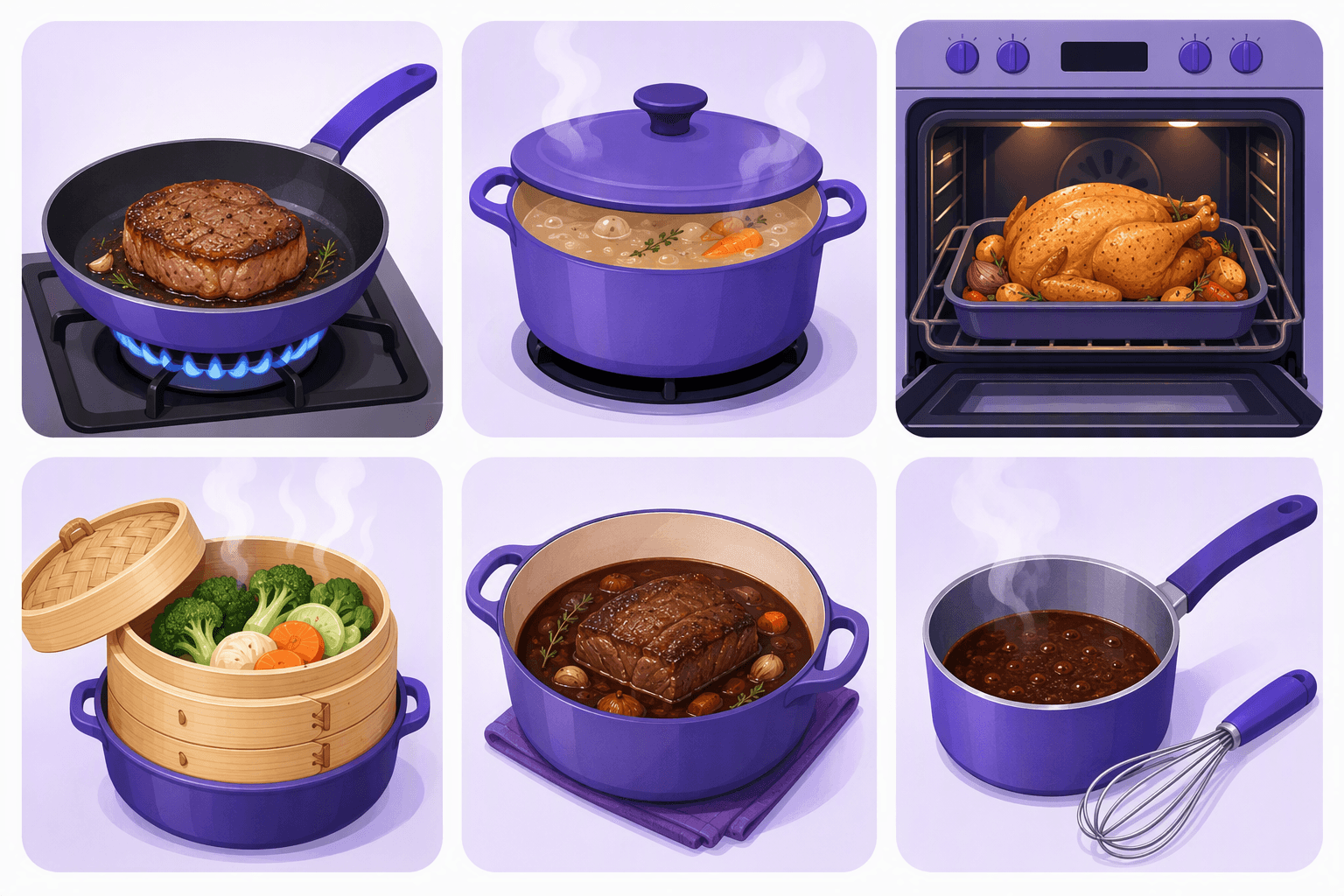
French cooking vocabulary is very verb-driven, and that shows up as adjectives on menus. A single word like poêlé or mijoté tells you the technique, the texture, and often the sauce style.
Claude Hagège, in his work on language and culture, treats food vocabulary as a window into social habits and shared expectations. In French, that expectation often includes knowing the method, not just the ingredient.
💡 A practical shortcut
If you only learn 10 cooking words, prioritize the ones that change texture: poêlé (pan-fried), mijoté (simmered), braisé (braised), rôti (roasted), vapeur (steamed). You will predict what arrives at the table much more accurately.
Market and shop vocabulary: buying ingredients with confidence
French has very specific shop nouns, and they are not optional. If you walk into a fromagerie, you are expected to talk about cheese, not just ask for "some cheese."
The Académie française and French public institutions publish guidance on standard French usage, which is helpful when you are trying to write or speak clearly in formal contexts (Académie française, accessed 2026). In daily life, you will still hear plenty of regional variation.
Primeur
Primeur (pree-MUR) is the greengrocer, especially for fruits and vegetables. You will also see primeur used as an adjective for early-season produce, but as a shop label it usually signals fresh produce.
At an outdoor marché, the primeur stall is where you practice numbers, weights, and polite requests. If you need that support, start with French numbers 1-100 and come back here.
Traiteur
Traiteur (treh-TUR) is your friend on busy days. It means prepared foods, catering, and ready-to-eat dishes, often sold by weight.
In many French towns, the traiteur is where families pick up quiche, salads, and roasted meats for a weekend meal without cooking everything from scratch.
Steak doneness: the words you must get right
French steak doneness vocabulary is compact and high-stakes. If you say the wrong one, you will still get a steak, just not the one you wanted.
- bleu: very rare, quick sear
- saignant: rare, very pink
- à point: medium
- bien cuit: well-done
🌍 Why French 'medium' can feel rarer than you expect
In many brasseries, the default for steak is on the pink side, and servers may assume you are comfortable with that. Saying à point or bien cuit is not rude, it is simply precise, and precision is valued in food ordering.
Pronunciation notes: nasal vowels without breaking MDX
In this article, nasal sounds are written as "OHNG", "AHNG", and "YOHNG" in the pronunciation column. That avoids angle brackets, which MDX interprets as tags.
Examples:
- saumon: soh-MOHNG
- fait maison: feh meh-ZOHNG
- suggestion: soo-zhehs-TYOHNG
If you want a deeper pronunciation overview, our French pronunciation guide explains why these sounds are nasal and how to place them.
Study plan: turn vocabulary into listening and speaking
Memorizing a list is not the goal, recognition is. Aim for two loops: read the word on a menu, then hear it in a clip, then say it once out loud.
A simple weekly structure works:
- Pick 15 words from one category (menu, market, cooking).
- Find two short scenes where you can hear at least five of them.
- Rewatch until you can predict the word before the subtitle appears.
For a broader method that fits movies and TV, use our guide on how to learn a language with movies. When you are ready to practice in real situations, build a small script using the phrases from French etiquette and customs.
One last tip for sounding natural
French food talk is polite by default. Add a greeting, a softener, and a thank you, and your vocabulary lands better.
Example pattern: "Bonjour, je vais prendre..." plus the dish, then "s'il vous plaît", then "merci."
If you want to learn French through real scenes and repeatable listening, explore Wordy on our French learning page.
Frequently Asked Questions
What does 'entrée' mean on a French menu?
What is the difference between 'plat du jour' and 'menu du jour'?
How do you ask for a steak to be cooked medium in French?
What does 'fait maison' mean in France?
What are common French words for food allergies on menus?
Sources & References
- Organisation internationale de la Francophonie (OIF), La langue française dans le monde
- Ethnologue: Languages of the World, French language entry (27th edition, 2024)
- Académie française, online resources (accessed 2026)
- CNRTL (Centre National de Ressources Textuelles et Lexicales), lexical entries (accessed 2026)
- Ministère de l'Agriculture et de la Souveraineté alimentaire (France), official guidance and resources (accessed 2026)
Start learning with Wordy
Watch real movie clips and build your vocabulary as you go. Free to download.


