Quick Answer
The most essential French food words to know: le pain (bread, luh pah), le fromage (cheese, luh froh-MAHZH), le poulet (chicken, luh poo-LEH), la salade (salad, lah sah-LAHD), and l'eau (water, loh). French cuisine was inscribed as a UNESCO Intangible Cultural Heritage in 2010, the first national cuisine ever honored. Learning food vocabulary is your fastest path to navigating menus, markets, and meals across France.
French food vocabulary is not just a language lesson. It is a doorway into one of the world's most celebrated culinary traditions. In 2010, UNESCO inscribed the "Gastronomic Meal of the French" as an Intangible Cultural Heritage of Humanity, making it the first national cuisine ever honored with this distinction.
With over 321 million speakers across five continents according to the Organisation internationale de la Francophonie, French remains one of the most widely spoken languages on Earth. Whether you are deciphering a menu in Lyon, shopping at a Parisian marché, or ordering a croque-monsieur at a café in Montreal, food vocabulary is among the first things you need.
"French gastronomy is a social custom aimed at celebrating the most important moments in the lives of individuals and groups. It emphasizes togetherness, the pleasure of taste, and the balance between human beings and the products of nature."
(UNESCO Intangible Cultural Heritage Committee, 2010 inscription decision)
This guide covers 30 essential food words organized by category, classic French dishes you will encounter everywhere, and the restaurant phrases that will help you navigate any dining situation with confidence.
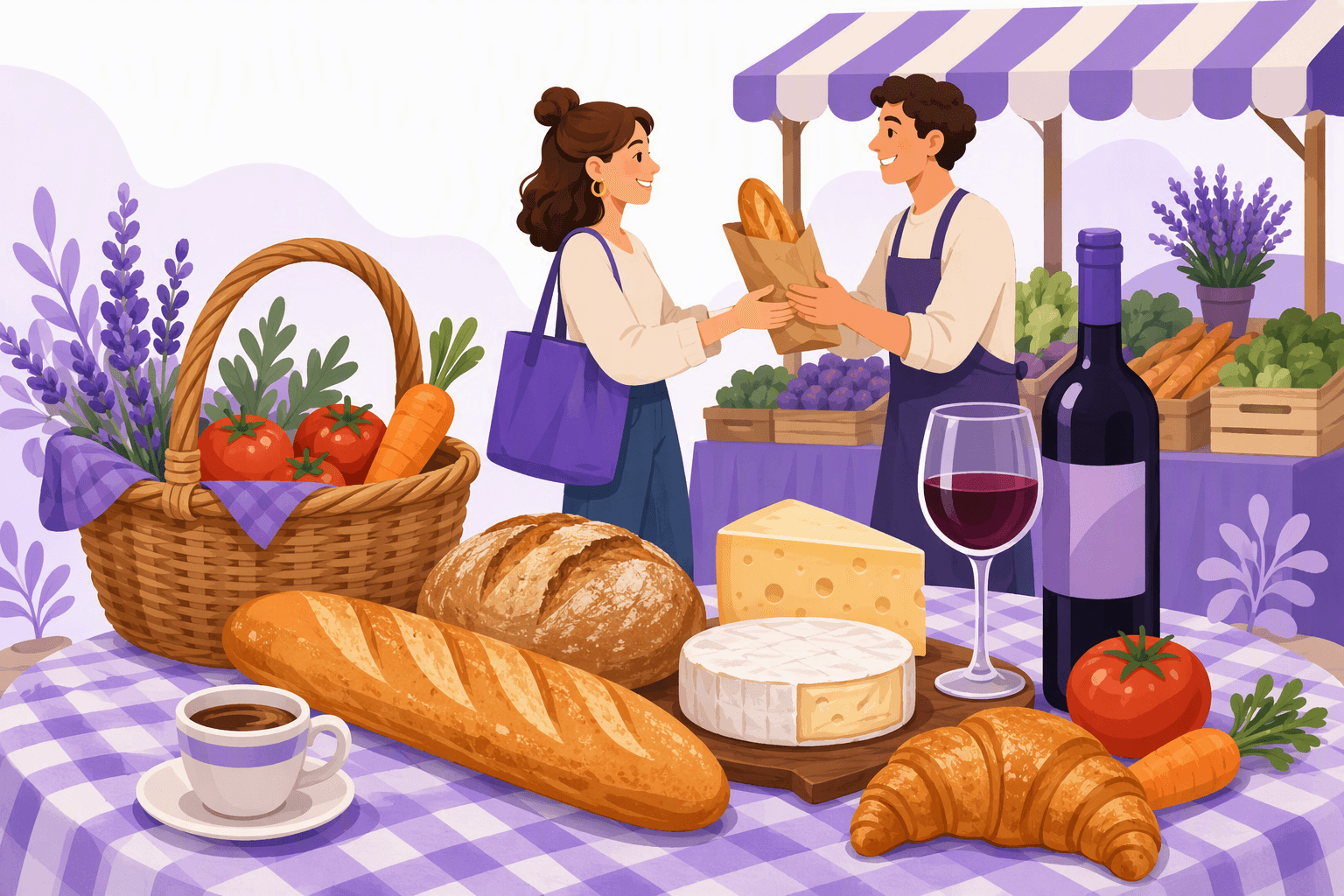
Quick Reference: 30 Essential French Food Words
| English | French | Pronunciation |
|---|---|---|
| Bread | Le pain | luh pah |
| Cheese | Le fromage | luh froh-MAHZH |
| Chicken | Le poulet | luh poo-LEH |
| Beef | Le boeuf | luh buhf |
| Fish | Le poisson | luh pwah-SOHN |
| Egg | L'oeuf | luhf |
| Butter | Le beurre | luh buhr |
| Milk | Le lait | luh leh |
| Apple | La pomme | lah pohm |
| Strawberry | La fraise | lah frehz |
| Tomato | La tomate | lah toh-MAHT |
| Potato | La pomme de terre | lah pohm duh tehr |
| Onion | L'oignon | lohn-YOHN |
| Carrot | La carotte | lah kah-ROHT |
| Salad / Lettuce | La salade | lah sah-LAHD |
| Rice | Le riz | luh ree |
| Sugar | Le sucre | luh sookr |
| Salt | Le sel | luh sehl |
| Pepper | Le poivre | luh PWAHV-ruh |
| Wine | Le vin | luh vah |
| Water | L'eau | loh |
| Coffee | Le café | luh kah-FEH |
| Cake | Le gâteau | luh gah-TOH |
| Ice cream | La glace | lah glahs |
| Soup | La soupe | lah soop |
| Ham | Le jambon | luh zhahm-BOHN |
| Shrimp / Prawn | La crevette | lah kruh-VEHT |
| Mushroom | Le champignon | luh shahm-pee-NYOHN |
| Pear | La poire | lah pwahr |
| Grape | Le raisin | luh reh-ZAH |
💡 Le, La, or L': Gender Matters
Every French noun has a grammatical gender. Food words are no exception: le pain (masculine), la pomme (feminine). When a noun starts with a vowel or silent "h," the article contracts to l' regardless of gender: l'eau, l'oeuf, l'oignon. There is no shortcut for memorizing gender, so learn each word with its article from the start.
Fruits (Les Fruits)
French markets, the famous marchés, overflow with seasonal produce. Fruit vocabulary is essential for shopping at any open-air market or supermarché.
La pomme
The apple is France's most consumed fruit. The word pomme also appears in one of French's most charming compound nouns: pomme de terre (potato), which literally translates to "apple of the earth." France is Europe's third-largest apple producer, with over 1.5 million tons harvested annually.
| English | French | Pronunciation | Note |
|---|---|---|---|
| Apple | La pomme | lah pohm | |
| Pear | La poire | lah pwahr | |
| Strawberry | La fraise | lah frehz | |
| Grape | Le raisin | luh reh-ZAH | Also means 'raisin' when dried |
| Orange | L'orange | loh-RAHNZH | Feminine: une orange |
| Lemon | Le citron | luh see-TROHN | |
| Peach | La pêche | lah pehsh | Also means 'fishing' |
Note the false friend: le raisin means "grape" in French, not "raisin." Dried grapes are les raisins secs (literally "dry grapes"). And la pêche does double duty: it means both "peach" and "fishing," so context is everything.
Vegetables (Les Légumes)
French cooking relies heavily on fresh vegetables. The classic mirepoix (onion, carrot, celery) forms the base of countless sauces and soups. According to the Académie française, many French vegetable names entered the language from Italian, Arabic, and Latin during centuries of culinary exchange.
La pomme de terre
Literally "apple of the earth," this compound noun reflects how potatoes were perceived when they first arrived from the Americas. The French pharmacist Antoine-Augustin Parmentier championed the potato in the 18th century, and his name lives on in dishes like hachis Parmentier (shepherd's pie).
| English | French | Pronunciation | Note |
|---|---|---|---|
| Potato | La pomme de terre | lah pohm duh tehr | Literally 'apple of the earth' |
| Tomato | La tomate | lah toh-MAHT | |
| Onion | L'oignon | lohn-YOHN | Feminine: une oignon |
| Carrot | La carotte | lah kah-ROHT | |
| Mushroom | Le champignon | luh shahm-pee-NYOHN | |
| Salad / Lettuce | La salade | lah sah-LAHD | |
| Green bean | Le haricot vert | luh ah-ree-KOH vehr |
🌍 The Silent H in L'haricot
Whether to say le haricot or l'haricot is one of the most debated points in French grammar. The Académie française rules that haricot has an "aspirated h," so the correct form is le haricot (no liaison). However, in everyday speech, many French speakers say l'haricot. Both are widely understood.
Meat and Seafood (Viandes et Fruits de Mer)
France has a rich tradition of charcuterie (prepared meats) and coastal seafood. Knowing these words is critical for navigating restaurant menus, where meat and fish are typically the centerpiece of le plat principal (the main course).
Le poulet
Chicken is the most consumed meat in France, surpassing beef since the early 2000s. You will see it everywhere: poulet rôti (roast chicken), poulet fermier (free-range chicken), and the classic coq au vin (rooster braised in wine). The distinction between poulet (young chicken) and coq (rooster) matters in traditional recipes.
| English | French | Pronunciation | Note |
|---|---|---|---|
| Chicken | Le poulet | luh poo-LEH | |
| Beef | Le boeuf | luh buhf | The 'f' is pronounced |
| Pork | Le porc | luh pohr | The 'c' is silent |
| Lamb | L'agneau | lahn-YOH | |
| Ham | Le jambon | luh zhahm-BOHN | |
| Fish | Le poisson | luh pwah-SOHN | Not 'poison' (le poison)! |
| Shrimp / Prawn | La crevette | lah kruh-VEHT | |
| Salmon | Le saumon | luh soh-MOHN |
⚠️ Poisson vs. Poison: A Dangerous Mistake
Le poisson (pwah-SOHN) means "fish." Le poison (pwah-ZOHN) means "poison." The only difference is a single "s" in spelling and a slight shift from an S-sound to a Z-sound in pronunciation. Mixing these up at a restaurant will, at minimum, earn you a memorable reaction from your server.
Dairy and Bread (Produits Laitiers et Pain)
No section on French food is complete without bread and cheese. France's bread culture is so deeply embedded that a 1993 law, the Décret Pain, legally defines what can be called a baguette in France. And Charles de Gaulle's famous quip about governing a country with 246 cheeses? Current estimates put the number well above 400.
Le fromage
France produces over 400 varieties of cheese, organized into eight official families: fresh, soft with bloomy rind (Brie, Camembert), soft with washed rind (Munster, Époisses), pressed uncooked (Saint-Nectaire), pressed cooked (Comté, Gruyère), blue (Roquefort), goat (chèvre), and processed. The cheese course, served after the main dish and before dessert, is a defining feature of the French meal structure.
| English | French | Pronunciation | Note |
|---|---|---|---|
| Cheese | Le fromage | luh froh-MAHZH | 400+ varieties in France |
| Butter | Le beurre | luh buhr | Foundation of French cooking |
| Milk | Le lait | luh leh | |
| Egg | L'oeuf | luhf | Plural: les oeufs (lay-zuh) |
| Cream | La crème | lah krehm | |
| Bread | Le pain | luh pah | |
| Baguette | La baguette | lah bah-GEHT | Legally defined by French law |
| Croissant | Le croissant | luh kwah-SAHN | Literally 'crescent' |
The word croissant literally means "crescent" (as in crescent moon). The pain au chocolat (or chocolatine as it is called in southwestern France) is the subject of a heated regional naming debate that the Académie française has wisely avoided settling. Both names refer to the same flaky pastry filled with chocolate batons.
Classic French Dishes (Plats Classiques)
These are the dishes you will find on menus across France, from Michelin-starred restaurants to corner bistros. Knowing their names helps you order with confidence.
Le croque-monsieur
This iconic grilled ham and cheese sandwich, topped with béchamel sauce, has been a Parisian café staple since the early 1900s. Le Petit Robert traces the name to around 1910. Add a fried egg on top and it becomes a croque-madame, the egg supposedly resembling a woman's hat.
La ratatouille
This Provençal vegetable stew from Nice combines eggplant, zucchini, peppers, tomatoes, and herbs. The name comes from the Occitan ratatolha, meaning "to stir up." Traditional ratatouille niçoise cooks each vegetable separately before combining them, a far cry from the simple one-pot version.
La bouillabaisse
Marseille's legendary fish stew originated as a humble fishermen's soup made from the catch that could not be sold. Today it is one of France's most celebrated dishes. Authentic bouillabaisse must contain at least three types of Mediterranean fish and is served with rouille (a garlicky saffron sauce) and toasted bread.
| English | French | Pronunciation | Note |
|---|---|---|---|
| Grilled ham & cheese | Le croque-monsieur | luh krok muh-SYUH | Add egg = croque-madame |
| Vegetable stew | La ratatouille | lah rah-tah-TOO-ee | From Provence/Nice |
| Fish stew | La bouillabaisse | lah boo-yah-BEHS | Marseille specialty |
| Onion soup | La soupe à l'oignon | lah soop ah lohn-YOHN | |
| Beef stew in wine | Le boeuf bourguignon | luh buhf boor-gee-NYOHN | Burgundy classic |
| Rooster in wine | Le coq au vin | luh kohk oh vah | |
| Thin pancake | La crêpe | lah krehp | Brittany specialty |
🌍 The French Meal Structure
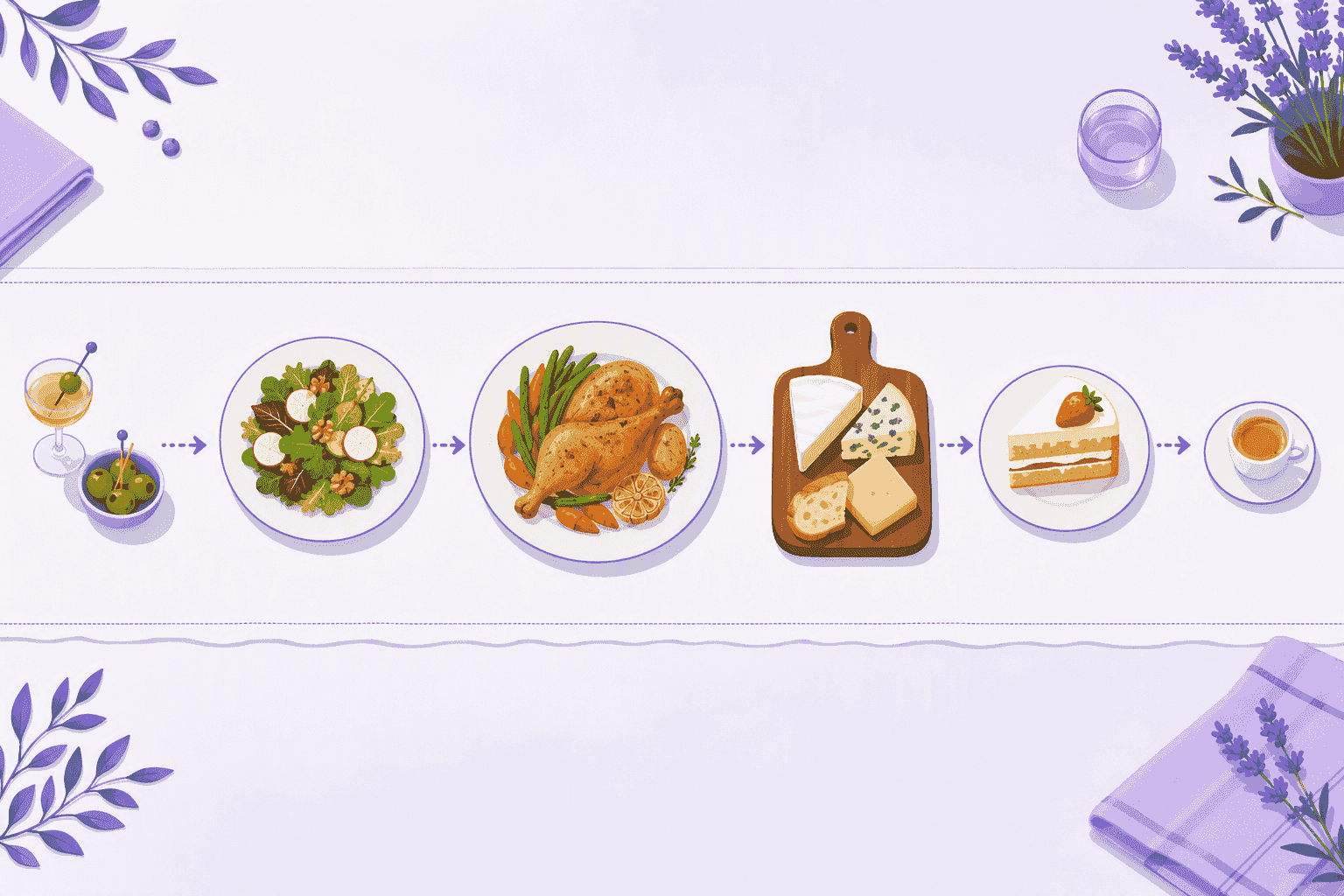
A traditional French meal follows a strict order: l'apéritif (pre-dinner drink), l'entrée (starter, NOT the main course!), le plat principal (main course), le fromage (cheese), le dessert, and le café (coffee). This is the very structure that UNESCO honored in 2010. Skipping courses is perfectly acceptable at everyday meals, but the order never changes.
Wine Vocabulary Basics (Le Vin)
France produces roughly 7-8 billion bottles of wine per year, making it one of the world's top producers alongside Italy. You do not need to be a sommelier, but a handful of wine terms will serve you well at any French table.
| English | French | Pronunciation |
|---|---|---|
| Red wine | Le vin rouge | luh vah roozh |
| White wine | Le vin blanc | luh vah blahn |
| Rosé wine | Le vin rosé | luh vah roh-ZEH |
| A glass of wine | Un verre de vin | uhn vehr duh vah |
| A bottle | Une bouteille | oon boo-TEH-yuh |
| Cheers! | Santé ! | sahn-TEH |
When toasting, say Santé ! (To health!) and make eye contact with each person, since avoiding eye contact during a toast is considered bad luck in France.
Restaurant Phrases (Au Restaurant)
Knowing food vocabulary is only half the battle. These phrases will carry you from the door of the restaurant to paying the bill.
| English | French | Pronunciation | Note |
|---|---|---|---|
| A table for two, please | Une table pour deux, s'il vous plaît | oon tahbl poor duh seel voo PLEH | |
| I would like... | Je voudrais... | zhuh voo-DREH | |
| The menu, please | La carte, s'il vous plaît | lah kahrt seel voo PLEH | 'Le menu' = fixed-price meal |
| The check, please | L'addition, s'il vous plaît | lah-dee-SYOHN seel voo PLEH | |
| I am vegetarian | Je suis végétarien(ne) | zhuh swee veh-zheh-tah-RYAH(N) | Add -ne for feminine |
| It's delicious! | C'est délicieux ! | seh deh-lee-SYUH | |
| Without... / With... | Sans... / Avec... | sahn / ah-VEHK | |
| The daily special | Le plat du jour | luh plah doo zhoor |
⚠️ Le Menu vs. La Carte: A Common Trap
In French, le menu refers to a fixed-price set meal (starter + main + dessert for one price). What English speakers call "the menu" (the full list of dishes) is la carte in French. When you say à la carte, you are ordering individual dishes from the full list, outside the set meal. Asking for la carte, s'il vous plaît gets you the list of everything available.
False Friends and Tricky Words
French and English share thousands of food-related cognates thanks to the Norman Conquest of 1066, when French became the language of the English court. But some words have drifted apart over the centuries, creating traps for the unwary.
Entrée: In French, une entrée is the starter course, the "entry" to the meal. In American English, it means the main course. This shift happened in 19th-century American dining, where the original French course structure was simplified. Ordering an entrée in France gets you an appetizer, not a steak.
Biscuit: In French, un biscuit means a cookie or cracker (literally "twice-cooked"). It does not mean the fluffy bread roll that Americans call a biscuit.
Raisin: Un raisin means a grape. If you want dried raisins, ask for des raisins secs.
Confiture vs. Preserves: La confiture means jam or preserves. It is NOT confetti (that is les confettis).
"The shared culinary vocabulary between French and English reflects 900 years of cross-Channel exchange, from the Norman kitchens of medieval England to the global influence of Escoffier's codified French cuisine."
(Le Petit Robert, etymological notes)
Practice with Real French Content
Food scenes in French films and television provide some of the best vocabulary practice available. Market haggling, kitchen conversations, and restaurant scenes are naturally packed with the words in this guide. Our guide to the best movies for learning French includes several films with memorable food-related dialogue. Ratatouille is an obvious choice, but films like Le Grand Restaurant and Julie & Julia offer rich culinary vocabulary in context.
Wordy lets you practice food vocabulary by watching French content with interactive subtitles. When a food word appears in dialogue, you can tap it to see the translation, hear the pronunciation, and save it for review. Explore our blog for more French learning guides, from numbers to everyday phrases, or visit our French learning page to start practicing today.
Frequently Asked Questions
What is the most important food word to know in French?
How do you order food at a restaurant in French?
What does 'entrée' mean in French versus English?
How many types of cheese does France have?
What is the structure of a traditional French meal?
Sources & References
- UNESCO, Gastronomic Meal of the French, Intangible Cultural Heritage of Humanity (inscribed 2010)
- Académie française, Dictionnaire de l'Académie française, 9th edition
- Le Petit Robert, Dictionnaire de la langue française (2025 edition)
- Ethnologue: Languages of the World, French language entry (2024)
Start learning with Wordy
Watch real movie clips and build your vocabulary as you go. Free to download.


