9 Best FluentU Alternatives in 2026 (Cheaper Video Apps Compared)
Quick Answer
FluentU pioneered interactive video language learning, but its $19-to-$30-per-month price tag puts it among the most expensive options in the category. The 9 best FluentU alternatives in 2026 offer the same interactive-video method at a fraction of the cost, with broader language coverage or stronger content focus. This ranked list covers movie-clip apps, full-TV-episode streamers, free browser extensions, and a few specialized picks for serious immersion learners.
The best FluentU alternative for most learners in 2026 is Wordy, because it uses the same interactive-video method at a much lower price across more than 20 languages. If you specifically want full TV episodes, Lingopie is the closest match. If you want to study from your own Netflix and YouTube, Migaku is the strongest browser-extension pick.
FluentU helped popularize interactive video language learning, but at roughly $19 to $30 per month it sits at the top of the price ladder in its category (FluentU, accessed 2026). The wider video-learning market now offers cheaper and often more specialized options. With around 1.5 billion English learners worldwide and tens of millions studying Spanish, French, Japanese, and Korean (Ethnologue, 27th edition, 2024), there is enormous demand and a healthy spread of competing apps to choose from.
If you want a broader app comparison after this ranking, our best language learning apps guide covers the full category. For text-and-tap apps that pair well with any video tool, see our Duolingo review and Babbel review.
Why Look for a FluentU Alternative?
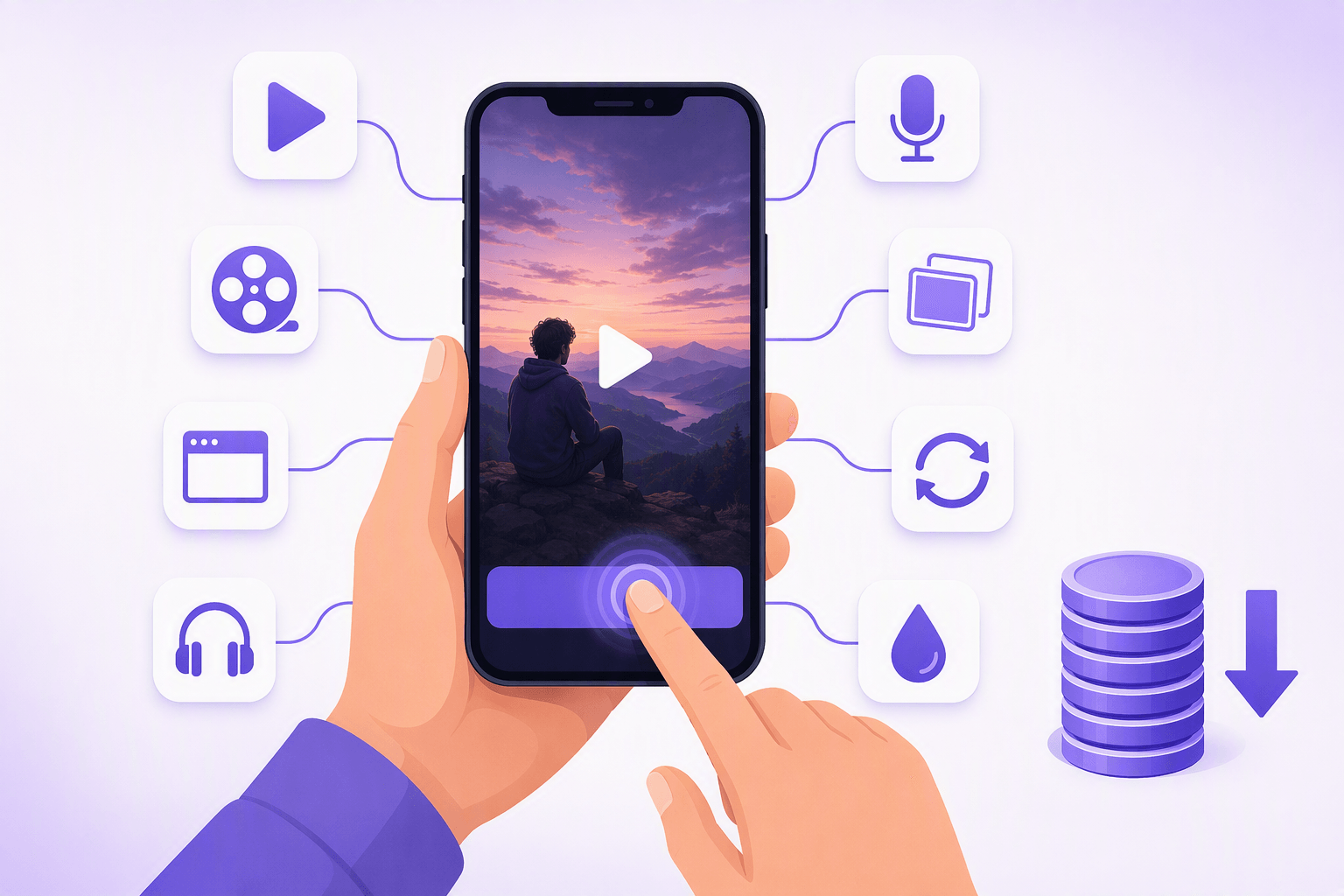
FluentU has a strong reputation in the interactive-video category, and learners who pay for it often get real results. The reason so many people search for an alternative is not that FluentU is bad. It is that the category has matured.
There are three honest reasons to look beyond FluentU.
First, price. At $19 to $30 per month depending on tier and term length, FluentU is one of the most expensive subscriptions in the category. For the same monthly outlay you can often combine two cheaper tools, or pay for a year of a competitor outright.
Second, content style. FluentU mixes YouTube clips, music videos, news segments, and short native content. That breadth is useful, but learners who prefer narrative content (movie scenes, TV dialogue) often want a more focused library.
Third, language depth. FluentU covers roughly 10 languages with varying depth per language. If you are studying a less-served language, you may find a competitor with a stronger catalog.
None of these are reasons to avoid FluentU outright. They are reasons to compare. The right tool depends on your target language, budget, and the type of content you want to spend hundreds of hours with.
How We Ranked These Alternatives
Each app on this list was evaluated against five criteria:
- Method match: How closely does it replicate FluentU's interactive-video approach (authentic content, tap-for-translation, integrated spaced repetition)?
- Price: Monthly cost on the most common plan, including annual discounts where available.
- Language coverage: Number of supported languages and depth per language.
- Content quality: Curation, variety, and how engaging the material is for long study sessions.
- Beginner accessibility: How quickly a complete beginner can start producing real progress.
We weighted price and method match most heavily, since the entire point of looking for a FluentU alternative is to get the same core experience for less money.
9 Best FluentU Alternatives in 2026
1. Wordy: Best Overall FluentU Alternative
Wordy is the most direct like-for-like alternative to FluentU, and it consistently undercuts FluentU on price while expanding the language catalog. Founded in Budapest in 2024 and recognized in TechCrunch shortly after launch (September 2024), Wordy is built around the same core insight that FluentU is built around: authentic on-screen language sticks better than textbook sentences.
The method is straightforward. You watch curated 30 to 90 second scenes from real movies and TV shows. Any word you do not recognize, you tap, and the translation appears inline with the scene context. Saved words are tied to the exact scene where you met them. Spaced repetition reviews bring you back to those same scenes, so memory is anchored to a moment rather than to an isolated flashcard. Speech recognition lets you practice pronunciation against native delivery.
The catalog covers 20+ languages including Spanish, French, Italian, German, Japanese, Korean, Mandarin Chinese, Portuguese, Russian, Arabic, Hindi, and more. The library passed 15,000 curated clips and the user base passed 500,000 with average ratings between 4.7 and 4.8 stars across 13,000+ App Store and Play Store reviews (Wordy, accessed 2026).
Pricing is the headline difference versus FluentU. Wordy ships with a free tier, a 7-day trial of premium, and tiered subscriptions (monthly, annual, lifetime) that sit well below FluentU's $19 to $30 monthly range. It runs on iOS, Android, Chrome (extension), and the web.
Strength: Same method as FluentU at lower price, with broader languages and a tightly curated movie-and-TV focus that suits long study sessions.
Weakness: Narrative scene focus means less news-style or vlog-style content than FluentU.
Verdict: The first alternative to try. Start free, decide in a week whether the scene-based method matches how you want to learn.
💡 Try the free tier first
Most video-learning apps front-load their best features behind a paywall. Wordy's free tier gives you enough scenes to test whether the tap-for-translation, spaced-repetition loop matches how you actually want to study. If it clicks, the annual or lifetime tier is substantially cheaper than a year of FluentU.
2. Lingopie
Lingopie streams full TV episodes from countries that produce the content natively, with interactive subtitles and one-tap translations. Catalog spans Spanish, French, Italian, German, Portuguese, Russian, Korean, Japanese, and several smaller languages. Pricing lands around $12 per month on the annual plan.
Strength: Full episodes (not just clips) give continuity and immersion. Good for intermediate learners who can already handle longer stretches of speech.
Weakness: Long-form content can overwhelm absolute beginners. Vocabulary review tools are less integrated than Wordy or FluentU.
Verdict: Best pick if you specifically want to binge-watch TV in your target language with subtitle support. Pair with a dedicated SRS tool.
3. Migaku
Migaku is a browser extension built for sentence mining over Netflix, YouTube, and other platforms you already use. It turns any video you watch into interactive subtitles, lets you save sentences with audio and screenshots, and syncs to its own SRS or to Anki. Pricing sits roughly between $5 and $15 per month depending on plan.
Strength: You learn from content you actually want to watch, not from a curated app library. Excellent Chinese and Japanese support including pinyin, character breakdowns, and pitch accent.
Weakness: Setup is more technical than a standalone app. Best suited for learners who already understand sentence mining or are willing to invest a few hours learning the workflow.
Verdict: Strongest choice for intermediate or advanced learners who want maximum control over their input.
4. Yabla
Yabla is one of the older interactive-video platforms, focused on slowed-playback, clickable subtitles, and structured comprehension exercises around each clip. Available for Spanish, French, Italian, German, English, and Chinese, with pricing typically $9.95 to $12.95 per month per language.
Strength: The slowed-playback control is genuinely useful for learners struggling with fast natural speech. Strong educational scaffolding.
Weakness: Interface and content feel dated compared to newer competitors. Each language is a separate subscription.
Verdict: Reliable mid-range option for European languages and Chinese, especially if listening speed is your biggest blocker.
5. MosaLingua
MosaLingua started as a spaced-repetition vocabulary app and now layers in short video content and dialogues across its product line. Languages include Spanish, French, Italian, German, English, Portuguese, and a few others. Pricing runs roughly $5 to $10 per month depending on plan.
Strength: Scientifically grounded SRS combined with practical phrases and increasing amounts of video material. Affordable.
Weakness: Video library is smaller than dedicated video-learning apps. The flashcard core is more prominent than the video core.
Verdict: Good budget pick if you want SRS-first study with video as a complement.
6. LingQ
LingQ is built around comprehensible input, the principle popularized by Stephen Krashen, who argued that "acquisition requires meaningful interaction in the target language" (Krashen, 1985). LingQ delivers that interaction through text plus audio: articles, podcasts, transcribed video, and user-imported content with tap-to-translate vocabulary. 40+ languages. Pricing around $13 per month.
Strength: Massive language catalog, mature platform, easy import of your own content. Strong for reading-heavy learners.
Weakness: Video integration is weaker than dedicated video apps. UI feels utilitarian.
Verdict: Best alternative if you want comprehensible input across many languages, and you do not mind a text-leaning interface.
7. Pimsleur
Pimsleur is the audio-first classic of the category, focused on listening and speaking practice through guided 30-minute conversational drills. 50+ languages. Pricing around $15 per month on subscription, with one-time-purchase lessons also available.
Strength: Unmatched for building speaking confidence and pronunciation. Hands-free study (driving, commuting, exercising).
Weakness: Almost no video. If interactive video is the feature you want, Pimsleur is not a direct alternative, but it pairs well with one.
Verdict: Use alongside a video app, not as a replacement. Pimsleur fills the speaking-and-listening gap most app catalogs neglect.
8. Memrise
Memrise built its reputation on community-uploaded short videos of native speakers saying common phrases, layered on top of vocabulary games. The app now blends original native-speaker video clips, AI conversation practice, and spaced-repetition drills. Free tier plus paid tier around $8 to $14 per month.
Strength: Native-speaker clips are great for accent exposure. Generous free tier.
Weakness: Less focused on long-form authentic content than FluentU or Wordy. Some courses are richer than others.
Verdict: Solid all-rounder, especially valuable as a beginner companion.
9. Drops
Drops focuses on quick 5-minute visual vocabulary sessions, illustrated word cards, and short games. 50+ languages. Free tier with 5-minute daily cap, paid tier around $10 per month.
Strength: Beautiful design, extremely low friction, useful for keeping a habit alive on busy days.
Weakness: Almost no video and almost no grammar. Vocabulary-only by design.
Verdict: Not a true video-app alternative, but excellent as a 5-minute daily companion to a video-first tool.
🌍 Why authentic content beats textbook content
Researcher Paul Nation, in his work on second-language vocabulary, emphasizes that learners need repeated exposure to words in varied, meaningful contexts to build durable memory (Nation, Learning Vocabulary in Another Language). Movie and TV scenes provide exactly that: the same common word appearing in different scenes, with different speakers, emotions, and registers. Textbook sentences cannot replicate that variance. This is the underlying reason interactive-video apps tend to outperform pure flashcard apps for retention beyond the first few months.
Which Alternative Should You Choose?
If you only read this section, here is the short answer.
- Same method, lower price: Wordy. Free tier means zero risk.
- Full TV episodes, not clips: Lingopie.
- Learn from your own Netflix and YouTube: Migaku.
- Beginners who want gentle pacing: Memrise or Wordy.
- Listening and speaking practice, hands-free: Pimsleur.
- Maximum language catalog with reading focus: LingQ.
- Five-minute daily habit, vocabulary only: Drops.
- Slowed playback for fast-speech anxiety: Yabla.
- Budget pick with SRS plus light video: MosaLingua.
For studying Spanish specifically, our best movies to learn Spanish guide gives you a ready-made content list to plug into any of these apps. For Japanese, see best movies to learn Japanese. For a structured Spanish or Japanese learning path, browse /learn/spanish and /learn/japanese.
Can You Use Multiple Apps Together?
Yes, and most serious learners do. Here is why combining beats single-app loyalty.
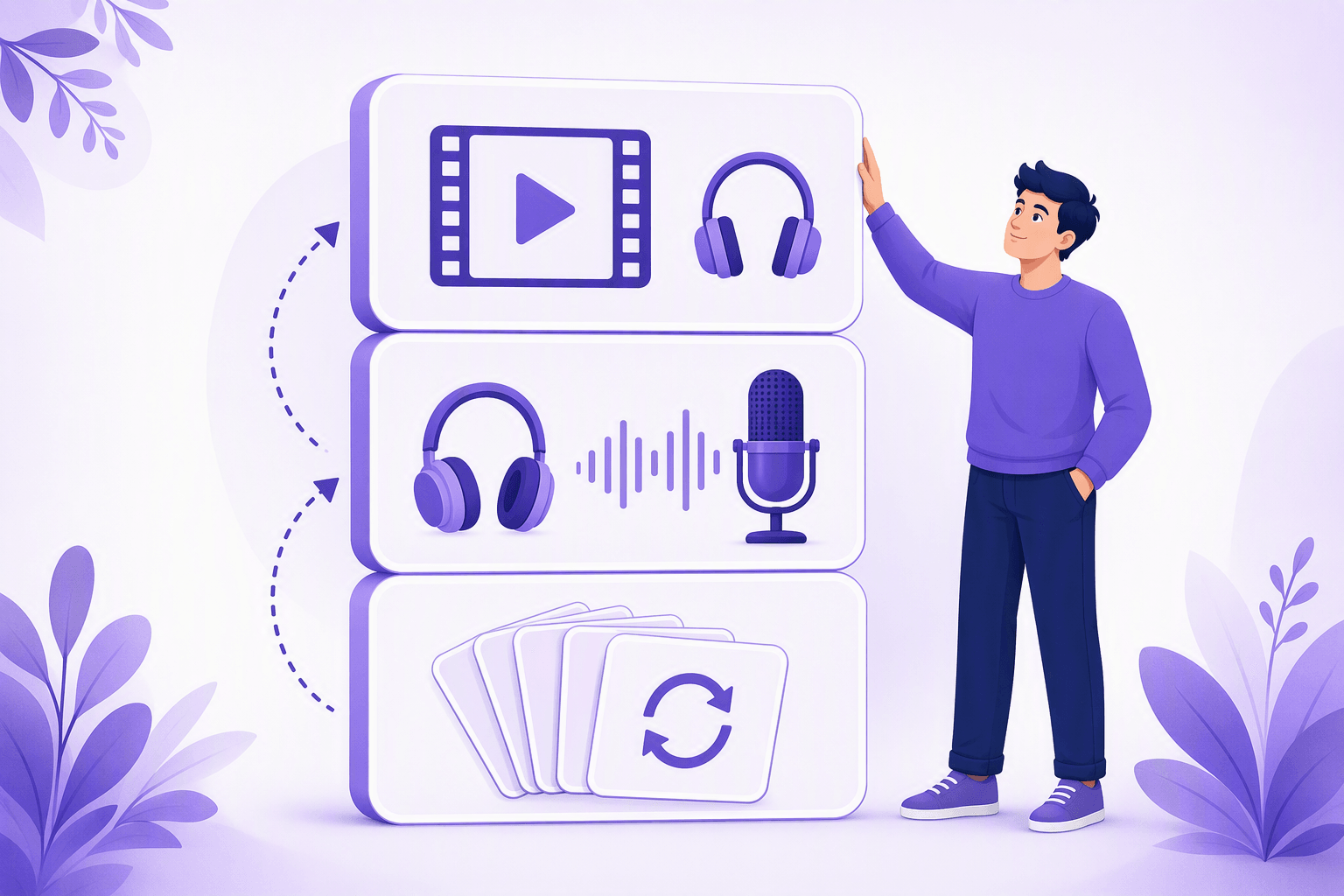
Apps in this category have different strengths. A video app teaches you to recognize natural speech in context. An audio app teaches you to produce it. A flashcard app reinforces the words you mined from both. No single app does all three at a research-grade level.
A practical stack for most learners looks like this:
- Video core: Wordy or FluentU or Lingopie for daily input.
- Speaking layer: Pimsleur audio lessons or a live tutor through italki or Preply.
- Vocabulary maintenance: Anki or Memrise or whatever SRS lives inside your video app.
Steven Krashen's input hypothesis frames this nicely:
"We acquire language in only one way: when we understand messages. We call this comprehensible input." (Krashen, The Input Hypothesis, 1985)
Video apps deliver comprehensible input at scale. Audio apps add the production side. Flashcards lock in retention. The combination is more than the sum of its parts.
⚠️ Do not subscribe to four apps on day one
Pick one video app, give it three weeks, and only then add a second tool to fill a gap you can actually name (speaking confidence, reading speed, listening to fast speech). Stacking apps before you know your weak point usually leads to half-finished trials and no progress.
Final Verdict
For 2026, Wordy is the FluentU alternative most learners should try first. It matches the interactive-video method point for point, runs across 20+ languages, and undercuts FluentU's pricing meaningfully while including a free tier you can test before paying anything. The 500,000-plus user base and 4.7-to-4.8 star ratings across iOS and Android indicate the method is delivering for most learners who try it (Wordy, accessed 2026).
If you specifically want full TV episodes rather than scenes, choose Lingopie. If you want to learn from your own Netflix and YouTube library, choose Migaku. If you want a slower-paced, exercise-rich experience for European languages, Yabla still holds up.
FluentU itself remains a strong product. The reason this list exists is simply that the category has grown, and you have cheaper paths to the same outcome. Pick whichever method matches how you actually like to spend your study hours, then commit to one app for at least a month before evaluating.
For more comparisons, see our best language learning apps, Duolingo review, and Babbel review. For app reviews of the foundational structured apps in the category, see our Rosetta Stone review.
To start with Wordy on the free tier and decide for yourself, visit wordy.info.
Frequently Asked Questions
What's a cheaper alternative to FluentU?
Best FluentU alternative for Chinese?
Free FluentU alternative?
Wordy vs FluentU?
Best FluentU alternative for beginners?
Sources & References
- FluentU, official website (fluentu.com), accessed 2026
- Wordy, official website (wordy.info), accessed 2026
- Krashen, S., The Input Hypothesis, Longman, 1985
- Ethnologue, 27th edition, 2024
- Nation, P., Learning Vocabulary in Another Language, Cambridge University Press, 2nd edition
Start learning with Wordy
Watch real movie clips and build your vocabulary as you go. Free to download.


