Quick Answer
English clothing vocabulary is easiest to learn when you group words by category: tops, bottoms, outerwear, underwear, shoes, and accessories. This guide gives you 140+ high-utility clothing words with simple pronunciation, plus US vs UK differences (pants vs trousers) and the phrases you need for shopping, laundry, and describing outfits.
Knowing the main English clothing words, like shirt, pants, jacket, coat, shoes, and dress, is enough to shop, pack, and describe what you are wearing. This guide expands that core into 140+ practical clothing, shoe, and accessory terms, with pronunciation and US vs UK notes so you can understand real conversations and store signs.
English is the world’s most widely learned second language, and it is also the main language of global media. Ethnologue estimates about 1.5 billion total English speakers worldwide (27th edition, 2024), which is why clothing vocabulary shows up constantly in travel, work, and everyday small talk.
If you are building your everyday vocabulary, pair this article with our 100 most common English words so you learn the function words that make clothing sentences actually work.
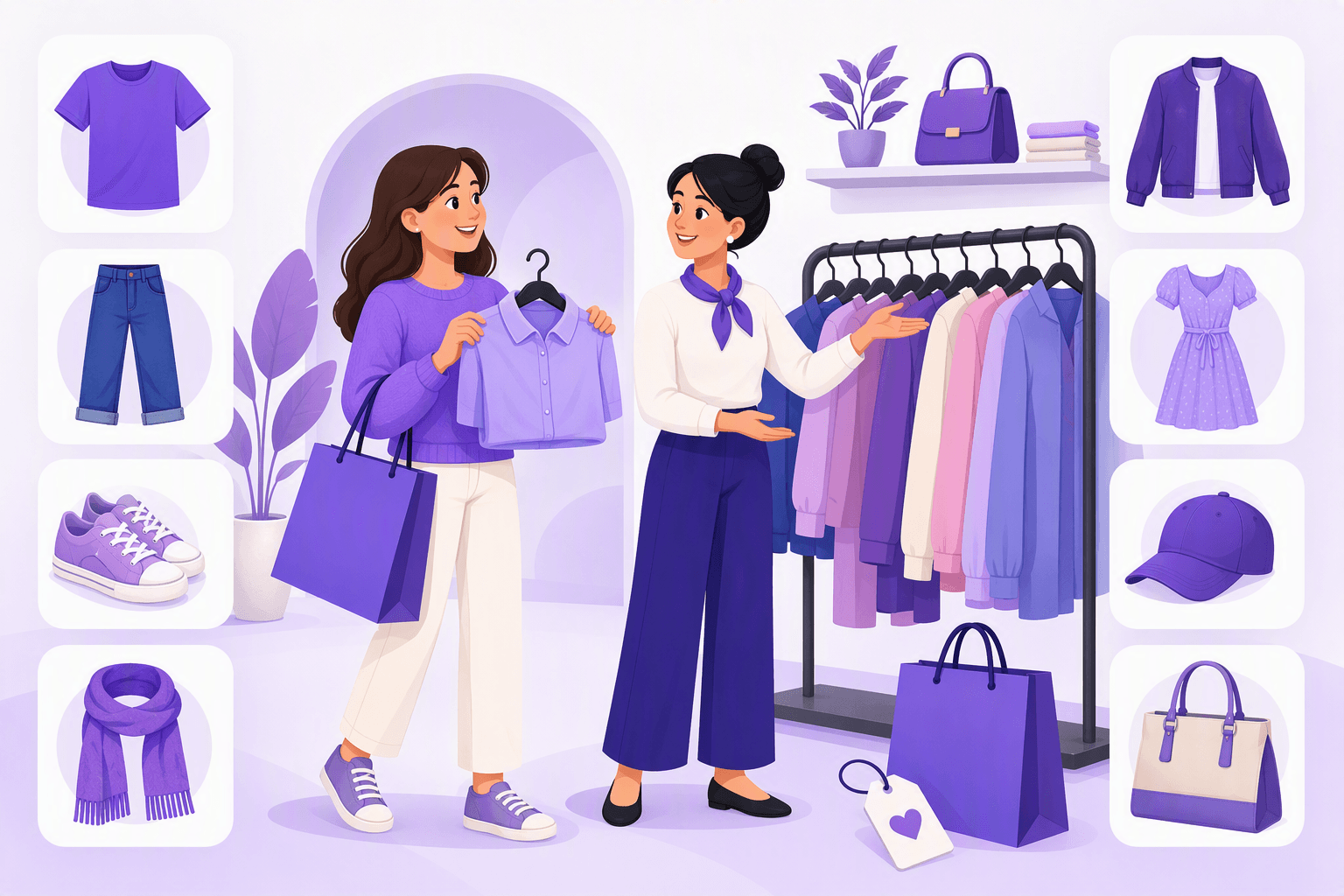
| English | Pronunciation | Note |
|---|---|---|
| clothes | KLOHZ | General plural word, not usually 'a clothe'. |
| clothing | KLOH-thing | More formal or category label. |
| outfit | OWT-fit | A complete look, one set of clothes. |
| garment | GAHR-muhnt | More formal, often in retail or manufacturing. |
| wardrobe | WAWR-drohb | Your collection of clothes, also a closet in some contexts. |
| to wear | wair | Verb: 'I wear a jacket'. |
| to try on | try on | Verb: put on to check fit. |
| to fit | fit | Verb: 'It fits well'. |
| size | syze | Clothing size or measurement. |
| style | style | Look or design. |
| fashion | FASH-uhn | Trends and clothing culture. |
| brand | brand | Company name on clothing. |
Clothing vocabulary, grouped the way native speakers think
Native speakers rarely memorize clothing words as one long list. We store them as categories, and we talk about them in routines: getting dressed, packing, doing laundry, shopping, and describing someone’s look.
That is also how costume designers and stylists talk. If you have ever watched behind-the-scenes interviews, you will hear category language like “outerwear,” “footwear,” and “accessories” because it speeds up decisions.
In linguistics, George Lakoff’s work on categorization and prototypes is useful here: learners do better when they build vocabulary around “best examples” (like shirt, jeans, shoes) and then expand outward to more specific items.
Tops (shirts, sweaters, and formal wear)
Tops are the easiest category to learn because they show up in every context, from school uniforms to office dress codes. In real speech, people often add a modifier: T-shirt, dress shirt, tank top, long-sleeve shirt.
| English | Pronunciation | Note |
|---|---|---|
| shirt | shurt | General word for a top with sleeves. |
| T-shirt | TEE-shurt | Casual, short sleeves, usually cotton. |
| tank top | TANK top | Sleeveless casual top. |
| blouse | blowss | Often used for women's tops, more formal than 'shirt'. |
| sweater | SWEH-ter | US common. UK often says 'jumper'. |
| jumper | JUHM-per | Common in UK for 'sweater'. |
| hoodie | HOO-dee | Sweatshirt with a hood. |
| sweatshirt | SWEHT-shurt | Thick casual top, no hood. |
| cardigan | KAHR-dih-guhn | Sweater that opens in front. |
| turtleneck | TUR-tuhl-nek | High collar that covers the neck. |
| polo shirt | POH-loh shurt | Collared casual shirt. |
| dress shirt | dres shurt | More formal shirt, often with buttons. |
| button-down | BUHT-n-down | Often means a collared shirt, sometimes specifically buttoned collar points. |
| top | top | Very general, common in shopping. |
| crop top | krop top | Short top that shows the waist. |
Fit words you will hear with tops
Fit vocabulary makes your clothing nouns usable in real sentences. Cambridge Dictionary and Oxford Learner’s Dictionaries both show how common collocations are, like “too tight,” “a bit loose,” and “fits well.”
| English | Pronunciation | Note |
|---|---|---|
| tight | tyte | Close to the body. |
| loose | loos | Not tight, more room. |
| baggy | BAG-ee | Very loose, often a style choice. |
| oversized | OH-ver-syzd | Intentionally large fit. |
| slim-fit | slim fit | Narrow cut, common in menswear. |
| to roll up | rohl up | Fold sleeves upward. |
| to tuck in | tuhk in | Put the shirt inside pants or skirt. |
| wrinkled | RING-kuhld | Not smooth, needs ironing. |
| stained | staynd | Has a mark that is hard to remove. |
| to match | mach | Look good together, same style or color. |
| to clash | klash | Look bad together, conflicting colors or patterns. |
Bottoms (pants, trousers, jeans, skirts, and shorts)
This is where US vs UK English matters most. If you only remember one difference, remember pants vs trousers.
For more systematic differences like this, keep our American vs British English guide bookmarked.
| English | Pronunciation | Note |
|---|---|---|
| pants | pants | US: trousers. UK: often underwear. |
| trousers | TROW-zerz | UK standard for pants. |
| jeans | jeenz | Denim pants. |
| shorts | shorts | Short pants for warm weather. |
| skirt | skurt | Bottom garment, not split like pants. |
| leggings | LEH-gingz | Tight, stretchy pants. |
| sweatpants | SWEHT-pants | Casual soft pants, also 'joggers'. |
| joggers | JOG-erz | Athletic casual pants, often tapered. |
| chinos | CHEE-nohz | Casual cotton pants, often for smart-casual. |
| slacks | slaks | More formal pants, office context. |
| suit pants | soot pants | Pants that match a suit jacket. |
| belt | belt | Accessory, but strongly tied to bottoms. |
🌍 A real 'pants' misunderstanding
In the UK, saying "I like your pants" can sound like you are commenting on someone’s underwear. In the US, it is a normal compliment about trousers. If you are traveling, switch to "trousers" (UK) or say "I like your jeans" to be safely specific.
Outerwear (jackets, coats, and cold-weather layers)
Outerwear vocabulary is high value because it appears in weather talk, travel packing, and everyday errands. It is also common in movies because characters enter, leave, and change locations constantly.
| English | Pronunciation | Note |
|---|---|---|
| jacket | JAK-it | General outer layer, usually hip-length. |
| coat | koht | Longer and warmer than a jacket. |
| raincoat | RAYN-koht | For rain, often waterproof. |
| windbreaker | WIND-bray-ker | Light jacket for wind. |
| parka | PAHR-kuh | Warm hooded coat, winter. |
| trench coat | trench koht | Classic long coat style. |
| blazer | BLAY-zer | Smart jacket, not always a full suit. |
| suit jacket | soot JAK-it | Jacket that matches suit pants. |
| vest | vest | US: sleeveless outer layer. UK: often 'waistcoat' for formal. |
| waistcoat | WAYST-koht | UK common for formal vest. |
| scarf | skarf | Neck accessory for warmth or style. |
| gloves | gluhvz | Hand covering. |
| beanie | BEE-nee | Casual knit hat. |
Underwear and sleepwear (useful, but handle with register)
Underwear words are common in real life, but they are more sensitive in conversation. Merriam-Webster’s usage notes often help learners here: the same item can have a neutral term and a more informal one.
| English | Pronunciation | Note |
|---|---|---|
| underwear | UHN-der-wair | General category word. |
| bra | brah | Women's undergarment. |
| boxers | BOK-serz | Men's underwear style. |
| briefs | breefs | Underwear style, also 'men's briefs'. |
| panties | PAN-teez | Common in US, can sound childish or intimate depending on context. |
| undershirt | UHN-der-shurt | Thin shirt worn under a shirt. |
| socks | soks | Foot covering, worn with shoes. |
| pajamas | puh-JAH-muhz | Sleepwear, UK also 'pyjamas' spelling. |
| nightgown | NYTE-gown | Sleep dress. |
| robe | rohb | Worn over pajamas, also 'bathrobe'. |
| bathrobe | BATH-rohb | Robe after shower. |
⚠️ Register and privacy
In English, underwear words are normal in a store or at home, but they can feel too personal in casual small talk. If you are unsure, use category words like "underwear" or "sleepwear" instead of very specific terms.
Shoes and footwear (where learners often miss key words)
Footwear vocabulary matters because it is tied to rules and routines. Many homes have a “shoes off” norm, and many workplaces have safety requirements.
Anna Wierzbicka’s work on cultural scripts is a good reminder that even simple items like shoes can carry hidden social rules, like what counts as “polite” in a home.
| English | Pronunciation | Note |
|---|---|---|
| shoes | shooz | General plural. |
| sneakers | SNEE-kerz | US common. UK often says 'trainers'. |
| trainers | TRAY-nerz | UK common for sneakers. |
| boots | boots | Footwear that covers the ankle or higher. |
| ankle boots | ANG-kuhl boots | Boots that stop at the ankle. |
| heels | heelz | Shoes with raised heel. |
| flats | flats | Shoes without a heel. |
| sandals | SAN-duhlz | Open shoes. |
| flip-flops | FLIP-flops | Casual beach sandals. |
| loafers | LOH-ferz | Slip-on smart-casual shoes. |
| dress shoes | dres shooz | Formal shoes for suits. |
| slippers | SLIP-erz | Indoor shoes. |
| shoelaces | SHOO-lays-iz | Laces you tie. |
| to lace up | lays up | Tie and tighten shoelaces. |
🌍 Shoes off, shoes on: a real-life culture signal
In the US and parts of Europe, some homes are shoes-on and some are shoes-off, and you often follow the host. In Japan and Korea, shoes-off is strongly expected in homes and many traditional spaces. In English, the polite check is simple: "Should I take my shoes off?"
Accessories (small words that make you sound fluent)
Accessories are “small nouns,” but they carry a lot of meaning in descriptions. In movies, you will hear them in compliments, teasing, and identity cues, like “Nice watch” or “Love your earrings.”
| English | Pronunciation | Note |
|---|---|---|
| hat | hat | General headwear. |
| cap | kap | Baseball cap style. |
| scarf | skarf | Also listed in outerwear, very common. |
| glasses | GLAS-iz | Eyeglasses. |
| sunglasses | SUHN-glas-iz | For sun. |
| watch | wach | Worn on wrist. |
| jewelry | JOO-uhl-ree | US pronunciation. UK often 'jewellery' spelling. |
| ring | ring | Finger jewelry. |
| necklace | NEK-liss | Neck jewelry. |
| bracelet | BRAYS-lit | Wrist jewelry. |
| earrings | EER-ringz | Ear jewelry. |
| belt | belt | Holds pants, also style. |
| tie | tye | Neckwear, formal. |
| bow tie | BOH tye | Formal tie style. |
| bag | bag | General. |
| backpack | BAK-pak | Bag worn on back. |
| purse | purs | US common. UK often says 'handbag'. |
| handbag | HAND-bag | Common in UK, also used in US. |
| wallet | WOL-it | Holds money and cards. |
Materials and patterns (the words on tags and product pages)
If you shop online in English, you will see material and pattern words more than you will hear them. Oxford Learner’s Dictionaries is especially helpful for learner-friendly definitions and examples.
| English | Pronunciation | Note |
|---|---|---|
| cotton | KOT-n | Common, breathable fabric. |
| denim | DEH-nim | Jeans fabric. |
| wool | wool | Warm natural fiber. |
| leather | LEH-ther | Animal hide material. |
| linen | LIN-in | Light fabric, wrinkles easily. |
| silk | silk | Smooth, delicate fabric. |
| polyester | pol-ee-ES-ter | Common synthetic fiber. |
| nylon | NY-lon | Synthetic, often in sportswear. |
| stretchy | STRECH-ee | Has elastic feel. |
| striped | strypt | Has stripes. |
| polka dot | POHL-kuh dot | Pattern of dots. |
| plaid | plad | US pronunciation. UK often says 'tartan' for some patterns. |
| tartan | TAHR-tn | Scottish-style checked pattern, common UK term. |
Shopping and laundry phrases you will actually use
Clothing vocabulary becomes useful when you can do three actions: ask for a size, describe a problem, and decide what to do next. These verbs and nouns show up constantly in store conversations and in TV scenes.
If you also want number practice for sizes and prices, review English numbers 1-100 so you can say “size 8,” “two sizes up,” and “twenty percent off” smoothly.
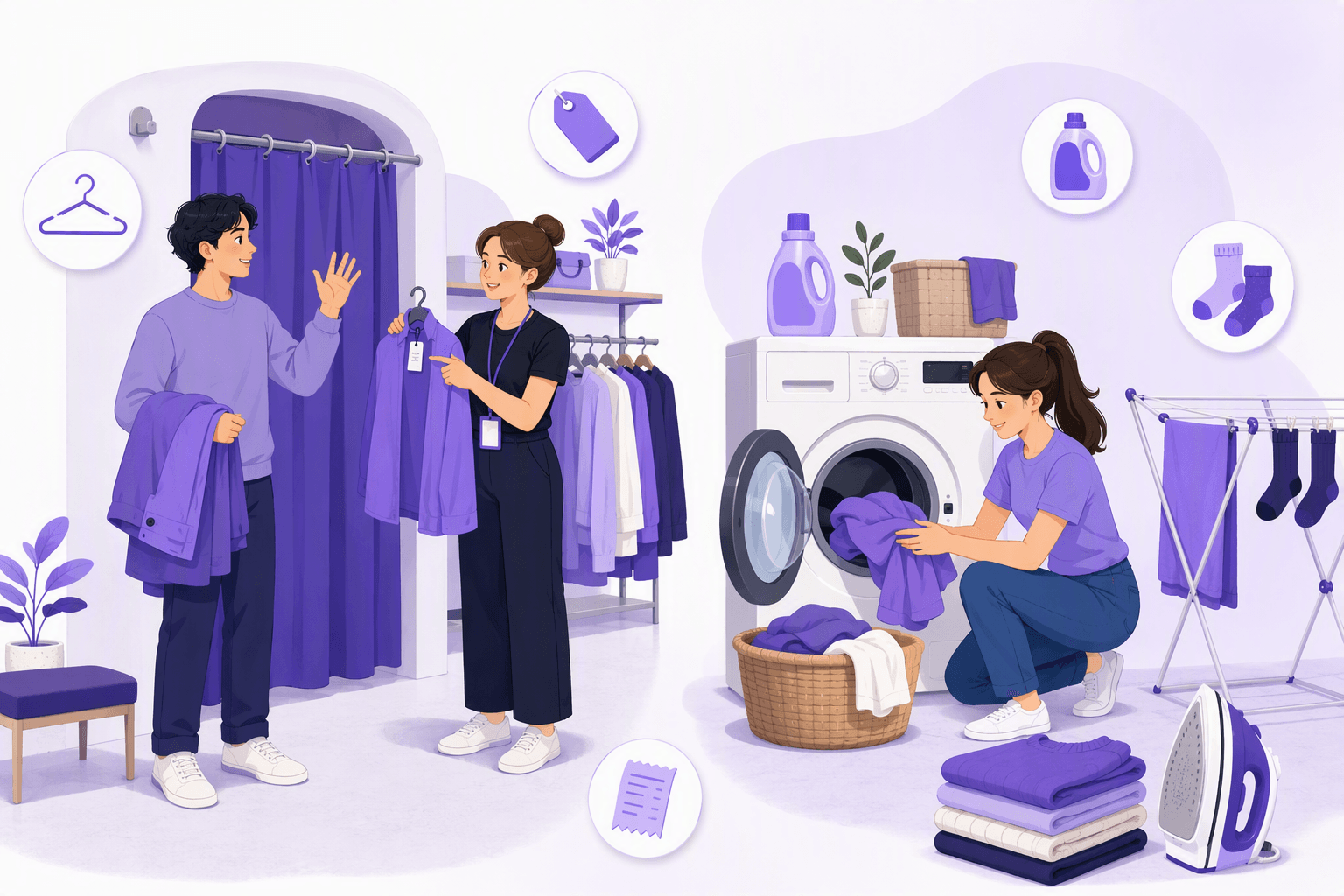
| English | Pronunciation | Note |
|---|---|---|
| fitting room | FIT-ing room | Place to try on clothes, also 'changing room'. |
| changing room | CHAYN-jing room | Common alternative to fitting room. |
| cashier | ka-SHEER | Person at checkout. |
| checkout | CHEK-owt | Place where you pay. |
| receipt | ri-SEET | Paper proof of purchase. |
| return | ri-TURN | Bring back for refund or exchange. |
| exchange | iks-CHAYNJ | Swap for another size or item. |
| refund | REE-fuhnd | Money back. |
| sale | sayl | Discount event. |
| discount | DIS-kownt | Money off. |
| laundry | LAWN-dree | Washing clothes. |
| washing machine | WOSH-ing muh-SHEEN | Machine for washing clothes. |
| dryer | DRY-er | Machine for drying clothes. |
| to wash | wosh | Clean with water. |
| to dry | dry | Remove water. |
| to iron | EYE-ern | Remove wrinkles with heat. |
| stain remover | STAYN ri-MOO-ver | Product to remove stains. |
US vs UK clothing vocabulary you will hear in real life
A few differences create most misunderstandings. If you learn these pairs, you will understand far more dialogue in British shows and American movies.
David Crystal’s writing on English varieties helps learners keep one key idea in mind: difference does not mean “wrong,” it means “local standard.” Clothing words are a perfect example.
| Common difference | English | Pronunciation | Note |
|---|---|---|---|
| pants (US) / trousers (UK) | pants | pants | US 'pants' = trousers. UK 'pants' can mean underwear. |
| sweater (US) / jumper (UK) | sweater | SWEH-ter | Same item, different common word. |
| sneakers (US) / trainers (UK) | sneakers | SNEE-kerz | Athletic casual shoes. |
| purse (US) / handbag (UK) | purse | purs | UK 'purse' can mean a small wallet for coins/cards. |
| fanny pack (US) / bum bag (UK) | fanny pack | FAN-ee pak | Be careful: 'fanny' is more vulgar in UK usage. |
💡 If you only learn one safe shopping strategy
When you are unsure of a word, point and use a general noun plus a question: "Do you have this in a different size?" or "Can I try this on?" You will sound natural even with limited vocabulary.
How to practice clothing vocabulary with movie and TV clips
Clothing words stick best when they are attached to actions and emotions: embarrassment, compliments, urgency, and weather discomfort. That is why they are easy to learn from scenes.
Use a three-step loop:
- Listen for the noun phrase, like “your jacket” or “those shoes.”
- Repeat it with the same rhythm.
- Swap one word, like jacket to coat, shoes to boots.
If you want a ready-made list of scenes that naturally contain everyday vocabulary, start with best movies to learn English. For casual speech that often includes outfit talk, add English slang, but keep it separate from store and work contexts.
Mini checklist: what to learn first (so you can use it tomorrow)
If your goal is travel or shopping, prioritize:
- 10 core items: T-shirt, shirt, jeans, pants or trousers, jacket, coat, socks, shoes, sneakers or trainers, dress
- 6 fit words: size, fits, too big, too small, tight, loose
- 6 store words: fitting room, cashier, receipt, return, exchange, refund
That set covers most real interactions, and it prevents the classic “I know the noun but I cannot finish the sentence” problem. If you want to build sentence confidence quickly, our English travel phrases article is a good next step.
A note on compliments and tone (so you do not sound weird)
Complimenting clothing is normal in English, but the safest pattern is to compliment the item, not the body. “Nice jacket” and “I like your shoes” are friendly and neutral.
If you want to sound warmer without sounding too intimate, add a softener: “That’s a great color on you” is common among friends, but it can be too personal with strangers. In professional settings, keep it simple.
As a contrast, avoid mixing clothing compliments with edgy language you learned elsewhere. If you are curious about what not to say at work, see our English swear words guide, and treat it as recognition vocabulary, not a speaking goal.
Final take: clothing vocabulary is a fast win
Clothing vocabulary is one of the highest-return sets in English because it appears in shopping, weather, travel, and everyday descriptions. Learn it in categories, practice it in short scenes, and focus on fit and store words so you can act, not just recognize.
If you want to keep building practical everyday English, browse the Wordy blog and choose one category at a time, the same way native speakers organize it in their heads.
Frequently Asked Questions
What is the difference between 'pants' and 'trousers' in English?
How do I ask for a different size in a clothing store in English?
What does 'outfit' mean, and how is it different from 'clothes'?
What are the most common clothing words English learners should learn first?
How can I learn clothing vocabulary faster with movies and TV?
Sources & References
- Ethnologue: Languages of the World, English language entry (27th edition, 2024)
- Cambridge Dictionary, clothing-related entries (accessed 2026)
- Merriam-Webster Dictionary, clothing-related entries (accessed 2026)
- Oxford Learner's Dictionaries, clothing-related entries (accessed 2026)
Start learning with Wordy
Watch real movie clips and build your vocabulary as you go. Free to download.


