Quick Answer
Comprehensible input works for Japanese, but the writing system means you should build it listening-first: kids' anime and learner podcasts at the beginner stage, slice-of-life shows and easy news at intermediate, dramas and native podcasts at advanced. This guide maps real sources to each level, explains when Japanese subtitles turn watching into reading practice, and ends with a weekly routine you can actually sustain.
Comprehensible input in Japanese means listening and reading you can mostly understand from context, and the fastest way to get it as a beginner is audio-first: kids' anime, learner podcasts, and graded readers, because Japanese locks beginners out of reading long before it locks them out of listening. The idea comes from Stephen Krashen's input hypothesis: you acquire a language by understanding messages pitched slightly above your current level, which he abbreviated as i+1, your level plus one manageable step. Material you can follow at 90 to 98 percent comprehension feeds acquisition; material where you catch one word in ten is noise. If the theory is new to you, our complete guide to comprehensible input covers Krashen, the research, and the criticisms; this article is the Japanese-specific playbook.
The good news is that Japanese has one of the richest learner-input ecosystems of any language. The Japan Foundation counted about 3.79 million people studying Japanese worldwide in its 2021 survey, and that audience has produced an unmatched supply of learner podcasts, graded readers, and level-tagged anime lists. You just need to know what fits where.
Why Japanese comprehensible input is harder to start
For most learners, the wall is the script. Japanese writes with three systems at once: hiragana, katakana, and kanji, of which the official jōyō list alone contains 2,136 characters (Agency for Cultural Affairs, 2010). A Spanish learner can pick up a children's book on day one and decode every word aloud; a Japanese learner cannot read a menu until the kana are automatic and cannot read a novel for years. Reading, the cheapest input source in most languages, is gated.
The vocabulary is distant too. Outside the layer of katakana loanwords, terms like コーヒー (coffee) or インターネット (internet) that give you a small head start, almost nothing is guessable from European languages, so early listening has fewer free anchors than it would in Spanish or German. The distance shows up in the numbers: the US Foreign Service Institute plans roughly 2,200 classroom hours for English speakers to reach professional working proficiency in Japanese, against 600 to 750 for closely related languages. There is no trick that deletes that gap.
But the gap is asymmetric, and that is the strategic insight: spoken Japanese is far friendlier than written Japanese. The sound system is small and regular, five vowels and consistent syllables, words are pronounced the way they are spelled in kana, and everyday speech leans on a compact core of high-frequency phrases. Your ear does not care about kanji. So while a learner of French can start reading and listening at once, the correct Japanese order is: listen from day one, read along the kana as they solidify, and let kanji recognition ride on top of subtitles rather than blocking the whole pipeline.
"We acquire language in one way and only one way: when we understand messages." — Stephen Krashen, lectures on second language acquisition
Everything below is that principle, sorted by level.
Comprehensible input by level
Level labels are approximate; what matters is the comprehension test. If you cannot summarize what you just watched or heard, step down a level, no matter what the label says.
Beginner (A1-A2): kids' anime, learner podcasts, graded readers
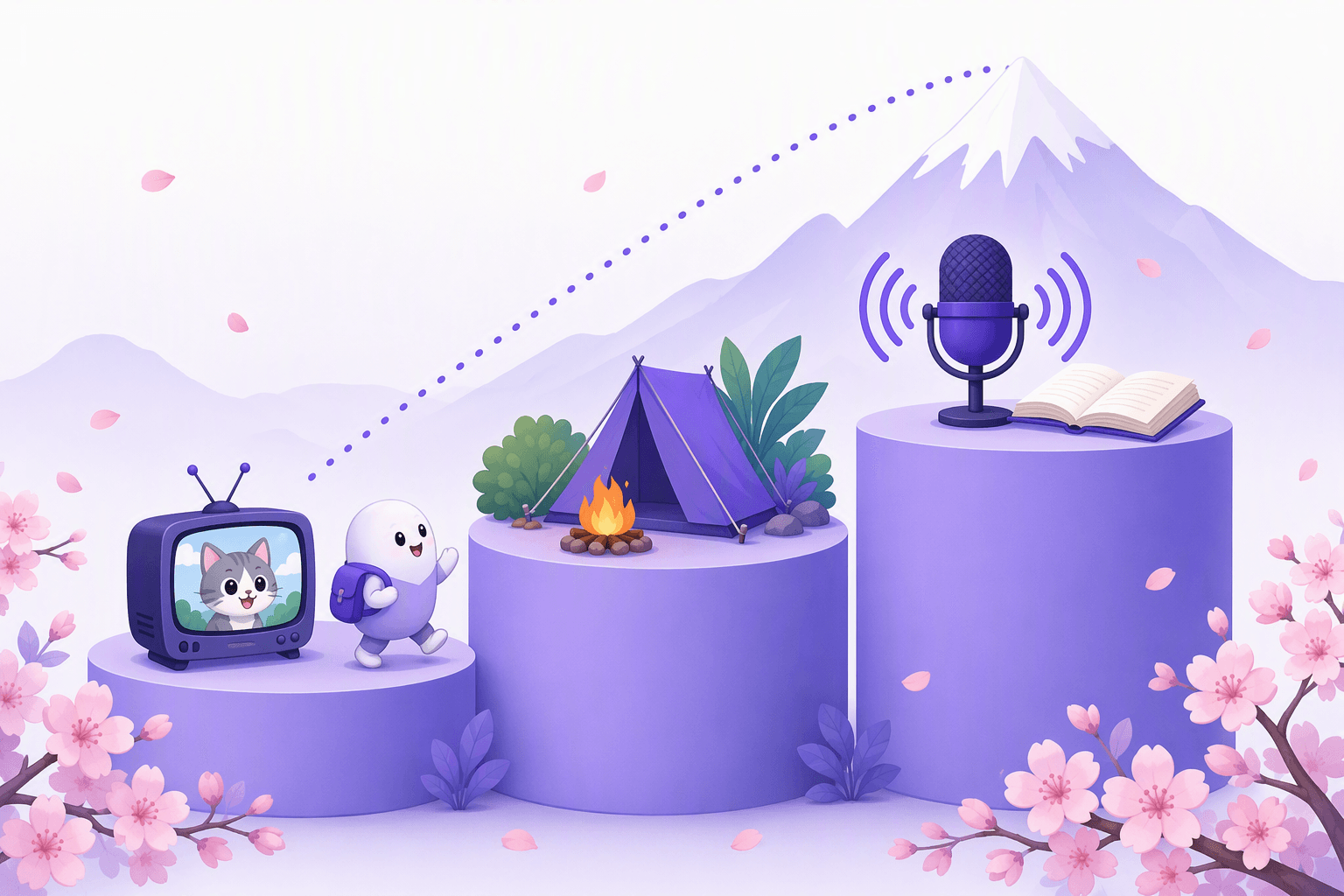
Anime made for children or built on simple daily life is the beginner's television. Shirokuma Café (Polar Bear Café) runs on slow, clear conversations about jobs, food, and friends; Chi's Sweet Home follows a kitten in three-minute episodes with the vocabulary of a household. Both give you constant visual support, short sentences, and heavy repetition, which is exactly what makes input comprehensible before you have vocabulary. Our list of the best anime series for learning Japanese sorts more options by difficulty.
Learner podcasts are the purest i+1 source in Japanese, because the hosts calibrate to you on purpose. Nihongo con Teppei for Beginners delivers four-to-five-minute monologues in slow, endlessly recycled everyday Japanese; hundreds of episodes exist, and the repetition is the feature. The Bitesize Japanese Podcast sits half a step up: slow but natural speech about daily topics, with transcripts, which makes it a bridge toward native pacing.
Graded readers solve the reading gate. The Tadoku project publishes free graded readers starting at Level 0, kana-friendly, with pictures carrying half the meaning, so you can start genuine extensive reading months before you could touch native text. Ten minutes of Tadoku a day quietly builds the kana automaticity everything else depends on.
Intermediate (B1-B2): slice of life, Terrace House, easy news
Once you follow kids' content comfortably, move to material about adult life that stays visually grounded.
Slice-of-life anime is the natural next rung: shows like Yuru Camp (Laid-Back Camp) or Barakamon run on real conversational patterns, everyday and hobby vocabulary, and no fantasy jargon. This is also the stage to be deliberate about register: anime speech spans natural to theatrical, and our guide to learning Japanese with anime covers what to copy and what to leave on screen.
Terrace House deserves its reputation among learners. It is unscripted conversation between real people being polite to strangers, which means natural speed, natural hesitations, and the polite register you will actually use, something scripted drama rarely provides. When it feels 80 percent comprehensible, it is one of the best sources in the language.
Intermediate podcasts carry the listening habit forward. The original Nihongo con Teppei runs at a faster clip than the beginner series while staying learner-aware, and 4989 American Life offers natural-speed monologues about everyday life in the US, with transcripts. Both are designed to be the stepping stone between slowed speech and native podcasts.
NHK News Web Easy rewrites current news in simplified Japanese with furigana over every kanji and audio for every article. Two or three articles a day is a compact reading-plus-listening habit tied to real events, and it is free.
Keep expectations calibrated for native TV in general: vocabulary coverage research found that comfortably following movie dialogue takes roughly the 3,000 most frequent word families (Webb & Rodgers, Applied Linguistics, 2009). Intermediate is where you close that gap, and easier native content is how.
Advanced (B2-C1): dramas, variety, native podcasts
At this stage the question flips from "what can I understand?" to "what will I actually keep watching?"
Dramas give you emotional, domain-rich Japanese: workplace series feed you keigo in context, family dramas feed you casual speech across generations. Variety shows are the hardest listening in the language: overlapping speech, wordplay, on-screen text flying past, and regional accents; when variety becomes comfortable, very little else will trouble you. Native podcasts are the endgame for input volume, since they strip away all visual support: shows like Yuru Gengogaku Radio, a hugely popular podcast about linguistics, or any native show on a topic you already know, where your background knowledge keeps the input comprehensible. Novels and audiobooks join the rotation here as kanji reading matures.
Kanji and subtitles: make listening feed reading
In most languages subtitles are a listening aid. In Japanese they are also your kanji curriculum, which changes the advice.
Turn on Japanese subtitles early, as soon as kana are readable, even though you will miss most of the kanji at first. Three things happen. Sounds you half-hear get anchored to real words instead of staying mush. High-frequency kanji start attaching to spoken words you already know, 食べる and 大丈夫 become sight words through sheer repetition, long before you could write them. And every episode silently doubles as reading practice at a pace no textbook matches. If the kana themselves are still shaky, fix that first; our hiragana guide and beginner kanji guide cover the on-ramp.
One practical warning: not every platform carries Japanese subtitle tracks. Anime streaming services aimed at international fans often ship translated subtitles only, while Netflix frequently includes Japanese subtitles on anime and Japanese originals. Before committing to a show as study material, check that a Japanese track exists; a series you love with only translated subtitles is entertainment, not reading practice.
The ladder for Japanese subtitles mirrors the general one: your own language's subtitles or dual subtitles in the first months, Japanese subtitles as the long default through intermediate, then subtitles off for familiar shows. The middle rung lasts longer in Japanese than in other languages, and that is fine, because in Japanese the middle rung is also reading practice.
💡 The rewatch rule
The cheapest upgrade in this whole method: rewatch, one rung up. An episode you watched with your native language's subtitles last month is perfect material for Japanese subtitles today, and for no subtitles later. Familiar plot keeps the input comprehensible while the language does the stretching.
The clip-repetition method
The gap between "kids' anime" and "Terrace House" is real, and the way across is repetition of short pieces rather than volume of long ones. A full episode at 70 percent comprehension washes over you; a ninety-second scene watched three times ends up nearly fully understood, and the second and third passes are where real-speed Japanese starts resolving into words.
The manual version: pick one scene per day, watch it with Japanese subtitles, rewatch without, and say two or three lines aloud. This is exactly the loop Wordy is built around: short curated clips from real shows with tap-to-translate subtitles, and spaced repetition that replays the same scene so words are reviewed inside the moment you met them. Either way, the unit of progress is the scene, not the episode.
A weekly routine that scales
A sustainable week at roughly an hour a day:
| Day | Core input (30-40 min) | Second slot (15-20 min) |
|---|---|---|
| Monday | Anime or drama episode, Japanese subtitles | Learner podcast episode |
| Tuesday | Podcast, full attention | Tadoku reader or NHK News Web Easy |
| Wednesday | Rewatch Monday's episode, subtitles one rung up | Clip repetition, one scene |
| Thursday | New episode, Japanese subtitles | Learner podcast |
| Friday | Podcast | NHK News Web Easy, two articles |
| Saturday | Film or double episode, no-subtitle stretch for familiar parts | — |
| Sunday | Re-listen to the week's podcasts on the go | Clip repetition, one scene |
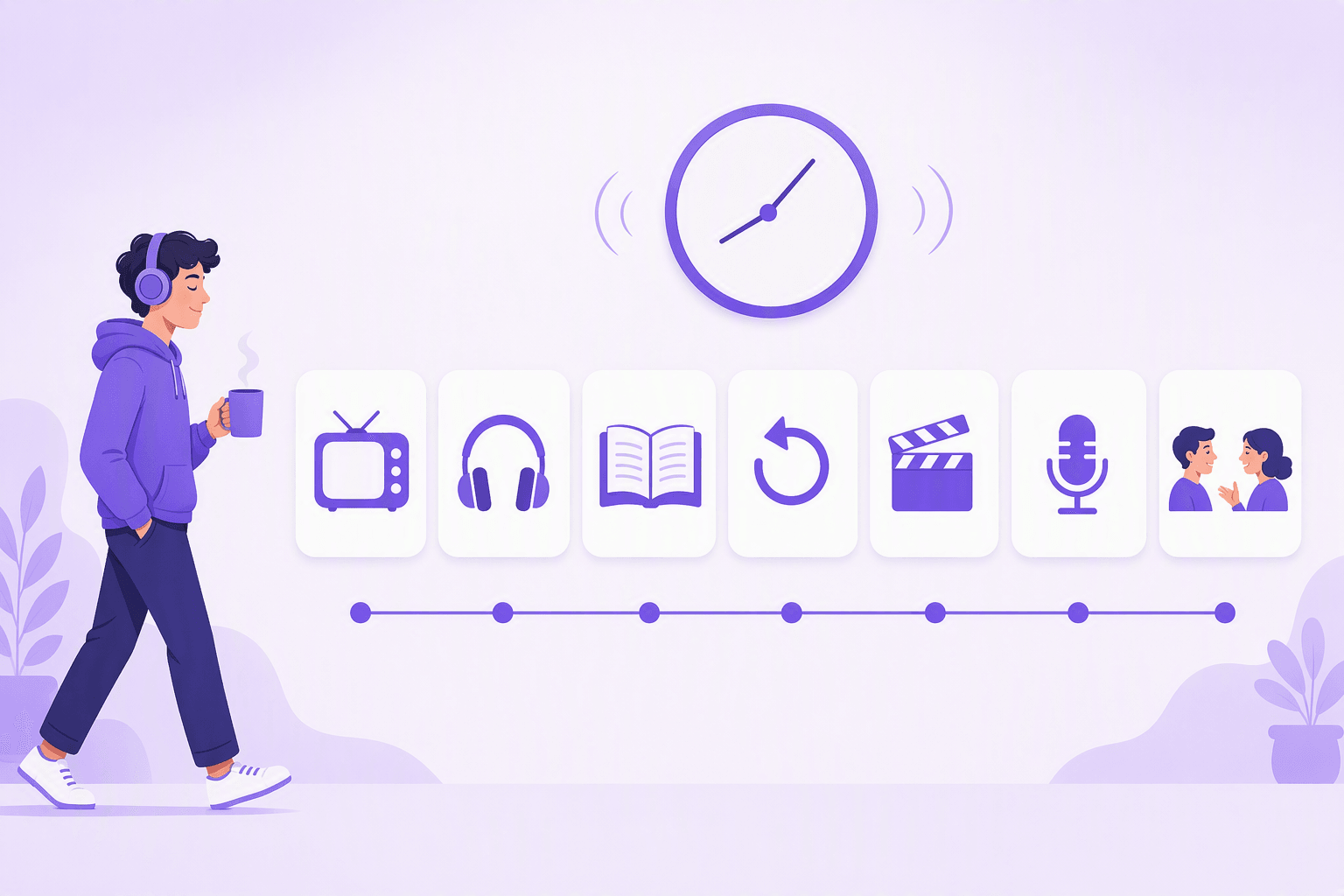
Scale the template to your level rather than copying it blindly: a beginner's "episode" should be Chi's Sweet Home and the reading slot Tadoku Level 0, while an advanced learner can swap the anime slot for a drama and the learner podcasts for native ones. The structure, one core input block plus one small second skill daily, stays the same from A1 to C1.
Two rules keep it working. Re-test your level every few weeks by trying material one rung up, because learners habitually stay too easy for too long. And protect enjoyment ruthlessly: Krashen's affective filter argument, and every immersion learner's experience, says input you enjoy beats input you endure, hour for hour. If movies are more your speed than series, build the week around those instead.
At an hour a day this is about 365 hours a year, which against the FSI's 2,200-hour benchmark tells you the honest timescale: Japanese is a multi-year project. But comprehensible input compounds quietly. The first time you follow an entire scene without subtitles, months before you can say much at all, you will understand why input-first learners never go back to grinding textbooks alone.
Frequently Asked Questions
Is anime comprehensible input?
Should I use Japanese subtitles or English subtitles?
How many hours of input do I need for JLPT N3?
Does passive listening while commuting count as input?
Can I learn Japanese through input alone?
Sources & References
- Krashen, S., *Principles and Practice in Second Language Acquisition*, Pergamon Press, 1982
- Japan Foundation, Survey of Japanese-Language Education Abroad, 2021
- U.S. Department of State, Foreign Service Institute, foreign language training categories
- Agency for Cultural Affairs (文化庁), Jōyō kanji list, 2010
- Webb, S. & Rodgers, M.P.H., 'The Lexical Coverage of Movies', Applied Linguistics, 2009
Start learning with Wordy
Watch real movie clips and build your vocabulary as you go. Free to download.


