Chinese Zodiac Animals in Japanese: Names, Pronunciation, and Cultural Notes
Quick Answer
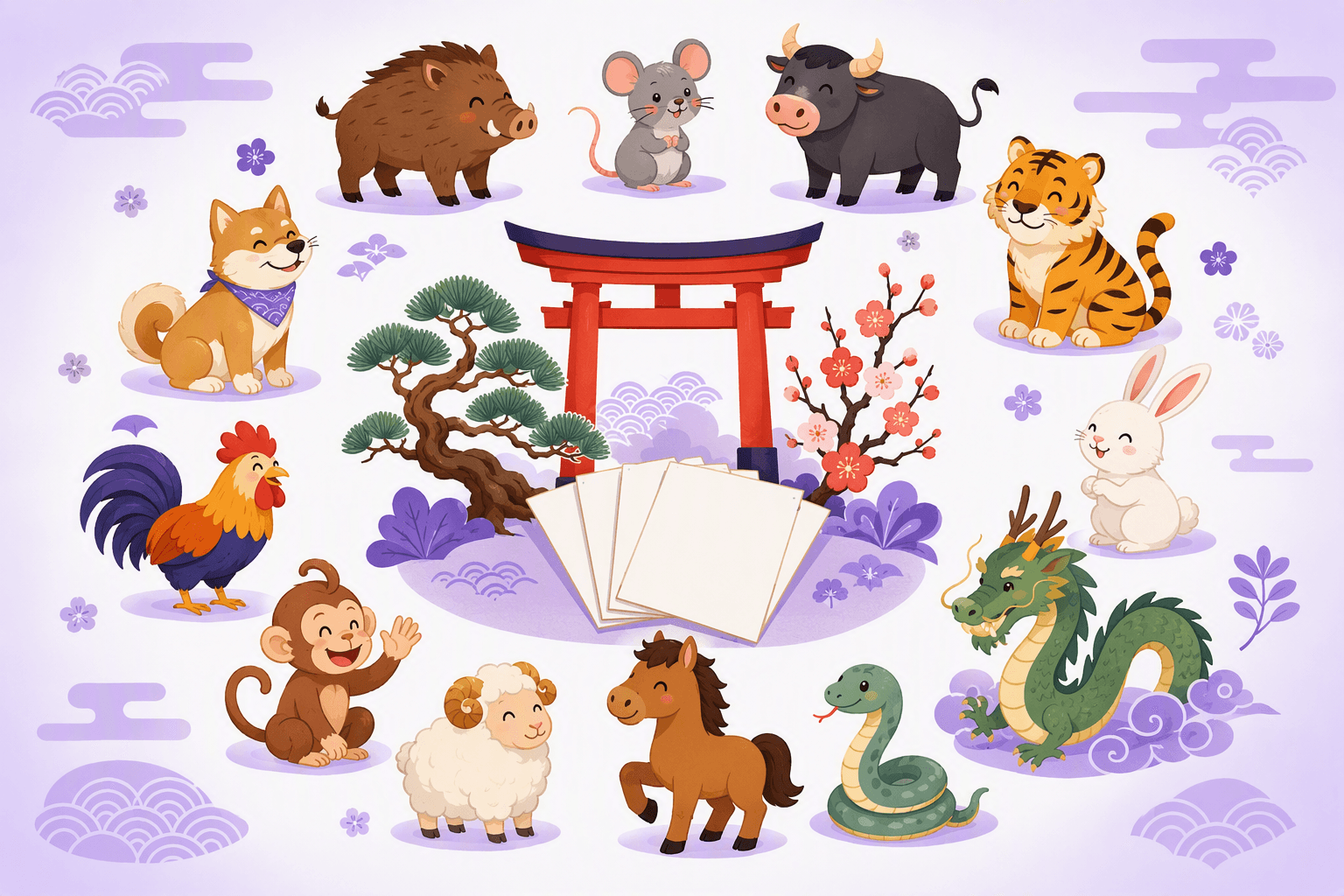
The Chinese zodiac animals in Japanese are the 12-year cycle called 十二支 (jūnishi), used in Japan for years, New Year cards, and personality talk. This guide gives each animal name in kanji and kana, clear English-friendly pronunciation, and the key cultural differences between Chinese and Japanese usage.
The Chinese zodiac animals in Japanese are the 十二支 (jūnishi, JOO-nee-shee), a 12-year animal cycle you will hear in Japan when people talk about birth years, New Year traditions, and the current year’s theme. Below you will learn each animal’s Japanese name (kanji and kana), an English-friendly pronunciation, and the cultural details that make zodiac talk in Japan sound natural.
| English | Japanese | Pronunciation | Formality |
|---|---|---|---|
| Zodiac (12 animals) | 十二支 | JOO-nee-shee | polite |
| Zodiac (everyday word) | 干支 | EH-toh | casual |
| Rat/Mouse | 子(ね) | neh | polite |
| Dragon | 辰(たつ) | TAH-tsoo | polite |
| Pig/Boar | 亥(い) | ee | polite |
💡 Two words you will actually see in Japan
干支 (eto, EH-toh) is the everyday label on calendars, store displays, and 年賀状 (nengajō, NEHN-gah-joh) New Year cards. 十二支 (jūnishi, JOO-nee-shee) is more “explainer” language, used in books, museums, and formal descriptions.
If you are learning Japanese through real dialogue, zodiac talk shows up most around January in TV variety shows, ads, and family conversations. For conversational basics first, start with how to say hello in Japanese, then come back and you will recognize the seasonal references.
Why the Chinese zodiac matters in Japanese culture
Japan uses the zodiac as a shared cultural calendar, not just a fortune-telling system. The eto animal is printed on New Year items, appears in shrine and temple goods, and becomes a marketing theme for the year.
It is also a low-stakes way to make small talk. Asking someone’s eto can feel like asking “What year were you born?” but with a softer, playful frame.
Japan is not the only place where zodiac culture travels, but Japanese usage is distinctive because it is tightly linked to New Year etiquette. The custom of sending nengajō creates a yearly “reset moment” where the animal is everywhere.
A quick note on Japanese and pronunciation
Japanese is spoken by roughly 123 million people, primarily in Japan, and it is one of the most studied languages globally (Ethnologue 2024). That means you will hear zodiac words in many learning materials, but the tricky part is that the zodiac animals have two naming layers.
There is the “everyday animal” (like 犬 inu, EE-noo, dog), and there is the zodiac sign label (like 戌 inu, EE-noo, dog sign). Some are the same sound, some are not, and some use special kanji.
十二支 vs 干支
- 十二支 (jūnishi, JOO-nee-shee): literally “twelve branches,” the 12-sign cycle.
- 干支 (eto, EH-toh): shorthand for the older sexagenary cycle concept, used in modern Japanese as “zodiac year sign.”
In daily life, eto is the word you will hear most. If you ask “干支は何?” (eto wa nani, EH-toh wa NAH-nee), you are asking someone’s zodiac animal year.
Expert perspective: why shared cultural scripts matter
"Much of what we call 'culture' in everyday life is carried by routine language and shared scripts, the small predictable ways people talk in recurring situations."
Professor Claire Kramsch, applied linguist (Kramsch, Language and Culture)
Zodiac talk in Japan is exactly that: a shared script that becomes especially active at New Year.
The 12 Chinese zodiac animals in Japanese (with kanji, kana, and pronunciation)
Below are the standard Japanese zodiac sign names, followed by the everyday animal word you will also hear. Pronunciations are English-friendly approximations.
⚠️ A common learner mistake
Do not assume the zodiac kanji equals the everyday animal kanji. For example, the zodiac “dog” is 戌 (inu, EE-noo), not 犬 (inu). Same pronunciation, different character.
子
Zodiac sign: 子 (ね)
Kana: ね (ne)
Pronunciation: neh
Everyday animal: 鼠 (ねずみ)
Kana: ねずみ (nezumi)
Pronunciation: neh-ZOO-mee
Culturally, Japanese nezumi can point to mouse or rat depending on context, which is why English translations vary. In Japan, you will mostly see the zodiac sign written as 子 and read as ne.
丑
Zodiac sign: 丑 (うし)
Kana: うし (ushi)
Pronunciation: OO-shee
Everyday animal: 牛 (うし)
Kana: うし (ushi)
Pronunciation: OO-shee
This one lines up cleanly: the zodiac is “ox,” and the everyday animal is “cow.” In casual Japanese, people usually just say ushi without clarifying ox vs cow.
寅
Zodiac sign: 寅 (とら)
Kana: とら (tora)
Pronunciation: TOH-rah
Everyday animal: 虎 (とら)
Kana: とら (tora)
Pronunciation: TOH-rah
Tora is also a common name element and a classic character archetype in stories. You may hear “寅年” (tora-doshi, TOH-rah-doh-shee), “Year of the Tiger.”
卯
Zodiac sign: 卯 (う)
Kana: う (u)
Pronunciation: oo
Everyday animal: 兎 (うさぎ)
Kana: うさぎ (usagi)
Pronunciation: oo-SAH-gee
This is one of the biggest surprises for learners. The zodiac label is just “u,” but the animal is usagi. You will see rabbit-themed designs everywhere in 卯年 (u-doshi, oo-DOH-shee).
辰
Zodiac sign: 辰 (たつ)
Kana: たつ (tatsu)
Pronunciation: TAH-tsoo
Everyday animal: 竜 or 龍 (りゅう)
Kana: りゅう (ryū)
Pronunciation: RYOO
In Japan, 辰 is the standard zodiac character, and it is read tatsu. If you are talking about dragons generally, ryū is common, especially in names and fantasy contexts.
巳
Zodiac sign: 巳 (み)
Kana: み (mi)
Pronunciation: mee
Everyday animal: 蛇 (へび)
Kana: へび (hebi)
Pronunciation: HEH-bee
Mi is the zodiac label, hebi is the animal. You will hear “巳年” (mi-doshi, mee-DOH-shee) around New Year, but in conversation people may switch to hebi for clarity.
午
Zodiac sign: 午 (うま)
Kana: うま (uma)
Pronunciation: OO-mah
Everyday animal: 馬 (うま)
Kana: うま (uma)
Pronunciation: OO-mah
This one is straightforward. Uma also appears in many idioms and place names, so it is a useful word beyond zodiac talk.
未
Zodiac sign: 未 (ひつじ)
Kana: ひつじ (hitsuji)
Pronunciation: hee-TSOO-jee
Everyday animal: 羊 (ひつじ)
Kana: ひつじ (hitsuji)
Pronunciation: hee-TSOO-jee
The zodiac “sheep” is hitsuji. Note that 未 is also a common kanji meaning “not yet” in other words, so context matters.
申
Zodiac sign: 申 (さる)
Kana: さる (saru)
Pronunciation: SAH-roo
Everyday animal: 猿 (さる)
Kana: さる (saru)
Pronunciation: SAH-roo
Saru is “monkey,” and 申 is the zodiac sign character. You will see “申年” (saru-doshi, SAH-roo-doh-shee) on calendars.
酉
Zodiac sign: 酉 (とり)
Kana: とり (tori)
Pronunciation: TOH-ree
Everyday animal: 鶏 (にわとり)
Kana: にわとり (niwatori)
Pronunciation: nee-wah-TOH-ree
Tori is “bird” in general, and in the zodiac it refers to rooster. If you want to be specific in daily speech, niwatori is “chicken.”
戌
Zodiac sign: 戌 (いぬ)
Kana: いぬ (inu)
Pronunciation: EE-noo
Everyday animal: 犬 (いぬ)
Kana: いぬ (inu)
Pronunciation: EE-noo
Same pronunciation, different kanji. In handwriting, many Japanese people will choose 犬 in casual notes, but official zodiac print uses 戌.
亥
Zodiac sign: 亥 (い)
Kana: い (i)
Pronunciation: ee
Everyday animal: 猪 (いのしし)
Kana: いのしし (inoshishi)
Pronunciation: ee-noh-SHEE-shee
This is another common translation trap. In Japanese zodiac usage, 亥 refers to wild boar, not a farm pig. If you say buta (ぶた, BOO-tah), that is “pig” in everyday Japanese, but it is not the zodiac animal.
How to talk about zodiac years naturally in Japanese
Knowing the animal names is step one. Step two is sounding natural when you ask and answer.
Here are the patterns you will hear most.
Asking someone’s zodiac sign (animal year)
- 干支は何? (eto wa nani, EH-toh wa NAH-nee): “What’s your zodiac animal?”
- 干支、何年? (eto, nan-doshi, EH-toh, nahn-DOH-shee): “Which zodiac year are you?”
In a polite setting, add desu ka:
- 干支は何ですか? (eto wa nan desu ka, EH-toh wa NAHN dess kah)
Saying your zodiac year
You can answer with just the animal:
- 寅だよ。 (tora da yo, TOH-rah dah yoh): “Tiger.”
Or with the “year” form:
- 寅年。 (tora-doshi, TOH-rah-doh-shee): “Year of the Tiger.”
If you want a full sentence:
- 私の干支は寅です。 (watashi no eto wa tora desu, wah-TAH-shee noh EH-toh wah TOH-rah dess)
The “-doshi” pattern
Japanese often adds 年 (doshi, DOH-shee) to mean “year of” in zodiac context:
| English | Japanese | Pronunciation |
|---|---|---|
| Year of the Dragon | 辰年 | TAH-tsoo-doh-shee |
| Year of the Rabbit | 卯年 | oo-DOH-shee |
| Year of the Boar | 亥年 | ee-DOH-shee |
You will also see 年 (toshi, TOH-shee) in other contexts, but doshi is the common reading in zodiac compounds.
Where you will actually see 十二支 in Japan
Zodiac culture is not abstract in Japan, it is printed, sold, mailed, and displayed.

年賀状 and New Year language
Nengajō (New Year postcards) are one of the biggest reasons eto stays culturally “alive.” The animal becomes a design theme, and many people include a short greeting like あけましておめでとうございます (akemashite omedetō gozaimasu, ah-keh-MAH-shee-teh oh-meh-deh-TOH goh-zah-ee-MAHSS).
If you are building your seasonal Japanese, pair this article with how to say goodbye in Japanese because New Year messaging often includes both greetings and parting lines when you see people for the first time in the year.
Shrines, temples, and “year animal” items
Shrines and temples often sell ema (絵馬, EH-mah) plaques and omamori (お守り, oh-MAH-moh-ree) charms featuring the year’s animal. This is less about “zodiac belief” and more about seasonal participation.
🌍 A Japan-specific detail: the boar is a local choice
Many cultures translate the last zodiac animal as “pig,” but Japan’s everyday association is 猪 (inoshishi), wild boar. That matches Japan’s fauna and folklore, so the zodiac iconography often looks like a boar, not a pink farm pig.
Pop culture and wordplay
You will hear zodiac references in variety shows, comedy, and advertising. A common pattern is using the animal as a quick personality hook, even if everyone knows it is not scientific.
If you are studying Japanese through clips, this is great listening practice because the vocabulary is concrete and repeated. It is also safer small talk than topics like politics or salary.
Chinese zodiac vs Japanese zodiac: what’s different for learners?
The core 12-animal sequence is shared across East Asia and is widely described as the “Chinese zodiac” in English (Britannica). But the Japanese learner experience has a few predictable pitfalls.
Translation mismatches: rat vs mouse, pig vs boar
- 鼠 (nezumi) can be mouse or rat in English.
- 亥 is culturally pictured as wild boar in Japan, and the everyday word is inoshishi.
When you speak Japanese, you do not need to solve the English debate. Use the Japanese word that matches the context, especially eto labels like 子, 卯, 亥.
Kanji that are “zodiac-only” for many learners
Characters like 辰, 戌, and 亥 are not everyday beginner kanji in many textbooks. That is why you should learn them as symbols first, not as general reading practice.
A practical approach is: memorize the kana reading and recognize the kanji shape on calendars.
Eto is not Western astrology
If you ask 星座は何? (seiza wa nani, SAY-zah wa NAH-nee), you are asking someone’s constellation sign. If you ask 干支は何? you are asking their animal year.
That distinction matters, and it is a common misunderstanding in bilingual conversations.
Learning tip: use zodiac talk as “seasonal listening practice”
Seasonal vocabulary is easier to retain because you see it everywhere at once. In January, Japanese media becomes saturated with the year animal, and your brain gets repeated exposure.
A simple study plan:
- Learn the 12 readings as a chant (ne, ushi, tora, u, tatsu, mi, uma, hitsuji, saru, tori, inu, i).
- Watch 5 to 10 short clips with New Year content and write down every time you hear eto.
- Practice one small-talk exchange, then reuse it.
If you want more “real Japanese” that shows up in dialogue, add one slang-focused article to balance formal study, but keep it responsible. See our guide to Japanese swear words for context and severity, since movies and TV often include strong language.
Mini glossary: useful zodiac-related Japanese words
| English | Japanese | Pronunciation | Note |
|---|---|---|---|
| zodiac (everyday) | 干支 | EH-toh | Common in daily life and New Year context. |
| twelve zodiac signs | 十二支 | JOO-nee-shee | More explanatory or formal. |
| New Year postcard | 年賀状 | NEHN-gah-joh | Traditional New Year greeting mail. |
| this year | 今年 | KOH-toh-shee | Often used with the year animal. |
| year of (zodiac) | 〜年(〜どし) | DOH-shee | As in 辰年 (tatsu-doshi). |
Sample lines you can copy (movie and TV friendly)
These are short, natural lines that fit everyday scenes.
- 今年、干支は何だっけ? (kotoshi, eto wa nan dakke, KOH-toh-shee, EH-toh wah NAHN dah-kkeh): “What was this year’s zodiac again?”
- 私、辰年なんだ。 (watashi, tatsu-doshi nan da, wah-TAH-shee, TAH-tsoo-doh-shee nahn dah): “I’m a Dragon year.”
- へえ、同じ干支だね。 (hee, onaji eto da ne, heh, oh-NAH-jee EH-toh dah neh): “Oh, we’re the same zodiac.”
If you want a contrasting set of emotionally loaded phrases that also appear constantly in media, how to say I love you in Japanese is a good companion piece because it teaches register and context, not just literal translation.
Cultural etiquette: when zodiac talk is appropriate
Zodiac talk is generally safe in Japan because it is framed as seasonal and playful. Still, context matters.
Use it when:
- You are meeting someone casually, especially around New Year.
- A calendar, store display, or TV segment brings it up naturally.
- You want a light topic that invites a short answer.
Avoid pushing it when:
- Someone is clearly private about age or personal details.
- The setting is formal and time-sensitive, like a business negotiation.
🌍 A polite way to ask without sounding intrusive
Instead of asking directly “How old are you?”, asking “干支は何ですか?” can feel softer. But it still implies a birth-year range, so read the room and keep it optional.
Practice with Wordy: learn zodiac words through real scenes
Zodiac vocabulary sticks best when you hear it in context, like a New Year TV special, a family dinner scene, or a shrine visit clip. That is exactly the kind of repeated, seasonal language exposure that accelerates listening comprehension.
If you are building a broader study plan, start at the Wordy blog index and combine culture articles like this with core conversation guides.
Summary: the 12 animals, the two key terms, and the Japan-specific twist
Remember the two umbrella terms: 干支 (eto, EH-toh) for everyday use, and 十二支 (jūnishi, JOO-nee-shee) for the 12-sign system. Learn the special zodiac readings like 卯 (u, oo) and 亥 (i, ee), and keep in mind Japan’s common boar imagery for the last sign.
Once you can recognize the year animal on calendars and hear it in New Year dialogue, you will start catching cultural references that textbooks often skip.
Frequently Asked Questions
What are the Chinese zodiac animals called in Japanese?
Is the Japanese zodiac the same as the Chinese zodiac?
How do you say 'Year of the Dragon' in Japanese?
What is the Japanese word for zodiac sign?
How common is it to use the zodiac in Japan today?
Sources & References
- National Institute for Japanese Language and Linguistics (NINJAL), 'Nihongo no rekishi' and lexical resources on 干支/十二支, accessed 2026
- Japan Foundation, Japanese cultural resources on New Year customs (年賀状 and 干支), accessed 2026
- Encyclopaedia Britannica, 'Chinese zodiac', updated regularly, accessed 2026
- Ethnologue (27th edition, 2024), 'Japanese' language entry (speaker statistics)
- Agency for Cultural Affairs (文化庁), cultural and linguistic policy resources, accessed 2026
Start learning with Wordy
Watch real movie clips and build your vocabulary as you go. Free to download.


