At the Restaurant in French: 35+ Phrases for Ordering, Paying, and Polite Talk
Quick Answer
To handle a restaurant in French, you mainly need polite openers (Bonjour, s'il vous plaît, merci), ordering phrases (Je vais prendre..., Pour moi...), and payment language (L'addition, s'il vous plaît). This guide gives you 35+ real phrases with pronunciation, IPA, and the cultural rules that matter in France and other French-speaking places.
| English | French | Pronunciation | Formality |
|---|---|---|---|
| Hello (to staff) | Bonjour | bohn-ZHOOR | polite |
| Please | S'il vous plaît | seel voo PLEH | polite |
| Thank you | Merci | mehr-SEE | polite |
| Excuse me | Excusez-moi | ehk-skuu-ZEH mwah | polite |
| A table for two, please | Une table pour deux, s'il vous plaît | ewn tabl poor duh seel voo PLEH | polite |
| Do you have a reservation? | Vous avez une réservation ? | voo zah-VEH ewn reh-zehr-vah-SYOHN | polite |
| I have a reservation | J'ai une réservation | zheh ewn reh-zehr-vah-SYOHN | polite |
| The menu, please | La carte, s'il vous plaît | lah kart seel voo PLEH | polite |
| What do you recommend? | Vous me conseillez quoi ? | voo muh kohn-say-YEH kwah | polite |
| I'll have... | Je vais prendre... | zhuh veh PRAHND-ruh | polite |
| For me... | Pour moi... | poor mwah | polite |
| Without... | Sans... | sahn | polite |
| Water, please | De l'eau, s'il vous plaît | duh loh seel voo PLEH | polite |
| Tap water, please | Une carafe d'eau, s'il vous plaît | ewn kah-rahf doh seel voo PLEH | polite |
| Still or sparkling? | Plate ou gazeuse ? | plat oo gah-ZUHZ | polite |
| I'm allergic to... | Je suis allergique à... | zhuh swee zah-lehr-ZHEEK ah | polite |
| Is there ... in it? | Il y a ... dedans ? | eel yah deh-DAHN | polite |
| It's delicious | C'est délicieux | seh day-lee-SYUH | polite |
| The bill, please | L'addition, s'il vous plaît | lah-dee-SYOHN seel voo PLEH | polite |
| Can I pay by card? | Je peux payer par carte ? | zhuh puh peh-YEH par kart | polite |
The short answer
To eat at a restaurant in French, you can get through almost everything with Bonjour, s'il vous plaît, merci, Je vais prendre..., and L'addition, s'il vous plaît. Add one reservation line, one allergy line, and one payment line, and you can handle most real interactions without switching to English.
French is spoken by hundreds of millions of people worldwide and is an official language in dozens of countries, according to the OIF and Ethnologue (27th edition, 2024). That global reach creates variety, but restaurant etiquette in France has a few predictable rules that matter as much as vocabulary.
If you want a quick refresher on greetings before you walk in, see our how to say hello in French guide.
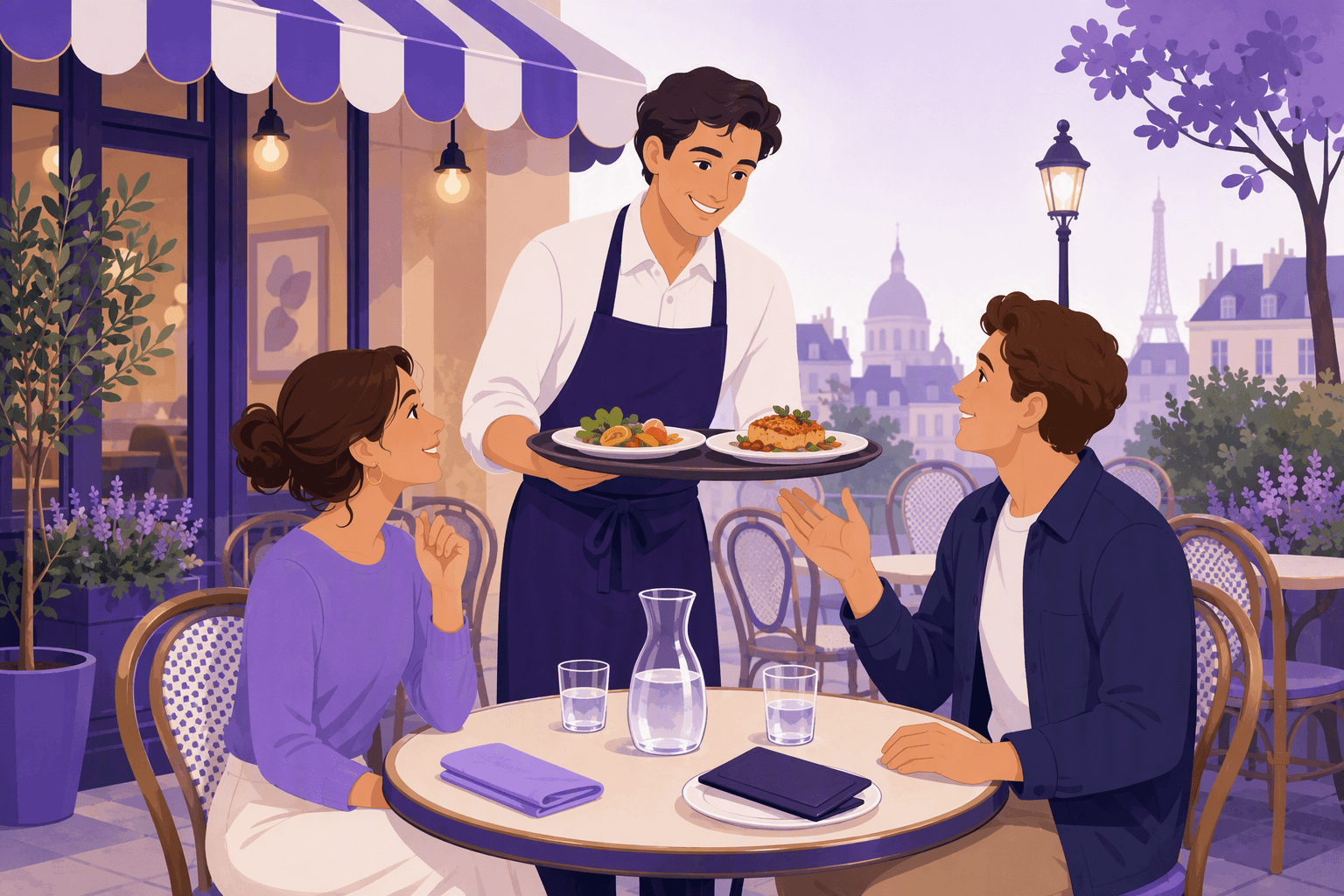
Why restaurant French feels harder than it is
Restaurants compress a lot of social meaning into short exchanges. In France especially, politeness is structured, and the greeting is a real social contract, not background noise.
Linguist Penelope Brown and Stephen Levinson’s work Politeness: Some Universals in Language Usage is useful here: people protect each other’s “face” through predictable politeness moves. In a French restaurant, Bonjour + s'il vous plaît is that move, and skipping it can make you sound abrupt even if your grammar is perfect.
🌍 The single biggest rule: always greet first
In France, begin with "Bonjour" (/bɔ̃.ʒuʁ/) before requests, questions, or even "Excusez-moi". It signals respect and starts the interaction on the right footing. The same words without the greeting can sound like an order.
Booking and arriving
Bonjour
Bonjour means “hello” and is the default opener with staff. IPA: /bɔ̃.ʒuʁ/.
Use it when you enter, when you approach the host stand, and when you catch a server’s attention. It is normal to repeat it later if you re-engage after a pause.
/bohn-ZHOOR/
Literal meaning: Good day.
“Bonjour, une table pour deux, s'il vous plaît.”
Hello, a table for two, please.
In France, greeting staff is expected. It is the fastest way to sound respectful, even with basic French.
Une table pour deux, s'il vous plaît
Une table pour deux, s'il vous plaît is the clean, polite request for seating. IPA: /yn tabl puʁ dø sil vu plɛ/.
If you are a larger group, swap the number: pour quatre (/puʁ katʁ/), pour six (/puʁ sis/). Keep the structure.
Vous avez une réservation ?
Vous avez une réservation ? is what you will hear. IPA: /vu za.ve yn ʁe.zɛʁ.va.sjɔ̃/.
To answer: J'ai une réservation (/ʒe yn ʁe.zɛʁ.va.sjɔ̃/) plus your name. If you want to be extra clear: au nom de... (/o nɔ̃ də/).
On est combien ?
In casual places, staff may ask On est combien ? meaning “How many are you?” IPA: /ɔ̃ nɛ kɔ̃.bjɛ̃/.
A simple answer is On est deux (/ɔ̃ nɛ dø/). It is normal to use on for “we” in spoken French.
💡 A small pronunciation win
French nasal vowels are a common stumbling block. In "Bonjour" (/bɔ̃.ʒuʁ/) and "combien" (/kɔ̃.bjɛ̃/), the vowel is nasalized. Do not add an extra N sound at the end.
Getting the menu and asking questions
La carte, s'il vous plaît
In France, la carte often means the menu (especially the list of dishes). IPA: /la kaʁt/.
You can also hear le menu (/lə mə.ny/) meaning either “the menu” in general or a fixed-price set menu, depending on the restaurant.
Qu'est-ce que vous me conseillez ?
Qu'est-ce que vous me conseillez ? is a polite “What do you recommend?” IPA: /kɛs kə vu mə kɔ̃.sɛ.je/.
A more conversational version you will hear is Vous me conseillez quoi ? (/vu mə kɔ̃.sɛ.je kwa/). It is still polite with vous.
C'est quoi ?
C'est quoi ? is “What is it?” IPA: /sɛ kwa/. Use it for clarifying a dish you do not recognize.
If you want a softer version: Ça veut dire quoi ? (/sa vø diʁ kwa/) meaning “What does that mean?”
🌍 Why 'vous' matters in restaurants
In most restaurant interactions, staff and customers default to "vous" (/vu/) even if the tone is friendly. Switching to "tu" (/ty/) can feel overly familiar unless the staff explicitly does it first, or you are in a very informal setting with clear social cues.
Ordering food like a normal person
Je vais prendre...
Je vais prendre... is the most useful ordering frame. IPA: /ʒə vɛ pʁɑ̃dʁ/.
It matches English “I’ll have” and sounds decisive without being rude. You can also use Pour moi... (/puʁ mwa/) to introduce your choice.
/zhuh veh PRAHND-ruh/
Literal meaning: I am going to take...
“Je vais prendre le poulet, s'il vous plaît.”
I'll have the chicken, please.
This is one of the most common ways to order in France. It sounds natural and avoids overly formal phrasing.
Je voudrais...
Je voudrais... is a classic polite request. IPA: /ʒə vu.drɛ/.
It can sound slightly more formal than Je vais prendre, and it is also useful for extra items: Je voudrais un verre d'eau.
Sans...
Sans means “without.” IPA: /sɑ̃/.
Examples: sans oignons (/sɑ̃ zɔ.ɲɔ̃/) without onions, sans fromage (/sɑ̃ fʁɔ.maʒ/) without cheese. It is short and very practical.
À part
À part means “on the side.” IPA: /a paʁ/.
For example: La sauce à part, s'il vous plaît (/la sos a paʁ sil vu plɛ/). This is common for dressings and sauces.
⚠️ Avoid 'Je prends' as your default
"Je prends..." (/ʒə pʁɑ̃/) is grammatically fine, but it can sound abrupt in service contexts if you do not soften it. If you use it, pair it with "s'il vous plaît" and a friendly tone. "Je vais prendre..." is safer.
Drinks: water, coffee, and the famous carafe
De l'eau, s'il vous plaît
De l'eau is “some water.” IPA: /də lo/.
In France, you usually need to specify what kind of water you want.
Une carafe d'eau, s'il vous plaît
Une carafe d'eau is tap water served in a carafe. IPA: /yn ka.ʁaf do/.
This is normal and widely accepted. In many places, it is free, but you still ask politely.
Plate ou gazeuse ?
Plate ou gazeuse ? means “Still or sparkling?” IPA: /plat u ɡa.zøz/.
Answer with plate (/plat/) or gazeuse (/ɡa.zøz/). If you want bottled water, you can add une bouteille (/yn bu.tɛj/).
Un café, s'il vous plaît
Un café usually means an espresso in France. IPA: /œ̃ ka.fe/.
If you want a larger coffee, ask for un café allongé (/œ̃ ka.fe a.lɔ̃.ʒe/). If you want a milky coffee, un café crème (/œ̃ ka.fe kʁɛm/) is common.
🌍 Coffee timing is cultural
In many French restaurants, coffee is treated as the end-of-meal punctuation. Ordering it too early can feel unusual, not wrong, but it may signal you are done eating. If you want it with dessert, just wait and order both together.
Allergies and dietary needs (say it clearly)
Je suis allergique à...
Je suis allergique à... is the key safety phrase. IPA: /ʒə sɥi a.lɛʁ.ʒik a/.
If it is serious, add C'est grave (/sɛ ɡʁav/) or C'est très grave (/sɛ tʁɛ ɡʁav/). Then confirm with a direct question.
Il y a ... dedans ?
Il y a ... dedans ? means “Is there ... in it?” IPA: /il j‿a də.dɑ̃/.
You can point to the menu item and ask: Il y a des noix dedans ? (/il j‿a de nwa də.dɑ̃/) “Are there nuts in it?”
Je ne mange pas de...
Je ne mange pas de... is “I don’t eat...” IPA: /ʒə nə mɑ̃ʒ pa də/.
It is useful for preferences and restrictions, but allergies should still be stated as allergique when relevant.
In French Grammar in Context (Butt and Benjamin, Macmillan Education), negation is treated as a core structure for everyday interaction, and restaurants are exactly where you need it quickly.
Compliments and small talk (optional, but powerful)
C'est délicieux
C'est délicieux is “It’s delicious.” IPA: /sɛ de.li.sjø/.
A simpler option is C'est très bon (/sɛ tʁɛ bɔ̃/). Both are common and appreciated.
Merci, c'était très bon
Merci, c'était très bon is a natural end-of-meal compliment. IPA: /mɛʁ.si se.tɛ tʁɛ bɔ̃/.
If you want to sound especially warm: Merci beaucoup (/mɛʁ.si bo.ku/).
Bonne soirée
Bonne soirée is “Have a good evening.” IPA: /bɔn swa.ʁe/.
It pairs nicely with our how to say goodbye in French guide if you want more farewell options.
Paying, splitting, and the French rhythm of the bill
L'addition, s'il vous plaît
L'addition, s'il vous plaît is the standard request. IPA: /la.di.sjɔ̃ sil vu plɛ/.
In many French restaurants, the server will not drop the bill automatically. Staying at the table to talk is normal, so you ask when you are ready.
/lah-dee-SYOHN seel voo PLEH/
Literal meaning: The addition, please.
“Excusez-moi... L'addition, s'il vous plaît.”
Excuse me... The bill, please.
In France, asking for the bill is routine. You are not rushing the staff, you are signaling you are ready to pay.
Je peux payer par carte ?
Je peux payer par carte ? means “Can I pay by card?” IPA: /ʒə pø pe.je paʁ kaʁt/.
You might also hear: Ça sera par carte ? (/sa sə.ʁa paʁ kaʁt/) “Will it be by card?”
On peut payer séparément ?
On peut payer séparément ? means “Can we pay separately?” IPA: /ɔ̃ pø pe.je se.pa.ʁe.mɑ̃/.
Splitting is possible in many places, but not always convenient. Asking politely matters, and having cash can simplify things.
C'est possible d'avoir un reçu ?
C'est possible d'avoir un reçu ? is “Is it possible to have a receipt?” IPA: /sɛ pɔ.sibl da.vwaʁ œ̃ ʁə.sy/.
Useful for work meals or travel reimbursements.
🌍 Tipping in France
Service is generally included, so tipping is optional rather than expected. Many diners leave small change or round up when service is good. The key cultural difference is that politeness is expressed more through greetings and tone than through a mandatory tip.
What not to say (common tourist traps)
"Garçon !"
Garçon ! literally means “boy,” and while it exists in old stereotypes, it can sound rude or theatrical today. IPA: /ɡaʁ.sɔ̃/.
Use Excusez-moi (/ɛk.sky.ze mwa/) or S'il vous plaît (/sil vu plɛ/) instead. If you need a title, Monsieur (/mə.sjø/) or Madame (/ma.dam/) works with a respectful tone.
"Je veux..."
Je veux... means “I want...” IPA: /ʒə vø/.
It is not automatically rude, but in service contexts it can feel too direct. Je voudrais... or Je vais prendre... is the safer default.
Overusing English filler
Many staff in tourist areas speak English, but starting in French is still a strong signal of respect. If you get stuck, a simple Désolé, je ne comprends pas (/de.zɔ.le ʒə nə kɔ̃.pʁɑ̃ pa/) is better than switching abruptly.
If you want more help with that exact moment, our guide to how to say I don't understand in French pairs well with restaurant situations.
Mini scripts you can copy (realistic, not perfect)
Script 1: Walk-in, no reservation
You: Bonjour. Une table pour deux, s'il vous plaît. (/bɔ̃.ʒuʁ yn tabl puʁ dø sil vu plɛ/)
Staff: Vous avez une réservation ? (/vu za.ve yn ʁe.zɛʁ.va.sjɔ̃/)
You: Non, désolé. (/nɔ̃ de.zɔ.le/)
Script 2: Ordering with a small change
You: Je vais prendre le plat du jour. (/ʒə vɛ pʁɑ̃dʁ lə pla dy ʒuʁ/)
You: Et une carafe d'eau, s'il vous plaît. (/e yn ka.ʁaf do sil vu plɛ/)
You: La sauce à part, si possible. (/la sos a paʁ si pɔ.sibl/)
Script 3: Paying and leaving politely
You: Excusez-moi... L'addition, s'il vous plaît. (/ɛk.sky.ze mwa la.di.sjɔ̃ sil vu plɛ/)
Staff: Ça sera par carte ? (/sa sə.ʁa paʁ kaʁt/)
You: Oui. Merci, c'était très bon. Bonne soirée ! (/wi mɛʁ.si se.tɛ tʁɛ bɔ̃ bɔn swa.ʁe/)
How to practice with movie and TV clips (so it sticks)
Restaurant French repeats the same patterns: greeting, request, clarification, thanks. That makes it ideal for clip-based learning because you can memorize the rhythm, not just the words.
Use short scenes and loop them until you can predict the line before it appears. Then swap one detail, like changing the dish or the number of people, and repeat.
For a broader method, see how to learn a language with movies and the dual subtitles guide. If you want more everyday building blocks, start with the 100 most common French words.
💡 A realistic goal for one week
Memorize 10 phrases: Bonjour, Une table pour deux, La carte, Je vais prendre, Pour moi, Sans, Une carafe d'eau, Excusez-moi, L'addition, Je peux payer par carte. Then practice them out loud with IPA once, and with the pronunciation approximation daily.
A quick cultural reality check (France vs elsewhere)
French is used across multiple continents, and restaurant norms shift with local culture. In Québec, for example, service style can feel closer to North American norms, and you may hear different vocabulary choices.
Still, the core politeness markers are stable: greeting, s'il vous plaît, and merci. If you can do those smoothly, you will be understood almost everywhere French is spoken.
If you are curious about how French changes by region, our French language overview is a good next step.
One last thing: keep it polite, not perfect
A small grammar mistake rarely matters in a restaurant. What matters is that you greet, you ask politely, and you confirm important details like allergies.
And if you accidentally pick up a spicy word from a movie scene, keep it out of restaurants. Our French swear words guide explains what to avoid and why.
If you want to keep learning French through real scenes, explore Wordy’s clip-based approach on the French learning page.
Frequently Asked Questions
How do you ask for the bill in French?
Is it rude to say "Garçon !" to call a waiter in France?
What is the difference between "Je voudrais" and "Je vais prendre"?
How do you say you have an allergy in French at a restaurant?
Do you tip in France?
What should you say when you enter a restaurant in French?
Sources & References
- Académie française, resources on French usage and politeness, accessed 2026
- CNRTL (Centre National de Ressources Textuelles et Lexicales), lexical entries for common restaurant terms, accessed 2026
- Organisation internationale de la Francophonie (OIF), data on French in the world, accessed 2026
- Ethnologue: Languages of the World, French language entry (27th edition, 2024)
- Alliance Française, French language and culture learning resources, accessed 2026
Start learning with Wordy
Watch real movie clips and build your vocabulary as you go. Free to download.


