Wordy vs Migaku (2026): Curated Clips or Browser Extension?
Quick Answer
Wordy and Migaku both push learners toward authentic video input, but they sit at opposite ends of the customization scale. Migaku is a powerful browser extension that turns any Netflix or YouTube content into sentence-mined flashcards, ideal for advanced Japanese, Korean, and Chinese learners who can configure their own workflow. Wordy delivers the same input-driven principle with curated 30-to-90-second movie and TV clips and zero setup, which makes it dramatically easier for beginners and mobile-first learners. The right pick depends on your level, your willingness to configure tools, and your target language.
Wordy vs Migaku is really a choice between two philosophies that share one belief: you learn a language by understanding real input, not by drilling textbook sentences. Migaku gives you a power tool, a browser extension that turns Netflix, YouTube, and other browser video into sentence-mined flashcards reviewed in Anki. Wordy gives you a curated, mobile-first library of 30-to-90-second movie and TV clips with tap-to-translate, built-in spaced repetition that replays the scene, and zero setup. Migaku wins for advanced Japanese, Korean, and Chinese learners who want full control. Wordy wins for beginners, intermediates, mobile users, and anyone learning a language where Migaku is thin.
The shared idea behind both tools is well grounded. Stephen Krashen argued for decades that acquisition happens through comprehensible input, language you can mostly understand thanks to context (Krashen, 1985). Both apps respect that, then make very different tradeoffs about how to deliver it.
If you are evaluating broader options too, our best language learning apps guide places both tools in the wider market, and the Duolingo review covers the most popular alternative to either of them.
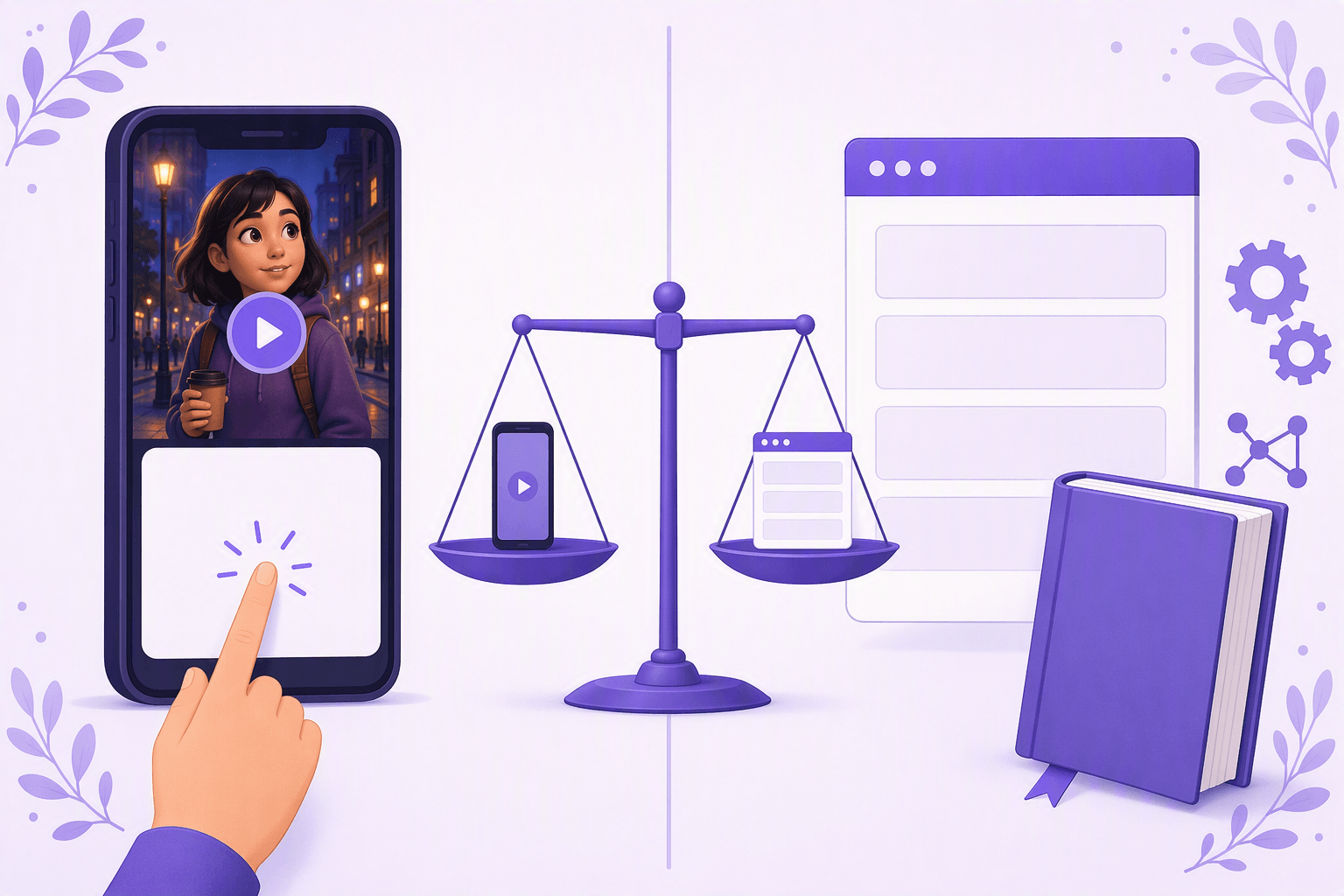
Quick Verdict by Use Case
You can skim the rest of the article, but here is the short answer for the most common goals.
- Beginner, any language: Wordy. Migaku is overwhelming before you can read subtitles.
- Intermediate, Spanish, French, Italian, German: Wordy. Migaku is strongest in CJK languages.
- Intermediate to advanced Japanese, Korean, Chinese: Migaku, if you tolerate setup. Wordy if you want mobile-first practice.
- Mobile-first learner: Wordy. Migaku needs a desktop browser for the full workflow.
- Anki user already: Migaku slots in naturally.
- Hates Anki or has never used it: Wordy.
- Wants curated content: Wordy.
- Wants to mine specific anime, K-drama, or YouTube content: Migaku.
What Each App Does
Both apps push you toward video input, but the surface area is very different.
Wordy in one paragraph
Wordy is a language learning app built around real movie and TV clips, typically 30 to 90 seconds long. You pick a language from a library of more than twenty, and the app serves curated scenes at a level you can handle. You tap any word in the interactive subtitle to see a translation, and the word is saved tied to the scene you saw. Reviews replay the original clip, which strengthens recognition in context rather than in isolation. Wordy is available on iOS, Android, web, and as a Chrome extension, and it has grown to more than 500,000 users with average ratings between 4.7 and 4.8 across stores. It was profiled in TechCrunch in September 2024.
Migaku in one paragraph
Migaku, formerly known as MIA (Mass Immersion Approach), is a browser extension plus a companion mobile app. Once installed, it injects interactive subtitles into Netflix, YouTube, and supported sites, so you can hover or click any word to see definitions, hear pronunciation, and save the word or full sentence as a flashcard. Cards then enter an Anki-style spaced repetition system that you can also export to Anki itself. Migaku covers more than thirty languages, but its center of gravity is Japanese, Korean, and Chinese, where features like pitch accent, automatic furigana, and dictionary stacking matter most. Founded in 2017 by the team behind MIA, Migaku has become a staple in the immersion learning community.
Method: Sentence Mining vs Curated Clips
This is the core difference. If you understand it, the rest is detail.
Migaku's method: sentence mining
Sentence mining means finding a sentence in real content that contains exactly one new unknown word (a "1T" sentence, one new target), then saving that sentence as a flashcard. Over months, the cards accumulate into a personalized deck that mirrors the language you actually consume.
Migaku optimizes for this workflow. You pick your own content, mine your own sentences, and review them at your own cadence. The upside is that nothing is wasted: every card is from media you care about. The downside is that you must find appropriate content, judge what counts as a 1T sentence, and maintain a deck.
Wordy's method: curated clips with embedded review
Wordy assumes you do not want to be a deck maintainer. The library of 15,000-plus clips is curated by the team, and the app surfaces scenes appropriate for your level. Tap any word, get a translation, save the word, and move on. The spaced repetition layer brings the clip back, not just the word, so reconsolidation happens in the same scene where you first encountered the term.
The tradeoff is that you are not mining your favorite show in real time. You are watching a curated library that already exists.
💡 Two flavors of the same idea
Both apps share the principle that words should be learned in context, with audio and visual cues, and reviewed over time. Migaku gives you the raw tools to build that yourself across any content. Wordy gives you a finished product where the curation work is already done. Neither is wrong, but they suit different temperaments.
Setup Curve and Learning Time
How long until you actually study?
Migaku setup
A realistic Migaku setup takes from one to three hours for a first-time user. You install the browser extension, sign in, choose a target language, install or configure a dictionary, set up your SRS preferences, optionally install Anki and the Migaku Anki add-on, pick a card template, and then find your first piece of content. Migaku has improved its onboarding noticeably since the MIA days, but the surface area is still wide.
For a learner who already uses Anki and watches Netflix on a laptop, that hour is well spent and the long-term payoff is large. For a learner who does not, it is a wall.
Wordy setup
Wordy setup is a few minutes. Install the app on iOS or Android, pick a target language, set a daily goal, and start watching the first scene. There is no extension to install, no dictionary to configure, no deck template to choose. Speech recognition for production practice is available without extra setup.
The cost of that simplicity is less customization. You cannot point Wordy at a specific YouTube channel or a specific Netflix show that is not in the library.
Languages and Strengths
The two apps cover similar language counts but at different depths.
Wordy languages
Wordy supports more than twenty languages. The biggest libraries tend to be English, Spanish, French, German, Italian, Portuguese, Japanese, Korean, Chinese, and a growing set of others. Because Wordy is curated, language quality is even rather than community-dependent.
Migaku languages
Migaku officially supports more than thirty languages, but its strength is uneven. The Japanese, Korean, and Chinese experiences are clearly the most developed, with pitch accent support for Japanese and hanzi or hanja layering for Chinese and Korean. European languages work, but the dictionary depth and the community-shared resources are thinner outside the CJK trio.
If you are learning Spanish, French, German, or Italian, the language-specific Migaku advantage shrinks, and the setup tax stays the same. If you are learning Japanese, Korean, or Chinese at intermediate or advanced level and you want every feature for that language, Migaku is in its element.
For Japanese learners weighing both, you can also use our best anime movies to learn Japanese list as a content source, and the learn Japanese page covers the practical path Wordy uses. Korean learners can do the same with best Korean dramas to learn Korean and the learn Korean overview.
Pricing Comparison
Pricing on both products tends to shift, so check the official sites before committing. As of 2026:
- Migaku sits around five to fifteen dollars per month depending on plan and billing period, with an annual option roughly in the sixty to one hundred twenty dollar range (Migaku, accessed 2026).
- Wordy offers a free tier with paid plans, a seven-day trial on paid plans, monthly, annual, and lifetime tiers (Wordy, accessed 2026).
On a pure dollar basis, the two are in the same ballpark. The bigger cost is your time. Migaku's setup and ongoing deck maintenance are real time costs that do not appear on a pricing page. Wordy's curation removes that time, but you give up some control in exchange.
Who Should Pick Migaku
Migaku is the right choice if several of the following describe you.
- You are at intermediate level or higher in Japanese, Korean, or Chinese.
- You already use Anki or are comfortable learning it.
- You watch Netflix, YouTube, or other browser-based video on a laptop.
- You want pitch accent, furigana, hanzi readings, or other language-specific power features.
- You are willing to spend a few hours configuring your environment to gain long-term efficiency.
- You think of yourself as an immersion learner and want maximum control.
Researchers like Paul Nation have argued that vocabulary learning is most efficient when it combines meaning-focused input with deliberate study and review (Nation). Migaku's sentence mining plus Anki workflow is essentially that idea taken to its logical extreme for the patient, technical learner.
"You should keep doing both extensive and focused study. Words need both meaning-focused encounters and explicit attention to stick."
Paul Nation, Learning Vocabulary in Another Language
That quote describes the Migaku ideal user: someone who can sustain both halves of the equation.
🌍 A note on AJATT and the immersion community
Migaku grew out of the Mass Immersion Approach community, which itself was inspired by AJATT (All Japanese All The Time). That subculture popularized the idea of swimming in your target language through anime, dramas, music, and games rather than studying about the language. If you find that culture motivating, Migaku is built for it. If the idea of curating your own anime study sounds like a burden, you are not in the target audience for that tool, and Wordy will feel more natural.
Who Should Pick Wordy
Wordy is the right choice if several of the following describe you.
- You are a beginner or early intermediate in any language.
- You learn primarily on a phone.
- You want zero setup and a finished product, not a toolkit.
- You learn a language where Migaku is thin (most non-CJK languages).
- You do not want to learn Anki.
- You want spaced repetition that replays the original scene, not just the word.
- You want speech recognition for production practice without extra configuration.
Wordy is built around a simple chain: watch a clip you can mostly follow, tap unknowns to translate, save them tied to the scene, and let spaced repetition bring the scene back. That maps directly to the Common European Framework of Reference for Languages emphasis on receptive and productive skills at every level (Council of Europe, CEFR), and it removes the deck-management overhead that stalls many self-directed learners.
💡 A simple decision shortcut
Ask yourself: would you enjoy spending an hour configuring a tool for a long-term payoff, or would you rather start studying in five minutes and accept fewer knobs? Migaku is the first answer. Wordy is the second. Both are valid.
Can You Use Both?
Yes, and some learners do, in two patterns.
The first pattern is sequencing. You start with Wordy as a beginner or early intermediate to build base comprehension, then graduate to Migaku once you can read most subtitles and want to mine specific anime, K-dramas, or YouTubers. Many learners never need step two, but the option exists.
The second pattern is parallel use. You use Wordy on your phone during commutes, breaks, and quick sessions, and you use Migaku at your desk for longer, content-driven study with Anki. The two tools do not conflict, and the words you encounter in one often show up in the other, which reinforces them.
The case against using both is bandwidth. Two systems mean two backlogs, and most learners do better with one practice they actually sustain. If you are not sure, pick one and reassess in three months.
Final Verdict
Migaku is the more powerful tool for its niche. If you are an intermediate or advanced learner of Japanese, Korean, or Chinese, you are comfortable with browser extensions and Anki, and you want to sentence mine your own content, Migaku is one of the best tools that exists. The setup cost is real, but the long-term payoff for the right user is large.
Wordy is the more practical tool for everyone else. If you are a beginner, an intermediate working in a non-CJK language, a mobile-first learner, or anyone who looked at the Migaku setup and felt tired, Wordy delivers the same input-driven principle in a finished product. You watch a real scene, you tap an unknown word, you review it later inside the same scene, and you keep going.
The honest summary is that they are not really competitors so much as two products for two different temperaments. Pick the one that matches yours, then put in the daily reps. The method matters, but the consistency matters more.
If you want a broader view of where these two fit in the current app market, start with our best language learning apps guide, then read the Babbel review and the Duolingo review so you can compare a structured course, a habit app, and the two immersion tools side by side.
Frequently Asked Questions
Which is easier, Wordy or Migaku?
Is Migaku better for Japanese than Wordy?
Do you need Anki with Wordy?
Can you sentence mine with Wordy?
Which is better for beginners, Wordy or Migaku?
Sources & References
- Migaku, official website (migaku.com), accessed 2026
- Wordy, official website (wordy.info), accessed 2026
- Krashen, S., The Input Hypothesis, Longman, 1985
- Nation, P., Learning Vocabulary in Another Language, Cambridge University Press, 2nd edition
- Council of Europe, Common European Framework of Reference for Languages (CEFR)
Start learning with Wordy
Watch real movie clips and build your vocabulary as you go. Free to download.


