Quick Answer
Learning a foreign language is worth it because it gives you direct access to more people, work opportunities, culture, travel experiences, and information. The biggest benefit is not becoming perfect, but gaining the ability to participate in conversations and communities that would otherwise remain closed.
Learning a foreign language is worth it because it expands who you can talk to, what you can understand, where you can work, and how independently you can move through the world. You do not need flawless grammar or a native-like accent to gain those benefits. A few hundred useful words, strong listening habits, and the confidence to participate already change what is possible.
The practical case is stronger than ever. Ethnologue’s 27th edition lists 7,164 living languages worldwide, while English remains only one route into that multilingual reality. Learning another language is not merely an academic achievement. It is a way to take part in more of the world on its own terms.
If English is your target language, start with the language you will actually encounter, including everyday numbers, informal speech, and media. Our guide to English numbers is a useful example of how small, high-frequency topics build immediate confidence.
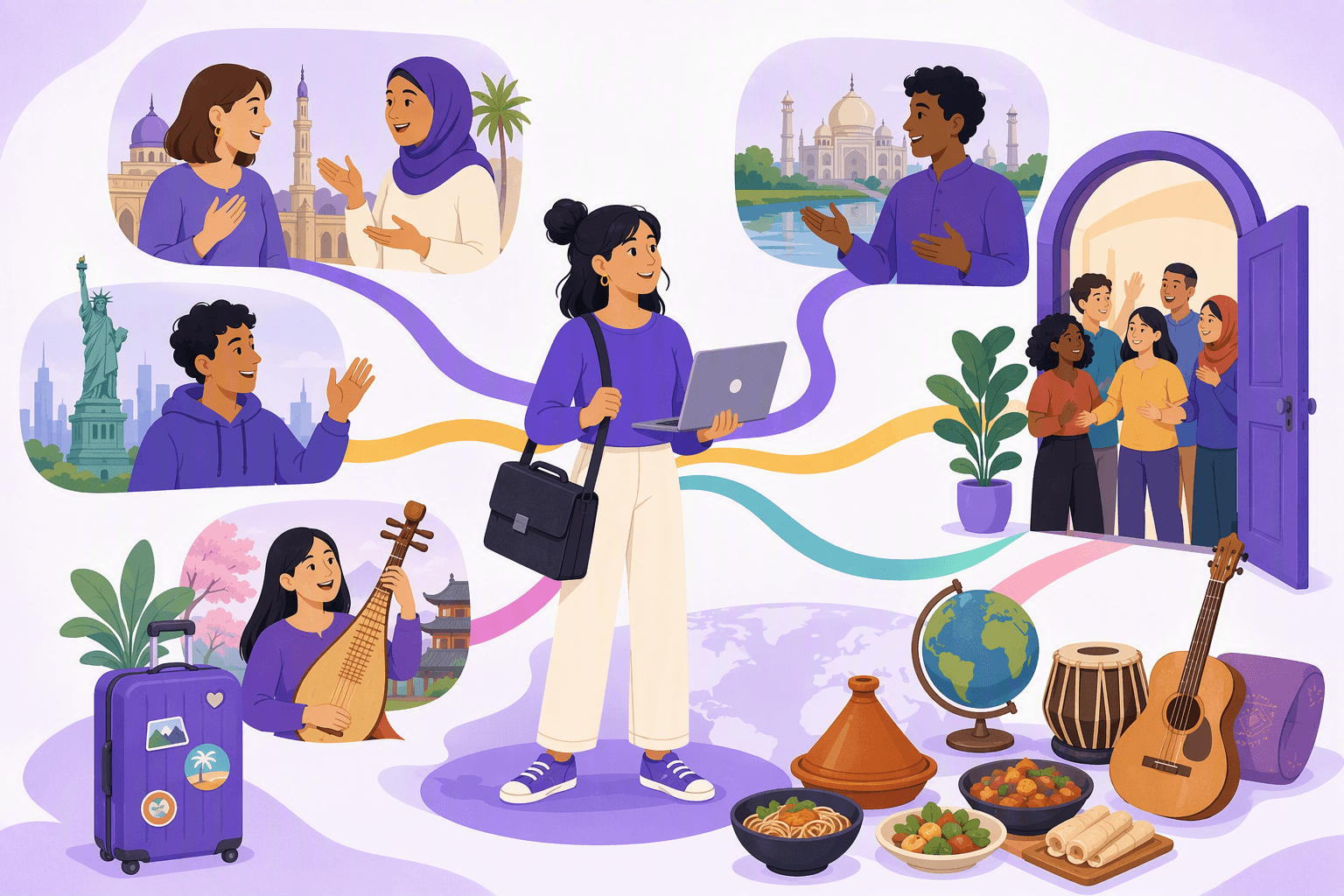
1. A foreign language connects you with more people
The clearest reason to learn another language is also the simplest: more people can know the real version of you. Translation tools can help with directions or menus, but they rarely carry timing, warmth, irony, personal stories, or the small details that make a relationship feel natural.
A shared language changes the balance of an interaction. Instead of always asking another person to accommodate you, you meet them partway. That effort often communicates respect before you have said anything sophisticated.
This matters in families too. Many people learn a heritage language to speak with grandparents, cousins, or older community members whose strongest language differs from theirs. Even limited ability can open conversations that would otherwise be filtered through a relative.
In the United States, the Census Bureau reports that tens of millions of people aged five and older speak a language other than English at home. Multilingual life is not restricted to international travel. It is present in workplaces, schools, neighborhoods, hospitals, and online communities.
2. It makes travel more independent and more human
A foreign language makes travel easier, but its deeper value is the kind of travel it enables. You can read local notices, understand transport changes, ask follow-up questions, and solve problems without waiting for an English-speaking intermediary.
You also notice more. A translated museum label gives you information. Understanding the original language lets you overhear conversations, read headlines, recognize local jokes, and understand what people are debating in real time.
Travel is not only tourism
When you can communicate beyond basic transactions, ordinary moments become richer. You can ask a shop owner what they recommend, understand a host’s house rules, chat with another passenger, or follow a tour guide’s unscripted comment.
This does not require advanced fluency. A learner who can greet people, ask clear questions, understand basic replies, and repair a misunderstanding already has much more freedom than a traveler who relies entirely on a phone.
💡 Learn for the situations you will face
Before a trip, prioritize directions, food, money, emergencies, introductions, and polite repair phrases such as asking someone to repeat or speak more slowly. Useful language beats impressive but rare vocabulary.
3. It gives you career advantages that are concrete
Language skills can make you more useful in roles involving customers, international teams, research, logistics, education, tourism, healthcare, law, diplomacy, and technology. The value is highest when a language combines with another skill, such as nursing, sales, software development, engineering, or teaching.
Employers often need people who can do more than translate words. They need staff who recognize tone, cultural expectations, and the difference between a literal message and an appropriate one. Language learning develops that awareness through repeated practice.
The European Commission’s survey on languages found that 54% of European Union respondents could hold a conversation in at least one language besides their mother tongue. In a region where cross-border work and study are common, another language is not an unusual extra. It is a practical professional tool.
The advantage is not limited to international jobs
A bilingual employee may be able to support local clients, interpret basic needs, build trust with a community, or notice when a translated document sounds unnatural. These are tangible contributions, especially in public-facing work.
Language ability also improves how you learn from global sources. Industry news, academic articles, product reviews, training videos, and specialist forums often appear first in the language of the people producing them. Translation can be useful, but direct access is faster and gives you more context.
4. It changes how you understand culture
Languages do not simply attach labels to the same universal set of ideas. They organize social relationships, politeness, time, humor, emotion, and identity in ways that matter in daily interaction.
Linguist Anna Wierzbicka’s work on cross-cultural pragmatics examines how cultural values surface in ordinary words and conversational habits. Learning a language therefore means learning what counts as direct, warm, distant, respectful, funny, or overly personal in a particular setting.
For example, some languages make social rank or familiarity visible in routine grammar. Others make speakers choose between formal and informal address. English has fewer grammatical forms of this kind, but it still signals social relationships through word choice, indirect requests, titles, and conversational timing.
You become better at noticing your own habits
A second language can make your first language visible. You may notice how often English speakers use individualistic phrasing, how strongly some requests rely on softening words, or how much meaning is carried by intonation rather than grammar.
That awareness is useful even when you are speaking your native language. It improves communication with colleagues, customers, friends, and people whose cultural assumptions differ from yours.
🌍 Fluency includes social judgment
Knowing the dictionary meaning of a sentence is not enough. Real fluency includes knowing when a phrase sounds warm, distant, playful, blunt, formal, or inappropriate. Movies, television, and real conversations are especially useful because they show language inside relationships.
For learners of English, movies chosen for English learning can reveal how people interrupt, disagree, apologize, flirt, joke, and soften requests in context.
5. It improves your ability to learn and pay attention
Learning a language is sustained mental practice. You repeatedly distinguish unfamiliar sounds, remember patterns, infer meaning from context, choose among alternatives, and retrieve words quickly enough to communicate.
Research by Ellen Bialystok, Fergus Craik, and Gigi Luk examines how bilingual experience relates to attention and executive control. The careful conclusion is not that learning a language provides a magical intelligence upgrade. Human cognition is more complicated than that.
The stronger claim is still valuable: using more than one language gives your brain regular practice managing competing systems. That practice involves attention, inhibition, memory, and flexible switching, especially when you use the language actively rather than only completing isolated exercises.
The benefits depend on use
Passive exposure has value, but meaningful use matters. Listening to a show, responding to a message, trying to tell a story, and correcting your own error require more mental work than recognizing a flashcard answer.
This is one reason regular short sessions outperform occasional heroic study days. Fifteen focused minutes of listening and recall every day creates more retrieval opportunities than a single long session that you abandon after two weeks.
For a practical method, pair language exposure with spaced recall. Our guide to spaced repetition explains how planned review can help useful words stay available when you need them.
6. It gives you access to media before translation
Subtitles and translated editions are valuable, but they are interpretations. A translator has to choose one tone, one joke, one cultural reference, and one degree of formality from several possibilities.
When you understand a language directly, you can notice what changed. You hear accents, catch repeated catchphrases, recognize wordplay, and understand why a character’s speech sounds old-fashioned, regional, intimate, or rude.
This is especially important for comedy, music, drama, and online content. A joke may depend on a double meaning that has no exact equivalent. A song lyric may use a familiar phrase whose emotional weight is invisible in a literal translation.
Informal language teaches social reality
Textbooks typically prioritize safe, standard language. That foundation matters, but daily speech contains shortened forms, filler words, regional expressions, and slang.
You do not need to copy every casual expression. In fact, copying slang without understanding its social setting can sound forced. But recognizing it helps you follow real conversations and avoid misunderstandings.
If you are learning English through contemporary media, compare standard vocabulary with our English slang guide. For stronger language, treat context and audience with care, as explained in the English swear words guide.
7. It builds tolerance for uncertainty
Language learners spend a lot of time not knowing. You hear a word you have never encountered, miss part of a sentence, make an error, or realize that a direct translation does not work.
That can be uncomfortable at first. Over time, it develops a useful habit: continue communicating despite incomplete information. You learn to ask questions, infer meaning, rephrase an idea, and accept correction without treating it as failure.
The Council of Europe’s Common European Framework of Reference for Languages emphasizes what learners can do at each stage. This is a healthier model than measuring yourself against an imagined native speaker. Can you introduce yourself, follow simple instructions, express a preference, solve a travel problem, or explain an opinion? Those abilities are real progress.
Confidence comes from repair, not perfection
Effective speakers are not people who never make mistakes. They are people who can recover from them. They know how to pause, use simpler words, ask for clarification, and try again.
That mindset transfers to work, study, and relationships. It teaches you that being understood matters more than delivering a perfect sentence on the first attempt.
8. It can strengthen identity and belonging
For heritage learners, a foreign language may be tied to family history, migration, and belonging. It can make cultural traditions feel less distant and allow someone to participate in family life without relying on translation.
For others, a new language creates a second social identity. You may become more willing to take conversational risks, more attentive to politeness, or more curious about other people’s routines. This does not mean becoming a different person. It means gaining another set of tools for expressing yourself.
François Grosjean’s writing on bilingual life argues against judging bilingual people as two monolingual people combined. Multilingual ability is its own lived reality. Someone may speak one language at work, another with family, and a third mainly through reading or media. Each language can serve a different part of life.
9. It makes you a more careful communicator
When you learn another language, you experience what it feels like to search for a word, misunderstand an idiom, or worry that you sound impolite. That experience can make you more patient with learners of your own language.
You may start speaking more clearly, avoiding unexplained idioms, allowing extra response time, and checking whether someone understood. These are useful communication habits in any multilingual environment.
Language learning also reveals that mistakes are not evidence of low intelligence. They are evidence that someone is trying to operate in a demanding system. That perspective is valuable in classrooms, workplaces, and public life.
10. The best reason is personal, not abstract
Career gains, brain training, and travel freedom are all good reasons to learn a foreign language. But the reason that survives difficult weeks is usually personal.
Maybe you want to understand a grandparent. Maybe you want to live abroad, follow a favorite actor without subtitles, work with a particular community, study at a foreign university, or speak to your partner’s family. That reason gives daily practice a purpose.
Choose a goal that produces real contact with the language. Watch one familiar show, send one message, learn one useful phrase, or listen to five minutes of natural speech. Progress becomes easier to see when it is connected to something you genuinely want to do.
How to start without burning out
Start with a language connected to your life, then build a small weekly routine. Aim for consistency rather than intensity.
A practical beginner plan can look like this:
- Learn 10 to 15 high-frequency words and phrases each week.
- Listen to short, understandable audio every day.
- Review old material before adding large amounts of new vocabulary.
- Say or write something from memory, even if it is simple.
- Get regular exposure to real voices, not only isolated exercises.
- Track what you can now do, not only what you still cannot do.
Your first milestone might be ordering food, introducing yourself, understanding a short scene, or having a five-minute chat. Those are meaningful achievements, and they provide evidence that the effort is working.
A foreign language will not solve every problem or make every trip easy. It does something more durable: it gives you another way to participate in the world.
Frequently Asked Questions
Why should I learn a foreign language if English is widely spoken?
What is the biggest benefit of learning a foreign language?
Is learning a language good for your brain?
Is it too late to learn a foreign language as an adult?
Which foreign language should I learn first?
Sources & References
- Ethnologue, Languages of the World, 27th edition, 2024
- European Commission, Special Eurobarometer 386: Europeans and Their Languages, 2012
- U.S. Census Bureau, American Community Survey Language Use in the United States, accessed 2026
- Council of Europe, Common European Framework of Reference for Languages: Companion Volume
- Bialystok, Craik, and Luk, Bilingualism: Consequences for Mind and Brain, Trends in Cognitive Sciences
Start learning with Wordy
Watch real movie clips and build your vocabulary as you go. Free to download.


