Quick Answer
Merci means 'thank you' in French. Pronounced mehr-SEE, it works in almost any situation, from quick everyday thanks to polite customer service. You can strengthen it with 'merci beaucoup' or soften it with 'merci bien', and you can respond with 'de rien' or 'je vous en prie' depending on formality.
Merci means "thank you" in French, and it is the default way to express gratitude in everyday life, pronounced mehr-SEE. It works almost everywhere, from a quick thanks to a stranger to polite customer service, and you can scale it up with merci beaucoup or make it more formal with full sentences like je vous remercie.
French is a global language, not just a France thing. Ethnologue estimates about 80 million native speakers and over 300 million total speakers worldwide, and the Organisation internationale de la Francophonie (OIF) regularly tracks French use across dozens of countries and territories. That range matters because "merci" is universal, but how much you say around it (hello, titles, tone) changes by place.
If you are building everyday French, pair this with a solid greeting and goodbye routine. See our guides to how to say hello in French and how to say goodbye in French so your "merci" lands naturally.

| English | French | Pronunciation | Formality |
|---|---|---|---|
| Thank you. | Merci. | mehr-SEE | polite |
| Thanks a lot. | Merci beaucoup. | mehr-SEE boh-KOO | polite |
| Thank you very much. | Merci beaucoup ! | mehr-SEE boh-KOO | formal |
| Thanks (informal). | Merci ! | mehr-SEE | casual |
| Thank you, sir/ma'am. | Merci, monsieur / madame. | mehr-SEE muh-SYUR / mah-DAHM | formal |
| I thank you (formal). | Je vous remercie. | zhuh VOO ruh-mehr-SEE | formal |
| Thanks anyway. | Merci quand même. | mehr-SEE kahn MEHM | polite |
| No, thanks. | Non, merci. | nohn mehr-SEE | polite |
What "merci" literally means (and where it comes from)
In modern usage, merci simply means "thank you." If you learn only one gratitude word in French, this is it.
Historically, the word is connected to ideas of mercy, favor, grace, which is why you may see older French or literary contexts where merci relates to "mercy" rather than thanks. The Académie française and the CNRTL both document these senses in their lexical entries (accessed 2026).
For learners, the practical takeaway is simple: in daily conversation, merci = thank you, and native speakers do not hear it as dramatic or old-fashioned.
How to pronounce "merci" (mehr-SEE) without sounding stiff
Merci is pronounced mehr-SEE.
The first syllable is like "mehr" (not "mare"), and the second syllable is a clear "SEE." Keep it light and quick, with the stress naturally falling toward the end, which is typical for French phrase rhythm.
Common pronunciation mistakes
Many English speakers over-round the first vowel or add an extra "r" sound. Aim for a soft French "r" in the back of the throat, not an American "r."
Also avoid saying it like "MER-see" with heavy stress on the first syllable. French tends to feel smoother and more even, with the phrase-final syllable carrying the emphasis.
💡 A fast self-check
If your "merci" sounds like two equal beats, you are close. If it sounds like a big punch on "MER" and a tiny "see," flatten it out and let the end carry the energy: mehr-SEE.
Is "merci" formal or informal?
Merci is neutral and polite. You can use it with friends, coworkers, strangers, and in stores.
What changes formality in French is often not the core word, but the surrounding choices: tu vs vous, titles (monsieur, madame), and whether you use a full sentence.
Research on politeness strategies (Brown and Levinson, Politeness: Some Universals in Language Usage, Cambridge University Press) frames everyday courtesy as face-saving behavior. In French, "merci" is one of the smallest, most frequent face-saving moves in public life.
When "merci" alone is enough
Use plain merci for small, everyday transactions:
- Someone holds the door.
- A cashier gives you change.
- A coworker sends a file.
- A stranger moves aside on the sidewalk.
In many French-speaking settings, especially in France, the politeness baseline is often bonjour + request + merci. Skipping the greeting can feel colder than in some English-speaking cultures.
When you should upgrade it
Upgrade when the favor is bigger, or when you want warmth:
- Merci beaucoup (mehr-SEE boh-KOO) for real appreciation.
- Merci, c'est gentil (mehr-SEE, seh zhan-TEE) when someone is being kind.
- Je vous remercie (zhuh VOO ruh-mehr-SEE) in formal contexts.
The most useful "merci" variations (what people actually say)
Below are the versions you will hear constantly in movies, TV, and daily life. If you learn them as chunks, you will sound more natural than if you only memorize a dictionary definition.
Merci
This is the default. It can be calm, warm, or even sarcastic depending on tone, but the word itself is neutral.
/mehr-SEE/
Literal meaning: A standard 'thank you.'
“Merci, bonne journée.”
Thanks, have a good day.
In shops and cafes, a quick 'merci' is expected. Pairing it with 'bonjour' and a closing like 'bonne journée' is a common French politeness pattern.
Merci beaucoup
This is the most common intensifier, and it is safe everywhere.
/mehr-SEE boh-KOO/
Literal meaning: 'Thank you' + 'a lot.'
“Merci beaucoup pour votre aide.”
Thank you very much for your help.
Use this when you want to sound genuinely appreciative without becoming overly formal. It is a frequent line in customer service, emails, and friendly conversations.
Merci bien
Merci bien (mehr-SEE BYEN) is common, but it can feel a bit brisk depending on tone. In some contexts it reads like "thanks, got it."
Use it when you want to acknowledge something efficiently, like receiving information or completing a transaction.
⚠️ Tone matters with 'merci bien'
In a tense moment, 'merci bien' can sound like a pointed 'thanks' in English. If you want warmth, prefer 'merci beaucoup' or add a smile and a closing like 'bonne journée.'
Merci quand même
Merci quand même (mehr-SEE kahn MEHM) means "thanks anyway." It is useful when you are refused or the answer is no, but you want to stay polite.
It is a great phrase for travel: sold out tickets, no table available, wrong size, and so on.
Non, merci
Non, merci (nohn mehr-SEE) is the polite way to refuse. It is softer than a bare "non."
You can also say non merci quickly as one unit, especially when declining food or a sales offer.
"Merci" in real French etiquette: hello, thanks, goodbye
In many French-speaking environments, politeness is structured and audible. Claire Kramsch, in Language and Culture (Oxford University Press), emphasizes that language learning is also learning the social meanings attached to routine interactions.
A practical pattern you can copy:
- Bonjour (bohn-ZHOOR)
- Your request
- S'il vous plaît (seel voo PLEH) if you are asking
- Merci
- Au revoir (oh ruh-VWAHR) or bonne journée
This is why learners who only say "merci" sometimes still feel they are getting a cool reaction. The missing piece is often the greeting. If you want a ready-made set, start with how to say hello in French and how to say goodbye in French.
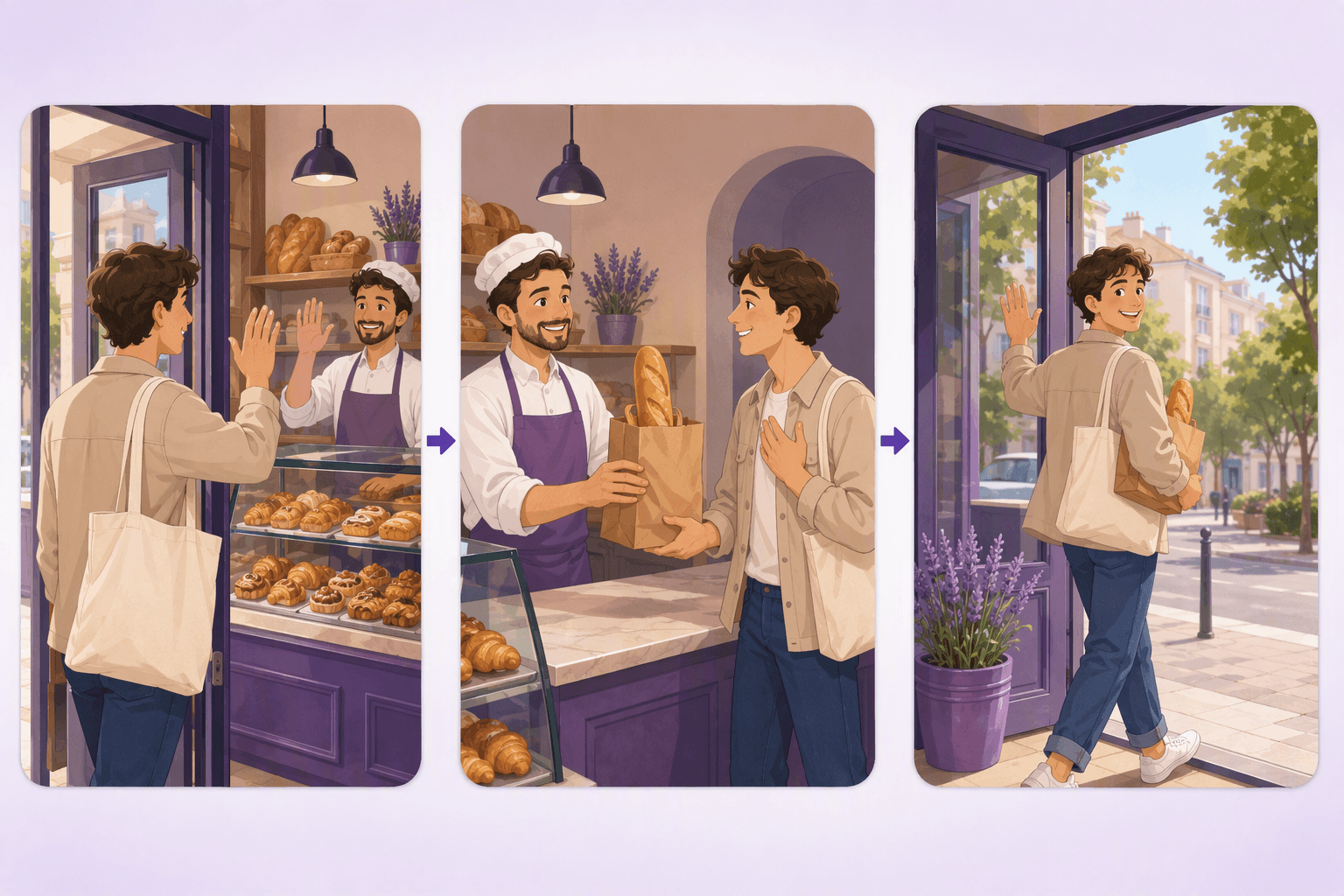
🌍 A small but real cultural difference
In France, entering a small shop without saying 'bonjour' can be read as ignoring the staff as people. A quick 'bonjour' often changes the whole interaction, and your 'merci' will feel like part of a normal social script instead of a standalone word.
How to say "thank you" in French at different levels of formality
Casual: friends, classmates, texting
- Merci ! (mehr-SEE)
- Merci beaucoup ! (mehr-SEE boh-KOO)
- Merciii ! in texting, stretching the vowels for enthusiasm (informal writing only)
If you are learning informal French, you will also hear slangy gratitude in some groups, but it varies heavily by age and region. For the opposite end of the spectrum, see our French swear words guide so you can recognize strong language without accidentally copying it.
Polite: everyday public life
- Merci with a neutral tone
- Merci, bonne journée (mehr-SEE, bawn zhoor-NAY)
- Merci, au revoir (mehr-SEE, oh ruh-VWAHR)
This is the register you want for travel, work, and most interactions with strangers.
Formal: professional emails, customer service, official situations
- Je vous remercie (zhuh VOO ruh-mehr-SEE)
- Je vous remercie par avance (zhuh VOO ruh-mehr-SEE par ah-VAHNS), "thank you in advance"
- Je vous remercie de votre compréhension (zhuh VOO ruh-mehr-SEE duh VOH-truh kohn-prah-ahn-SYOHN), "thank you for your understanding"
Maurice Grevisse and André Goosse’s reference grammar Le Bon Usage is a classic guide to formal written French norms. You do not need to write like a grammar book, but it helps explain why formal French often prefers full clauses over single words.
💡 Email shortcut that sounds native
If you are writing a polite email, 'Merci' alone can feel abrupt. A fuller closing like 'Je vous remercie' or 'Merci beaucoup pour votre retour' often reads smoother.
How to respond to "merci" (you’re welcome)
| Reply meaning | French | Pronunciation | Formality |
|---|---|---|---|
| You're welcome. | De rien. | duh RYEN | casual |
| You're welcome (polite). | Je vous en prie. | zhuh VOO zahn PREE | polite |
| My pleasure. | Avec plaisir. | ah-VEHK pleh-ZEER | polite |
| No problem. | Pas de problème. | pah duh proh-BLEHM | casual |
| Don't mention it. | Il n'y a pas de quoi. | eel nyah pah duh KWAH | polite |
De rien
De rien (duh RYEN) is the most common everyday reply. It is casual and friendly, like "no problem" or "it’s nothing."
Be careful with the French "r" and the nasal-ish feel around rien. Do not pronounce it like "ree-en" with two full syllables.
Je vous en prie
Je vous en prie (zhuh VOO zahn PREE) is a polite, standard "you’re welcome." It is a safe choice with strangers, older people, and professional contexts.
Avec plaisir
Avec plaisir (ah-VEHK pleh-ZEER) is closer to "my pleasure." It signals warmth and willingness, and you will hear it in hospitality and service.
"Merci" in movies and TV: what to listen for
Because Wordy teaches through real clips, here is what "merci" usually does in dialogue:
- Closes a micro-interaction: merci + exit line (au revoir, bonne journée).
- Softens a refusal: non, merci.
- Signals social alignment: merci, t'es gentil (thanks, that’s kind).
- Marks emotional distance: a flat merci can be a boundary, like "thanks, we’re done."
When you watch French scenes, pay attention to what comes right before and after "merci." Often the real meaning is carried by the surrounding politeness markers, not the word itself.
If you want more high-frequency building blocks, combine this with 100 most common French words. "Merci" is not just vocabulary, it is a social tool you will use constantly.
Regional notes: France, Canada, and beyond
Merci is universal across the French-speaking world, but the interaction style around it can differ.
- In France, the bonjour ritual in small shops is especially strong.
- In parts of Canada, service interactions can feel more similar to North American English norms, but "merci" is still frequent and expected.
- In many African Francophone contexts, French coexists with local languages, and you may hear code-switching, but "merci" remains a shared default in French.
The OIF’s work on Francophonie highlights how French functions as a global language across multiple continents (accessed 2026). For learners, that means you should treat "merci" as stable, and treat the surrounding etiquette as adaptable.
Common learner mistakes with "merci" (and easy fixes)
Mistake 1: Using "merci" without a greeting in shops
Fix: add bonjour first. Even one word changes the vibe.
Mistake 2: Overusing "merci beaucoup" for tiny things
It is not wrong, but it can feel slightly heavy if every door-hold gets a "merci beaucoup." Save it for real help, or when you want warmth.
Mistake 3: Saying "merci" when you mean "sorry"
In English, people sometimes say "thanks" to soften a problem ("Thanks for waiting"). French can do that too, but if you are apologizing, you often need désolé(e) or pardon.
If apologies are your weak spot, you might also like how to say excuse me in French.
Mistake 4: Replying to "merci" with silence
In some cultures, silence is fine. In French, a quick de rien or je vous en prie keeps the interaction smooth.
Mini practice: 5 real-life scripts you can copy
- Cafe
- Bonjour.
- Un café, s'il vous plaît.
- Merci.
- Au revoir.
- Someone holds the door
- Merci !
- De rien.
- Declining an offer
- Vous voulez un sac ?
- Non, merci.
- Work message
- Je t'ai envoyé le fichier.
- Merci beaucoup !
- Formal email closing
- Je vous remercie pour votre retour.
- Cordialement,
Keep going: gratitude plus connection
Gratitude phrases often lead into warmth and relationships. If you are learning romantic French, see how to say I love you in French for what people actually say beyond textbook lines.
And if you want a structured way to pick up these phrases in context, browse the Wordy blog for more phrase guides built around real dialogue.
Frequently Asked Questions
Does 'merci' always mean thank you?
Is 'merci beaucoup' more polite than 'merci'?
How do you respond to 'merci' in French?
Is it rude to say just 'merci' in France?
What is the difference between 'merci' and 'je vous remercie'?
Sources & References
- Académie française, 'merci' entry, accessed 2026
- CNRTL, 'merci' lexical entry, accessed 2026
- Organisation internationale de la Francophonie (OIF), La langue française dans le monde, accessed 2026
- Ethnologue: Languages of the World, French language entry (2024)
- Alliance Française, French politeness and greetings guidance, accessed 2026
Start learning with Wordy
Watch real movie clips and build your vocabulary as you go. Free to download.


