Quick Answer
Spanish nature vocabulary includes words such as árbol for tree, montaña for mountain, río for river, and bosque for forest. This guide teaches essential landscape, weather, plant, animal, and outdoor words with pronunciation, examples, and regional context.
Spanish nature vocabulary gives you the words to describe the world around you: árbol /ˈaɾ.bol/ for tree, montaña /monˈta.ɲa/ for mountain, río /ˈri.o/ for river, bosque /ˈbos.ke/ for forest, and mar /maɾ/ for sea. Learn these words in connected groups, then use them to describe real scenes, weather reports, travel plans, and the landscapes you see in Spanish-language movies.
Spanish is spoken by roughly 600 million people worldwide, according to the Instituto Cervantes, across 20 sovereign countries where it is an official language. That geographic reach matters for nature vocabulary: a person in Mexico, Argentina, Spain, Colombia, or Chile may share the core word naturaleza /natuɾaˈle.sa/, but their everyday references can point to deserts, cloud forests, high mountains, islands, or tropical coastlines.
For useful everyday foundations beyond nature words, start with Spanish greetings. Then use the vocabulary below to turn a view into a real Spanish sentence.
| English | Spanish | Pronunciation | Note |
|---|---|---|---|
| nature | naturaleza | /natuɾaˈle.sa/ | Feminine noun: la naturaleza. |
| landscape | paisaje | /paiˈsa.xe/ | Often used for a scenic view. |
| mountain | montaña | /monˈta.ɲa/ | Feminine: la montaña. |
| hill | colina | /koˈli.na/ | A smaller raised area of land. |
| valley | valle | /ˈba.ʎe/ | Masculine: el valle. |
| river | río | /ˈri.o/ | The accent shows the two vowel sounds. |
| lake | lago | /ˈla.ɣo/ | Masculine: el lago. |
| waterfall | cascada | /kasˈka.ða/ | Feminine: la cascada. |
| forest | bosque | /ˈbos.ke/ | Also means woods. |
| jungle | selva | /ˈsel.ba/ | Common for dense tropical forest. |
| desert | desierto | /deˈsjeɾ.to/ | Masculine: el desierto. |
| beach | playa | /ˈpla.ʝa/ | Feminine: la playa. |
| coast | costa | /ˈkos.ta/ | Feminine: la costa. |
| island | isla | /ˈis.la/ | Feminine: la isla. |
| cave | cueva | /ˈkwe.ba/ | Feminine: la cueva. |
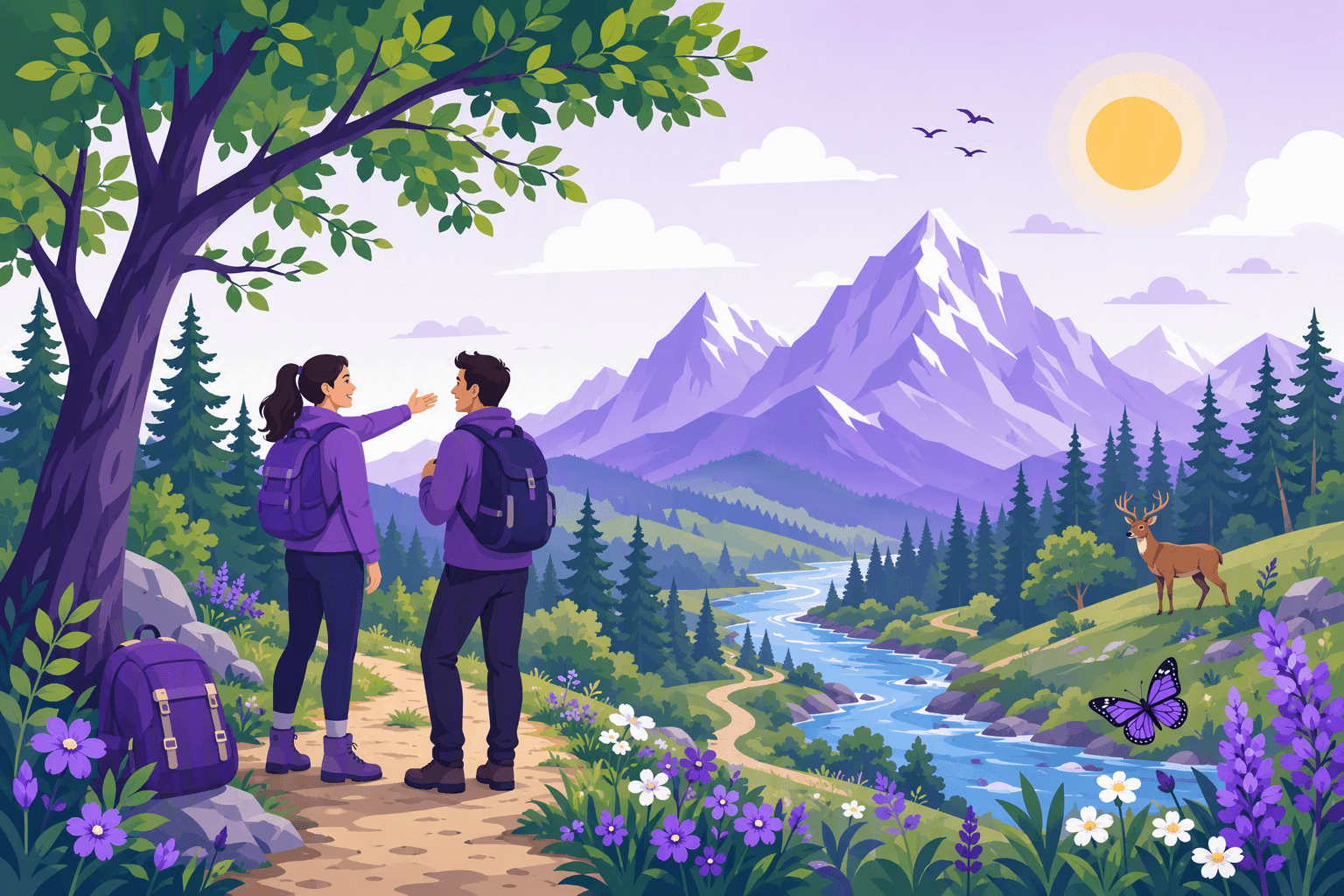
Landscapes and places
The broadest word is paisaje /paiˈsa.xe/, meaning landscape or scenery. You might say El paisaje es impresionante /el paiˈsa.xe es impɾesjoˈnan.te/, meaning the landscape is impressive.
Use campo /ˈkam.po/ for countryside, rural land, or farmland. It does not automatically mean a forest. If you mean a wooded area, use bosque /ˈbos.ke/. If you mean dense tropical vegetation, selva /ˈsel.ba/ is usually the better choice.
A sierra /ˈsje.ra/ is a mountain range, particularly one with a jagged or saw-like profile. You will see this word in place names throughout the Spanish-speaking world, such as Sierra Nevada /ˈsje.ra neˈba.ða/ in Spain and Sierra Madre /ˈsje.ra ˈma.ðɾe/ in Mexico.
The word laguna /laˈɣu.na/ can be tricky. Depending on the country and local geography, it can refer to a lagoon, a small lake, or a shallow body of water. This is a useful reminder that landscape vocabulary is shaped by place rather than by a perfect one-to-one English translation.
🌍 Names carry local knowledge
Keith H. Basso's work on place names shows how language can preserve cultural memory and practical knowledge about land. Spanish place names work similarly: terms such as río /ˈri.o/, valle /ˈba.ʎe/, cerro /ˈse.ro/, and cañón /kaˈɲon/ often describe the geography people encountered, traveled through, or depended on.
Plants, trees, and natural materials
| English | Spanish | Pronunciation | Note |
|---|---|---|---|
| tree | árbol | /ˈaɾ.bol/ | Masculine, despite ending in -ol. |
| flower | flor | /floɾ/ | Feminine: la flor. |
| leaf | hoja | /ˈo.xa/ | The h is silent. |
| branch | rama | /ˈra.ma/ | Feminine: la rama. |
| root | raíz | /raˈis/ | The accent marks the stress. |
| seed | semilla | /seˈmi.ʎa/ | Feminine: la semilla. |
| grass | hierba | /ˈjeɾ.ba/ | Also spelled yerba in some contexts. |
| bush | arbusto | /aɾˈβus.to/ | Masculine: el arbusto. |
| plant | planta | /ˈplan.ta/ | Can mean a living plant or factory, depending on context. |
| wood | madera | /maˈðe.ɾa/ | Material from a tree. |
| stone | piedra | /ˈpje.ðɾa/ | Feminine: la piedra. |
| soil | tierra | /ˈtje.ra/ | Also means earth or land. |
| sand | arena | /aˈɾe.na/ | Feminine: la arena. |
| mud | barro | /ˈba.ro/ | Often used for wet mud or clay. |
Árbol
Árbol /ˈaɾ.bol/ is one of the first nature words worth learning because it appears in ordinary descriptions, parks, environmental news, and seasonal conversations. The plural is árboles /ˈaɾ.bo.les/.
Say Hay muchos árboles en el parque /ai ˈmu.tʃos ˈaɾ.bo.les en el ˈpaɾ.ke/, meaning there are many trees in the park. Notice that Spanish commonly uses hay /ai/, meaning there is or there are, when introducing something in a place.
Tierra
Tierra /ˈtje.ra/ has several connected meanings: soil, earth, ground, and land. In La tierra está seca /la ˈtje.ra esˈta ˈse.ka/, it means soil. In cuidar la Tierra /kwiˈðaɾ la ˈtje.ra/, it refers to the planet Earth.
This flexibility is common in environmental language. The Real Academia Española dictionary records multiple senses for tierra /ˈtje.ra/, so context does the deciding work.
Weather and the sky
Nature conversations often begin with the weather. Build this vocabulary alongside our guide to Spanish weather words, especially if you plan to travel or watch local forecasts.
| English | Spanish | Pronunciation | Note |
|---|---|---|---|
| sky | cielo | /ˈsje.lo/ | Masculine: el cielo. |
| sun | sol | /sol/ | Masculine: el sol. |
| moon | luna | /ˈlu.na/ | Feminine: la luna. |
| star | estrella | /esˈtɾe.ʎa/ | Feminine: la estrella. |
| cloud | nube | /ˈnu.βe/ | Feminine: la nube. |
| rain | lluvia | /ˈʝu.βja/ | Feminine: la lluvia. |
| wind | viento | /ˈbjen.to/ | Masculine: el viento. |
| storm | tormenta | /toɾˈmen.ta/ | Feminine: la tormenta. |
| lightning | relámpago | /reˈlam.pa.ɣo/ | Masculine: el relámpago. |
| thunder | trueno | /ˈtɾwe.no/ | Masculine: el trueno. |
| rainbow | arcoíris | /aɾ.koˈi.ɾis/ | Usually masculine: el arcoíris. |
| shadow | sombra | /ˈsom.bɾa/ | Feminine: la sombra. |
Animals in the natural world
For a general animal list, see our Spanish animals vocabulary guide. In nature contexts, it is especially useful to distinguish a domestic animal /aniˈmal/ from fauna /ˈfau.na/, a collective term for the animals of a region or ecosystem.
Fauna /ˈfau.na/ and flora /ˈflo.ɾa/ are common in signs at national parks, nature museums, environmental reports, and documentaries. Both are feminine nouns: la fauna /la ˈfau.na/ and la flora /la ˈflo.ɾa/.
| English | Spanish | Pronunciation | Note |
|---|---|---|---|
| wildlife | vida silvestre | /ˈbi.ða silˈβes.tɾe/ | A broad phrase for wild animals and plants. |
| animal | animal | /aniˈmal/ | Masculine noun. |
| bird | ave | /ˈa.βe/ | Often feminine: el ave uses el in singular. |
| fish | pez | /pes/ | Plural: peces. |
| butterfly | mariposa | /ma.ɾiˈpo.sa/ | Feminine: la mariposa. |
| bee | abeja | /aˈβe.xa/ | Feminine: la abeja. |
| wolf | lobo | /ˈlo.βo/ | Masculine: el lobo. |
| fox | zorro | /ˈso.ro/ | In much of Latin America, /ˈso.ro/ is often /ˈso.ro/. |
| deer | venado | /beˈna.ðo/ | Ciervo is also common, especially in Spain. |
| eagle | águila | /ˈa.ɣi.la/ | Feminine, but takes el in singular: el águila. |
| whale | ballena | /baˈʎe.na/ | Feminine: la ballena. |
| turtle | tortuga | /toɾˈtu.ɣa/ | Feminine: la tortuga. |
Regional words and environmental culture
Spanish is a pluricentric language, meaning no single national variety owns every everyday term. The Asociación de Academias de la Lengua Española documents regional vocabulary across the Americas, and nature terms are among the most locally specific.
For example, cerro /ˈse.ro/ commonly refers to a hill or low mountain in many Latin American countries. In parts of Spain, monte /ˈmon.te/ can mean mountain, hill, uncultivated land, or wooded high ground, depending on the setting.
Páramo /ˈpa.ɾa.mo/ has a specialized meaning in the Andes, where it refers to a high, cold ecosystem above the forest line. Knowing the word gives you more than a translation: it identifies a distinctive landscape and the communities, water systems, and wildlife connected to it.
UNESCO's Man and the Biosphere Programme recognizes hundreds of biosphere reserves worldwide, including many in Spanish-speaking regions. When you read about a reserva de la biosfera /reˈseɾ.βa ðe la βjosˈfe.ɾa/, you are seeing vocabulary used in conservation, tourism, science, and public policy.
💡 Learn nature vocabulary through scenes
Choose one scene from a movie, travel video, or documentary. Pause it and describe the visible place with five nouns, one weather word, and two adjectives. For example: Hay un río, un bosque y muchas nubes. El paisaje es tranquilo y verde /ai un ˈri.o un ˈbos.ke i ˈmu.tʃas ˈnu.βes el paiˈsa.xe es tɾaŋˈki.lo i ˈbeɾ.ðe/.
Useful sentences for describing nature
These sentence frames help you move beyond memorizing a list.
- Me gusta caminar por el bosque /me ˈɣus.ta ka.miˈnaɾ poɾ el ˈbos.ke/: I like walking through the forest.
- La vista de la montaña es preciosa /la ˈbis.ta ðe la monˈta.ɲa es pɾeˈsjo.sa/: The mountain view is beautiful.
- Hace mucho viento hoy /ˈa.se ˈmu.tʃo ˈbjen.to oi/: It is very windy today.
- El río está lleno de agua /el ˈri.o esˈta ˈʎe.no ðe ˈa.ɣwa/: The river is full of water.
- Vimos una puesta de sol increíble /ˈbi.mos ˈu.na ˈpwes.ta ðe sol iŋ.kɾeˈi.βle/: We saw an incredible sunset.
- Hay que proteger el medio ambiente /ai ke pɾo.teˈxeɾ el ˈme.ðjo amˈbjen.te/: We must protect the environment.
The phrase medio ambiente /ˈme.ðjo amˈbjen.te/ means environment. It is one of the most practical terms for discussing recycling, climate, pollution, parks, and sustainability.
Spanish adjectives normally follow the noun, so say un bosque verde /un ˈbos.ke ˈbeɾ.ðe/, a green forest, and una playa tranquila /ˈu.na ˈpla.ʝa tɾaŋˈki.la/, a peaceful beach. Review Spanish adjectives and agreement to make descriptions more accurate.
How to retain these words
Do not try to learn 70 words as one flat list. Make four mental maps: landscapes, plants, sky, and wildlife. Then create short descriptions from each group.
A film scene is ideal because it links a word to image, sound, mood, and story. A character hiking through la selva /la ˈsel.ba/ or standing by el mar /el maɾ/ gives vocabulary a stronger memory hook than a disconnected flashcard.
You can also contrast words that look related but name different things. Playa /ˈpla.ʝa/ is beach, costa /ˈkos.ta/ is coast, and orilla /oˈri.ʎa/ is shore or water's edge. These distinctions make your Spanish more precise without requiring advanced grammar.
Once these words feel familiar, practice a greeting before your description, then a natural closing after it. Our guides to saying goodbye in Spanish and Spanish expressions about weather can help you turn vocabulary practice into complete conversations.
Frequently Asked Questions
What are the most important nature words to learn in Spanish?
Is naturaleza masculine or feminine in Spanish?
Do Spanish nature words change between Spain and Latin America?
How can I memorize Spanish nature vocabulary quickly?
What is the difference between campo and bosque in Spanish?
Sources & References
- Instituto Cervantes, El español: una lengua viva, 2024
- Real Academia Española, Diccionario de la lengua española, accessed 2026
- Asociación de Academias de la Lengua Española, Diccionario de americanismos, accessed 2026
- UNESCO, Man and the Biosphere Programme
- Keith H. Basso, Wisdom Sits in Places, University of New Mexico Press
Start learning with Wordy
Watch real movie clips and build your vocabulary as you go. Free to download.


