Quick Answer
The most common animals in Spanish are el perro (dog), el gato (cat), el caballo (horse), el pájaro (bird), and el pez (fish). Most animal nouns have grammatical gender, and many have distinct masculine and feminine forms: el perro / la perra, el gato / la gata. Some animals use a single invariable form regardless of biological sex, such as la jirafa, la serpiente, and el búho.
Animal vocabulary is one of the most universally useful word sets in any language. In Spanish, learning animal names gives you access to dozens of everyday idioms, helps you navigate markets, farms, veterinary visits, and natural parks across 21 Spanish-speaking countries, and introduces key grammar concepts like noun gender and regional variation. Whether you're looking up "animals in spanish" for travel, study, or conversation, this guide covers everything you need.
With approximately 559 million speakers worldwide according to Ethnologue's 2024 data, Spanish spans an extraordinary geographic range, from the Iberian lynx of Spain to the jaguars of the Amazon, the condors of the Andes, and the quetzals of Central America. The vocabulary reflects this diversity, with regional names that vary as much as the fauna itself.
"Animal vocabulary is among the most culturally revealing categories in any lexicon. The names a language gives its fauna, and the idioms built around them, reflect centuries of human-animal interaction, regional ecology, and cultural values." (David Crystal, The Cambridge Encyclopedia of Language; María Moliner, Diccionario de uso del español)
This guide covers 50+ animals organized by category, with pronunciation, grammatical gender, regional variations, and the animal-based idioms that native speakers use every day. For interactive practice with real Spanish content, try our Spanish learning page.
Pets and Domestic Animals
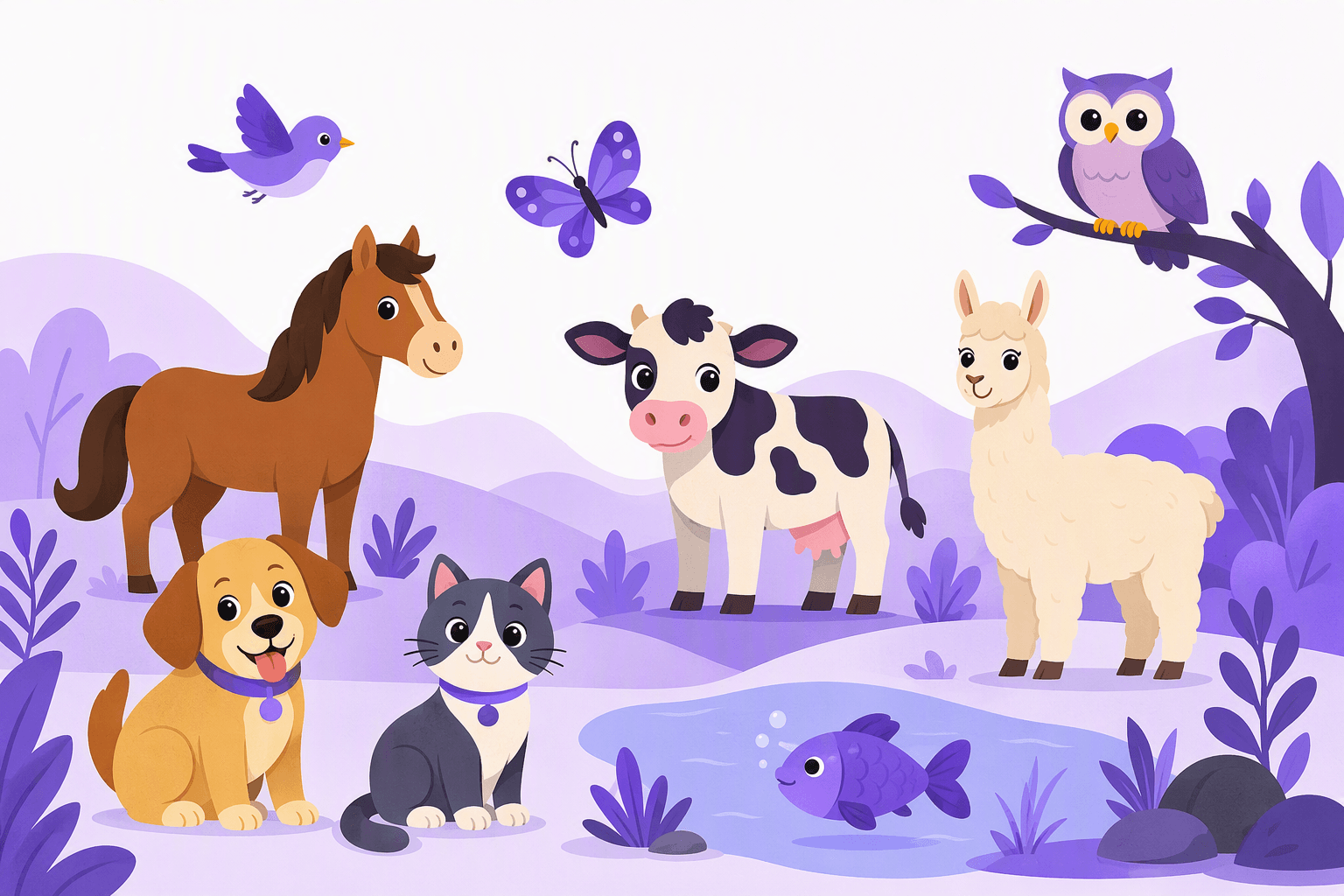
Domestic animals are among the first vocabulary words any Spanish learner encounters. These are high-frequency words that appear in everyday conversation, children's stories, and countless idioms.
| English | Spanish | Pronunciation | Note |
|---|---|---|---|
| Dog | El perro / La perra | PEH-rroh / PEH-rrah | Masc/fem forms; also slang for 'lazy' in some regions |
| Cat | El gato / La gata | GAH-toh / GAH-tah | Masc/fem forms; 'gato' also means 'jack' (car tool) |
| Bird | El pájaro | PAH-hah-roh | General term; 'ave' (la ave) is more formal/scientific |
| Fish | El pez | pehs | Living fish; 'el pescado' = caught/cooked fish |
| Rabbit | El conejo / La coneja | koh-NEH-hoh | Also means 'guinea pig' in some Andean countries |
| Turtle / Tortoise | La tortuga | tohr-TOO-gah | Covers both turtles and tortoises |
| Hamster | El hámster | AHM-stehr | Borrowed from English/German; always masculine |
| Parrot | El loro | LOH-roh | Also means a talkative person in colloquial use |
💡 Pez vs. Pescado
This is one of the trickiest distinctions for English speakers. El pez is a living fish in the water, the one you see at the aquarium. El pescado is a fish that has been caught and is destined for your plate. At a restaurant, you always order pescado, never pez. The verb pescar (to fish) connects the two: once a pez has been pescado (fished), it becomes el pescado.
Farm Animals
Farm animal vocabulary is essential for traveling through rural Spain and Latin America, visiting markets, and understanding food-related conversations. Several of these words have significant regional variation.
| English | Spanish | Pronunciation | Note |
|---|---|---|---|
| Cow | La vaca | BAH-kah | Always feminine; 'el toro' = bull, 'el buey' = ox |
| Horse | El caballo / La yegua | kah-BAH-yoh / YEH-gwah | Different words for male (caballo) and female (yegua) |
| Pig | El cerdo / La cerda | SEHR-doh / SEHR-dah | Spain; 'chancho' in Argentina, Chile, Peru; 'puerco' in Mexico |
| Chicken / Hen | La gallina | gah-YEE-nah | Hen; 'el gallo' = rooster, 'el pollo' = chicken meat |
| Sheep | La oveja | oh-BEH-hah | General term; 'el carnero' = ram, 'el cordero' = lamb |
| Goat | La cabra | KAH-brah | Also used in 'estar como una cabra' = to be crazy |
| Donkey | El burro / La burra | BOO-rroh | Also means 'stupid/stubborn person'; 'asno' is more formal |
| Turkey | El pavo | PAH-boh | Spain; 'guajolote' in Mexico (from Nahuatl) |
The distinction between el gallo (rooster), la gallina (hen), and el pollo (chicken as food) is important. When you buy chicken at the supermarket, you ask for pollo. The live bird strutting around the farm is un gallo or una gallina. This three-way split is more explicit than English, where "chicken" covers all three meanings.
🌍 Regional Names: Guajolote vs. Pavo
In Mexico, the turkey is called guajolote, a word borrowed from Nahuatl (huexolotl), the language of the Aztecs. This reflects the fact that turkeys were first domesticated in Mesoamerica. Spain and most of South America use pavo. Similarly, cerdo (pig) in Spain becomes chancho in Argentina, Chile, Peru, and Uruguay, and puerco or cochino in Mexico and Central America.
Wild Animals
Wild animal vocabulary appears frequently in nature documentaries, news stories, zoo visits, and the rich tradition of animal metaphors in Spanish literature and daily speech.
| English | Spanish | Pronunciation | Note |
|---|---|---|---|
| Lion | El león / La leona | leh-OHN / leh-OH-nah | Distinct male/female forms; symbol of bravery |
| Tiger | El tigre / La tigresa | TEE-greh / tee-GREH-sah | In Latin America, 'tigre' can also refer to jaguars |
| Bear | El oso / La osa | OH-soh / OH-sah | The bear is the symbol of Madrid (oso y madroño) |
| Wolf | El lobo / La loba | LOH-boh / LOH-bah | Iberian wolf (lobo ibérico) is a protected species in Spain |
| Fox | El zorro / La zorra | SOH-rroh / SOH-rrah | 'Zorro' also means cunning/sly; feminine form can be vulgar |
| Deer | El ciervo / La cierva | see-EHR-boh / see-EHR-bah | Also 'venado' in Latin America (from Latin 'venatus') |
| Monkey | El mono / La mona | MOH-noh / MOH-nah | 'Mono' also means cute/pretty in Spain (colloquial) |
| Elephant | El elefante / La elefanta | eh-leh-FAHN-teh | 'Tener memoria de elefante' = to have an excellent memory |
| Giraffe | La jirafa | hee-RAH-fah | Always feminine grammatically, even for males |
| Snake | La serpiente | sehr-pee-EHN-teh | Always feminine; also 'la culebra' (non-venomous) and 'la víbora' (venomous) |
Note that several wild animal words serve double duty in everyday Spanish. Zorro means both "fox" and "cunning person," and the fictional character El Zorro took his name from this meaning. Mono in Spain doubles as an adjective meaning "cute" or "pretty" (¡Qué vestido tan mono!, meaning "What a cute dress!"). And lobo appears in the phrase un lobo solitario (a lone wolf), used exactly as in English.
Latin American Wildlife
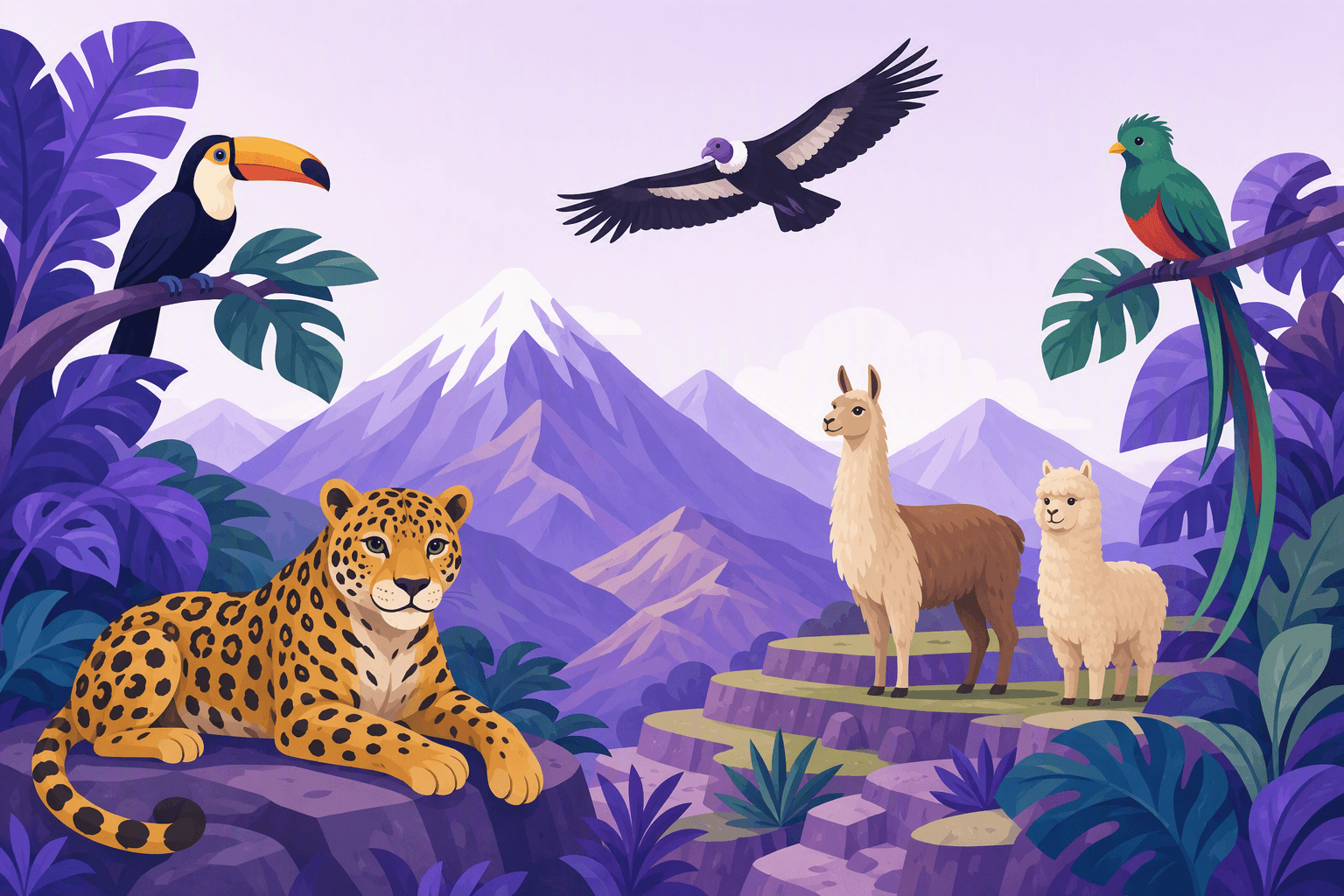
The Spanish-speaking Americas are home to unique fauna with names drawn from indigenous languages (Nahuatl, Quechua, Guaraní, and others). These words are part of standard Spanish vocabulary.
| English | Spanish | Pronunciation | Note |
|---|---|---|---|
| Jaguar | El jaguar | hah-GWAHR | From Guaraní 'yaguareté'; the largest cat in the Americas |
| Condor | El cóndor | KOHN-dohr | From Quechua 'kuntur'; national symbol of several Andean countries |
| Llama | La llama | YAH-mah | From Quechua; also means 'flame' in Spanish (same spelling) |
| Alpaca | La alpaca | ahl-PAH-kah | From Aymara 'allpaqa'; domesticated in Peru for thousands of years |
| Toucan | El tucán | too-KAHN | From Tupi 'tukana'; iconic bird of tropical Central and South America |
| Quetzal | El quetzal | keht-SAHL | From Nahuatl; sacred bird to the Maya and Aztec civilizations |
Many of these names entered Spanish and then passed into English virtually unchanged. Words like jaguar, condor, llama, alpaca, and quetzal all traveled from indigenous American languages through Spanish and into the global vocabulary. According to the RAE's 23rd edition dictionary, Spanish has absorbed over 300 animal-related terms from indigenous American languages.
Sea and Water Animals
Ocean and freshwater vocabulary is particularly useful in Spanish-speaking countries, where seafood is central to coastal cuisines from Galicia to the Caribbean to Chile.
| English | Spanish | Pronunciation | Note |
|---|---|---|---|
| Whale | La ballena | bah-YEH-nah | Always feminine; 'ballenato' = baby whale |
| Dolphin | El delfín | dehl-FEEN | Always masculine; plural: delfines |
| Shark | El tiburón | tee-boo-ROHN | Also used metaphorically for aggressive business people |
| Octopus | El pulpo | POOL-poh | A staple of Spanish cuisine (pulpo a la gallega) |
| Crab | El cangrejo | kahn-GREH-hoh | 'Caminar como cangrejo' = to walk sideways/backwards |
| Jellyfish | La medusa | meh-DOO-sah | Named after the Greek mythological figure Medusa |
| Shrimp | El camarón / La gamba | kah-mah-ROHN / GAHM-bah | 'Camarón' in Latin America; 'gamba' in Spain |
| Seal | La foca | FOH-kah | Always feminine grammatically |
The shrimp distinction is one of the clearest examples of transatlantic vocabulary differences. In virtually all of Latin America, a shrimp is un camarón. In Spain, it is una gamba, a word that also entered English in culinary contexts (gambas al ajillo). Both are correct, but using the wrong one instantly marks you as either Spanish or Latin American to a native speaker.
Birds
Bird vocabulary appears frequently in Spanish idioms, poetry, and everyday conversation. Spain alone is home to over 600 bird species, making it one of Europe's richest birding destinations.
| English | Spanish | Pronunciation | Note |
|---|---|---|---|
| Eagle | El águila (fem.) | AH-gwee-lah | Feminine but uses 'el' in singular (el águila) to avoid 'la a-' clash |
| Owl | El búho | BOO-oh | Also 'la lechuza' (barn owl); 'búho' = eagle owl type |
| Parrot | El loro | LOH-roh | 'Hablar como un loro' = to talk non-stop |
| Pigeon / Dove | La paloma | pah-LOH-mah | Symbol of peace; 'palomita' also means popcorn in some countries |
| Penguin | El pingüino | peen-GWEE-noh | Note the dieresis (ü): it indicates the 'u' is pronounced |
| Flamingo | El flamenco | flah-MEHN-koh | Same word as the music/dance genre; from Latin 'flamma' (flame) |
| Rooster | El gallo | GAH-yoh | Symbol of dawn; 'gallito' = someone who picks fights |
| Stork | La cigüeña | see-GWEH-nyah | Another word with dieresis (ü); iconic in Spain's city rooftops |
💡 El Águila: Why a Feminine Noun Uses 'El'
Águila is feminine, but you say el águila (not la águila) in the singular. This is because Spanish avoids placing the stressed a- sound right after la, since it sounds awkward and runs together. The same rule applies to el agua (water), el alma (soul), and el hambre (hunger). In the plural, the feminine article returns: las águilas. Adjectives still agree in feminine: el águila majestuosa (the majestic eagle).
Insects and Small Creatures
Insect vocabulary is practical for travel, from asking about mosquitoes to identifying what just landed on your plate at an outdoor restaurant.
| English | Spanish | Pronunciation | Note |
|---|---|---|---|
| Butterfly | La mariposa | mah-ree-POH-sah | Always feminine; one of the most poetic words in Spanish |
| Bee | La abeja | ah-BEH-hah | Always feminine; 'abejorro' = bumblebee |
| Ant | La hormiga | ohr-MEE-gah | 'Ser una hormiguita' = to be hardworking and thrifty |
| Spider | La araña | ah-RAH-nyah | Always feminine; 'telaraña' = spiderweb |
| Fly | La mosca | MOHS-kah | 'Estar mosca' = to be suspicious (colloquial) |
| Mosquito | El mosquito | mohs-KEE-toh | Literally 'little fly' (mosca + diminutive -ito) |
| Cockroach | La cucaracha | koo-kah-RAH-chah | Subject of the famous Mexican folk song |
| Worm | El gusano | goo-SAH-noh | Also used for caterpillars and grubs; 'gusano de seda' = silkworm |
The word mosquito is a perfect example of how Spanish vocabulary enters English. It literally means "little fly": mosca (fly) plus the diminutive suffix -ito. The word passed directly into English during the colonial era and has been used unchanged ever since. Similarly, cucaracha (cockroach) gave English the word "cockroach" through folk etymology.
Animal Idioms in Spanish
Some of the most colorful expressions in Spanish revolve around animals. These idioms appear constantly in daily conversation and understanding them is key to sounding natural.
🌍 Essential Animal Idioms
- Ser un burro (to be a donkey): stubborn or unintelligent
- Tener memoria de pez (to have a fish's memory): to be very forgetful
- Lágrimas de cocodrilo (crocodile tears): fake sadness or sympathy
- Ser un lince (to be a lynx): to be sharp, clever, observant
- Ser un pájaro (to be a bird): to be crafty, sneaky, or untrustworthy
- Estar como una cabra (to be like a goat): to be crazy
- Llevarse como el perro y el gato (to get along like dog and cat): to constantly fight
- Aburrirse como una ostra (to be bored like an oyster): to be extremely bored
- Ser un ratón de biblioteca (to be a library mouse): to be a bookworm
- A caballo regalado no le mires el diente: don't look a gift horse in the mouth
These idioms are deeply rooted in Spanish culture. Ser un lince (to be a lynx) references the Iberian lynx (lince ibérico), one of Europe's most endangered felines and a symbol of sharp-eyed intelligence in Spain. Estar como una cabra (to be crazy like a goat) likely comes from the unpredictable, seemingly irrational behavior of goats climbing steep mountain faces across the Spanish countryside.
Gender Rules for Animal Nouns
Understanding grammatical gender is essential when using animal vocabulary in Spanish. Animals follow several distinct patterns that differ from regular noun gender rules.
💡 Three Gender Patterns for Animals
Pattern 1: Masculine/Feminine pairs. Most common. Change the ending to switch gender:
- El perro / la perra (dog), el gato / la gata (cat), el oso / la osa (bear)
Pattern 2: Different words entirely. Some animals use completely different words for male and female:
- El caballo / la yegua (horse/mare), el toro / la vaca (bull/cow), el gallo / la gallina (rooster/hen)
Pattern 3: Epicene nouns. One fixed grammatical gender regardless of biological sex:
- Always feminine: la jirafa (giraffe), la serpiente (snake), la ballena (whale), la hormiga (ant)
- Always masculine: el búho (owl), el delfín (dolphin), el tiburón (shark), el mosquito (mosquito)
- To specify biological sex, add macho or hembra: la jirafa macho (male giraffe), el búho hembra (female owl)
According to the RAE, Pattern 3 (epicene nouns) is the most common for wild animals, while Pattern 1 (masculine/feminine pairs) dominates for domestic animals that humans have lived alongside for millennia. This makes intuitive sense: the animals we interact with most closely are the ones we developed distinct gendered names for.
Spain's Iconic Animals
Spain's cultural identity is deeply intertwined with its native fauna. The toro (bull) is perhaps the most internationally recognized symbol of Spanish culture, featuring prominently in art, literature, and tradition. The Osborne bull silhouette (originally an advertising sign) has become an unofficial national symbol visible on hillsides across the country.
The lince ibérico (Iberian lynx) represents one of conservation's greatest success stories. Once down to fewer than 100 individuals in 2002, the population has recovered to over 2,000 thanks to breeding programs according to IUCN data. Other emblematic species include the águila imperial ibérica (Spanish imperial eagle), the lobo ibérico (Iberian wolf), and the cigüeña blanca (white stork) whose massive nests top church towers across Castilla.
Practice With Movies and TV
One of the best ways to learn animal vocabulary in context is through Spanish-language films and television. Nature documentaries, animated films, and children's programming use animal vocabulary extensively and help you hear correct pronunciation from native speakers.
Check out our guide to the best movies to learn Spanish for recommendations that will expose you to natural vocabulary in context. You can also explore more Spanish vocabulary and interactive exercises on our Spanish learning page, or browse our full blog for more vocabulary guides covering body parts, colors, and numbers.
Frequently Asked Questions
What are the most common animals in Spanish?
How does grammatical gender work with animal names in Spanish?
What is the difference between pez and pescado in Spanish?
Are animal names different in Spain versus Latin America?
What are some common Spanish animal idioms?
How do you say baby animals in Spanish?
Sources & References
- Real Academia Española (RAE), Diccionario de la lengua española, 23rd edition
- Ethnologue: Languages of the World, 27th edition (2024)
- Crystal, D., The Cambridge Encyclopedia of Language (Cambridge University Press)
- IUCN Red List, Regional fauna data for Iberian Peninsula and Latin America
- Instituto Cervantes, El español en el mundo, 2024 annual report
Start learning with Wordy
Watch real movie clips and build your vocabulary as you go. Free to download.


