LingQ Review (2026): Steve Kaufmann's Comprehensible Input Tool
Quick Answer
LingQ is a serious reading-and-listening platform from polyglot Steve Kaufmann, designed around the comprehensible input hypothesis and supporting 40-plus languages with a deep library for the major ones. Its 'LingQ' system tracks every word you've encountered and feeds them back through subsequent content. The biggest drawbacks are a dated interface, a steep beginner curve, and the absence of any speaking output practice. For learners who prefer video over text-with-audio, a movie-clip app like Wordy offers the same input-driven idea with stronger visual cues.
LingQ is a strong fit if you want to learn a language by reading large amounts of authentic text while listening to matching audio, and if you do not mind a dated interface and zero speaking practice. It is one of the most coherent input-based platforms on the market, and it is loved by people who follow Steve Kaufmann's polyglot philosophy, but it is rarely the best first app for a true beginner or for someone who learns better from video than from text.
To put LingQ's scope in context, the platform supports more than 40 languages with deep libraries for the major ones, drawing from a global pool that Ethnologue tracks at over 7,100 living languages in its 27th edition (Ethnologue, 2024). That breadth is the whole point of LingQ: read as much as you can, in whatever language you want, for as long as it takes.
If you are still picking your toolkit, our best language learning apps overview compares LingQ against Duolingo, Babbel, and several newer entrants in one place.

What LingQ Is and Why It Exists
LingQ was founded in 2007 by Steve Kaufmann, a Canadian former diplomat who speaks more than 20 languages and built a public following around his "input first" approach to learning. The platform is the technical expression of his philosophy: read a lot, listen a lot, look up words in one click, and trust that comprehension will eventually become production.
The intellectual backbone of the platform is Stephen Krashen's input hypothesis, which proposes that learners acquire language by understanding messages slightly above their current level (Krashen, 1985). Kaufmann has explicitly aligned his method with this idea for years on The Linguist blog and YouTube channel, where he argues that grammar drills and forced output are far less effective than massive comprehensible input (Kaufmann, accessed 2026).
"We acquire language in only one way: when we understand messages."
Stephen Krashen, professor emeritus of linguistics, University of Southern California
That single sentence is the foundation LingQ is built on, and it explains every design choice you will see in the product, from the lookup-everything interface to the absence of speaking drills.
How the LingQ Method Works
The user flow is consistent and, once you get the hang of it, fast.
You pick a lesson from the library or import your own text. The lesson opens with the article on the page and synchronized audio underneath. Every word is initially marked as either blue (new and unknown) or you can immediately mark it as known. When you click a blue word, you create a "LingQ", which is essentially a saved flashcard linked to that word and the sentence it came from. As you mark words "known" they shift to gold and disappear from your blue list.
Crucially, every future lesson is colored against your personal vocabulary state. A new article does not look like a blank page, it looks like a document where the words you already know are clear and the words you do not yet recognize are highlighted in blue or yellow. That visual feedback is the part many LingQ devotees describe as addictive.
The platform also tracks how many "known words" you have accumulated in each language, which gives you a tangible long-term metric that streak-based apps do not provide.
Paul Nation, one of the most cited researchers in second-language vocabulary acquisition, has argued that learners need to meet a word in many different contexts before it becomes stable in memory (Nation, Learning Vocabulary in Another Language, 2nd ed.). LingQ's design takes that finding seriously by recycling your saved words across every subsequent lesson.
💡 Set a daily LingQ target, not a streak
LingQ shows you a daily activity score based on words read, LingQs created, and known words learned. That metric correlates with real vocabulary growth far better than a streak counter, because it measures input quantity, not just whether you opened the app. Pick a number you can sustain on bad days and protect it.
Where LingQ Genuinely Shines
LingQ is not for everyone, but the things it does well, it does very well.
Library Depth in the Major Languages
For Spanish, French, German, Russian, Japanese, Chinese, Korean, Portuguese, and Italian, the catalog is enormous and graded. You can find beginner mini-stories, intermediate news articles, advanced podcasts, and audiobooks inside the same interface. The major-language libraries are the strongest argument for paying the subscription, because few competitors offer this much aligned text-and-audio content in one place. If you are working on Spanish or Japanese, you can pair LingQ with our best movies to learn Spanish or best movies to learn Japanese lists for parallel video input.
The "Import Any Content" Feature
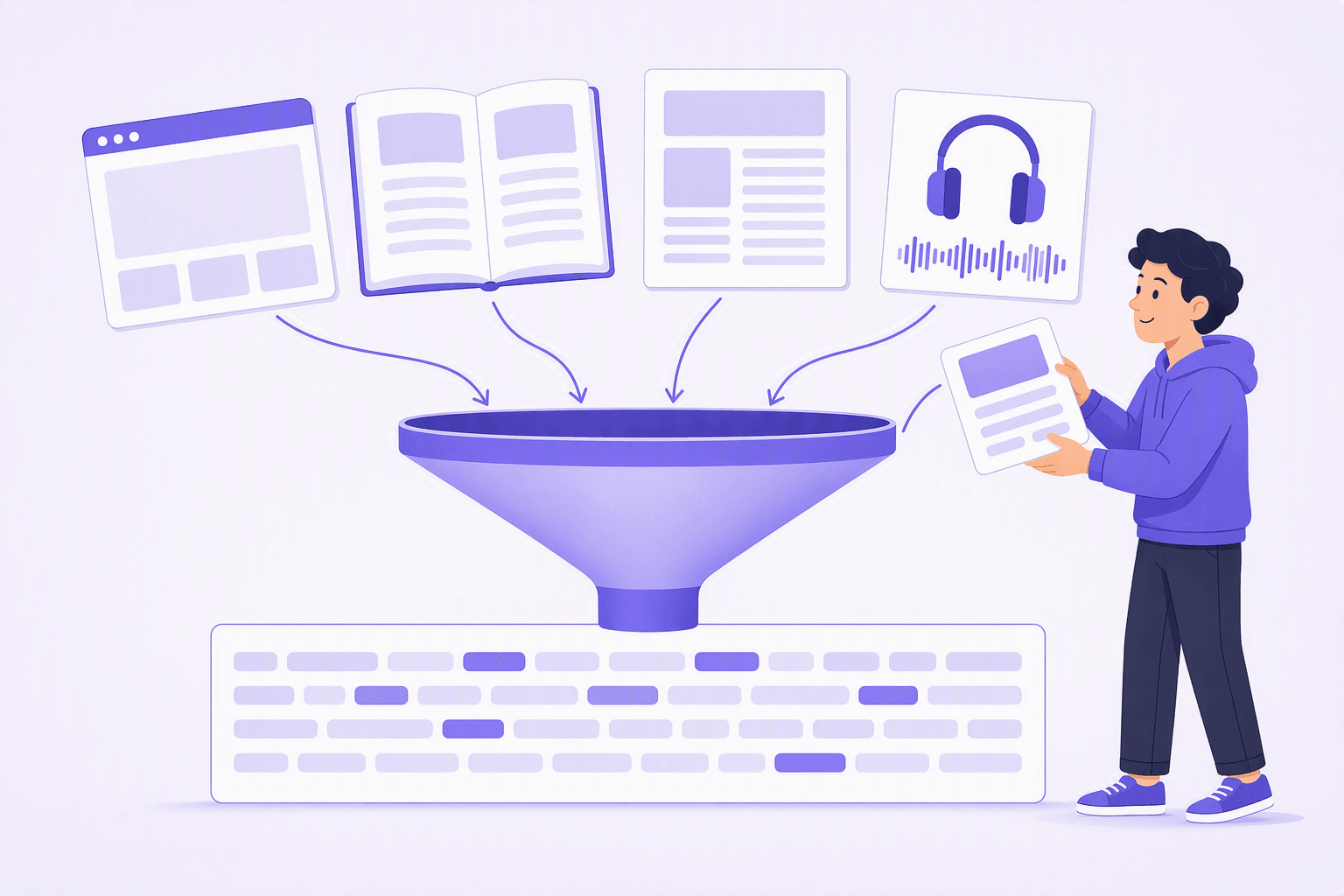
LingQ lets you paste articles, blog posts, news pages, or even YouTube transcripts into the platform and turn them into trackable lessons. For intermediate and advanced learners, this is the killer feature. You can take the article you actually want to read this week and feed it into the same vocabulary tracker you have been using for two years. According to LingQ's own product documentation, the importer works on text, web URLs, ebooks, and audio with transcripts (LingQ, accessed 2026).
A Vocabulary Counter That Actually Measures Something
Most apps give you XP or streaks, which measure engagement, not knowledge. LingQ gives you a known-word count. That number is imperfect, and there are debates in the community about how strict you should be when marking words "known," but at least it points at something real. Researchers like Paul Nation argue that learners need around 8,000 to 9,000 word-family vocabulary to read most authentic adult text comfortably, and LingQ's counter at least gives you a sense of how close you are.
Where LingQ Falls Short
LingQ has loud advocates, and it deserves them, but a fair review must acknowledge the gaps. If you are deciding between this and a more conventional course platform, our Babbel review covers the structured alternative in depth, and our Duolingo review covers the habit-driven alternative.
A Dated Interface
The web app and mobile app have improved over the years, but they still feel a generation behind apps like Duolingo or Drops. Menus are dense, settings are buried, and the visual hierarchy on a typical lesson page is busy. For a long-term tool, you can adapt. For a first impression, the design loses some learners who would have benefited from the underlying method.
A Steep Beginner Curve
LingQ assumes you are willing to swim in real text early. If you have studied no Spanish, your first article will be mostly blue, which means almost every word is unknown. Some people find that exciting and a sign of progress, others find it discouraging and quit within a week. A more guided beginner course often gets you to the first 500 high-frequency words faster, and only then does LingQ become genuinely efficient. If you are starting from zero in a major language, it can be worth spending three or four weeks on a structured app first.
No Speaking Practice At All
This is the biggest gap. LingQ has no speech recognition, no voice prompts, no AI conversation partner, and no built-in tutor integration in most workflows. The philosophy behind that absence is intentional, since Kaufmann argues that output emerges naturally from enough input. That can be true, but the data on adult learners suggests most people still need explicit speaking reps to actually use what they have stored. You will need to add tutoring or language exchange on the side.

Smaller Languages Feel Neglected
The major-language libraries are strong, but if you are learning Finnish, Vietnamese, Indonesian, or one of the rarer offerings, the catalog can feel thin and the audio quality less consistent. The platform still works, but the value-per-dollar shrinks compared to learners of Spanish or Japanese.
🌍 The polyglot community around LingQ
LingQ is not just a product, it is a small movement. Steve Kaufmann's YouTube channel has over a million subscribers, and the LingQ user community runs forums, Discord servers, and challenges where people compete on words read per month. That community is part of the product's value. If you respond well to public goals and shared progress posts, you will get more out of LingQ than the app itself suggests. If you prefer to learn quietly, the social layer is easy to ignore, but you will miss some of the motivation that keeps long-term users committed.
LingQ Pricing in 2026
LingQ is a paid platform. There is a free tier that lets you create a small number of LingQs (around 20 in most setups), which is enough to evaluate the interface but not enough to actually learn.
Paid plans run roughly in the following range, based on LingQ's published pricing pages (LingQ, accessed 2026):
- Premium monthly: about 13 dollars
- Premium annual: about 96 dollars, which works out to 8 dollars per month
- Premium two-year: discounted further per month
The platform regularly runs promotional discounts, and you will sometimes see lifetime or multi-year deals advertised through Kaufmann's channels. Pricing in your local currency may vary, and LingQ historically offers small refunds or extensions when users hit technical issues.
Compared to Duolingo Super (around 7 dollars per month at annual rates) and Babbel (around 10 to 15 dollars per month depending on plan), LingQ sits in the middle of the market. The value depends almost entirely on whether you will actually use the library every day.
Who Should Use LingQ?
LingQ is the right choice if several of the following are true:
- You already enjoy reading in your native language and want to read in your target language as soon as possible.
- You are at an intermediate level or higher, with at least a few hundred known words, or you are willing to grind through the first stretch.
- You are working on a language with a strong LingQ library, especially Spanish, French, German, Russian, Japanese, Korean, Chinese, Portuguese, or Italian.
- You are happy to organize your own speaking practice separately.
- You like measurable long-term metrics like known-word counts and time-listened.
LingQ is probably not the right choice if you want a single app that holds your hand through everything, if you learn better from video than from text, or if you need speaking practice built in from day one.
If you are still mapping out your overall strategy, /learn/spanish, /learn/japanese, and /learn/english walk through what a full input-and-output stack looks like in each of those languages.
Best LingQ Alternatives in 2026
LingQ sits in a specific niche, and there are now several credible alternatives depending on what you actually want from your tool.
Wordy (Best for Visual Learners)
Wordy keeps the comprehensible input idea but moves it from text to video. Instead of reading an article while listening to its audio, you watch a short scene from a movie or TV show, tap any word in the subtitles for an instant translation, and the word is then saved tied to that scene. Spaced repetition replays the same scenes, and speech recognition checks your pronunciation when you want to start speaking out loud.
The platform was founded in Budapest in 2024, was featured by TechCrunch in September of that year, and has grown to more than 500,000 users with 13,000-plus reviews averaging between 4.7 and 4.8 stars on the major stores. It supports more than 20 languages including English, Spanish, French, Italian, German, Japanese, Korean, Chinese, Portuguese, Arabic, Hindi, Russian, Polish, Vietnamese, Thai, Turkish, Dutch, Indonesian, and Czech.
You can try Wordy free on iOS or Android, or visit wordy.info for the web and Chrome extension.
Anki (Best for Total Control)
Anki is the open-source spaced-repetition flashcard tool that powers a lot of the polyglot community's vocabulary work. It is free on desktop, has a paid iOS app, and gives you total control over what you study. The catch is that you have to make or download every deck yourself, and Anki is not a reading environment. Most serious LingQ alternatives in the input-first camp use Anki for review and something else for input.
Readlang and Lute (Lightweight Reading Tools)
Readlang and the open-source Lute project both replicate parts of the LingQ idea on a smaller scale. They let you upload a text, click unknown words for translations, and build a known-word list. They are cheaper or free, but the library is your own, the audio integration is weaker, and the long-term tracking is less developed.
Duolingo and Babbel (For Structure Over Volume)
If LingQ feels too unstructured, Duolingo and Babbel sit at the opposite end of the spectrum. They guide you step by step through curated lessons, with quizzes, grammar explanations, and clear progress markers. You will read less authentic material, but you will rarely feel lost. Our Duolingo review and Babbel review cover both in depth.
Final Verdict
LingQ in 2026 is a respected, opinionated, slightly old-fashioned tool that does one job extremely well: it turns reading and listening into a measurable, compounding habit. If that is the gap in your current language stack, the subscription pays for itself.
What it does not do, and never has done, is teach you to speak. You will still need a tutor, a language exchange partner, or at minimum a daily self-talk routine to convert your stored vocabulary into actual conversation. That is not really a flaw, it is a design choice, but it is one you should plan around before you sign up.
For visual learners and anyone who finds dense walls of text draining, the movie-clip approach used by Wordy covers the same comprehensible-input goal in a format that is easier to sustain for thirty minutes a day. You can also use both, with Wordy for evening clips and LingQ for longer-form articles on the weekend.
Whichever route you pick, the most important thing is that you keep meeting the language in real, meaningful contexts every day. That is the single best predictor of progress, and it is the one thing every tool in this comparison is ultimately trying to help you do.
Frequently Asked Questions
Is LingQ worth the subscription?
Can LingQ make you fluent?
Is LingQ good for beginners?
How is LingQ different from Anki?
What's the best LingQ alternative for visual learners?
Sources & References
- LingQ, official website (lingq.com), accessed 2026
- Krashen, S., The Input Hypothesis, Longman, 1985
- Kaufmann, S., The Linguist (blog and YouTube channel), accessed 2026
- Nation, P., Learning Vocabulary in Another Language, Cambridge University Press, 2nd edition
- Ethnologue, 27th edition, 2024
Start learning with Wordy
Watch real movie clips and build your vocabulary as you go. Free to download.


