Quick Answer
Advanced Korean numbers are about choosing the right system (native vs Sino-Korean) and pairing it with the right counter. Native numbers dominate for age and counting items up to 99, while Sino-Korean numbers dominate for dates, minutes, money, addresses, and anything that feels 'official'. Once you learn the most common counters and time expressions, you can handle prices, schedules, and everyday counting naturally.
Advanced Korean numbers are mainly about choosing the correct number system (native Korean vs Sino-Korean) and attaching the right counter for the situation, especially for time, dates, money, age, floors, and phone numbers.

Korean has about 82 million speakers worldwide according to Ethnologue (27th edition, 2024). If you are learning through K-dramas, you will hear numbers constantly in everyday scenes: ordering food, paying, giving ages, setting meeting times, and reading apartment floors.
If you want the basics first, start with our Korean numbers 1-100. This guide assumes you already recognize core forms and now need the real-life rules.
The two number systems you actually switch between
Korean uses two parallel systems. This is not “two ways to say the same thing”, it is two different toolkits tied to context.
In the linguistics of Korean, this kind of division is often discussed as a functional split between native vocabulary and Sino-Korean vocabulary. In The Korean Language, Ho-min Sohn describes how Sino-Korean forms dominate domains like dates and formal measurement, while native forms remain strong in everyday counting and age.
Native Korean numbers (used with many counters)
Native Korean is the set you use for counting people and many objects, and for age. You will also use it for the “hour” part of time.
Key forms you need to be fluent in speech are the shortened 1-4 forms before counters:
- 하나 becomes 한
- 둘 becomes 두
- 셋 becomes 세
- 넷 becomes 네
These shortened forms show up everywhere: ordering “one thing”, “two people”, “three bottles”, and so on.
Sino-Korean numbers (used for dates, money, minutes, and “official” numbers)
Sino-Korean numbers are used for dates, minutes, prices, addresses, phone numbers, and most “read it off a screen” numbers.
If you have ever heard someone read a phone number in a drama, it is Sino-Korean all the way. The same is true for prices and apartment numbers.
💡 A practical shortcut
If you are reading numbers (prices, phone numbers, dates), default to Sino-Korean. If you are counting people or saying age, default to native Korean.
Quick Reference: the counters and number words that unlock real life
| English | Korean | Pronunciation | Formality |
|---|---|---|---|
| one (before a counter) | 한 | hahn | casual |
| two (before a counter) | 두 | doo | casual |
| three (before a counter) | 세 | seh | casual |
| four (before a counter) | 네 | neh | casual |
| item counter | 개 | geh | casual |
| people counter | 명 | myuhng | polite |
| age counter | 살 | sahl | casual |
| hour (o'clock) | 시 | shee | polite |
| minute | 분 | boon | polite |
| Korean won | 원 | wuhn | polite |
| number (ticket, order) | 번 | buhn | polite |
| floor | 층 | choong | polite |
Counters: the part Korean learners underestimate
In Korean, you rarely say a “bare number” in daily speech. You say number + counter, and the counter tells the listener what kind of thing you mean.
The National Institute of Korean Language (국립국어원) treats counters as a normal, productive part of modern usage, not as a niche grammar topic. That is why you should learn them early.
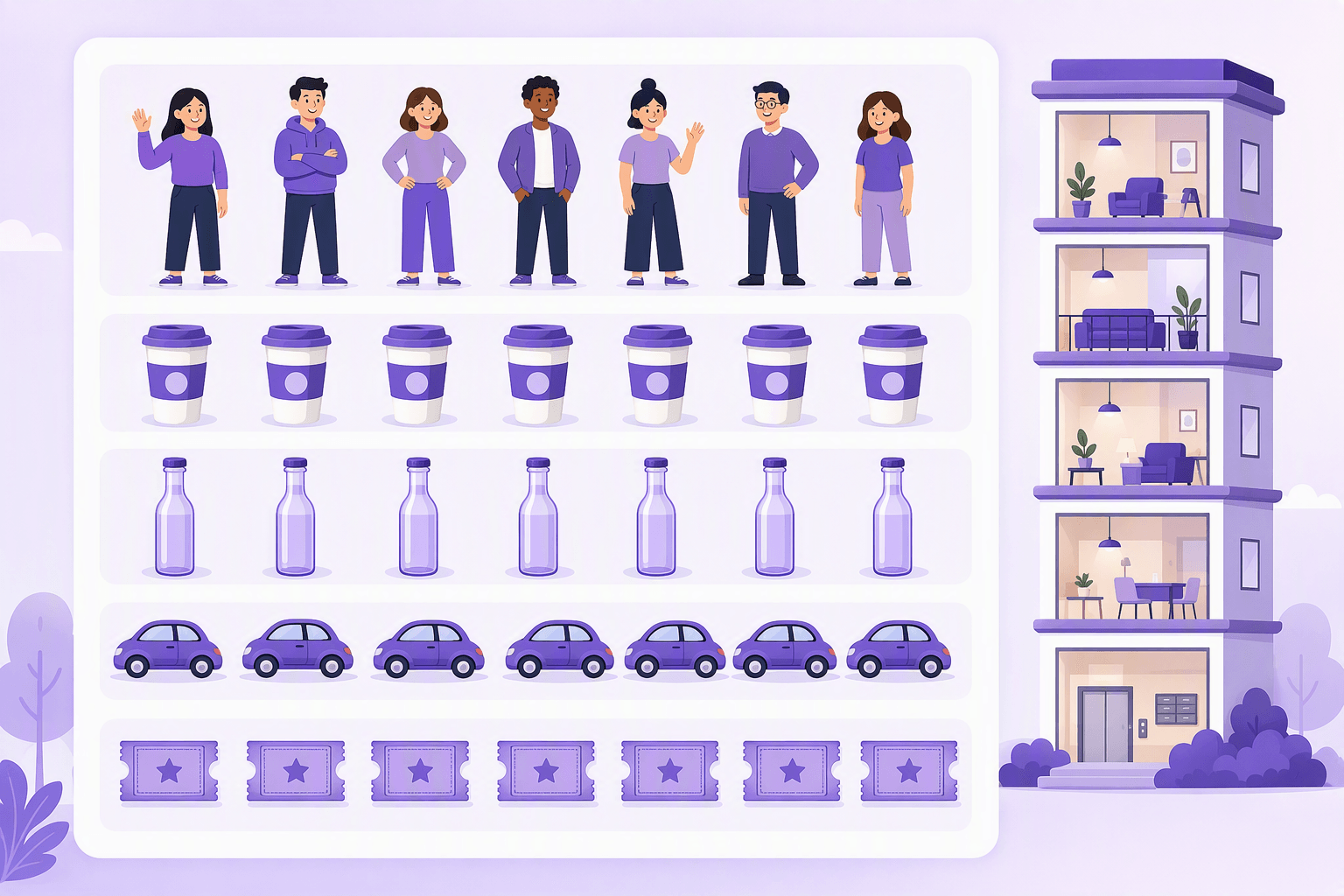
Each row above needs a different counter word in Korean: people take 명, cups take 잔, bottles take 병, cars take 대, tickets take 번, and the floors of that building take 층. The number changes shape, but the counter is what tells the listener what you are counting.
개
개 (geh) is the general counter for objects. It is the one you use when you do not know the “perfect” counter, and it is usually acceptable in casual contexts.
/hahn geh/
Literal meaning: one + item counter
“이거 한 개 주세요.”
Please give me one of these.
In shops and cafes, 한 개 주세요 is a default, natural request. If you use 하나 개, it sounds learner-like. The shortened form 한 is expected.
명
명 (myuhng) is a common counter for people, especially in polite contexts. You will also hear 분 (boon) as a more honorific “person” counter, but 명 is the workhorse.
/doo myuhng/
Literal meaning: two + people counter
“두 명이요.”
Two people.
At restaurants in Korea, staff often ask 몇 분이세요? or 몇 명이세요? Answering with 두 명이요 is concise and polite.
살
살 (sahl) is the counter for age. Age is one of the most frequent number topics in Korean small talk, especially when people are deciding what speech level feels natural.
For greeting language that pairs well with age talk, see how to say hello in Korean.
/suh-moo sahl/
Literal meaning: twenty + years old
“저는 스무 살이에요.”
I am twenty.
Native Korean has special forms for 20 (스물/스무) and 30 (서른). In real speech, 스무 살 is very common. For formal documents, you may see Sino-Korean forms, but everyday age talk is native.
⚠️ Age culture note
Korea has used different age-counting conventions (including a traditional system) alongside international age in some contexts. In real conversation, people often clarify with 만나이 (mahn-nah-ee) for international age. Listen for that word in workplace scenes and news.
Time: hours are native, minutes are Sino-Korean
Time is where learners finally feel the “two systems” in one phrase.
- Hours: native Korean + 시
- Minutes: Sino-Korean + 분
시
시 (shee) means “o’clock” or “hour” in clock time. The number before it is native.
Common hour forms you should recognize fast:
- 한 시 (1 o’clock)
- 두 시 (2 o’clock)
- 세 시 (3 o’clock)
- 네 시 (4 o’clock)
분
분 (boon) means “minute”. The number before it is Sino-Korean.
Examples:
- 십오 분 (15 minutes)
- 삼십 분 (30 minutes)
/seh shee shee-boh boon/
Literal meaning: three o'clock fifteen minutes
“세 시 십오 분에 만나요.”
Let's meet at 3:15.
Notice the system switch: 세 (native) for hours, 십오 (Sino-Korean) for minutes. This is one of the most common number patterns you will hear in daily life and in K-dramas.
Half past, quarter past, and “about” time
Korean often uses Sino-Korean fractions for “half” and “quarter” in time expressions:
- 반 (bahn) = half
- (less commonly in casual speech) 사분의 일 (sah-boon-eh eel) = one quarter
You will hear:
- 세 시 반 (3:30)
And for approximate time:
- 쯤 (jjeum) = around/about
- 정도 (jung-doh) = approximately (more formal)
Example: 세 시쯤 (around 3).
Dates: months and days are Sino-Korean
Dates are Sino-Korean territory. You will see this in calendars, texts, and announcements.
A typical date structure is:
- 6월 13일 = June 13th
월 (wol) is “month” and 일 (eel) is “day”. Both take Sino-Korean numbers.
일
Be careful with 일 because it can mean “day” (counter) or “one” (Sino-Korean 1) depending on position. Context usually makes it clear.
Example:
- 1일 (the 1st day of the month) is read as 일일 (eel-eel) in careful speech.
💡 What you hear in real speech
In fast conversation, people often drop parts that are obvious: "6월 13일" might become "6월 13일에" with the particle doing the work. Train your ear with short clips, not only written examples.
Money: 원, and why big numbers feel different in Korean
Korean prices are usually read in Sino-Korean numbers + 원 (wuhn).
원
원 is the Korean won. In shops, you will often hear:
- 천 원 (1,000 won)
- 만 원 (10,000 won)
만 and 억: the 10,000 grouping
Korean groups large numbers by 10,000 (만), not by 1,000 the way many English speakers intuitively chunk numbers.
This matters for:
- salaries
- rent deposits
- real estate listings
- car prices
Here are the key units:
- 만 (mahn) = 10,000
- 억 (uhk) = 100,000,000
If you read a price like 3,500,000 won, you will often see it written as 350만 원. That is “three hundred fifty 만 won”, not “three million five hundred thousand” in the English grouping style.
In Korean Grammar in Use, the authors treat these large-number units as essential everyday literacy, because they appear constantly in public life.
Floors, building numbers, and elevators
Apartment life and office towers make floor numbers high-frequency Korean.
층
층 (choong) is “floor”. Floors are typically Sino-Korean:
- 3층 (삼 층)
- 15층 (십오 층)
If you are watching dramas set in Seoul, listen for 층 in elevator scenes and security desk conversations.
Phone numbers: read them as strings, not as math
Phone numbers are read digit by digit in Sino-Korean numbers. People usually group them in chunks, and you should mimic the chunking you hear.
A common mobile format is:
- 010-1234-5678
You will hear:
- 공일공 (010)
- 일이삼사 (1234)
- 오육칠팔 (5678)
공
공 (gohng) is “zero” in many phone-number contexts. You may also see 영 (yuhng) as zero in other contexts, but 공 is extremely common for phone numbers.
This is a good example of register and domain vocabulary, a theme that shows up across Korean. In Sociolinguistics of Korean, J. K. Chambers discusses how context shapes “normal” choices, and numbers are one of the clearest places you can feel it.
Ordering in cafes and restaurants: numbers you hear constantly
Restaurant scenes are a goldmine for number practice. If you are building a clip-based routine, pair this guide with best Korean dramas to learn Korean.
Common patterns:
- “Two people” at the door: 두 명이요.
- “One of this” at the counter: 이거 한 개 주세요.
- “Table number” or “order number”: 몇 번이세요?
번
번 (buhn) is used for number labels: ticket number, order number, attempt number.
Example:
- 3번 (number 3)
- 한 번 (one time)
Be careful: 한 번 means “once” or “one time”, and it is a set phrase you will hear constantly in requests and invitations.
Common counters worth learning next (and how to choose)
Korean has many counters, but you do not need hundreds to function. Start with the ones that match your life.
Here is a practical set you will meet early:
- 개 (items)
- 명 (people)
- 살 (age)
- 시/분 (time)
- 원 (money)
- 번 (number, times)
- 층 (floors)
- 대 (machines, cars)
- 잔 (cups, glasses)
- 병 (bottles)
💡 Counter strategy that works
Learn counters through scenes. A cafe clip teaches 잔 and 병 naturally. A taxi clip teaches 대 and 원. A hospital clip teaches 분 and 층. This is why movie and TV dialogue is so efficient for numbers.
Pronunciation traps that cause misunderstandings
Korean numbers are short, so small sound differences matter.
네 vs 내
네 (neh) is “four” in native Korean before counters, but it can sound close to 내 (neh), “my”, in fast speech. Context usually saves you, but this is why you should practice with full phrases like 네 개, not isolated words.
십오 and the rhythm of fast speech
Sino-Korean compounds like 십오 (15) can compress in casual speech. You still need to recognize the underlying parts:
- 십 (10)
- 오 (5)
Listening practice helps more than overthinking. If you want a structured listening method, see how to learn a language with movies.
How numbers interact with politeness
Numbers themselves are not “polite” or “casual”, but the sentence around them is. Still, some counters and person words carry politeness.
- 명 is neutral to polite
- 분 is honorific for people
- counting age can trigger speech-level choices
This is one reason Korean learners often connect numbers with social comfort. Once you can say age and time smoothly, introductions become easier. Pair this with how to say goodbye in Korean so you can open and close conversations naturally.
A realistic practice plan (built for real speech)
Memorizing lists is not enough for advanced numbers. You need fast switching.
- Drill the 1-4 shortened forms with 3 counters: 한 개, 두 명, 세 살, 네 번.
- Drill time as chunks: 한 시, 두 시, 세 시 반, 십오 분, 삼십 분.
- Drill money with 만: 만 원, 이만 원, 삼만 오천 원.
- Drill one “public life” domain: floors (층) or tickets (번).
If you want more high-frequency vocabulary to support this, use our 100 most common Korean words as your base list.
🌍 Why K-dramas are especially good for numbers
K-dramas repeatedly show transactional talk: ordering, negotiating, scheduling, and family introductions. Those scenes force the same number patterns again and again, but with different emotions and speech levels. That repetition with variation is exactly what builds automaticity.
Common mistakes (and how to fix them fast)
Mixing the systems in the wrong place
If you say minutes with native numbers, it sounds wrong immediately to native speakers. Lock in the rule: minutes are Sino-Korean.
Saying full forms before counters
하나 개 is understandable, but it is not how people talk. Train your mouth to produce 한 개 automatically.
Reading big numbers in English chunks
If you keep thinking in thousands, 만 and 억 will feel confusing. Practice reading Korean prices exactly as written, especially in 만 units.
Learn numbers the way you will actually use them
Advanced Korean numbers are not a separate topic, they are the glue of daily life: time, money, dates, and counting. Once you can switch systems without pausing, your Korean starts to sound calm and natural.
If you want to hear these patterns in context every day, Wordy’s clip-based practice is built for exactly this kind of high-frequency, real-speech repetition. For more relationship language that often includes ages and dates, see how to say I love you in Korean, and for the opposite end of the register spectrum, read our guide to Korean swear words.
Frequently Asked Questions
When do I use native Korean numbers vs Sino-Korean numbers?
Why do Korean hours use native numbers but minutes use Sino-Korean?
What are the most important Korean counters to learn first?
How do I say 1, 2, 3 with counters like 한 개, 두 개?
How do Koreans say big numbers like 10,000 and 100,000,000?
Sources & References
- National Institute of Korean Language (국립국어원), Standard Korean Language Dictionary (표준국어대사전), accessed 2026
- National Institute of Korean Language (국립국어원), Korean Language Grammar resources, accessed 2026
- Ethnologue: Languages of the World, Korean language entry (27th edition, 2024)
- Korean Educational Development Institute (KEDI), Korean language education resources, accessed 2026
Start learning with Wordy
Watch real movie clips and build your vocabulary as you go. Free to download.


