Quick Answer
Korean has two complete number systems: Sino-Korean (il, i, sam) used for dates, money, phone numbers, and math, and native Korean (hana, dul, set) used for counting objects, telling time (hours), and ages. Both systems go up to 99 and are used daily. The most important first step is learning which system to use in which context.
Korean numbers present a fascinating challenge: the language maintains two entirely separate counting systems, and everyday life requires fluency in both. Knowing when to use which system is just as important as knowing the numbers themselves.
Korean is spoken by approximately 82 million people, primarily in South Korea and North Korea, according to Ethnologue's 2024 data. The Korean Foundation reports that over 16 million people worldwide are studying Korean, driven by the global rise of K-pop, K-drama, and Korean culture. Whether you are ordering food in Seoul, understanding a K-drama character's age, or reading prices at a convenience store, you will constantly switch between the two number systems.
"The dual number system in Korean is not redundant; each system occupies distinct functional domains. The challenge for learners is not memorizing the numbers themselves, but internalizing the distribution rules that determine which system to use." (Jaehoon Yeon & Lucien Brown, Korean: A Comprehensive Grammar, Routledge, 2019; Ho-min Sohn, The Korean Language, Cambridge University Press)
This guide covers both Sino-Korean and native Korean numbers from 1-100, explains exactly when to use each system, introduces counters, and explores the cultural meaning of numbers in Korean society.

| Korean (Sino / Native) | English | Pronunciation |
|---|---|---|
| 일 / 하나 | 1 | il / hana |
| 이 / 둘 | 2 | i / dul |
| 삼 / 셋 | 3 | sam / set |
| 사 / 넷 | 4 | sa / net |
| 오 / 다섯 | 5 | o / da-seot |
| 육 / 여섯 | 6 | yuk / yeo-seot |
| 칠 / 일곱 | 7 | chil / il-gop |
| 팔 / 여덟 | 8 | pal / yeo-deol |
| 십 / 열 | 10 | sip / yeol |
| 백 | 100 | baek |
Sino-Korean Numbers (한자어 수)
The Sino-Korean system, borrowed from Chinese, is used for dates, money, phone numbers, addresses, minutes and seconds, and mathematics. It is the more "official" of the two systems.
Sino-Korean 1-10
| English | Korean | Pronunciation | Note |
|---|---|---|---|
| 0 | 영 / 공 | yeong / gong | 영 for math, 공 for phone numbers |
| 1 | 일 | il | |
| 2 | 이 | i | |
| 3 | 삼 | sam | |
| 4 | 사 | sa | Sounds like 死 (death) |
| 5 | 오 | o | |
| 6 | 육 | yuk | |
| 7 | 칠 | chil | |
| 8 | 팔 | pal | |
| 9 | 구 | gu | |
| 10 | 십 | sip |
💡 When to Use Sino-Korean Numbers
Use Sino-Korean for: dates (삼월 = March, 십오일 = the 15th), money (오천 원 = 5,000 won), phone numbers (공일공... = 010...), addresses, minutes and seconds (삼십 분 = 30 minutes), math, and any number above 100. When in doubt with large numbers, Sino-Korean is almost always correct.
Sino-Korean 11-20 and Compound Formation
The Sino-Korean compound pattern is identical to Japanese and Chinese: sip (ten) + unit for 11-19, and unit + sip for the tens.
| English | Korean | Pronunciation | Note |
|---|---|---|---|
| 11 | 십일 | sib-il | 10 + 1 |
| 12 | 십이 | sib-i | 10 + 2 |
| 13 | 십삼 | sip-sam | 10 + 3 |
| 14 | 십사 | sip-sa | 10 + 4 |
| 15 | 십오 | sib-o | 10 + 5 |
| 16 | 십육 | sim-nyuk | 10 + 6 (sound change) |
| 17 | 십칠 | sip-chil | 10 + 7 |
| 18 | 십팔 | sip-pal | 10 + 8 |
| 19 | 십구 | sip-gu | 10 + 9 |
| 20 | 이십 | i-sip | 2 x 10 |
Sino-Korean Tens (20-100)
| English | Korean | Pronunciation |
|---|---|---|
| 20 | 이십 | i-sip |
| 30 | 삼십 | sam-sip |
| 40 | 사십 | sa-sip |
| 50 | 오십 | o-sip |
| 60 | 육십 | yuk-sip |
| 70 | 칠십 | chil-sip |
| 80 | 팔십 | pal-sip |
| 90 | 구십 | gu-sip |
| 100 | 백 | baek |
Compound examples: 25 = 이십오 (i-sib-o), 43 = 사십삼 (sa-sip-sam), 67 = 육십칠 (yuk-sip-chil), 99 = 구십구 (gu-sip-gu). The system is completely regular with no exceptions.
Sino-Korean Hundreds and Thousands
| English | Korean | Pronunciation | Note |
|---|---|---|---|
| 100 | 백 | baek | |
| 200 | 이백 | i-baek | |
| 300 | 삼백 | sam-baek | |
| 1,000 | 천 | cheon | |
| 10,000 | 만 | man | Key unit in Korean |
| 100,000 | 십만 | sim-man | 10 x 10,000 |
| 1,000,000 | 백만 | baeng-man | 100 x 10,000 |
Like Japanese, Korean groups large numbers by ten-thousands (만, man), not thousands. 100,000 is sip-man (ten ten-thousands), and one million is baek-man (hundred ten-thousands). This is a critical difference from Western number grouping that takes practice to internalize.
Native Korean Numbers (고유어 수)
The native Korean system is used for counting objects with counters, telling hours, stating age in casual speech, and quantities up to 99. It has unique forms for each number up to 99.
Native Korean 1-10
| English | Korean | Pronunciation | Note |
|---|---|---|---|
| 1 | 하나 | hana | Shortens to 한 before counters |
| 2 | 둘 | dul | Shortens to 두 before counters |
| 3 | 셋 | set | Shortens to 세 before counters |
| 4 | 넷 | net | Shortens to 네 before counters |
| 5 | 다섯 | da-seot | |
| 6 | 여섯 | yeo-seot | |
| 7 | 일곱 | il-gop | |
| 8 | 여덟 | yeo-deol | |
| 9 | 아홉 | a-hop | |
| 10 | 열 | yeol |
⚠️ Shortened Forms Before Counters
Numbers 1-4 and 20 change their form when placed directly before a counter word. 하나 becomes 한 (han), 둘 becomes 두 (du), 셋 becomes 세 (se), 넷 becomes 네 (ne), and 스물 becomes 스무 (seumu). Example: "three people" is 세 명 (se myeong), not 셋 명. This shortened form is mandatory and one of the most common mistakes learners make.
Native Korean 11-20
Native Korean teens follow the pattern yeol (ten) + unit. At 20, a new unique word appears: seumul.
| English | Korean | Pronunciation | Note |
|---|---|---|---|
| 11 | 열하나 | yeol-hana | 10 + 1 |
| 12 | 열둘 | yeol-dul | 10 + 2 |
| 13 | 열셋 | yeol-set | 10 + 3 |
| 14 | 열넷 | yeol-net | 10 + 4 |
| 15 | 열다섯 | yeol-da-seot | 10 + 5 |
| 16 | 열여섯 | yeol-yeo-seot | 10 + 6 |
| 17 | 열일곱 | yeol-il-gop | 10 + 7 |
| 18 | 열여덟 | yeol-yeo-deol | 10 + 8 |
| 19 | 열아홉 | yeol-a-hop | 10 + 9 |
| 20 | 스물 | seu-mul | Unique word |
Native Korean Tens (20-90)
Unlike the Sino-Korean system where tens follow a predictable pattern, native Korean tens each have unique names that must be memorized.
| English | Korean | Pronunciation | Note |
|---|---|---|---|
| 20 | 스물 | seu-mul | Shortens to 스무 before counters |
| 30 | 서른 | seo-reun | |
| 40 | 마흔 | ma-heun | |
| 50 | 쉰 | swin | |
| 60 | 예순 | ye-sun | |
| 70 | 일흔 | il-heun | |
| 80 | 여든 | yeo-deun | |
| 90 | 아흔 | a-heun |
Compound examples: 25 = 스물다섯 (seu-mul-da-seot), 33 = 서른셋 (seo-reun-set), 47 = 마흔일곱 (ma-heun-il-gop), 99 = 아흔아홉 (a-heun-a-hop). Native Korean numbers above 50 are increasingly rare in everyday speech, and most Koreans switch to Sino-Korean for larger numbers in casual contexts.
💡 When to Use Native Korean Numbers
Use native Korean for: counting objects with counters (사과 세 개 = 3 apples), telling hours (세 시 = 3 o'clock, but 삼십 분 = 30 minutes uses Sino-Korean), and age in conversation (스물다섯 살 = 25 years old). Note: Korean time uniquely mixes both systems. Hours use native Korean, minutes use Sino-Korean.
Korean Counters (Classifiers)
Like Japanese, Korean requires counter words when counting specific objects. Counters always follow the pattern: noun + native Korean number + counter.
| English | Korean | Pronunciation | Note |
|---|---|---|---|
| General objects | 개 (개) | -gae | Most common, use as default |
| People (polite) | 명 (명) | -myeong | 한 명, 두 명, 세 명 |
| People (formal) | 분 (분) | -bun | 한 분, 두 분 (honorific) |
| Animals | 마리 (마리) | -mari | 한 마리, 두 마리 |
| Bottles | 병 (병) | -byeong | 맥주 두 병 = 2 bottles of beer |
| Cups | 잔 (잔) | -jan | 커피 한 잔 = 1 cup of coffee |
| Books/volumes | 권 (권) | -gwon | 책 세 권 = 3 books |
| Sheets (flat) | 장 (장) | -jang | 종이 한 장 = 1 sheet of paper |
The counter 개 (gae, general object counter) is the most versatile. When you do not know the specific counter for something, 개 will almost always work in casual speech. The National Institute of Korean Language recognizes 개 as an acceptable general-purpose counter in informal contexts.
Ordinal Numbers in Korean
Korean ordinals are formed by adding 번째 (beonjjae) after the native Korean number. The first item has a special form.
| English | Korean | Pronunciation | Note |
|---|---|---|---|
| 1st | 첫 번째 / 첫째 | cheot beonjjae / cheotjjae | Special form for 'first' |
| 2nd | 두 번째 / 둘째 | du beonjjae / duljjae | |
| 3rd | 세 번째 / 셋째 | se beonjjae / setjjae | |
| 4th | 네 번째 / 넷째 | ne beonjjae / netjjae | |
| 5th | 다섯 번째 | da-seot beonjjae | |
| 6th | 여섯 번째 | yeo-seot beonjjae | |
| 7th | 일곱 번째 | il-gop beonjjae | |
| 8th | 여덟 번째 | yeo-deol beonjjae | |
| 9th | 아홉 번째 | a-hop beonjjae | |
| 10th | 열 번째 | yeol beonjjae |
The shortened forms (첫째, 둘째, 셋째, 넷째) are used for ranking children in a family: 첫째 (first child), 둘째 (second child). Beyond daily use, Sino-Korean ordinals with 제 (je) are used in formal contexts: 제일 (first), 제이 (second), 제삼 (third).
Cultural Significance of Numbers in Korea
Numbers carry deep cultural meaning in Korean society, influenced by both traditional beliefs and modern urban culture.
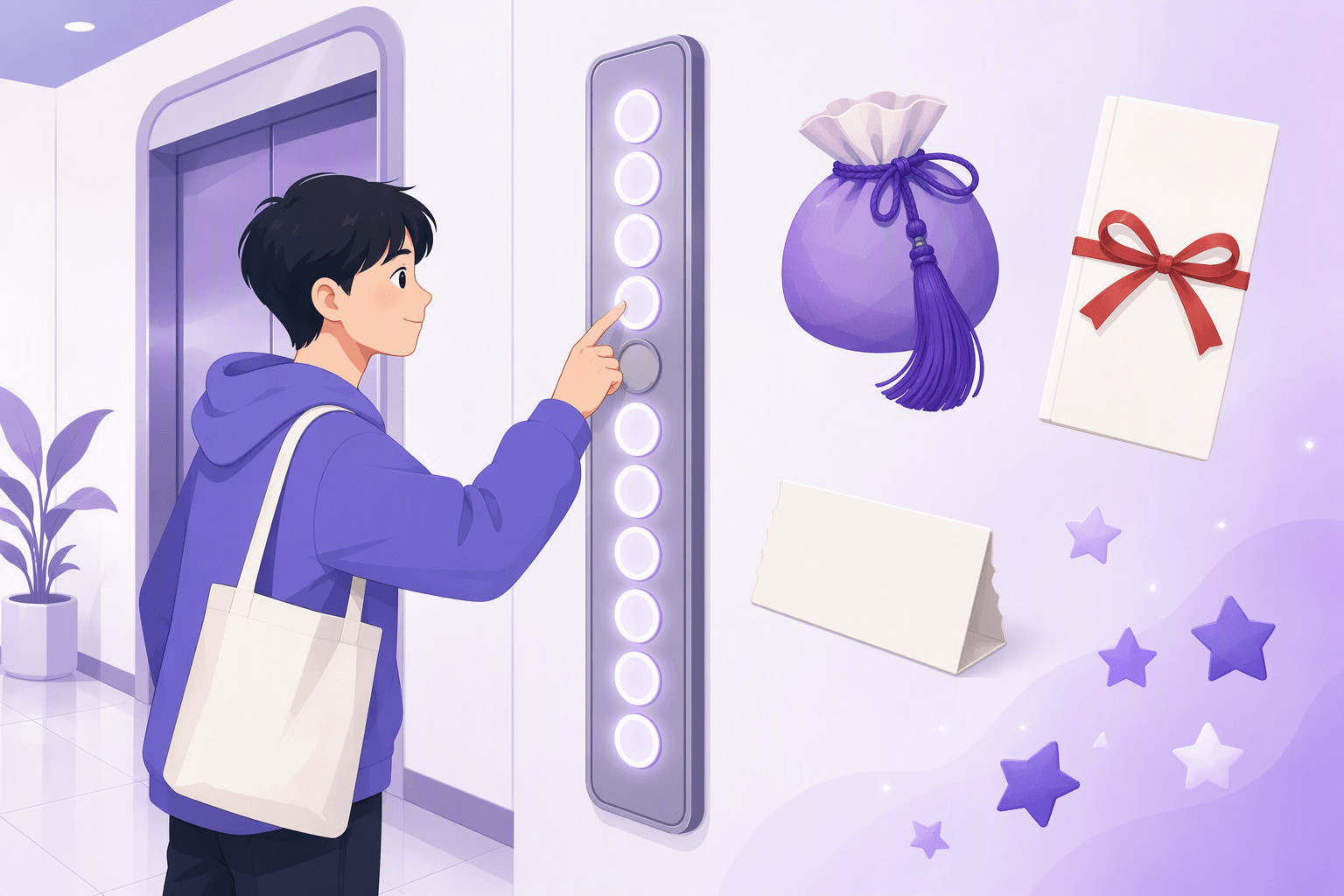
Unlucky 4 (사/sa): The Sino-Korean 4 (sa) sounds like the Chinese character for death (死). Many Korean buildings label the 4th floor as "F" (for "four") instead of "4" in elevator buttons. Some apartment complexes skip the 4th, 14th, and 44th floors entirely. This tetraphobia is gradually weakening among younger Koreans but remains strong in hospitals and among older generations.
Lucky 7 (칠/chil): The number 7 is widely considered lucky in Korea, reinforced by both traditional Buddhist associations (seven stars, seven treasures) and the influence of Western popular culture. Convenience store lottery tickets prominently feature 7.
Lucky 3 (삼/sam): Three holds positive connotations in Korean culture. The foundation myth of Korea involves the number 3 (Hwanung descended to a place between three peaks, and Dangun founded the nation). The Korean expression 삼세번 (sam-se-beon, three times) reflects the cultural belief that three attempts lead to success.
Number 8 (팔/pal): As in other East Asian cultures, 8 is considered auspicious because its Chinese character 八 resembles spreading prosperity. Phone numbers and license plates containing multiple 8s are sought after.
The age question: Korea traditionally used a different age-counting system where everyone turns one year older on New Year's Day. In 2023, South Korea officially switched to the international age system (만 나이, man nai). However, the traditional system (한국 나이, hanguk nai) persists in casual conversation, and Koreans routinely calculate both.
🌍 Number Superstitions in Daily Life
When giving monetary gifts in Korea, amounts with 4 are avoided. Wedding gifts are typically in multiples of 10,000 won (만 원): 50,000 won (오만 원), 100,000 won (십만 원). Hospital gift amounts avoid 4 entirely. The number 18 (십팔) is mildly taboo because sip-pal sounds similar to a common Korean expletive.
A Quick Reference: Which System When?
This table summarizes the critical decision of when to use each number system.
| English | Korean | Pronunciation | Note |
|---|---|---|---|
| Dates (month/day) | Sino-Korean | 삼월 십오일 = March 15th | Always Sino-Korean |
| Money | Sino-Korean | 오천 원 = 5,000 won | Always Sino-Korean |
| Phone numbers | Sino-Korean | 공일공... = 010... | Always Sino-Korean |
| Hours (time) | Native Korean | 세 시 = 3 o'clock | Hours only |
| Minutes (time) | Sino-Korean | 삼십 분 = 30 minutes | Minutes only |
| Age (casual) | Native Korean | 스물다섯 살 = 25 years old | Native + 살 |
| Counting objects | Native Korean | 사과 세 개 = 3 apples | With counters |
| Numbers 100+ | Sino-Korean | 백이십삼 = 123 | Native Korean caps at 99 |

Practice with Real Korean Content
Korean numbers appear in every K-drama, K-pop song, and everyday conversation. The dual system becomes intuitive with exposure, and you will naturally start hearing which system native speakers use in which context. Market scenes, restaurant orders, and phone conversations are especially number-dense.
Korean dramas and variety shows provide excellent number practice. Shopping scenes, age reveals, and game segments are loaded with both number systems. Check out our guide to the best movies for learning Korean for recommendations across genres.
Wordy helps you practice Korean numbers in real context with interactive subtitles on Korean shows and movies. When a number appears in dialogue, tap it to see the Hangul, romanization, and whether it uses Sino-Korean or native Korean. Explore our blog for more Korean learning guides, or visit our Korean learning page to start practicing today.
Frequently Asked Questions
What are the two Korean number systems?
When do you use Sino-Korean vs. native Korean numbers?
Is 4 unlucky in Korean?
Why do native Korean numbers change before counters?
How do you say age in Korean?
What number is considered lucky in Korean?
Sources & References
- National Institute of Korean Language (국립국어원), Standard Korean Language Dictionary
- Yeon, J. & Brown, L. (2019). Korean: A Comprehensive Grammar, 2nd edition. Routledge.
- Korean Foundation, Korean Language Education Survey, 2022
- Ethnologue: Languages of the World, Korean language entry (2024)
Start learning with Wordy
Watch real movie clips and build your vocabulary as you go. Free to download.


