Quick Answer
The most common Korean term of endearment is '자기야' (Jagiya), meaning 'baby' or 'honey.' It is gender-neutral and used by both dating and married couples. Korean pet names are uniquely shaped by age hierarchies, gender roles, and the distinction between dating and marriage, ranging from the married-only '여보' (Yeobo, darling) to the age-dependent '오빠' (Oppa) and '언니' (Eonni), to modern Konglish borrowings like '달링' (Dalling, darling) and '허니' (Heoni, honey).
The Short Answer
The most popular Korean term of endearment is 자기야 (Jagiya), meaning "baby" or "honey." It is gender-neutral, works for both dating and married couples, and is the pet name you will hear most often in K-dramas and real Korean relationships.
Korean is spoken by over 80 million people worldwide, according to Ethnologue's 2024 data. What makes Korean pet names fascinating is how deeply they are shaped by the culture's age hierarchies, gender roles, and the distinction between dating and marriage. Terms like 오빠 (Oppa) and 언니 (Eonni) are kinship words repurposed as romantic endearments, while 여보 (Yeobo) is reserved strictly for married couples. This system reflects a society where your relationship to another person (your age, your gender, your marital status) determines which words of affection are available to you.
"In Korean, the pet name you choose encodes not just affection but your entire social relationship with the listener: their age relative to yours, your gender, and whether you are dating or married. The vocabulary of love is also a vocabulary of social structure."
(Adapted from Ho-Min Sohn, The Korean Language, Cambridge University Press, 1999)
This guide covers 17 Korean terms of endearment organized by category: universal favorites, age-based kinship terms, married couple terms, modern Konglish borrowings, and playful nicknames. Each includes Hangul, romanization, pronunciation, an example sentence, and cultural context.

Quick Reference: Korean Terms of Endearment at a Glance
| English | Korean | Pronunciation | Formality |
|---|---|---|---|
| Baby / Honey | 자기야 (Jagiya) | Ja-gi-ya | casual |
| Darling (married) | 여보 (Yeobo) | Yeo-bo | casual |
| Older brother (romantic) | 오빠 (Oppa) | Op-pa | casual |
| Older sister (romantic) | 언니 (Eonni) | Eon-ni | casual |
| My love | 내 사랑 (Nae sarang) | Nae sa-rang | casual |
| Baby / Cutie | 애기 (Aegi) | Ae-gi | casual |
| Honey (sweet) | 꿀 (Kkul) | Kkul | slang |
| Princess | 공주님 (Gongjunim) | Gong-ju-nim | casual |
| Prince | 왕자님 (Wangjanim) | Wang-ja-nim | casual |
| Darling (Konglish) | 달링 (Dalling) | Dal-ling | casual |
| Honey (Konglish) | 허니 (Heoni) | Heo-ni | casual |
| Older brother (from male) | 형 (Hyeong) | Hyeong | casual |
| Older sister (from male) | 누나 (Nuna) | Nu-na | casual |
| Precious one | 소중한 사람 (Sojunghan saram) | So-jung-han sa-ram | polite |
| Name + 아/야 (suffix) | -아/야 (-a/ya) | -ah / -yah | casual |
| Sweetie / Cutie | 귀요미 (Gwiyomi) | Gwi-yo-mi | slang |
| My person / My one | 우리 사람 (Uri saram) | U-ri sa-ram | casual |
Why Korean Pet Names Are Unique
Before exploring individual terms, understanding what makes Korean terms of endearment different from Western pet names is essential. Three cultural forces shape the entire system.
Age hierarchy (서열, seoyeol): Many Korean pet names are repurposed kinship terms, including 오빠 (older brother, from a woman), 언니 (older sister, from a woman), 형 (older brother, from a man), and 누나 (older sister, from a man). Using these romantically requires the age relationship to be correct. You cannot call someone 오빠 if they are younger than you.
Gender specificity: Unlike English where "honey" or "babe" works regardless of who says it, several Korean endearments are gendered. 오빠 can only be used by women. 누나 can only be used by men. The term you choose announces both your gender and your partner's relative age.
Dating vs. marriage: Korean draws a clear line between couples who are dating and couples who are married. 여보 (Yeobo) is strictly for married partners. Using it while dating would feel like wearing a wedding ring on a second date.
🌍 The K-Drama Effect on Korean Pet Names
K-dramas have turned Korean pet names into a global phenomenon. Terms like 오빠 (Oppa) and 자기야 (Jagiya) are now recognized worldwide thanks to shows like Crash Landing on You, Goblin, and Descendants of the Sun. According to the Korean Culture and Information Service (KOCIS), the global Korean Wave (한류, Hallyu) has made Korean romantic vocabulary one of the most widely studied aspects of the language among international fans.
Universal Pet Names
These terms of endearment work regardless of age or gender and are the safest starting point for any Korean couple.
자기야 (Jagiya)
/Ja-gi-ya/
Literal meaning: Self / Oneself
“자기야, 오늘 뭐 먹을까?”
Baby, what should we eat today?
The most popular pet name among Korean couples. Gender-neutral and used by both dating and married partners. Often shortened to 자기 (Jagi). The literal meaning 'self' implies a merging of identities, calling your partner 'yourself.'
자기야 is the undisputed champion of Korean pet names. Its literal meaning ("self" or "oneself") creates a poetic intimacy that linguists have noted is unique to Korean. By calling your partner "self," you imply that they are an extension of you, that the boundary between "me" and "you" has dissolved. In practice, it functions identically to "baby" or "honey" in English.
The shortened form 자기 (Jagi) drops the vocative particle -야 and is equally common. You will hear both forms constantly in K-dramas and on Korean variety shows. According to the National Institute of Korean Language, 자기 as a term of endearment has been in widespread use since at least the 1990s.
내 사랑 (Nae Sarang)
/Nae sa-rang/
Literal meaning: My love
“내 사랑, 생일 축하해.”
My love, happy birthday.
A warm, emotionally rich endearment meaning 'my love.' Used by couples and also by parents to children. Carries more poetic weight than 자기야 and is better suited for heartfelt moments than daily conversation. Common in song titles and love letters.
While 자기야 handles the daily work of pet names, 내 사랑 is reserved for moments of genuine emotional depth. 내 (nae) means "my" and 사랑 (sarang) means "love." You are more likely to hear this in a birthday card, a tearful airport farewell, or a Korean movie than in a text about picking up groceries.
소중한 사람 (Sojunghan Saram)
/So-jung-han sa-ram/
Literal meaning: Precious / Important person
“당신은 나에게 소중한 사람이에요.”
You are a precious person to me.
A way of expressing deep affection through indirectness. Rather than a direct pet name, it describes the person's importance. Reflects the Korean communication style where restraint amplifies sincerity.
This expression reflects a characteristically Korean approach to endearment: describing what someone means to you rather than labeling them with a nickname. Telling someone they are 소중한 사람 (a precious person) carries enormous emotional weight precisely because of its restraint. Yeon and Brown note in Korean: A Comprehensive Grammar (Routledge, 2011) that Korean speakers often favor descriptive expressions over direct terms when the emotional stakes are highest.
Age-Based Kinship Terms (Used Romantically)
These are among the most distinctive Korean terms of endearment. Originally kinship terms for siblings, they have been repurposed as romantic address between partners of different ages. Our Korean learning page has exercises that help you practice these in context.

오빠 (Oppa)
/Op-pa/
Literal meaning: Older brother (from a female speaker)
“오빠, 같이 영화 보러 가자.”
Oppa, let's go watch a movie together.
Literally 'older brother' used by a woman, but in romantic contexts it functions as an affectionate address for an older boyfriend or husband. One of the most globally recognized Korean words thanks to K-pop. Only women can use it, and only for men who are older.
Perhaps no Korean word has achieved greater international recognition than 오빠. Its literal meaning ("older brother" from a female speaker) transforms in romantic contexts into something between "babe" and a flirtatious term of endearment for an older boyfriend. PSY's Gangnam Style ("오빠 강남 스타일") introduced the word to billions, and K-dramas have cemented its romantic connotation worldwide.
The Korean Culture and Information Service (KOCIS) notes that 오빠 occupies a unique cultural space where familial respect and romantic affection overlap. When a woman calls her boyfriend 오빠, she simultaneously acknowledges his older age (showing respect) and expresses intimate closeness. This dual function does not exist in English.
Important: 오빠 is exclusively used by women for older men. A man calling another man 오빠 in a romantic context would cause confusion.
언니 (Eonni)
/Eon-ni/
Literal meaning: Older sister (from a female speaker)
“언니, 오늘 진짜 예뻐.”
Eonni, you look really pretty today.
Literally 'older sister' used by a woman. In same-sex relationships between women, it can function as a romantic endearment for the older partner. Also used platonically between close female friends to express admiration and affection.
While 오빠 gets the global spotlight, 언니 carries equal cultural significance. In its standard use, it means "older sister" from a younger woman. Between close female friends, 언니 expresses warmth and admiration. In same-sex relationships between women, it functions as a romantic term of endearment with the same age-respect dynamic as 오빠.
형 (Hyeong)
/Hyeong/
Literal meaning: Older brother (from a male speaker)
“형, 오늘 시간 있어?”
Hyeong, are you free today?
Literally 'older brother' used by a man. In same-sex relationships between men, it can function as a romantic endearment for the older partner. Also widely used between close male friends as a sign of respect and brotherhood.
형 is the male counterpart of 오빠. It means "older brother" from a male speaker. While its romantic use is primarily in same-sex male relationships, it carries deep emotional warmth in Korean male friendships as well, where calling someone 형 signifies trust, loyalty, and fraternal affection.
누나 (Nuna)
/Nu-na/
Literal meaning: Older sister (from a male speaker)
“누나, 나 보고 싶었어?”
Nuna, did you miss me?
Literally 'older sister' used by a man. In romantic contexts, a younger man calls his older girlfriend or wife 누나. This dynamic has become increasingly popular in Korean media and real relationships, sometimes called '누나 로맨스' (nuna romance).
When a younger man dates an older woman in Korea, he addresses her as 누나, literally "older sister" from a male speaker. The "누나 romance" (누나 로맨스) has become a beloved K-drama trope, featured in shows like Something in the Rain and Encounter. The term carries a particular charm: the younger man acknowledges his partner's seniority while the intimacy of using a family term conveys deep affection.
💡 The Complete Age-Gender Grid
Korean kinship terms used romantically follow a strict grid. Memorize which one matches your situation:
| You Are | Partner Is | You Call Them |
|---|---|---|
| Woman | Older man | 오빠 (Oppa) |
| Woman | Older woman | 언니 (Eonni) |
| Man | Older man | 형 (Hyeong) |
| Man | Older woman | 누나 (Nuna) |
| Either | Same age/younger | Use 자기야 or their name |
Married Couple Terms
These terms are the territory of married partners. Using them while dating would be premature and potentially awkward.
여보 (Yeobo)
/Yeo-bo/
Literal meaning: Look here / Darling
“여보, 오늘 일찍 들어와요.”
Darling, come home early today.
Reserved almost exclusively for married couples. Carries deep domestic warmth and lifelong commitment. Shares the same etymological root as 여보세요 (the phone greeting). Using 여보 with someone you are merely dating would feel presumptuous.
여보 is the Korean "darling" reserved for marriage. It carries a warmth and domestic weight that 자기야 does not quite reach, the difference between a dating nickname and a term that acknowledges shared vows and a shared life. Interestingly, 여보 shares the same etymological root as 여보세요 (yeoboseyo, the phone greeting), both deriving from an archaic phrase meaning "look here."
According to Sohn's The Korean Language (Cambridge University Press, 1999), 여보 has been the standard married-couple address term in Korean for centuries. It is gender-neutral (both husbands and wives use it), and its continued prevalence reflects the deep cultural significance Koreans place on the institution of marriage.
우리 사람 (Uri Saram)
/U-ri sa-ram/
Literal meaning: Our person / My person
“이 사람은 우리 사람이에요.”
This person is my partner.
A uniquely Korean way to refer to your spouse or partner. The word 우리 (uri, 'our/we') reflects the Korean collectivist worldview where 'my' is often expressed as 'our.' 우리 남편 (uri nampyeon, 'our husband') and 우리 아내 (uri anae, 'our wife') follow the same pattern.
The word 우리 (uri) is one of the most revealing words in the Korean language. It means "our" or "we," but Koreans use it where English speakers would say "my": 우리 집 (our house, meaning "my house"), 우리 엄마 (our mom, meaning "my mom"), and 우리 사람 (our person, meaning "my partner"). This collectivist pronoun reflects a worldview where individual possession is softened into shared belonging.
Playful and Affectionate Nicknames
These pet names lean cute, playful, and sweet, the kind of terms couples use in text messages and lighthearted moments.
애기 (Aegi)
/Ae-gi/
Literal meaning: Baby
“우리 애기, 잘 잤어?”
My baby, did you sleep well?
A cutesy pronunciation of 아기 (agi, baby). Used between couples as a term of endearment meaning 'baby.' Extremely common in text messages and KakaoTalk conversations. Carries a playful, aegyo (cute/affectionate) tone.
애기 is a softened, cutesy version of the standard word 아기 (agi, baby). The vowel shift from 아 to 애 makes it sound more playful and affectionate, a form of 애교 (aegyo), the Korean concept of expressing cuteness and charm. Between couples, calling each other 애기 is like saying "baby" in English, but with an extra layer of deliberate adorableness that Korean culture celebrates rather than finds embarrassing.
꿀 (Kkul)
/Kkul/
Literal meaning: Honey (the substance)
“꿀 같은 내 여자친구.”
My girlfriend who is sweet like honey.
Literally means 'honey' (the substance bees make). Used as slang among younger Koreans to describe something sweet or perfect. As a pet name, it calls your partner sweet. Part of the modern Korean slang vocabulary, not traditional.
While 허니 (Heoni) is the Konglish borrowing of "honey," 꿀 is the native Korean word for actual honey. Younger Koreans have adopted it as slang to describe anything sweet or perfect: 꿀잠 (kkul-jam, "honey sleep," meaning a perfect nap), 꿀피부 (kkul-pibu, "honey skin," meaning flawless complexion). As a pet name, calling someone 꿀 says they are the sweetest thing in your life.
공주님 (Gongjunim)
/Gong-ju-nim/
Literal meaning: Princess
“오늘은 공주님 모시러 왔습니다.”
I have come to escort the princess today.
A playful, affectionate way for a man to address his girlfriend or wife. 공주 means 'princess' and -님 adds an honorific. Reflects K-drama romantic ideals where the male lead treats his partner like royalty. Can be sincere or playfully exaggerated.
K-dramas have popularized the image of the devoted male lead treating his partner like royalty, and 공주님 is the verbal expression of that ideal. The honorific suffix -님 (nim) adds a layer of mock-formality that makes the term feel both respectful and playful, as you are simultaneously elevating your partner to royalty and acknowledging the game with a smile.
왕자님 (Wangjanim)
/Wang-ja-nim/
Literal meaning: Prince
“왕자님이 드디어 오셨네.”
The prince has finally arrived.
The male counterpart to 공주님. A woman might call her boyfriend or husband 왕자님 (prince) playfully. Less common than 공주님 in everyday use but popular in text messages and cute couple dynamics.
The male counterpart to 공주님. A woman calling her partner 왕자님 carries the same playful elevation: you are my prince, and I am half-serious about it. It appears more often in text messages and social media captions than in daily spoken conversation, fitting Korean couple culture's love of cute, performative affection in digital spaces.
귀요미 (Gwiyomi)
/Gwi-yo-mi/
Literal meaning: Cutie / Cute one
“우리 귀요미, 이리 와.”
Come here, my cutie.
Derived from 귀엽다 (gwiyeopda, to be cute). The '귀요미 송' (Gwiyomi Song) went viral in 2013 and cemented this word in Korean pop culture. Used as a pet name to call someone adorable. Popular among younger couples.
귀요미 exploded into Korean pop culture with the viral 귀요미 송 (Gwiyomi Song) in 2013 and has remained a staple of cute couple vocabulary ever since. Derived from 귀엽다 (gwiyeopda, to be cute), it transforms the adjective into a noun, "the cute one." It is the kind of pet name that thrives in Korean couple culture, where expressing and performing cuteness (애교, aegyo) is a valued relational skill rather than something to be embarrassed about.
Konglish Pet Names (Korean-English Borrowings)
Globalization and the influence of Western media have introduced English-derived pet names into Korean couples' vocabulary, adapted through Korean pronunciation.
달링 (Dalling)
/Dal-ling/
Literal meaning: Darling (from English)
“달링, 사랑해!”
Darling, I love you!
The English word 'darling' adapted into Korean pronunciation. Used by younger, internationally-minded couples. Carries a modern, playful feel. More common in text messages and social media than in spoken Korean with older generations.
달링 is the Korean pronunciation of "darling," written in Hangul and fully naturalized into the language. It occupies a specific cultural space: modern, playful, and slightly Western-influenced. Couples who use 달링 tend to be younger and internationally oriented. Using it with Korean in-laws or in front of older relatives might draw raised eyebrows, not because it is offensive but because it signals a departure from traditional Korean romantic vocabulary.
허니 (Heoni)
/Heo-ni/
Literal meaning: Honey (from English)
“허니, 뭐 하고 있어?”
Honey, what are you doing?
The English word 'honey' adapted into Korean. Similar cultural positioning to 달링: modern, casual, and associated with younger couples or those with international exposure. Sometimes used humorously or with self-aware irony about its Western origin.
Like 달링, 허니 is a Konglish borrowing that has found a niche among younger Korean couples. Some use it sincerely; others adopt it with a playful awareness of its foreign origin, a wink at the globalized nature of modern Korean romance. While older Koreans might find these borrowed terms somewhat strange, they have become completely normalized in Korean digital communication, appearing frequently in KakaoTalk messages and Instagram captions.
💡 Name + 아/야: The Simplest Korean Endearment
One of the most natural Korean terms of endearment is simply adding the vocative particle -아 (after consonants) or -야 (after vowels) to your partner's name. "민수야" (Minsuya), "수진아" (Sujina). This suffix turns a name into a gentle call, like the difference between saying "John" flatly and "Johnny" warmly. Korean couples use this constantly, and it is often the first step from formal address to intimate familiarity.
Korean Terms of Endearment: Dating vs. Marriage
Understanding which pet names belong to which relationship stage is crucial. Here is a practical guide.
| Term | Dating Couples | Married Couples | Notes |
|---|---|---|---|
| 자기야 (Jagiya) | Yes | Yes | Universal, the safest choice |
| 여보 (Yeobo) | No | Yes | Marriage only |
| 오빠/언니/형/누나 | Yes | Yes | Requires correct age/gender |
| 내 사랑 (Nae sarang) | Yes | Yes | Emotionally heavy, for special moments |
| 애기 (Aegi) | Yes | Yes | Playful and cute |
| 달링/허니 (Dalling/Heoni) | Yes | Less common | Modern, Konglish |
| 공주님/왕자님 | Yes | Yes | Playful, slightly theatrical |
| Name + 아/야 | Yes (common early on) | Yes | The gentlest form of endearment |
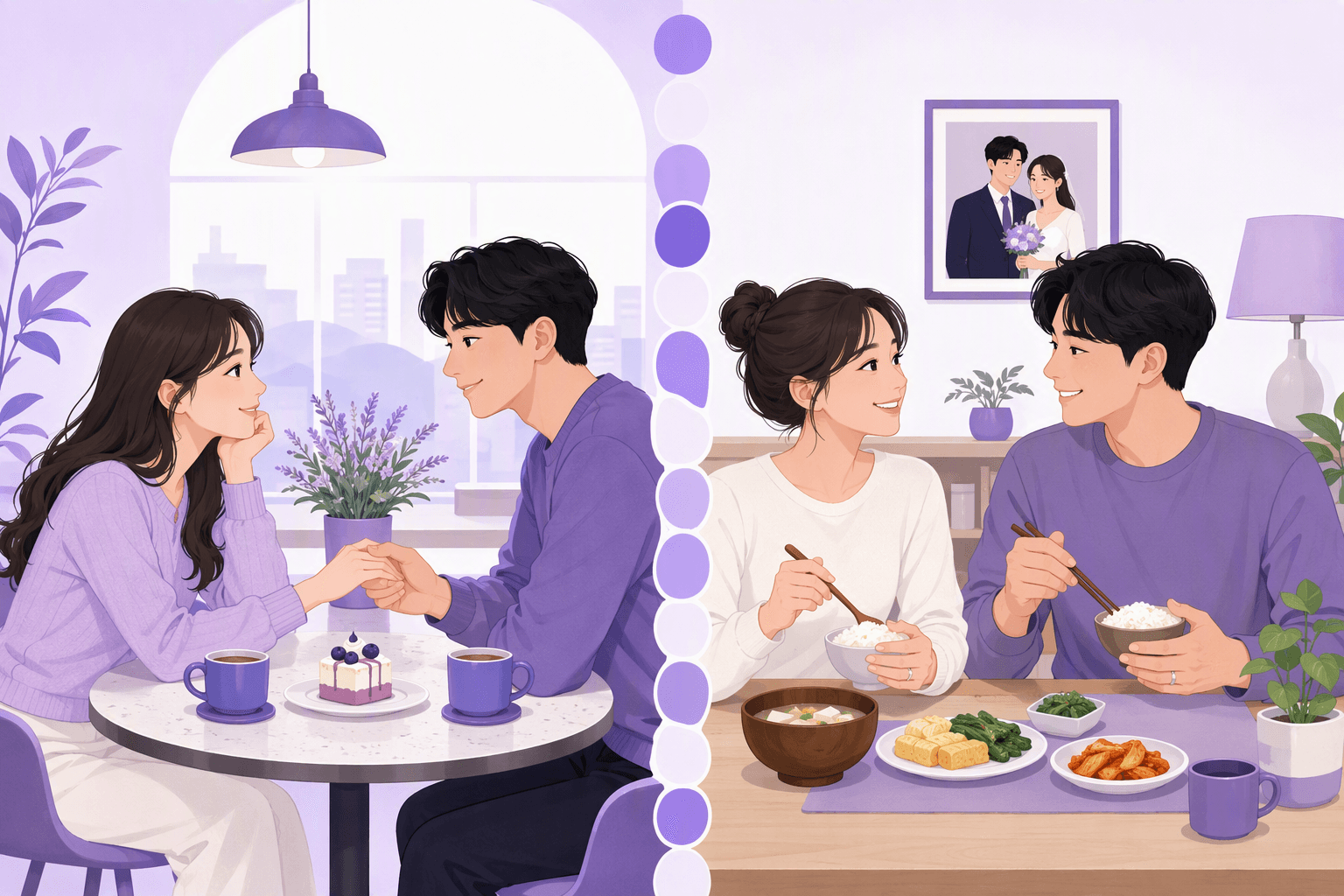
"The Korean language provides a remarkably precise toolkit for calibrating the distance between two people. Every pronoun, every suffix, every term of address is a measurement of social and emotional proximity."
(Jaehoon Yeon & Lucien Brown, Korean: A Comprehensive Grammar, Routledge, 2011)
🌍 The Role of 애교 (Aegyo) in Korean Pet Names
Korean couple culture embraces 애교 (aegyo), the deliberate performance of cuteness and charm. Using baby-talk pet names like 애기, adding -이 or -이야 to everything, or adopting an exaggeratedly sweet tone are all forms of aegyo that Korean couples practice openly. Unlike some Western cultures where baby talk between adults might be seen as immature, Korean culture views aegyo as a relational skill, a way of expressing vulnerability and closeness. Many Korean pet names only make full sense within this aegyo framework.
Practice With Real Korean Content
Reading about Korean terms of endearment builds vocabulary, but hearing them spoken naturally (the sing-song 자기야 between K-drama leads, the warm 여보 between a married couple over breakfast, the flirtatious 오빠 that changed the course of a love story) is what makes them real. Korean romance dramas are an unparalleled resource for absorbing these terms in their natural emotional context.
Wordy lets you watch Korean movies and dramas with interactive subtitles, tapping any pet name to see its meaning, formality level, and cultural context in real time. Instead of memorizing 자기야 from a list, you absorb it from the scene where the lead finally calls their partner by that name for the first time.
For more Korean content, explore our blog for guides including the best movies to learn Korean. You can also visit our Korean learning page to start practicing with real content today.
Frequently Asked Questions
What is the most common Korean pet name for couples?
What is the difference between 자기야 (Jagiya) and 여보 (Yeobo)?
Can a man be called 오빠 (Oppa) by his girlfriend?
Do Korean couples use English pet names like 'honey' or 'darling'?
What Korean pet name should I use if I just started dating?
Why are age and gender so important in Korean pet names?
Sources & References
- National Institute of Korean Language (국립국어원), Standard Korean Language Dictionary
- Sohn, H.-M. (1999). 'The Korean Language.' Cambridge University Press.
- Yeon, J. & Brown, L. (2011). 'Korean: A Comprehensive Grammar.' Routledge.
- Korean Culture and Information Service (KOCIS), 'Understanding Korean Culture' (2023)
- Ethnologue: Languages of the World, Korean language entry (2024)
Start learning with Wordy
Watch real movie clips and build your vocabulary as you go. Free to download.


