Advanced Korean Swear Words: What They Mean, How Harsh They Are, and What Koreans Actually Say
Quick Answer
Advanced Korean swear words are often built from a few core insults plus grammar that changes the force: endings like -새끼, -년, and commands like 꺼져 can turn a complaint into a direct attack. If you want to understand K-dramas and real speech safely, focus on meaning, severity, and when Koreans would never use them.
Advanced Korean swear words are usually not “new words”, they are common insults and profanity used with harsher grammar, stronger nouns, and taboo body references, and they can escalate a scene fast if you copy them without understanding context.
If your goal is to understand what you hear in K-dramas, variety shows, or games, this guide focuses on meaning, severity, and what Koreans actually do in real conversations, including what not to repeat.
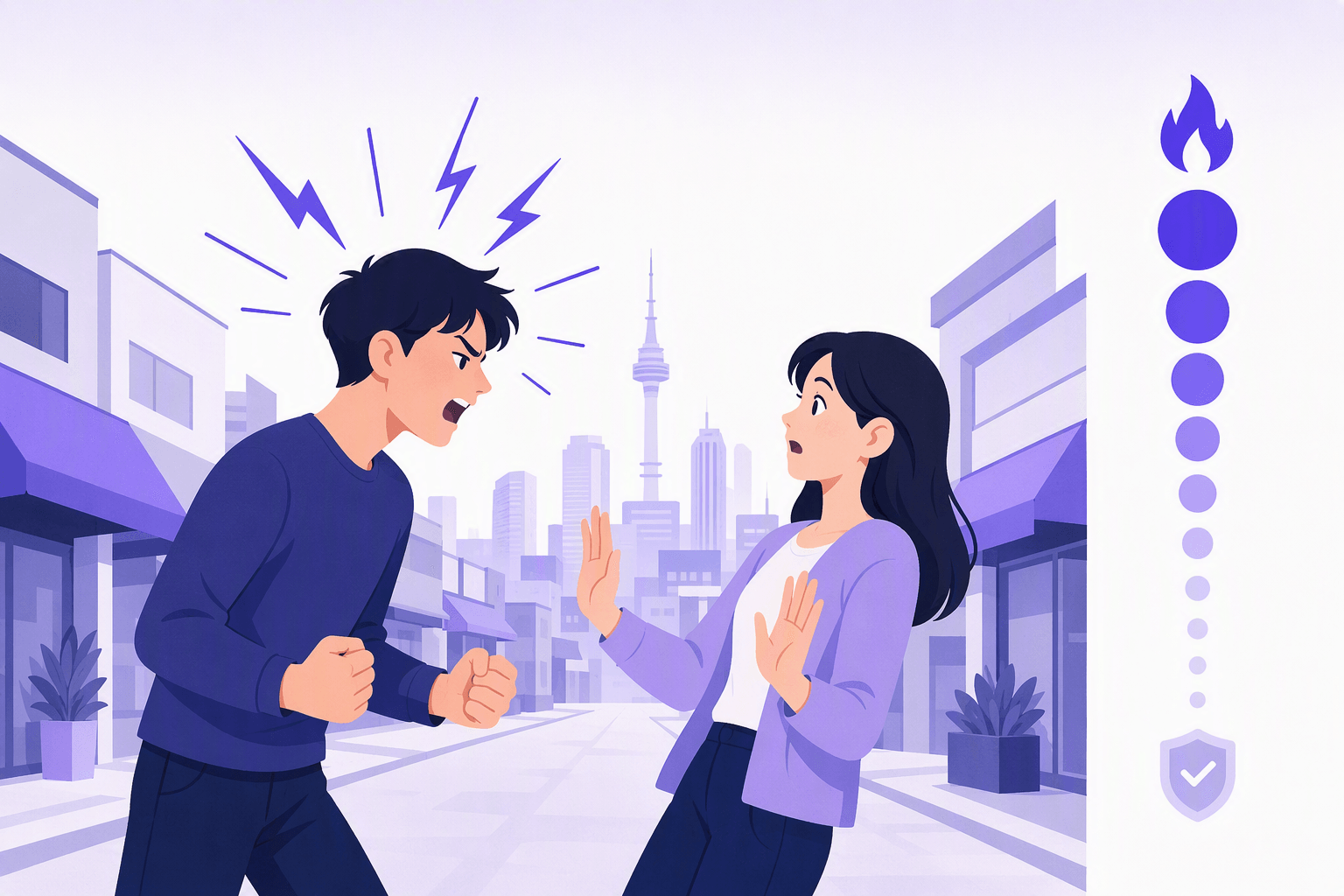
⚠️ Responsible use
This article is for comprehension, not for performing insults. Korean profanity can damage relationships quickly because it often attacks someone’s social status, family, or gender, and it can also break expected speech levels. If you are not fully fluent, treat these as listening vocabulary only.
Korean is spoken by roughly 82 million people worldwide (Ethnologue, 27th edition, 2024). That means you will hear regional and generational variation, but the “high-risk” words below are widely recognized across South Korea.
For a safer baseline first, read our guide to Korean swear words. For everyday polite conversation, start with how to say hello in Korean and how to say goodbye in Korean.
Why Korean swearing feels extra harsh to learners
Korean insults often feel stronger than their subtitle translations because they combine taboo vocabulary with social rule-breaking.
Speech levels make insults sharper
Korean has clear politeness and formality choices, and using the “wrong” level can be insulting even without profanity. When you add profanity, it becomes a double hit.
This is why a short command can feel like a slap. It is not only the meaning, it is also the social stance.
Many insults target “who you are”, not “what you did”
A lot of Korean profanity is identity-based: it labels someone as trash, an animal, or “that kind of person.” Research on politeness and face (Brown & Levinson, Politeness: Some Universals in Language Usage, Cambridge University Press) helps explain why direct attacks on someone’s “face” escalate conflict quickly.
Dictionaries will define the word, not the social blast radius
Learners often look up a word in a dictionary and assume they can use it like an English equivalent. Korean swear words have strong pragmatic constraints: who you say it to, where, and with what ending matters.
For definitions and standard usage notes, the National Institute of Korean Language dictionary is a reliable reference (표준국어대사전, accessed 2026).
How “advanced” Korean swearing is constructed
You can understand a lot of Korean profanity by recognizing a few building blocks.
Suffix insults: -새끼 and -년
These are not “cute add-ons.” They are escalators.
- -새끼 (SEH-kkee) is extremely common in fights and hostile banter. It is often translated as “bastard” or “jerk,” but the tone can be nastier depending on context.
- -년 (nyuhn) is a gendered insult aimed at women. It is socially explosive and can be interpreted as misogynistic slur-like language.
🌍 Why -년 is a bigger problem than learners expect
In English subtitles, -년 may be softened to “bitch” or even “that woman,” but in many real contexts it reads as contempt toward women as a category. Even if you hear it in a drama, repeating it can mark you as unsafe or disrespectful immediately.
Commands and imperatives: the “fight mode” switch
Korean has many ways to command someone, and profanity often appears in imperative form. Imperatives are inherently face-threatening, and profanity makes them direct aggression.
Descriptive profanity: “this is X-like”
Korean uses patterns like X 같다 (GAHT-tah, “it’s like X”) to describe something as disgusting, ridiculous, or unbearable. This is common in gaming and ranting.
High-risk words you will hear (and should recognize)
Below are advanced, high-salience items. Pronunciations are approximations for learners, not perfect phonetics.
씨발
씨발 (SHEE-bahl) is one of the most common strong profanities in Korean. It is used as an expletive (like “f***”) and also as an intensifier.
It can appear alone, repeated, or embedded in longer phrases. In public, it is widely considered rude and aggressive.
/SHEE-bahl/
Literal meaning: A taboo expletive used to vent anger or shock.
“아, 씨발…”
Ah, f***...
Common in heated arguments and some male-dominated peer groups, but high-risk in workplaces, public spaces, and with strangers. Subtitles often soften it.
개새끼
개새끼 (geh-SEH-kkee) is a direct insult, literally “dog + -saekki.” It is closer to “you bastard” than to a mild “jerk.”
It is often used in confrontations, road rage scenes, and intense drama dialogue.
/geh-SEH-kkee/
Literal meaning: Literally 'dog offspring', used as a harsh insult.
“저 개새끼가 또 왔어.”
That bastard came again.
Very aggressive. In some friend groups it can appear as hostile joking, but learners should treat it as a real insult. Using it at the wrong time can start a fight.
미친놈 / 미친년
미친놈 (mee-CHIN-nohm) and 미친년 (mee-CHIN-nyuhn) mean “crazy guy” and “crazy woman,” used as insults. They are common, but still harsh.
They also carry stigma around mental health. In many settings, Koreans will choose safer frustration phrases instead.
좆같다
좆같다 (joht-GAHT-tah) is very vulgar. It uses a taboo body reference and expresses disgust or “this is f***ing awful.”
If you hear it, treat it as “strong profanity,” not as casual slang.
⚠️ Subtitles often under-translate this
Words like 좆같다 are frequently toned down to “this sucks” in translations. In Korean, the register is far more vulgar. If you repeat it, you will not sound like a normal learner, you will sound like someone trying to provoke.
꺼져
꺼져 (KKUH-juh) means “get lost” or “f*** off,” literally “turn off/go out.” It is a short, sharp command.
Because it is an imperative, it can sound more confrontational than longer insults.
닥쳐
닥쳐 (DAHK-chuh) means “shut up.” It is rude even among friends unless used jokingly with the right relationship.
In a workplace or with strangers, it is an immediate escalation.
병신
병신 (byuhng-SHEEN) is a strong insult historically tied to disability. It is widely recognized as offensive.
Many Koreans avoid it for the same reason English speakers avoid ableist slurs, but you still hear it in older media and in some online spaces.
What Koreans say instead when they want to sound “mad” but not trashy
If you want to speak naturally, you need “pressure release” phrases that are intense but socially survivable.
아, 진짜
아, 진짜 (ah, JIN-jjah) is one of the most common frustration markers. Depending on intonation, it can mean “seriously?” “come on,” or “you’ve got to be kidding.”
It is not profanity, but it can still sound annoyed.
미치겠다
미치겠다 (mee-CHEE-geh-tah) literally “I’m going crazy,” used like “this is driving me insane.” It is common and expressive.
It can be dramatic, but it is far safer than direct swearing.
짜증 나
짜증 나 (JJAH-juhng nah) means “I’m annoyed.” It is everyday speech, especially when complaining about situations rather than attacking a person.
열받아
열받아 (yeohl-BAH-dah) means “I’m heated,” “I’m pissed.” It is stronger than 짜증 나, but still not a direct slur.
🌍 A useful rule for sounding adult
In many Korean settings, sounding “adult” under stress means complaining about the situation, not labeling the person. Phrases like 짜증 나 and 열받아 vent emotion while avoiding identity-attacking nouns like 새끼 or 년.
The K-drama effect: why you hear swearing in patterns
Dramas and films use profanity strategically. It signals character type, power, and intimacy.
Swearing as character design
A tough character may swear to show dominance. A “nice” character may swear once to show a breaking point.
This is similar to what discourse analysts study: swearing can be a stance marker, not only a literal meaning.
Why translations mislead
English subtitles compress register differences because English has fewer built-in social-level markers than Korean. A translator may choose “jerk” for something that is much stronger, or “get out” for 꺼져.
If you want to calibrate, focus on the Korean word itself and the reaction of other characters.
Regional and social variation (what changes, what doesn’t)
Korean profanity varies by age, gender norms, and group culture.
Gender expectations are real
In many communities, men swearing casually is more socially tolerated than women swearing the same way, even today. That does not mean it is “fine,” it means the social judgment differs.
If you are learning Korean, avoid copying gendered insults entirely. They are not “fluent,” they are risky.
Online spaces amplify harshness
Gaming voice chat, comment sections, and some meme communities use stronger language more freely. That is not a good model for real-life conversation.
The Korean Language Society (한글학회, accessed 2026) has long focused on norms and responsible language use, and the gap between “online talk” and “public talk” is part of modern language reality.
How to learn swear words safely with movies and K-dramas
Understanding profanity is useful for listening comprehension, but producing it is optional.
Step 1: Learn the “meaning band,” not a single translation
Map each word to a severity band in your head: mild complaint, rude insult, strong profanity, taboo slur. This prevents you from treating everything as “just slang.”
If you want more everyday listening vocabulary first, build a base with the 100 most common Korean words.
Step 2: Notice who says it to whom
Track relationship variables: friends vs strangers, older vs younger, boss vs employee. Korean is sensitive to hierarchy, and profanity often signals a deliberate rejection of that hierarchy.
Step 3: Copy the safe alternatives, not the nuclear options
If you want to sound natural, copy frustration phrases like 아, 진짜 and 짜증 나. Save the strong words for comprehension only.
For a broader overview of what is common and what is extreme, see Korean swear words.
Step 4: Use clips, not lists
Short scenes give you the facial expression, timing, and consequence. That context is what dictionaries cannot provide.
If you are learning with video, Wordy’s approach is to practice with short, level-matched clips, so you can hear how real Korean sounds when it is calm, annoyed, or angry, without turning your speech into a copy of a fight scene.
A practical “do and don’t” checklist
Do
- Do learn recognition of 씨발, 개새끼, 꺼져, 닥쳐 so you understand conflict scenes.
- Do learn neutral venting phrases for daily life.
- Do pay attention to speech level, even when angry.
Don’t
- Don’t use -년, even as a joke.
- Don’t swear at strangers, service workers, or coworkers, even if you heard it in a drama.
- Don’t assume English equivalents match severity.
💡 If you want one safe upgrade to your Korean
Instead of trying to swear, learn how to de-escalate: 죄송합니다 (joeh-SONG-hahm-nee-dah, 'I’m sorry') and 잠깐만요 (jahm-KKAN-mahn-yoh, 'just a moment') will help you far more in real life than any insult.
Related guides to keep your Korean balanced
Swear words are a tiny slice of real Korean. To sound like a person, you need greetings, closings, and affection language too.
Pair this article with how to say hello in Korean, how to say goodbye in Korean, and when you want the opposite emotional register, how to say I love you in Korean.
If you want more learning methods beyond vocabulary, browse the full Wordy language learning blog and focus on listening-first practice that matches how Korean is actually spoken.
Frequently Asked Questions
What is the strongest Korean insult learners should avoid?
Is 새끼 always a swear word in Korean?
Do Koreans swear as much as K-dramas make it seem?
What is the difference between 욕 (swearing) and 반말 (informal speech)?
What should I say instead of swearing when I’m frustrated in Korean?
Sources & References
- Ethnologue, Korean, 27th edition, 2024
- National Institute of Korean Language (국립국어원), Standard Korean Language Dictionary (표준국어대사전), accessed 2026
- Korean Language Society (한글학회), publications on Korean language norms, accessed 2026
- Brown, P. & Levinson, S. C., Politeness: Some Universals in Language Usage, Cambridge University Press
Start learning with Wordy
Watch real movie clips and build your vocabulary as you go. Free to download.


