Quick Answer
Korean nature vocabulary includes words such as 산 for mountain, 바다 for sea, 비 for rain, and 꽃 for flower. This guide teaches 75 useful Korean words for landscapes, weather, seasons, plants, and wildlife, plus the cultural associations that make them memorable.
Korean nature vocabulary starts with 자연 /tɕa.jʌn/, meaning nature, but the words you will use most often are more concrete: 산 /san/ for mountain, 바다 /pa.da/ for sea, 비 /pi/ for rain, 꽃 /k͈ot̚/ for flower, and 하늘 /ha.nɯl/ for sky. Learn these terms in groups and you can understand weather reports, travel scenes, song lyrics, and everyday comments about the outdoors.
Korean is spoken by more than 81 million people worldwide, according to Ethnologue's 27th edition. Nature vocabulary matters particularly because South Korea is a highly urban country with a powerful outdoor culture: mountains cover roughly 63 percent of its land area, and hiking, blossom viewing, beach trips, and autumn leaf outings remain major seasonal rituals.
If you are still building your basics, pair this list with our guide to Korean greetings. You will quickly be able to move from a simple greeting to comments such as 날씨가 좋아요 /nal.s͈i.ɡa tɕo.a.jo/, meaning the weather is nice.
| English | Korean | Pronunciation | Note |
|---|---|---|---|
| Nature | 자연 | jah-YUHN | Broad term for the natural world. |
| Mountain | 산 | sahn | A central word in Korean geography and hiking culture. |
| Sea | 바다 | bah-dah | Also used for ocean in everyday speech. |
| River | 강 | gahng | Often appears in place names. |
| Lake | 호수 | HOH-soo | A lake or large pond. |
| Island | 섬 | suhm | Jeju is 제주도, literally Jeju Island. |
| Beach | 해변 | HEH-byuhn | A beach or seashore. |
| Forest | 숲 | soop | The final consonant is held briefly. |
| Field | 들판 | deul-pahn | An open field or plain. |
| Valley | 계곡 | gyeh-gok | Common destination for summer trips. |
| Cave | 동굴 | dohng-gool | A natural cave. |
| Rock | 바위 | bah-wee | A rock or large stone. |
| Soil | 흙 | heuk | Earth or soil. |
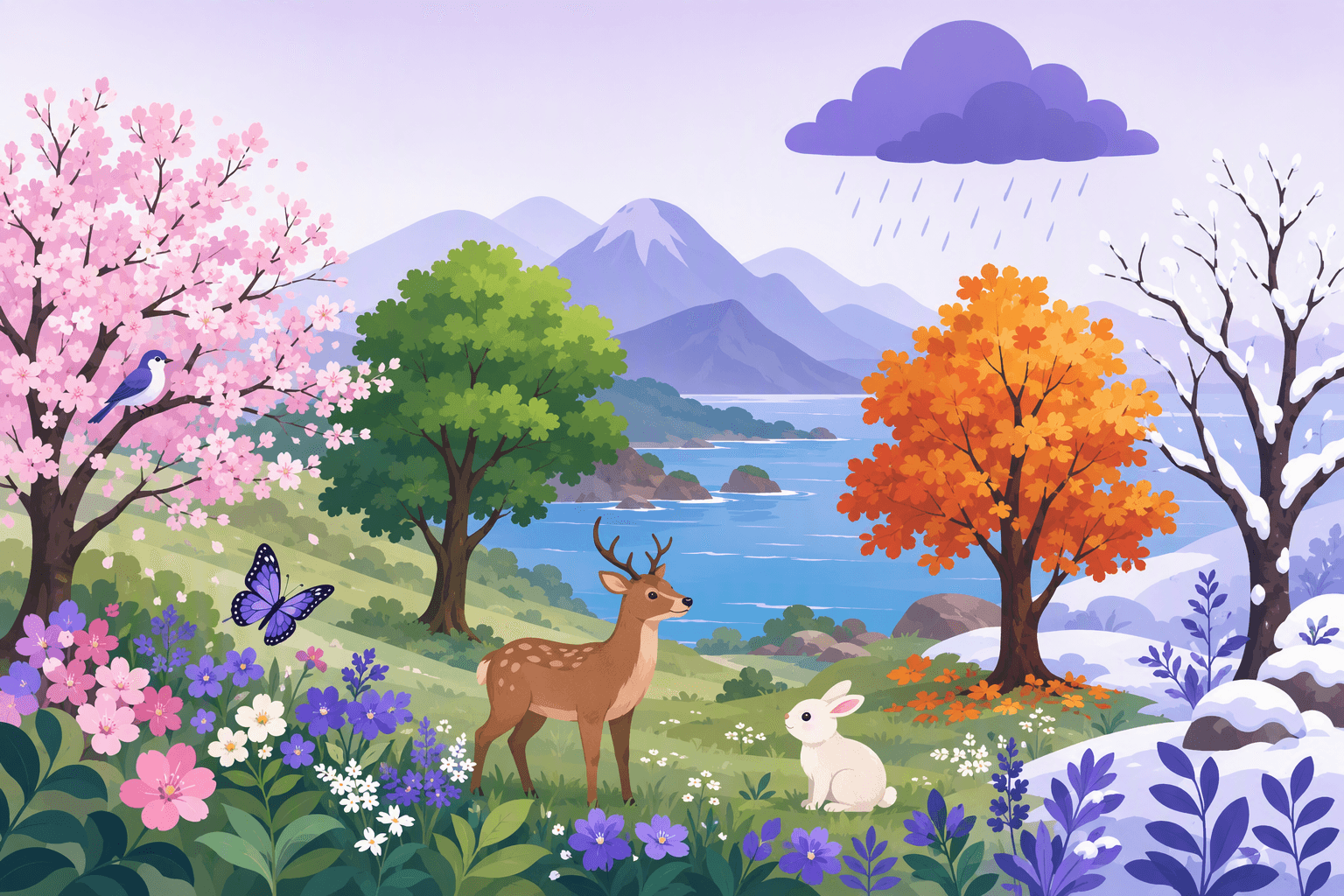
Korean landscape words
Korea's terrain makes landscape terms especially useful. 산 /san/ is mountain, 강 /kaŋ/ is river, and 섬 /sʌm/ is island. You will see all three in travel content and place names.
The Korean peninsula has thousands of islands, concentrated heavily along the southwest coast. That is why 섬 /sʌm/ appears so frequently in regional geography, while 도 /to/ can mean island when it follows a place name, as in 제주도 /tɕe.dʑu.do/.
산
산 /san/ means mountain. It can stand alone, but it is also attached to mountain names, usually after the specific name: 한라산 /hal.la.san/, Hallasan, and 설악산 /sʌl.ak̚.san/, Seoraksan.
Korean hiking culture is not limited to elite climbers. Families, coworkers, retirees, and students all hike, often wearing practical trail clothing and stopping for food afterward. David Mason's Spirit of the Mountains examines the deep role mountains play in Korean religious sites, local history, and spiritual traditions.
바다
바다 /pa.da/ means sea. In daily Korean, it is the standard word for the sea or ocean, whether someone is going to the east coast, visiting Busan, or talking about a seaside vacation.
A common phrase is 바다에 가고 싶어요 /pa.da.e ka.ko ɕi.pʌ.jo/, meaning I want to go to the sea. The particle 에 /e/ marks the destination, a pattern you will meet often in Korean travel phrases.
숲
숲 /sup̚/ means forest. Its spelling has a doubled consonant at the beginning and a final consonant at the end, but the spoken word is short and compact.
You may hear 숲길 /sup̚.k͈il/, forest path, in tourism and wellness contexts. Korea's forest culture also includes 치유의 숲 /tɕʰi.ju.ɰi sup̚/, healing forest, a phrase used for designated woodland programs focused on rest and wellbeing.
🌍 Mountains are everyday places
In Korea, a mountain is not necessarily remote wilderness. Many cities have accessible trails, temples, cable cars, restaurants, and neighborhood entrances close to mountain paths. Saying you went hiking, 등산했어요 /tɯŋ.san.hɛs͈ʌ.jo/, can describe a very ordinary weekend activity.
Weather words in Korean
Weather vocabulary is high-frequency Korean because it helps you make plans, show consideration, and begin small talk. The general word is 날씨 /nal.s͈i/, weather. The Korea Meteorological Administration uses many of the same core terms below in public forecasts.
| English | Korean | Pronunciation | Note |
|---|---|---|---|
| Weather | 날씨 | nal-SSHEE | Useful for forecasts and small talk. |
| Sun | 해 | heh | Can also refer to daytime sunlight. |
| Sunlight | 햇빛 | het-bbit | Light from the sun. |
| Sky | 하늘 | hah-neul | Sky or heavens, depending on context. |
| Cloud | 구름 | goo-reum | Cloud. |
| Rain | 비 | bee | Also used in compounds such as raincoat. |
| Snow | 눈 | noon | The same spelling can also mean eye. |
| Wind | 바람 | bah-rahm | Can also mean wish in another context. |
| Storm | 폭풍 | pok-poong | A strong storm. |
| Thunder | 천둥 | chuhn-doong | Thunder. |
| Lightning | 번개 | buhn-ggeh | Lightning. |
| Fog | 안개 | ahn-geh | Fog or mist. |
| Humidity | 습도 | seup-doh | Common in summer forecasts. |
| Fine dust | 미세먼지 | mee-seh-muhn-jee | A major air-quality topic in Korea. |
비
비 /pi/ means rain. To say it is raining, Korean uses 비가 와요 /pi.ɡa wa.jo/, literally rain comes. This is more natural than trying to translate the English sentence word for word.
For heavier rain, you may hear 장마 /tɕaŋ.ma/, the summer rainy season. It usually arrives in early to mid-summer and affects travel, laundry, commuting, and outdoor plans. Korea's humid summer weather makes 습도 /sɯp̚.to/, humidity, a practical word too.
눈
눈 /nun/ can mean snow, but it can also mean eye. Context makes the meaning clear. 눈이 와요 /nu.ni wa.jo/ means it is snowing, while 눈이 예뻐요 /nu.ni je.p͈ʌ.jo/ means the eyes are pretty.
This double meaning is useful for learners because it shows why Korean cannot always be translated one word at a time. Ho-min Sohn's The Korean Language emphasizes how context and grammatical particles work together to clarify meaning in Korean.
미세먼지
미세먼지 /mi.se.mʌn.dʑi/ means fine dust or particulate pollution. It is not a poetic nature word, but it is essential modern weather vocabulary in Korea.
On days with high levels, people check an air-quality app, wear masks outdoors, or say 미세먼지가 심해요 /mi.se.mʌn.dʑi.ɡa ɕim.hɛ.jo/, meaning the fine dust is bad. This is a particularly Korean real-life topic that many beginner word lists miss.
Plants, flowers, and seasonal nature
Korean seasonal vocabulary is rich because spring blossoms and autumn leaves shape leisure, fashion, food, and domestic travel. The Korea National Arboretum documents extensive native plant resources, but you only need a small set of words to begin recognizing what people are talking about.
| English | Korean | Pronunciation | Note |
|---|---|---|---|
| Tree | 나무 | nah-moo | Tree or wood, depending on context. |
| Leaf | 잎 | eep | Often pronounced with a short final sound. |
| Flower | 꽃 | kkot | Common in songs and spring expressions. |
| Grass | 풀 | pool | Grass, herb, or plant material. |
| Seed | 씨앗 | sshee-at | Seed. |
| Cherry blossom | 벚꽃 | beot-kkot | A major spring viewing tradition. |
| Autumn foliage | 단풍 | dahn-poong | Red and yellow autumn leaves. |
| Pine tree | 소나무 | soh-nah-moo | A traditional symbol of endurance. |
| Bird | 새 | seh | Bird. |
| Butterfly | 나비 | nah-bee | Butterfly. |
| Fish | 물고기 | mool-goh-gee | Fish in the general sense. |
| Deer | 사슴 | sah-seum | Deer. |
| Squirrel | 다람쥐 | dah-rahm-jwee | Common in woodland imagery. |
꽃
꽃 /k͈ot̚/ means flower. You will hear it in literal descriptions, names, songs, and idioms. 꽃이 피다 /k͈o.tɕʰi pʰi.da/ means for a flower to bloom.
The most famous spring word is 벚꽃 /pʌt̚.k͈ot̚/, cherry blossom. Cherry-blossom forecasts attract enormous attention in Korea, and parks, university campuses, river paths, and palace grounds become crowded during the brief blooming period.
단풍
단풍 /tan.pʰuŋ/ means autumn foliage, especially vivid leaves in red, orange, and yellow. It does not mean one individual leaf. For a leaf, use 잎 /ip̚/.
People often travel to national parks to see 단풍 /tan.pʰuŋ/. A useful sentence is 단풍 보러 가요 /tan.pʰuŋ po.rʌ ka.jo/, meaning we are going to see the autumn leaves. This seasonal use of 보러 가다 /po.rʌ ka.da/, to go in order to see, is a useful pattern for travel Korean.
소나무
소나무 /so.na.mu/ means pine tree. Pines are a long-standing symbol of resilience and constancy in Korean visual culture because they remain green through winter.
You may see pine trees around temples, palaces, and mountain trails. The word also appears in place names and traditional art, where natural imagery can signal more than scenery. Laurel Kendall's work on Korean ritual and belief provides useful context for how landscapes, plants, ancestors, and local spiritual practices can overlap.
🌍 Spring and autumn have different nature vocabularies
Spring is closely associated with 벚꽃 /pʌt̚.k͈ot̚/, while autumn is associated with 단풍 /tan.pʰuŋ/. Both can describe scenery, but they also signal a social activity: meeting friends, taking photos, eating outdoors, or planning a short trip around a seasonal peak.
Useful Korean nature sentences
Memorizing isolated nouns helps, but short sentence patterns turn vocabulary into conversation. Korean often omits the subject when it is obvious, so these phrases sound natural without an explicit word for I or we.
| Korean | IPA | Meaning |
|---|---|---|
| 날씨가 좋아요. | /nal.s͈i.ɡa tɕo.a.jo/ | The weather is nice. |
| 비가 와요. | /pi.ɡa wa.jo/ | It is raining. |
| 바람이 많이 불어요. | /pa.ram.i ma.ni pu.rʌ.jo/ | The wind is blowing a lot. |
| 하늘이 정말 예뻐요. | /ha.nɯ.ri tɕʌŋ.mal je.p͈ʌ.jo/ | The sky is really pretty. |
| 산에 가고 싶어요. | /sa.ne ka.ko ɕi.pʌ.jo/ | I want to go to the mountain. |
| 꽃이 피었어요. | /k͈o.tɕʰi pʰi.ʌs͈ʌ.jo/ | The flowers have bloomed. |
| 단풍이 아름다워요. | /tan.pʰuŋ.i a.rɯm.ta.wʌ.jo/ | The autumn foliage is beautiful. |
| 공기가 맑아요. | /koŋ.ɡi.ɡa mal.ka.jo/ | The air is clear. |
The phrase 공기가 맑아요 /koŋ.ɡi.ɡa mal.ka.jo/ is especially useful after rain or during a countryside trip. 공기 /koŋ.ɡi/ means air, and 맑다 /malk̚.ta/ means clear or clean in the sense of air, water, weather, or even a bright voice.
For a warmer response to someone sharing nature photos, try 정말 예뻐요 /tɕʌŋ.mal je.p͈ʌ.jo/, really beautiful. If the photo comes from a close friend or partner, you can connect this vocabulary with phrases from our guide to saying I love you in Korean.
How to remember Korean nature vocabulary
Learn words through scenes, not alphabetical lists. Picture a rainy drama scene for 비 /pi/, a mountain trail for 산 /san/, and a spring park for 벚꽃 /pʌt̚.k͈ot̚/. Visual context makes the word easier to retrieve when you hear it later.
Use weather as a daily mini-practice. Check the forecast and say one sentence aloud: 오늘 비가 와요 /o.nɯl pi.ɡa wa.jo/, it is raining today, or 오늘 하늘이 맑아요 /o.nɯl ha.nɯ.ri mal.ka.jo/, the sky is clear today.
Finally, listen for these words in Korean media. Nature scenes in dramas often carry emotional meaning: rain can frame a difficult moment, cherry blossoms can signal a new beginning, and mountains can represent rest or distance. For more practical vocabulary practice through real contexts, explore how to learn Korean with K-dramas and revisit vocabulary in clips rather than memorizing it once.
💡 Learn the weather pattern first
The pattern noun plus 가 or 이 plus 와요 is extremely useful. Practice 비가 와요 /pi.ɡa wa.jo/, 눈이 와요 /nu.ni wa.jo/, and 바람이 불어요 /pa.ram.i pu.rʌ.jo/. With just three sentences, you can describe several common weather conditions naturally.
Nature vocabulary gives you a way to talk about more than objects. With 산 /san/, 바다 /pa.da/, 비 /pi/, 꽃 /k͈ot̚/, and 단풍 /tan.pʰuŋ/, you can understand seasonal plans, compliment a view, follow weather updates, and notice the cultural meaning built into Korean landscapes.
Frequently Asked Questions
What is nature in Korean?
What are the most useful Korean nature words for beginners?
How do Koreans talk about the weather?
Does Korean have separate words for spring flowers and autumn leaves?
Why are mountains important in Korean culture?
Sources & References
- National Institute of Korean Language, Standard Korean Language Dictionary, accessed 2026
- Korea Forest Service, Forest and Mountain Statistics, accessed 2026
- Korea Meteorological Administration, Weather Terminology and Climate Information, accessed 2026
- Ethnologue, Korean, 27th edition, 2024
- Korea National Arboretum, National Plant Resources Information, accessed 2026
Start learning with Wordy
Watch real movie clips and build your vocabulary as you go. Free to download.