Korean Language Overview: Where It’s Spoken, How It Works, and How to Learn It
Quick Answer
Korean is the national language of South Korea and North Korea, written mainly in Hangul, a highly systematic alphabet. It has topic markers, verb endings that show politeness and mood, and sentence order that often places the verb at the end. With consistent pronunciation rules and clear grammar patterns, Korean is very learnable if you focus early on Hangul, listening, and speech levels.
Korean is a major world language spoken by tens of millions of people, written in the remarkably learnable Hangul alphabet, and built around clear grammar patterns like particles and verb endings that encode politeness. If you want a practical Korean language overview, the essentials are: where Korean is spoken, how Hangul maps sounds to letters, why verbs come last, and how speech levels shape everyday conversation.
| English | Korean | Pronunciation | Formality |
|---|---|---|---|
| Hello | 안녕하세요 | ahn-nyung-hah-SEH-yoh | polite |
| Hi (casual) | 안녕 | ahn-NYUNG | casual |
| Thank you | 감사합니다 | kahm-sah-hahm-NEE-dah | formal |
| Sorry / Excuse me | 죄송합니다 | jweh-song-hahm-NEE-dah | formal |
| Yes | 네 | neh | polite |
| No | 아니요 | ah-nee-yoh | polite |
Where Korean is spoken (and why it matters for learners)
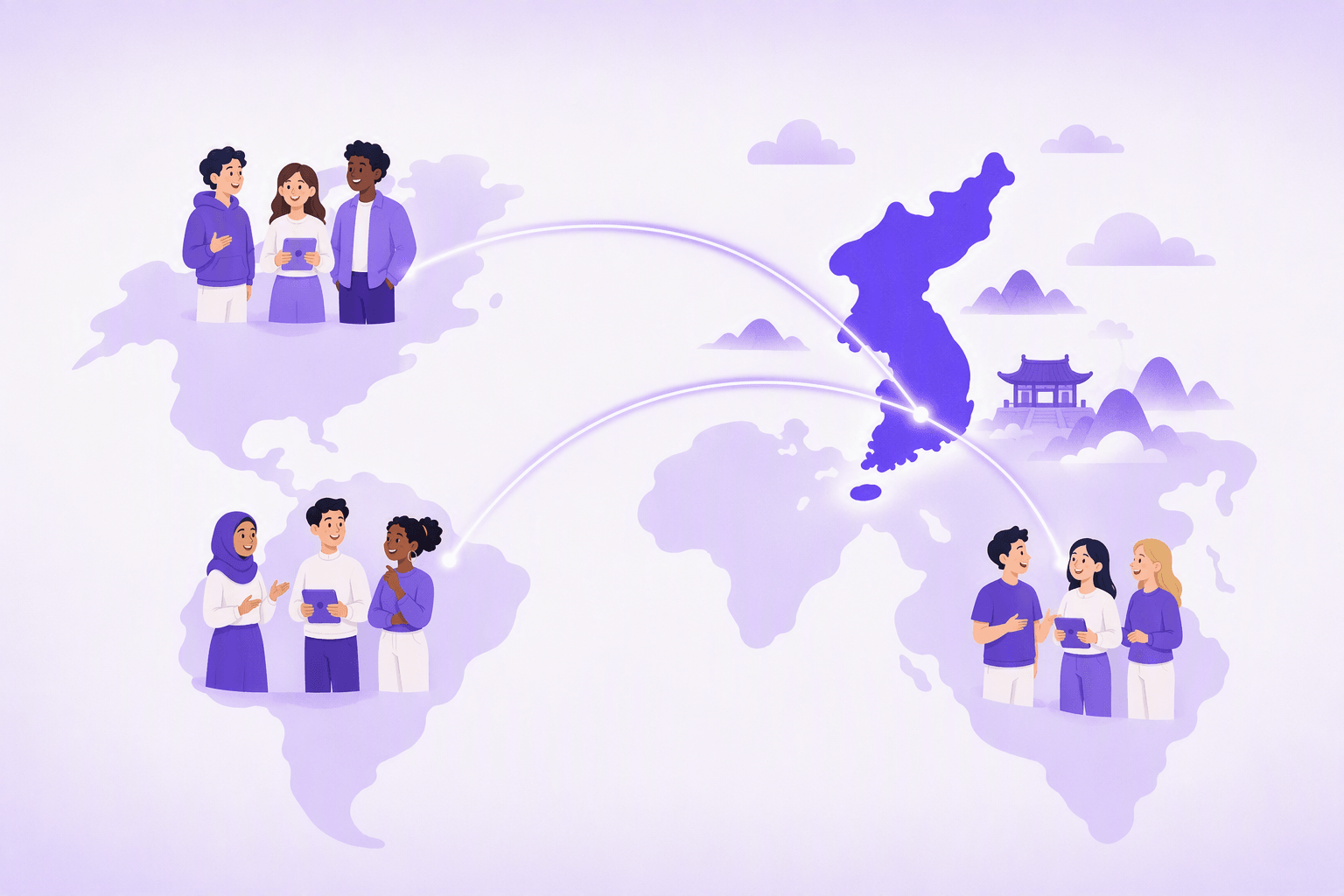
Korean is the national language of South Korea and North Korea, and it is also widely used in diaspora communities. Ethnologue (27th edition, 2024) estimates roughly 82 million native speakers worldwide, which makes Korean one of the most significant languages you can learn for travel, work, and media.
For learners, “where it’s spoken” is not just trivia. It affects accent exposure, vocabulary choices, and even what subtitles you see in shows.
South Korea and North Korea: one language, different standards
South Korea’s standard language (표준어, pyo-jun-uh, “pyoh-JOON-uh”) is based on Seoul speech. North Korea’s standard (문화어, mun-hwa-uh, “moon-HWA-uh”) is based on Pyongyang norms.
Most grammar is shared, and basic conversation is mutually intelligible. Differences show up more in preferred vocabulary, some pronunciations, and how loanwords are handled.
Diaspora Korean: real Korean outside Korea
Large Korean-speaking communities exist in the United States, China, and Japan, among other countries. In some communities, you will hear “heritage Korean” that mixes older vocabulary, regional features, and code-switching.
If your goal is conversation, it helps to train your ear on multiple voices. Wordy’s clip-based approach is useful here because you can hear many speakers, not just one textbook narrator. If you are choosing what to watch, start with our picks of Korean dramas for learners.
Hangul: the writing system that makes Korean easier than it looks
Hangul (한글, han-geul, “HAHN-geul”) is one of the biggest reasons Korean is approachable. It is an alphabet, not a picture-based system, and it was designed to represent sounds systematically.
The key mindset shift is that Hangul letters are grouped into syllable blocks. You read left to right inside each block, and blocks go left to right across the line.
How syllable blocks work
A Korean “character” is often a block like 한 or 국, but each block is built from smaller letters:
- 한 = ㅎ (h) + ㅏ (a) + ㄴ (n)
- 국 = ㄱ (g/k) + ㅜ (u) + ㄱ (g/k)
This means you can learn to decode words quickly, even before you know what they mean. That is a huge advantage for vocabulary growth.
Pronunciation: consistent, but with predictable sound changes
Hangul is consistent, but spoken Korean has sound changes, especially when consonants meet across syllables. Learners often feel confused because they “know the letters” but still mishear words.
A practical approach is: learn the basic letter sounds first, then add sound-change patterns through listening. Pair reading with audio, and read out loud.
💡 Fast Hangul practice that actually works
Pick 20 short words from subtitles, read them out loud, then replay the line and shadow the actor. You are training decoding and real timing together, which is closer to how Korean is processed in conversation.
Korean sentence structure: why the verb often comes last
Korean is typically described as SOV (subject-object-verb). In many everyday sentences, the verb comes at the end, and the meaning is built up through particles and endings.
English speakers often try to translate word-for-word and get stuck. Instead, listen for the final verb ending, because that is where tense, politeness, and mood are packed.
Particles: small markers that do big work
Particles attach to nouns and show their role in the sentence. You do not need to master every particle at once, but you should recognize the core ones early:
- 은/는 (topic marker): “eun/neun” (uhn/nuhn)
- 이/가 (subject marker): “ee/gah”
- 을/를 (object marker): “eul/reul” (uhl/reul)
- 에/에서 (location/time): “eh/eh-suh”
Particles are not always spoken clearly in fast speech, and they can be dropped in casual conversation. Still, they are essential for understanding how Korean organizes information.
Topic vs subject: the “what we’re talking about” idea
Korean often frames a sentence with a topic, then comments about it. This is why you will see sentences that feel like: “As for X, (it) is Y.”
This topic-comment structure is one reason Korean can sound indirect or context-heavy. It is not vague, it is efficient when both speakers share context.
Politeness and speech levels: the social engine of Korean
Korean is famous for honorifics and politeness levels, and for good reason. Verb endings change depending on who you are talking to, your relationship, and the setting.
If you learn only dictionary form, you will understand subtitles but struggle to speak naturally. If you learn only polite -요 form, you will speak, but you might not recognize casual speech in shows.
"Honorifics in Korean are not merely 'polite forms' but a grammaticalized way of encoding social relationships and speaker stance."
Song, Jae Jung, The Korean Language: Structure, Use and Context (Routledge)
The forms you will hear most as a learner
In modern South Korea, learners most often need:
- 해요체 (hae-yo-che, “heh-YOH-che”): polite everyday speech, ending in -요
- 합니다체 (ham-ni-da-che, “hahm-nee-DAH-che”): formal speech, ending in -습니다/-ㅂ니다
- 해체 (hae-che, “heh-che”): casual speech among close friends, often ending in -아/-어
A simple strategy is to speak in 해요체 first, and learn to recognize the other two through listening.
Honorific marker -시-: respect inside the verb
One of the most useful pieces is -시- (si, “shee”), inserted into verbs to show respect toward the subject (often the listener, but not always).
You will see it in common phrases like:
- 계세요 (gye-se-yo, “gyeh-SEH-yoh”) as an honorific form related to “to be/exist”
- 하세요 (ha-se-yo, “hah-SEH-yoh”) as in “please do”
This is why Korean politeness is not only about “adding please.” It is built into the grammar.
⚠️ A common learner mistake
Do not assume -요 always means “polite enough.” In customer service, presentations, and official settings, -습니다/-ㅂ니다 is often expected. In close relationships, -요 can feel distant. Match the setting, not just the words.
Vocabulary: why Korean words feel “new,” and how to learn them faster
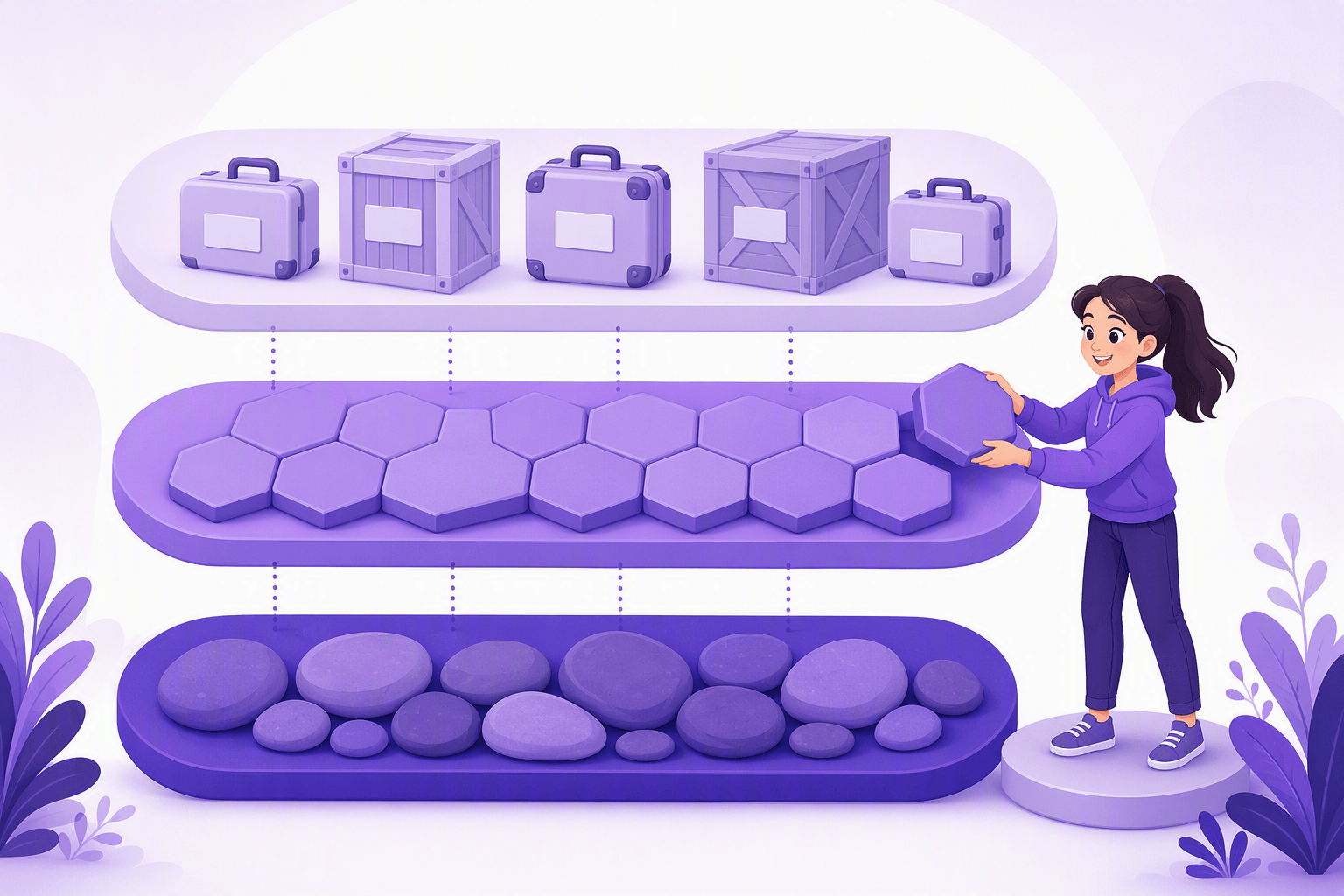
Korean vocabulary comes from multiple layers. Understanding those layers makes memorization easier because you start seeing patterns instead of isolated words.
Native Korean vs Sino-Korean vs loanwords
- Native Korean words are often used in daily life and core verbs.
- Sino-Korean words (from Chinese characters, 한자 han-ja, “HAHN-jah”) are common in academic, formal, and abstract vocabulary.
- Loanwords, especially from English, are frequent in modern life, often written in Katakana-like style but using Hangul.
You do not need to learn Hanja to speak Korean, but recognizing Sino-Korean patterns can help you guess meanings in advanced vocabulary.
Konglish: helpful, but not always what you think
“Konglish” refers to English-derived words that may shift meaning in Korean. Examples include words used for convenience, branding, or shortened forms.
This matters in real listening because you might hear a familiar sound and misunderstand the meaning. Treat loanwords as Korean words that happen to have English ancestry.
🌍 Why subtitles can mislead you
Korean dialogue often relies on relationship cues and implied subjects, so subtitles may add names or pronouns that are not spoken. When you study with clips, focus on what is actually said, then compare the translation as a separate step.
Korean in real life: greetings, goodbyes, and affection
If you only learn “dictionary Korean,” you will miss the social texture that makes Korean sound natural. Start with the phrases that appear constantly in real scenes, then expand.
For practical phrase sets, use these guides alongside this overview:
안녕하세요
안녕하세요 (ahn-nyung-hah-SEH-yoh) is the safest everyday greeting. It is polite, neutral, and works with strangers, coworkers, and service staff.
You will also hear it used as a “soft reset” in conversation, similar to “Hi” when you approach someone again.
안녕
안녕 (ahn-NYUNG) is casual. It can mean “hi” or “bye,” and the exact meaning depends on the situation and intonation.
In dramas, you will hear it between close friends, siblings, and sometimes from adults to children.
사랑해
사랑해 (sah-rahng-HEH) is intimate and casual, used with partners or very close relationships. 사랑해요 (sah-rahng-HEH-yoh) adds politeness and can feel softer or more careful.
In many real couples, affection is shown more through actions and routine phrases than through frequent “I love you” statements. That is cultural style, not lack of emotion.
Korean pronunciation: what to focus on first
Korean pronunciation is learnable, but it has a few high-impact features that affect comprehension.
Tense consonants and aspiration
Korean contrasts plain, aspirated, and tense consonants. Learners often hear them as the “same” at first, but native speakers use them to distinguish words.
A practical listening goal is not perfect production on day one. It is being able to hear the difference reliably, especially for ㄱ/ㅋ/ㄲ, ㄷ/ㅌ/ㄸ, ㅂ/ㅍ/ㅃ, ㅅ/ㅆ.
Rhythm and reduction in fast speech
In casual speech, syllables compress and particles soften. This is why textbook audio can feel easy, while dramas feel fast.
Train with short clips and repeat them. If you want a broader foundation in listening-first learning, see our beginner language learning tips.
How to learn Korean efficiently in 2026 (a realistic plan)
A good Korean plan balances three things: decoding (Hangul), comprehension (listening), and production (speaking and writing). Most learners overinvest in one and stall.

Step 1: Learn Hangul, then immediately use it
Spend a short, focused burst learning letters and syllable blocks. Then switch to reading real words with audio.
Avoid romanization as your main input. It is useful as a temporary pronunciation note, but it delays real reading.
Step 2: Build a “high-frequency grammar” toolkit
You do not need every grammar point. You need the ones that show up constantly:
- -요 polite endings
- past tense patterns
- negation (안, 못)
- basic connectors like 그리고 (geu-ri-go, “geu-REE-go”), 그래서 (geu-rae-seo, “geu-REH-suh”)
Once you recognize these, subtitles stop looking like noise and start looking like structure.
Step 3: Use clips to connect sound to meaning
Movies and TV are dense with repeated social patterns: greetings, requests, teasing, apologies, and status language. That repetition is exactly what learners need.
Wordy’s approach is built around this: short scenes, interactive subtitles, and review. If you want more ideas for what to watch, start at the Korean learning page and browse the blog for level-appropriate media lists.
Step 4: Add speaking in small, controlled doses
Speaking helps, but only if you can hear what you are trying to say. Use “shadowing” (repeat immediately after audio) and “sentence mining” (save one useful sentence per day).
Aim for clarity and correct politeness first. Speed comes later.
💡 A simple daily routine (20 minutes)
Do 5 minutes of Hangul reading out loud, 10 minutes of clip listening and shadowing, and 5 minutes of review. This keeps pronunciation, grammar recognition, and vocabulary moving together instead of competing for attention.
Cultural notes that change how Korean sounds
Korean is not only a set of words. It is a system for managing relationships, distance, and warmth.
Titles and roles matter more than names
In many contexts, people use role nouns instead of names: 선배 (seon-bae, “sun-BEH”), 후배 (hu-bae, “hoo-BEH”), 사장님 (sa-jang-nim, “sah-JAHNG-neem”). This shows respect and clarifies the relationship.
If you translate these as “sir” or “boss,” you lose nuance. Learn them as social vocabulary.
“No” is often softened
Direct refusal can sound harsh, so Korean often uses indirect phrasing, hesitation, or alternatives. You will hear patterns like “좀…” (jom, “johm,” meaning “a bit…”) to soften a request or refusal.
This is not dishonesty. It is politeness strategy, similar to how many languages protect the listener’s “face” in conversation.
Swearing exists, but it is socially risky
Korean has strong taboo language, and it is tied to age, hierarchy, and setting. If you are curious, read our guide to Korean swear words, but treat it as comprehension training first, not speaking material.
⚠️ Responsible use
In Korean, using the wrong speech level or taboo language can damage relationships quickly, especially with strangers or older people. If you are not sure, stay in polite -요 speech and avoid insults entirely. You will still sound natural and friendly.
The bottom line: what makes Korean “click”
Korean becomes much easier once you stop translating word-by-word and start listening for structure: particles that frame nouns, and verb endings that carry the sentence’s social meaning. Learn Hangul early, prioritize real listening, and treat politeness as grammar, not decoration.
When you are ready to expand beyond this overview, practice with everyday scenes and phrase sets, then revisit grammar with examples you have actually heard. For more clip-based learning ideas and curated guides, explore the Wordy blog and start a focused plan on /learn/korean.
Frequently Asked Questions
How many people speak Korean?
Is Korean hard to learn for English speakers?
How long does it take to learn Hangul?
Do South and North Korea speak the same Korean?
What should I learn first in Korean?
Sources & References
- Ethnologue. Korean. Ethnologue: Languages of the World, 27th edition, 2024.
- National Institute of Korean Language (국립국어원). Korean Language and Hangul resources, accessed 2026.
- King Sejong Institute Foundation. Korean language education materials and curriculum guidance, accessed 2026.
- Sohn, Ho-min. The Korean Language. Cambridge University Press, 1999.
- Song, Jae Jung. The Korean Language: Structure, Use and Context. Routledge, 2005.
Start learning with Wordy
Watch real movie clips and build your vocabulary as you go. Free to download.


