Korean Holidays and Festivals: 14 Celebrations You’ll Actually See (and What People Say)
Quick Answer
Korean holidays and festivals revolve around family, respect, seasonal food, and community events. The biggest traditional holidays are 설날 (Seollal, Lunar New Year) and 추석 (Chuseok, harvest festival), while modern public holidays include 광복절 (Liberation Day) and 한글날 (Hangul Day). Knowing the core greetings and etiquette helps you participate naturally.
Korean holidays and festivals are a mix of traditional lunar-calendar family days (especially 설날 and 추석), modern national commemorations (like 광복절 and 한글날), and big public events (like 보령 머드 축제). If you know what each day is for, plus a few polite phrases and food customs, you can participate without guessing.
Korean is spoken by roughly 82 million people worldwide (Ethnologue, 27th ed.). Most holiday culture you see in media comes from South Korea, but many traditions are shared across the Korean-speaking world, with differences in emphasis and public observance.
If you want the basics for greeting people during holiday visits, start with our how to say hello in Korean and how to say goodbye in Korean. Those two pages cover the polite speech levels that show up constantly during family gatherings.
How Korean holidays work (so the calendar makes sense)
Korean holidays fall into three buckets: lunar holidays, solar public holidays, and festivals that are more like city-wide events. The first two affect travel and business hours the most.
Lunar holidays: family, food, and respect
설날 (Seollal) and 추석 (Chuseok) follow the lunar calendar, so the dates change every year. They are also the holidays most tied to family hierarchy, formal greetings, and traditional foods.
If you have studied politeness, this is where it becomes real. Research on politeness strategies (Brown and Levinson, Politeness: Some Universals in Language Usage, Cambridge University Press) is useful here because Korean holiday talk is full of face-saving: indirect requests, honorifics, and careful greetings to elders.
Solar public holidays: modern history and civic rituals
These are fixed on the Gregorian calendar. They include independence commemorations, memorial days, and national identity days like 한글날.
For language learners, these days are great listening practice because TV and YouTube content becomes predictable: speeches, documentaries, and street interviews repeat the same vocabulary.
Festivals: local identity and tourism
Festivals like the Boryeong Mud Festival are less about family and more about place-based culture. They are also easier for visitors because you can participate without knowing family etiquette.
The two biggest traditional holidays
If you only learn two Korean holidays deeply, make them these. They drive travel, gift-giving, and a lot of the holiday vocabulary you hear in dramas.
설날
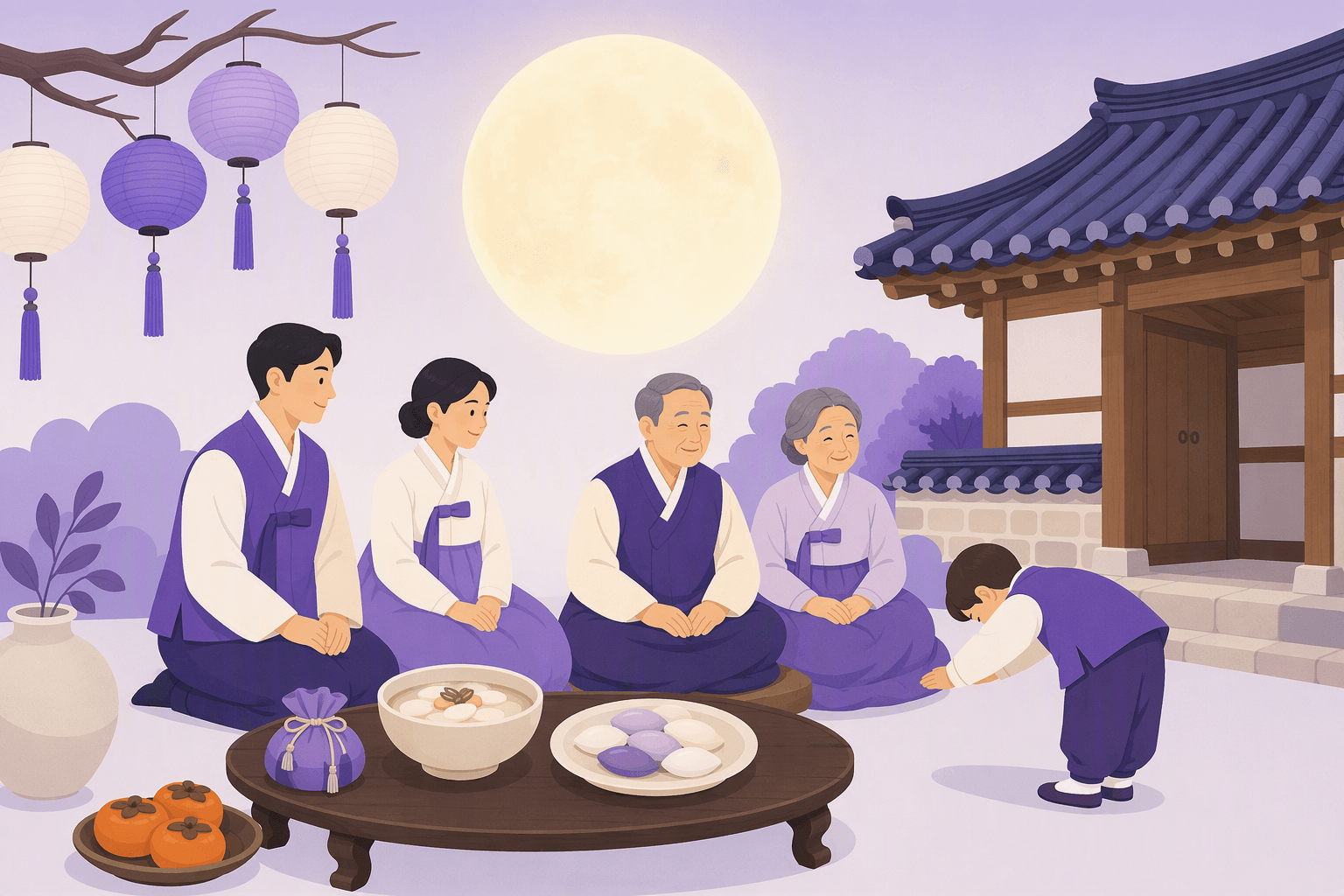
설날 (Seollal, seh-RAHL) is Lunar New Year, and it is the most important family holiday for many Koreans. People travel to their hometowns, visit elders, and share traditional foods.
A common formal greeting is:
- 새해 복 많이 받으세요 (seh-HEH bok MAH-nee bah-DEUH-seh-yoh): “Please receive lots of luck in the new year.”
You will also hear talk about 세배 (seh-BEH), the deep formal bow to elders, and 세뱃돈 (seh-BEH-don), New Year’s money given to children. Even if your family does not do every ritual, the vocabulary is everywhere in media.
🌍 What to bring if you visit a Korean home on Seollal
Fruit, premium snacks, or a neatly packaged gift set are common. If you are unsure, ask what is convenient, because hosts may already have too much food. In formal families, the presentation matters as much as the item.
Food you should recognize: 떡국 (tteok-guk, tteok-GOOK), rice cake soup. There is a strong cultural association between eating 떡국 and “becoming one year older,” so it shows up in jokes and small talk.
추석
추석 (Chuseok, CHOO-suhk) is the harvest festival, often described as the other major family travel holiday. Families gather, share food, and many visit ancestral graves or hold memorial rites, depending on family tradition.
The iconic food is 송편 (song-pyeon, song-PYUN), half-moon rice cakes often filled with sesame, beans, or chestnuts. You will see them in dramas as a visual shorthand for “it’s Chuseok.”
A safe message to coworkers or friends is:
- 추석 잘 보내세요 (CHOO-suhk jal boh-NEH-seh-yoh): “Have a good Chuseok.”
If you want a slightly warmer tone:
- 풍성한 한가위 보내세요 (POONG-sung-hahn hahn-GAH-wee boh-NEH-seh-yoh): “Have a plentiful Hangawi.”
- 한가위 is an older name for Chuseok, and it sounds traditional.
🌍 Why Chuseok feels emotionally intense
Chuseok is a homecoming holiday, and that can mean long travel, family expectations, and a lot of cooking. In modern Korea, you will also hear conversations about sharing household labor more fairly. Watching holiday episodes of variety shows is a good window into these changing norms.
Major national public holidays (what they commemorate)
These holidays are fixed-date and often come with ceremonies, flags, and history vocabulary. Korea.net and other public cultural resources summarize the official meaning and common observances (KOCIS, accessed 2026).
삼일절
삼일절 (sam-il-jeol, sahm-EEL-juhl) is March 1st Independence Movement Day. It commemorates the March 1 Movement of 1919, a major moment in modern Korean history.
You may see 태극기 (tae-geuk-gi, TEH-guk-gee), the Korean national flag, displayed at homes and public buildings. News coverage tends to include formal speech and historical terms, which is useful if you are building advanced listening skills.
광복절
광복절 (gwang-bok-jeol, gwahng-BOK-juhl) is Liberation Day, August 15. It marks liberation from Japanese colonial rule in 1945.
Expect speeches, documentaries, and interviews with older generations. The vocabulary overlaps with school history terms, so it is a good day to study with subtitles and pause often.
개천절
개천절 (gae-cheon-jeol, geh-CHUN-juhl) is National Foundation Day, October 3. It is linked to the founding myth of Gojoseon and the idea of national origins.
Even if you are not focused on mythology, it is a useful cultural reference. It shows up in political speeches and museum programming.
한글날
한글날 (hahn-geul-nahl, HAHN-geul-nahl) is Hangul Day, October 9. It celebrates the Korean writing system and its cultural importance.
The National Institute of Korean Language (국립국어원) is a key authority on Korean language standards and public language education (NIKL, accessed 2026). Around 한글날, you will see content about spelling, loanwords, and “correct” Korean.
In The Korean Language, Ho-min Sohn frames Korean as a language where social relationships are built into grammar through speech levels and honorifics. Hangul Day is when that idea becomes visible in public conversation because people talk about language as identity, not just communication.
현충일
현충일 (hyeon-chung-il, hyuhn-CHOONG-eel) is Memorial Day, June 6. It honors those who died in service.
The tone is solemn. If you are messaging someone, keep it respectful and neutral, and avoid celebratory language.
어린이날
어린이날 (eo-rin-ee-nahl, uh-REEN-ee-nahl) is Children’s Day, May 5. Families go to parks, zoos, museums, and kid-focused events.
This day is great for learners because the language in public spaces is simpler: signs, announcements, and family talk. If you need everyday nouns, pair it with our 100 most common Korean words to catch more of what you hear.
석가탄신일
석가탄신일 (seok-ga-tan-shin-il, suk-GAH-tahn-SHEEN-eel) is Buddha’s Birthday, a public holiday in South Korea. Temples often hang lanterns, and there are public lantern displays in some areas.
Even if you are not Buddhist, it is a visually memorable cultural event. It also introduces polite vocabulary you will hear at temples, like 조용히 (jo-yong-hee, joh-YOHNG-hee), “quietly,” and 공양 (gong-yang, gohng-YAHNG), offerings.
성탄절
성탄절 (seong-tan-jeol, sung-TAHN-juhl) is Christmas, December 25, and it is a public holiday in South Korea. It is celebrated both religiously and as a couples’ holiday, with lights, concerts, and cafes.
If you are dating, you might also want language for affection. Our how to say I love you in Korean covers options beyond 사랑해 (sah-RANG-heh), including more polite and more serious forms.
Seasonal and cultural festivals you’ll actually see
These are not always national holidays, but they are common in travel plans, social media, and TV. Some are also recognized internationally through UNESCO’s Intangible Cultural Heritage lists (UNESCO ICH, accessed 2026).
보령 머드 축제
보령 머드 축제 (bo-ryeong meo-deu chuk-je, boh-RYUHNG muh-DEU chook-JEH) is the Boryeong Mud Festival. It is famous with both Koreans and international visitors.
The language you hear is casual and playful. You will also hear a lot of English loanwords in announcements, which can be a confidence boost for beginners.
진주 남강 유등축제
진주 남강 유등축제 (jin-ju nam-gang yu-deung-chuk-je, jeen-JOO nahm-GAHNG yoo-DEUNG-chook-JEH) is the Jinju Namgang Lantern Festival. It is visually striking and very photo-friendly.
If you want to practice describing scenes, this is perfect: 빛 (bit, beet) “light,” 강 (gang, gahng) “river,” and 예쁘다 (yeh-BBEU-dah) “to be pretty.”
안동 국제 탈춤 페스티벌
안동 국제 탈춤 페스티벌 (ahn-dong guk-je tal-chum peh-seu-ti-beol, ahn-DOHNG gook-JEH tahl-choom PEH-seu-tee-buhl) is a mask dance festival in Andong.
Mask dance traditions connect to satire and social commentary. The Cultural Heritage Administration (Korea Heritage Service) is a key source for understanding intangible heritage categories and how traditional performances are preserved (CHA, accessed 2026).
김장 문화 (seasonal tradition)
김장 (kim-jang, keem-JAHNG) is the seasonal making of kimchi, traditionally done in late autumn or early winter. UNESCO lists “Kimjang, making and sharing kimchi” as intangible cultural heritage (UNESCO ICH, accessed 2026).
Even if you do not personally make kimchi, you will hear the word 김장 in everyday talk. It can mean the event itself, the preparation, and sometimes the social obligation of sharing.
🌍 Kimjang is also about social networks
Kimjang is often described as food work, but it is also relationship work. Sharing kimchi reinforces ties between relatives, neighbors, and coworkers. For learners, it is a reminder that Korean food vocabulary often carries social meaning, not just ingredients.
대보름
정월대보름 (jeong-wol-dae-bo-reum, juhng-WOHL deh-BOH-reum) is the first full moon of the lunar year. Some people eat 오곡밥 (oh-gok-bap, oh-GOK-bahp), “five-grain rice,” and nuts like 부럼 (bu-reom, BOO-rum) as part of the tradition.
You might not see it as a huge public shutdown day, but you will see it referenced in cultural content and school materials.
What people actually say: useful holiday phrases (with pronunciation)
This section is about phrases you will hear out loud, with formality differences that matter. Use these as templates for texts, workplace messages, and family visits.
| English | Korean | Pronunciation | Formality |
|---|---|---|---|
| Happy Lunar New Year (formal) | 새해 복 많이 받으세요 | seh-HEH bok MAH-nee bah-DEUH-seh-yoh | formal |
| Have a good Chuseok (polite) | 추석 잘 보내세요 | CHOO-suhk jal boh-NEH-seh-yoh | polite |
| Have a good holiday (polite) | 연휴 잘 보내세요 | YUN-hyoo jal boh-NEH-seh-yoh | polite |
| Enjoy your day off (casual) | 푹 쉬어 | pook SHWEE-uh | casual |
| Long time no see (casual) | 오랜만이야 | oh-REN-mahn-ee-yah | casual |
| Take care on the way (polite) | 조심히 가세요 | joh-SHEEM-hee gah-SEH-yoh | polite |
A quick etiquette note: “polite” endings like -세요 show up constantly in holiday messages, even between people who are usually casual. Holidays push conversations slightly upward in formality, especially when you are addressing someone older, a boss, or a client.
💡 A simple holiday text template
If you are unsure what holiday someone celebrates, use 연휴 잘 보내세요 (YUN-hyoo jal boh-NEH-seh-yoh), meaning “Have a good long weekend/holiday break.” It works for Seollal, Chuseok, and multi-day public holiday stretches without sounding overly intimate.
Holiday etiquette that matters (and what learners often miss)
You do not need perfect manners to be welcomed, but a few behaviors make a big difference.
Greetings: match the relationship, not your mood
Korean greetings are relationship-sensitive. If you greet an elder with a casual tone, it can sound careless even if your words are friendly.
If you want a refresher on speech levels, our how to say hello in Korean guide is the fastest way to avoid awkward first impressions.
Shoes, seating, and pouring drinks
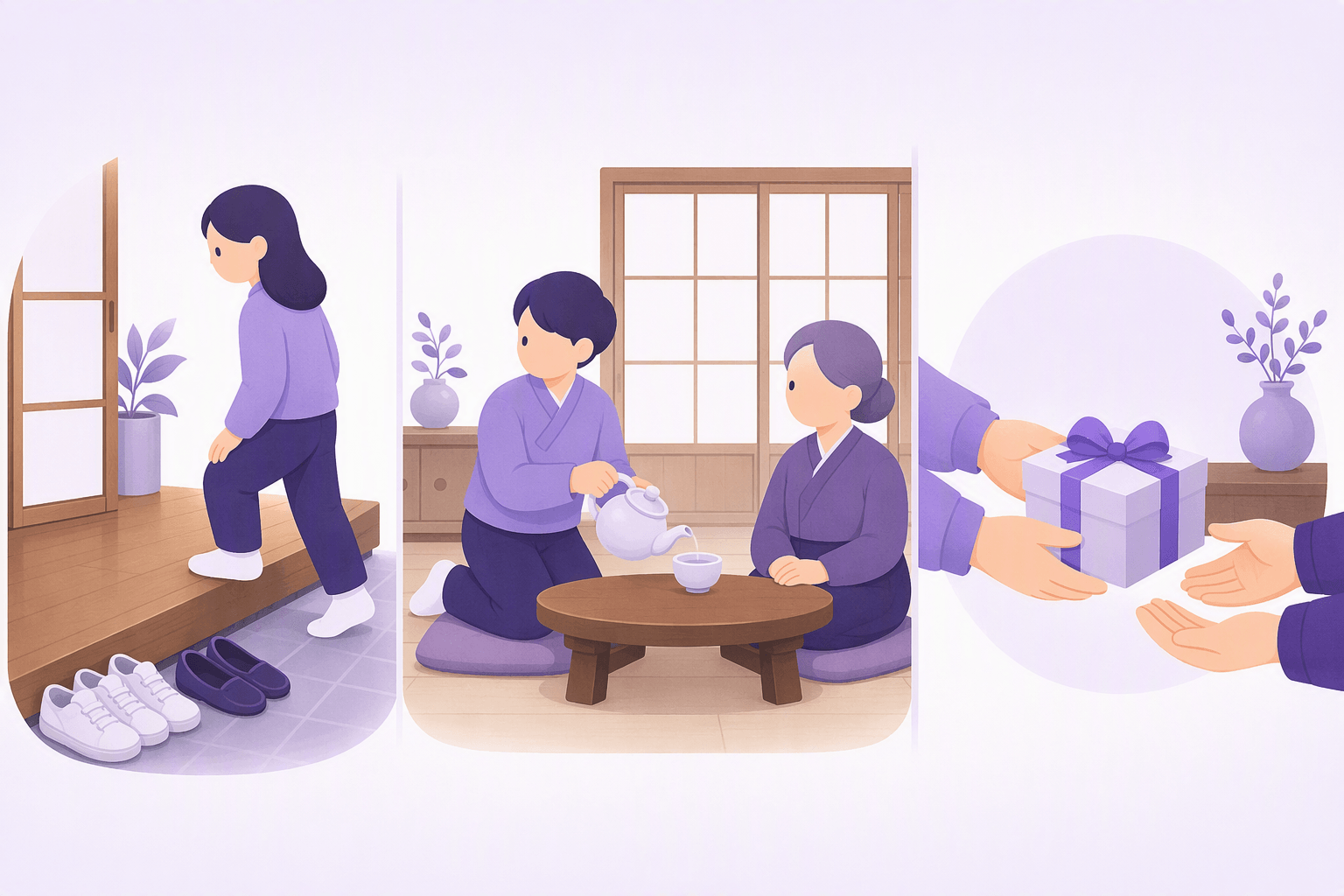
In homes, remove shoes unless you are clearly in a space where shoes are worn. At meals, elders are usually served first, and pouring drinks for others is common in many settings.
If alcohol is involved, you may see people turn slightly away from elders when drinking. Not everyone follows this strictly, but noticing it shows cultural awareness.
Gifts: avoid “too much,” aim for “thoughtful”
Holiday gifting can be generous, but it can also create 부담 (bu-dam, BOO-dahm), meaning “burden.” If you are visiting a family for the first time, a modest, nicely presented gift is usually better than an expensive one that creates pressure.
Swearing and joking: be careful with “holiday looseness”
Some gatherings get loud and casual, especially with close friends. But mixed-age family gatherings are not the place to test edgy slang.
If you are curious about what you might hear in dramas, keep it as recognition-only. Our guide to Korean swear words is written for understanding tone and severity, not for copying into family dinner conversation.
Learn holidays faster with movie and drama clips
Holidays are easy to learn through scenes because the visuals do half the work: 떡국 on the table, 송편 being made, suitcases in the hallway, crowded highways, and the same greeting lines repeated.
Use a simple method:
- Watch one holiday scene with Korean subtitles.
- Write down three phrases you actually heard.
- Rewatch and shadow the line with the same rhythm.
- Save the phrases and review them with spaced repetition.
If you want a structured approach to clip-based learning, read how to learn a language with movies. It explains why repeated, meaningful scenes build listening skill faster than random vocabulary lists.
A practical “holiday survival” checklist
Here is what to prepare if you will be in Korea during Seollal or Chuseok.
- Book travel early: trains and buses sell out, and highways get congested.
- Expect closures: small shops may close, and opening hours can change.
- Learn two greetings: 새해 복 많이 받으세요 and 추석 잘 보내세요.
- Bring a small gift if invited to a home.
- Keep your language polite by default, then relax if the other person clearly does.
If you want to keep building everyday Korean that shows up in every season, pair this article with 100 most common Korean words and practice them in real scenes.
At the end of the day, Korean holidays are less about “doing the ritual perfectly” and more about showing respect, sharing food, and reading the room. If you can do those three things, your Korean will sound natural even with simple sentences.
If you want to train your ear on the exact phrases people use during holiday episodes, Wordy’s Korean clip library is built for that kind of repeatable, subtitle-driven practice.
Frequently Asked Questions
What are the two biggest traditional holidays in Korea?
Do Koreans celebrate Lunar New Year or January 1?
What should I say to Koreans on Seollal or Chuseok?
Is Chuseok like Korean Thanksgiving?
What is Hangul Day and why does it matter?
Sources & References
- National Institute of Korean Language (국립국어원), Korean Language and Hangul resources, accessed 2026
- Korean Culture and Information Service (KOCIS), Korea.net cultural guides on national holidays, accessed 2026
- Cultural Heritage Administration (Korea Heritage Service), Intangible Cultural Heritage information pages, accessed 2026
- Ethnologue, 27th edition, 2024
- UNESCO Intangible Cultural Heritage Lists, Republic of Korea entries, accessed 2026
Start learning with Wordy
Watch real movie clips and build your vocabulary as you go. Free to download.


