Quick Answer
Korea officially uses international age, called 만 나이, for most legal and administrative purposes. The older Korean age system, where babies begin at one and everyone ages up on January 1, remains widely understood and still affects social conversation, school cohorts, and ideas about hierarchy.
The Korean age system traditionally counted a baby as one at birth and added a year to everyone’s age every January 1. Since June 2023, South Korea has used international age, called 만 나이 /man na.i/, for most official purposes, but the older system still matters for understanding Korean conversations, school cohorts, friendship dynamics, and respectful speech.
If you were born in 2000, for example, your traditional Korean age in 2026 would have been 27. Your international age is 25 or 26, depending on whether your birthday has passed. That gap is why age can seem confusing in Korean dramas, workplace conversations, and older online posts.
Korean is spoken by roughly 80 million people worldwide, including about 51 million people in South Korea. Age is not just a number in many Korean interactions: it can influence which greeting, title, and speech level feels appropriate. Start with our guide to saying hello in Korean to see how politeness changes even in a basic greeting.
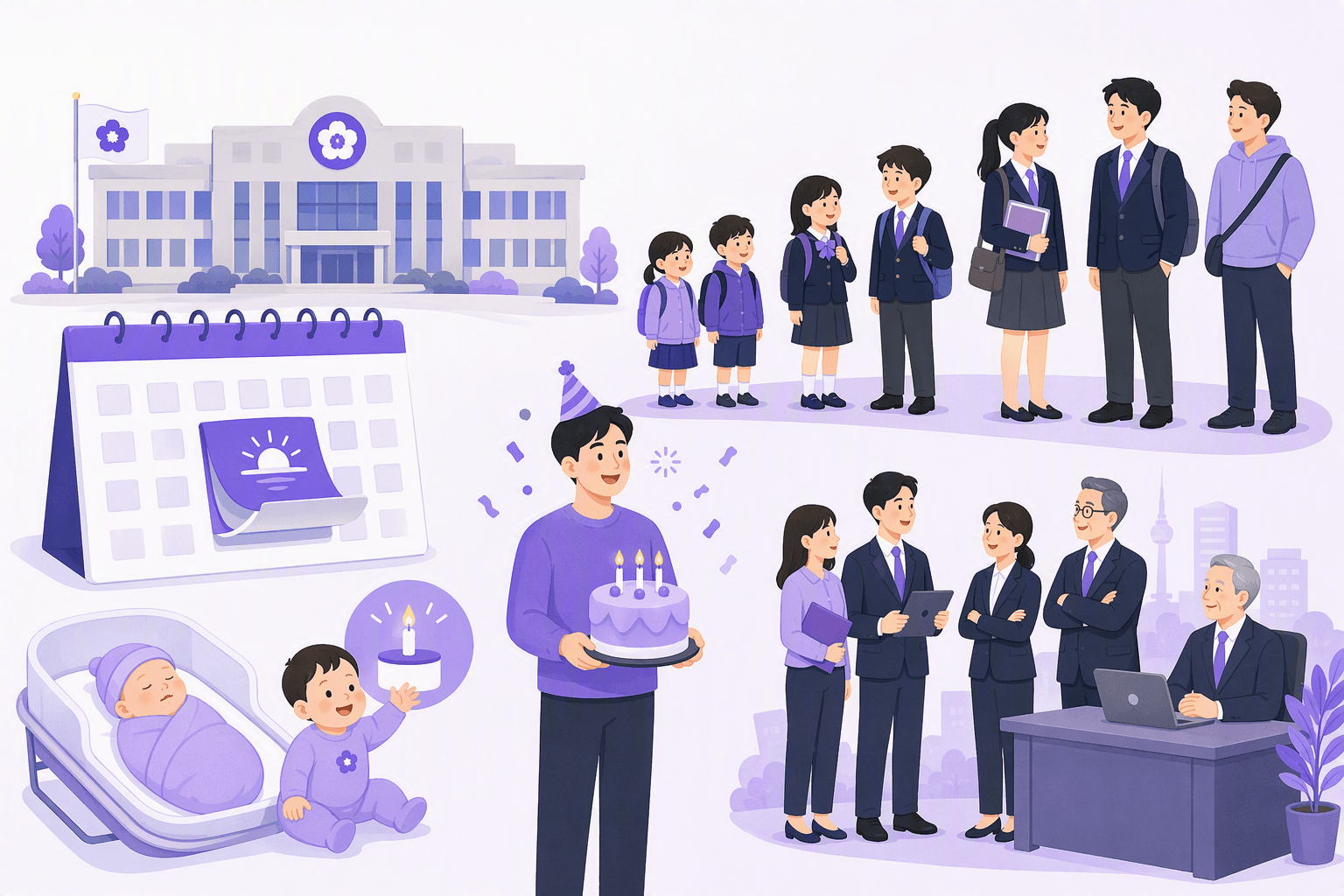
The three ways Koreans may talk about age
Korean age discussions can involve three separate systems. In 2026, only one is the normal legal default, but all three appear in conversation, news reporting, and cultural references.
| English | Korean | Pronunciation | Note |
|---|---|---|---|
| International age | 만 나이 | mahn nah-ee | Official default for most laws and documents. IPA: /man na.i/. |
| Traditional Korean age | 한국 나이 | hahn-gook nah-ee | A baby starts at one, and everyone ages up on January 1. IPA: /han.ɡuk na.i/. |
| Year age | 연 나이 | yuhn nah-ee | Calculated from birth year and current year, used in some age-based rules. IPA: /jʌn na.i/. |
| Age | 나이 | nah-ee | The everyday word for age. IPA: /na.i/. |
| Years old | 살 | sahl | Counter commonly used after a number when stating age. IPA: /sal/. |
International age: the official standard
만 나이 /man na.i/ means full age, often translated as international age. A person is zero at birth and turns one on their first birthday, just as in the United States, Canada, the United Kingdom, and most other countries.
South Korea revised its general legal framework so that this method is the default for administrative and civil matters. The goal was practical clarity: fewer documents needed to specify which age system they meant, and international comparisons became simpler.
You may hear someone say 만으로 스물다섯 살이에요 /ma.nɯ.ɾo sɯ.mul.ta.sʌt sa.ɾi.e.jo/, meaning that they are 25 years old by full age. In casual conversation, however, speakers often omit 만 /man/ when the context is clear.
Traditional Korean age: the system people remember
The older system is often called 한국 나이 /han.ɡuk na.i/, literally Korean age. Under this method, a newborn begins life at one rather than zero.
Then, on January 1, every person in the country becomes a year older together. Someone born on December 31 would be one at birth and become two the following day. That result can feel startling if you only know international age.
The traditional calculation is simple:
Current year minus birth year plus one
For a person born in 2000, the calculation in 2026 is 2026 minus 2000 plus one, which equals 27. Their birthday does not matter under this older calculation.
Year age: a system that still appears in rules
연 나이 /jʌn na.i/ means year age. It is calculated as the current year minus the birth year, without adding one.
For someone born in 2000, their year age is 26 throughout 2026. This system may appear in regulations that group people by birth year, such as some youth protections, school-related rules, and age-limited policies.
Do not assume that every Korean age reference means the same thing. If the setting is legal, medical, administrative, or financial, 만 나이 /man na.i/ is usually the relevant one. If the setting is social, ask which meaning the speaker intends.
Why the traditional Korean age system developed
The older Korean age system was not random, and it was not unique to Korea. Similar East Asian age-counting traditions existed historically in China, Japan, Vietnam, and other communities shaped by shared calendrical and philosophical traditions.
One explanation is that age counted the first period of existence, including pregnancy, rather than starting only at birth. The January 1 increment also tied a person’s life to a collective calendar instead of an individual birthday.
Ho-min Sohn’s Korean Language describes Korean communication as deeply shaped by social relationships, including relative status and age. The age system fitted a society where shared cohorts, seniority, and family position carried real social meaning.
The system also made age easier to calculate in a period when many people did not record or celebrate exact birthdays in the modern sense. A shared new-year increment created a simple answer for a community, even if it did not measure an individual’s exact time since birth.
🌍 A shared birthday feeling
Traditional Korean age made January 1 feel like a collective aging event. Everyone moved forward together, which reinforced the importance of birth-year groups. The practice is still visible in nostalgic jokes, television dialogue, and conversations between people who grew up before the legal change.
Why Korea changed to international age
The shift to 만 나이 /man na.i/ was mainly about consistency. People could have three different ages depending on whether they were using international age, traditional Korean age, or year age, creating confusion in forms, contracts, insurance, healthcare, and public communication.
The Ministry of Government Legislation promoted the change as a way to reduce everyday uncertainty. In official contexts, people no longer need to wonder whether a stated age includes the traditional extra year or whether it changed on January 1.
The reform did not erase all other age calculations. Some laws and policies still use year-based eligibility because they need to treat an entire birth cohort equally. The key point is that the legal context should state the relevant standard.
This distinction matters when watching Korean news or reading translations. An article might report someone’s age using full age, while a drama character uses the old system in dialogue. Both can be accurate in their own context.
How age shapes Korean relationships
Age can affect Korean language choices more directly than it affects English. Korean has several speech levels, and speakers select endings based partly on closeness, setting, rank, and relative age.
A younger person speaking to an older stranger will normally choose polite forms such as 안녕하세요 /an.njʌŋ.ha.se.jo/, pronounced ahn-NYUHNG-hah-seh-yoh. With a close friend of the same age, they may use a casual greeting instead.
Knowing someone’s age can help establish whether two people can comfortably use informal speech, called 반말 /pan.mal/, or should begin with polite speech, called 존댓말 /t͡ɕon.dɛ.mal/. These are tendencies, not automatic rules. Workplace role, family status, and personal preference also matter.
Korean speakers sometimes ask 몇 살이에요? /mjʌt sa.ɾi.e.jo/, meaning how old are you, fairly early after meeting. This can sound more direct than an English-speaking visitor expects, but it is often practical rather than intrusive.
School cohorts and birth years
Birth year remains socially powerful even after the official age reform. People born in the same calendar year may call each other 동갑 /toŋ.ɡap/, meaning the same age, even when their birthdays are months apart.
School entry rules group children by birth year, so a shared cohort can shape friendships and social identity for decades. A person may say they are a 1998-born person, 구십팔 년생 /ku.ɕip.pʰal njʌn.sɛŋ/, rather than leading with a numerical age.
The phrase 빠른 년생 /p͈a.ɾɯn njʌn.sɛŋ/, literally early birth-year person, refers to a historically complicated school-placement pattern. It commonly describes someone born early in a calendar year who entered school with the previous year’s cohort under older practices.
Titles can matter more than names
Once people establish relative age, they may choose titles rather than first names. A younger man might call an older male friend 형 /hjʌŋ/, while a younger woman might call an older female friend 언니 /ʌn.ni/.
These words are often translated as older brother and older sister, but their real social use extends beyond biological family. They can signal affection, group belonging, or respectful familiarity.
Age does not give anyone unlimited authority, and modern Korean workplaces are changing quickly. Still, learning these patterns will help you understand why drama characters pause before switching speech levels or ask about a birth year before becoming casual.
💡 Start polite when you are unsure
Use polite Korean first, especially with adults you have just met, service staff, teachers, or coworkers. You can move to casual speech after the other person suggests it or when a relationship clearly becomes close. This is safer than assuming a shared birth year automatically permits informal language.
How to ask and answer age naturally
The safest everyday question is 몇 살이에요? /mjʌt sa.ɾi.e.jo/. It is polite, but it can still be personal, so use it when there is a genuine social reason to know.
For a more formal question, use 연세가 어떻게 되세요? /jʌn.se.ɡa ʌ.t͡tʌ.ke twe.se.jo/. This treats the other person’s age with added respect and is appropriate for an older adult or a formal setting.
Here are useful response patterns:
| Situation | Korean | IPA | Meaning |
|---|---|---|---|
| Casual polite answer | 스물다섯 살이에요 | /sɯ.mul.ta.sʌt sa.ɾi.e.jo/ | I am 25 years old. |
| Official clarification | 만 스물다섯 살이에요 | /man sɯ.mul.ta.sʌt sa.ɾi.e.jo/ | I am 25 by international age. |
| Birth-year answer | 이천 년생이에요 | /i.t͡ɕʰʌn njʌn.sɛŋ.i.e.jo/ | I was born in 2000. |
| Same-age reaction | 동갑이네요 | /toŋ.ɡa.bi.ne.jo/ | We are the same age. |
In ordinary conversation, giving your birth year can be smoother than stating your age. It lets the other person calculate the relationship without forcing a debate about which age system applies.
For introductions, pair this knowledge with Korean hello phrases. When leaving new acquaintances, polite farewells matter too, so review how to say goodbye in Korean.
Common mistakes learners make
Treating traditional Korean age as current legal age
Do not add one to your age when filling out a Korean visa form, booking medical care, signing a contract, or completing an official application. Use your full international age unless the document explicitly gives a different instruction.
The old method is culturally useful knowledge, but it is no longer the default administrative calculation. In 2026, saying your international age first prevents avoidable confusion.
Assuming age alone determines politeness
Age is important, but Korean politeness is broader than a number. A younger manager may receive formal speech from an older employee in a meeting, while close friends several years apart may have negotiated a casual style.
The linguist Young-Key Kim-Renaud’s work on Korean honorifics emphasizes that social relations and communicative context interact. Listen to the setting and relationship, not only the birth year.
Using family titles immediately
Calling someone 오빠 /o.p͈a/ or 언니 /ʌn.ni/ can be warm, but it is not a universal substitute for a name. Let the relationship develop, and follow how people introduce themselves and address one another.
This is especially relevant in fandom spaces and dramas, where subtitles can make these terms seem interchangeable with English names. Their tone depends heavily on who is speaking and why.
Believing every age joke is a legal rule
You may see comments online that someone became younger overnight when the reform took effect. The joke reflects the difference between systems, but people did not physically lose years, and not every age-based law changed in the same way.
When accuracy matters, distinguish between 만 나이 /man na.i/, traditional Korean age, and year age. That small habit will make Korean news, subtitles, and real conversations much easier to follow.
Learning age culture through Korean media
Korean dramas are especially useful for noticing age language in action. Listen for characters asking someone’s birth year, switching from polite to casual endings, or choosing 형 /hjʌŋ/, 누나 /nu.na/, 언니 /ʌn.ni/, and 오빠 /o.p͈a/.
Watch the scene before copying the expression. A title used by a close friend, a romantic partner, a junior colleague, or a fan can carry very different emotional weight.
When characters become closer, you may also hear affectionate language alongside age-based titles. Our guide to saying I love you in Korean explains which expressions fit serious romance, warmth, and everyday affection.
Understanding the Korean age system gives you more than a calculator. It gives you a clearer view of how Korean speakers organize familiarity, respect, group identity, and changing social norms.
Frequently Asked Questions
Is the Korean age system still used in 2026?
Why did Korean babies start at one year old?
How do I calculate my old Korean age?
What does 만 나이 mean in Korean?
Do Koreans still ask each other's age?
Sources & References
- Ministry of Government Legislation, Act on Administrative Basic Law, accessed 2026
- National Institute of Korean Language, Standard Korean Dictionary entries for 나이 and 만 나이, accessed 2026
- Korean Statistical Information Service, Resident Population Statistics, accessed 2026
- Ho-min Sohn, Korean Language, Cambridge University Press
Start learning with Wordy
Watch real movie clips and build your vocabulary as you go. Free to download.


